

Biosorption of lanthanum and cerium from aqueous solutions using tangerine (Citrus reticulata) peel: Equilibrium, kinetic, and thermodynamic studies
Open accessThe DOI matches its Crossref record; 3 of the 5 references it cites were found in a registry or an index.
Abstract
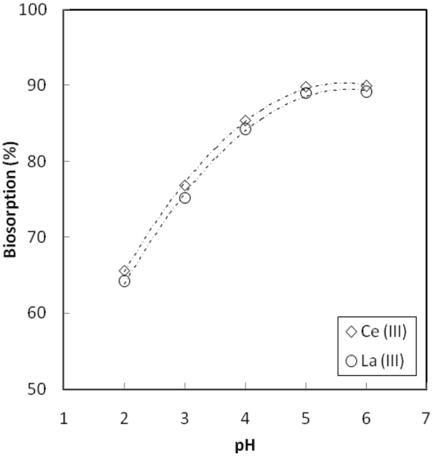
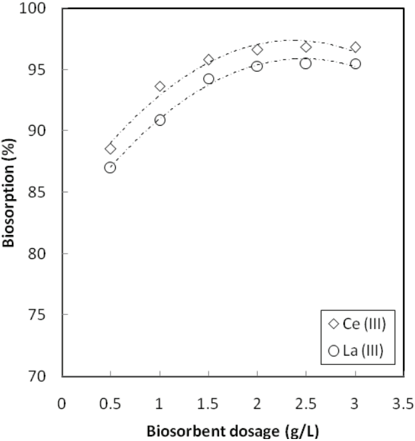
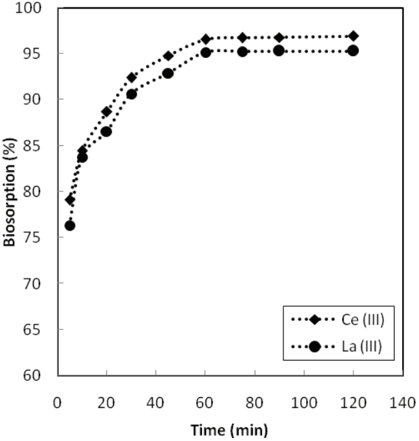
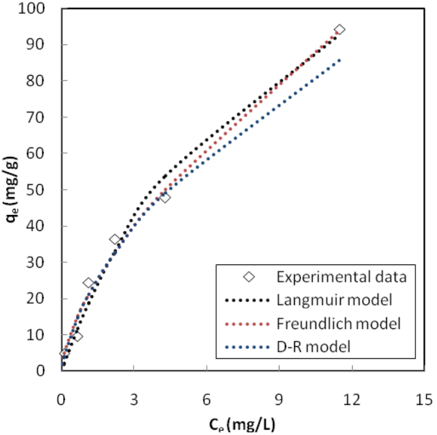
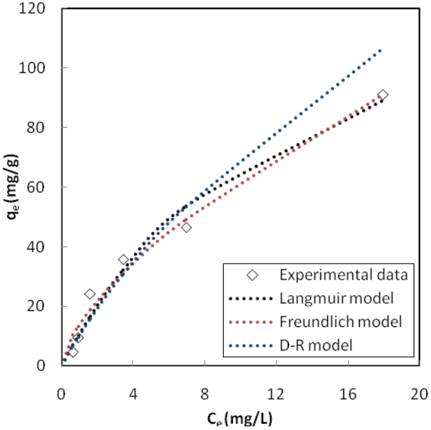
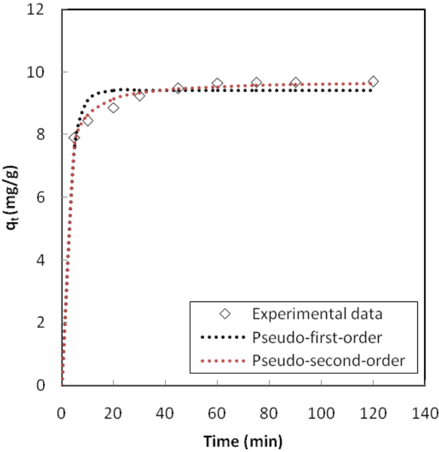
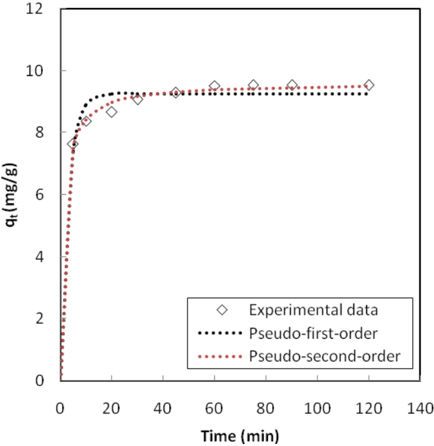
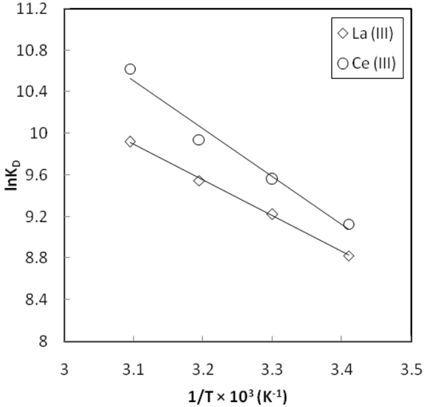
Biosorption of lanthanum (III) and cerium (III) from aqueous solution by tangerine (Citrus reticulate) peel has been investigated in a batch system as a function of pH, biosorbent dosage, contact time, and temperature. The equilibrium pH was found to severely affect the biosorption performance; pH 5.0 is found to be an optimum pH for favorable biosorption of La (III) and Ce (III). The biosorption of lanthanum and cerium was investigated by the Langmuir, Freundlich and Dubinin-Radushkevich (D-R) isotherm models. Maximum biosorption uptakes, according to the Langmuir model, were obtained as 154.86 and 162.79 (mg/g) for La(III) and Ce(III), respectively. The biosorption kinetic was tested with pseudo-first order and pseudo-second order models. The results showed that the kinetic of biosorption process was described by the pseudo-second order model very well. Thermodynamic parameters including the change of Gibbs free energy (?G?), enthalpy change (?H?) and entropy change (?S?) for both sorption systems were determined at four different temperatures. The results showed that the biosorption of La(III) and Ce(III) on tangerine (C. reticulate) peel is a spontaneous and endothermic process. FTIR analysis demonstrated that carboxyl and hydroxyl groups were involved in the biosorption of the metal ions.
Overview
The claims and statistics of this paper haven’t been checked yet.
Free: it reads the open-access text and checks the first 5 claims that cite a source we can check. Create a free account to check every claim.
Integrity signals
Registry
Cites
Statistics
Figures
Verification
Claims the paper makes
The claims and statistics of this paper haven’t been checked yet.
Free: it reads the open-access text and checks the first 5 claims that cite a source we can check. Create a free account to check every claim.
Self-check
Percentages, sums and reported differences re-computed from the paper’s own numbers.
The self-check needs the paper’s full text.
Citations
Cites
Über die adsorption in lösungen
Freundlich, H. (1907) · Zeitschrift für Physikalische Chemie · doi:10.1515/zpch-1907-5723 · Cited by 9,001
Basic principles of organic chemistry
Roberts, J. D., & Caserio, M. C. (1965) · Andalas University Repository (Andalas University) · Cited by 989
Biosorption of Ce(III) onto modified Pinus brutia leaf powder using central composite design
Aslani, C. K., Sert, Ş., Çetinkaya, B., Yalçıntaş, E., & Acar, M. B. (2011) · Wood Science and Technology · doi:10.1007/s00226-011-0437-8 · Cited by 44
Research works printed but not linked: 1
- D.A. Wase (Ed.), Biosorbent for Metal Ions, CRC Press, London, 1997, pp. 11-88
Cited by
Iftekhar, S., Ramasamy, D. L., Srivastava, V., Asif, M. B., & Sillanpää, M. (2018) · Chemosphere · doi:10.1016/j.chemosphere.2018.04.053 · Cited by 350
Bio-derived materials as a green route for precious & critical metal recovery and re-use
Dodson, J. R., Parker, H. L., Muñoz García, A., Hicken, A., Asemave, K., Farmer, T. J., He, H., Clark, J. H., & Hunt, A. J. (2015) · Green Chemistry · doi:10.1039/c4gc02483d · Cited by 278
Tangerine, banana and pomegranate peels valorisation for sustainable environment: A review
El Barnossi, A., Moussaid, F., & Iraqi Housseini, A. (2021) · Biotechnology Reports · doi:10.1016/j.btre.2020.e00574 · Cited by 178
Fruit peel waste as a novel low-cost bio adsorbent
Pathak, P. D., Mandavgane, S. A., & Kulkarni, B. D. (2015) · Reviews in Chemical Engineering · doi:10.1515/revce-2014-0041 · Cited by 150
Galhoum, A. A., Mafhouz, M., Abdel-Rehem, S. S., Gomaa, N. A., Atia, A. A., Vincent, T., & Guibal, E. (2015) · Nanomaterials · doi:10.3390/nano5010154 · Cited by 144
“Sorbent Metal pH range qm (mg·g−1) Reference Tangerine peel La(III) 5 155 [52] Sargassum sp.”
BackgroundDashtian, K., & Zare‐Dorabei, R. (2017) · Journal of Colloid and Interface Science · doi:10.1016/j.jcis.2017.01.072 · Cited by 108
Hamza, M. F., Salih, K. A. M., Abdel‐Rahman, A. A. ‐., Zayed, Y. E., Wei, Y., Liang, J., & Guibal, E. (2020) · Chemical Engineering Journal · doi:10.1016/j.cej.2020.126399 · Cited by 103
Abdić, Š., Memić, M., Šabanović, E., Sulejmanović, J., & Begić, S. (2018) · International Journal of Environmental Science and Technology · doi:10.1007/s13762-018-1645-7 · Cited by 100
“2013; Torab-Mostaedi 2013; Ferraz et al.”
BackgroundInfluentialRemoval of cerium from different aqueous solutions using different adsorbents: A review
Allahkarami, E., & Rezai, B. (2019) · Process Safety and Environmental Protection · doi:10.1016/j.psep.2019.03.002 · Cited by 101
Das, D., Varshini, C. J. S., & Das, N. (2014) · Minerals Engineering · doi:10.1016/j.mineng.2014.06.013 · Cited by 101
Li, X., Yan, C., Luo, W.-J., Gao, Q., Zhou, Q., Liu, C., & Zhou, S. (2015) · Chemical Engineering Journal · doi:10.1016/j.cej.2015.09.003 · Cited by 77
Fila, D., Hubicki, Z., & Kołodyńska, D. (2022) · Chemical Engineering Journal · doi:10.1016/j.cej.2022.137245 · Cited by 79
A literature review of cerium recovery from different aqueous solutions
Allahkarami, E., & Rezai, B. (2020) · Journal of environmental chemical engineering · doi:10.1016/j.jece.2020.104956 · Cited by 68
Pinheiro, R. F., Grimm, A., Oliveira, M. L. S., Vieillard, J., Silva, L. F. O., de Brum, I. A. S., Lima, E. C., Naushad, M., Sellaoui, L., Dotto, G. L., et al. (2023) · Chemical Engineering Journal · doi:10.1016/j.cej.2023.144484 · Cited by 58
Simultaneous adsorption of heavy metals from water by novel lemon-peel based biomaterial
Šabanović, E., Memić, M., Sulejmanović, J., & Selović, A. (2020) · Green Sciences · doi:10.2478/pjct-2020-0007 · Cited by 61
Jaya Sre Varshini, C., Das, D., & Das, N. (2014) · Journal of Rare Earths · doi:10.1016/s1002-0721(14)60136-8 · Cited by 59
Adsorption of Ponceau 4R from aqueous solutions using alkali boiled Tilapia fish scales
Zhu, K., Gong, X., He, D., Li, B., Ji, D., Li, P., Peng, Z., & Luo, Y. (2013) · RSC Advances · doi:10.1039/c3ra43817a · Cited by 54
Zafar, S., Khan, M. I., Rehman, H. U., Fernández-García, J., Shahida, S., Prapamonthon, P., Khraisheh, M. A. M., Rehman, A. U., Ahmad, H., Mirza, M. L., et al. (2020) · Desalination and Water Treatment · doi:10.5004/dwt.2020.26270 · Cited by 50
Zare‐Dorabei, R., Jalalat, V., & Tadjarodi, A. (2016) · New Journal of Chemistry · doi:10.1039/c6nj00239k · Cited by 48
Keshtkar, A. R., Moosavian, M. A., Sohbatzadeh, H., & Mofras, M. (2018) · Groundwater for Sustainable Development · doi:10.1016/j.gsd.2018.10.005 · Cited by 51
Moșoarcă, G., Popa, S., Vancea, C., Dan, M. L., & Boran, S. (2022) · Polymers · doi:10.3390/polym14101966 · Cited by 53
Zafar, S., Khan, M. I., Khraisheh, M. A. M., Shahida, S., Javed, T., Mirza, M. L., & Khalid, N. (2019) · Desalination and Water Treatment · doi:10.5004/dwt.2019.23724 · Cited by 45
Zafar, S., Khan, M. I., Khraisheh, M. A. M., Lashari, M. H., Shahida, S., Azhar, M. F., Prapamonthon, P., Mirza, M. L., & Khalid, N. (2019) · Desalination and Water Treatment · doi:10.5004/dwt.2019.24646 · Cited by 43
Comparative study on lanthanum(III) sorption onto Lewatit TP 207 and Lewatit TP 260
Esma, B., Abderrahim, O., & Didi, M. A. (2013) · Journal of Radioanalytical and Nuclear Chemistry · doi:10.1007/s10967-013-2766-6 · Cited by 55
“The values of DG are the fundamental criterion of spontaneity (see Table 2); their negative values reveal that the sorption occur spontaneously at each temperature and confirm the thermodynamically feasibility of the sorption processes [36].”
BackgroundLahiji, M. N., Keshtkar, A. R., & Moosavian, M. A. (2016) · Particulate Science And Technology · doi:10.1080/02726351.2016.1248262 · Cited by 43
“Cerium, the most abundant and one of the important elements of the REEs, has some wellestablished uses which are quite different from others (Torab Mostaedi, 2013).”
BackgroundZafar, S., Khan, M. I., Khraisheh, M. A. M., Shahida, S., Khalid, N., & Mirza, M. L. (2018) · Desalination and Water Treatment · doi:10.5004/dwt.2018.23155 · Cited by 39
Moșoarcă, G., Vancea, C., Popa, S., Dan, M. L., & Boran, S. (2022) · Polymers · doi:10.3390/polym14183825 · Cited by 39
“lene) related to cellulose, hemicellulose and lignin [36]; 2350 cm−1—aromatic ring C=C [38]; 1709 cm−1—conjugated C=O bonds [39]; 1603 cm−1—stretching vibration of C=C plus the asymmetric-stretching vibration of COOH in the aromatic ring related to cellulose, hemicellulose and lignin [40]; 1396 cm−1–both C-O stretch a…”
BackgroundZhou, Q., Yan, C., & Luo, W. (2016) · Materials & Design · doi:10.1016/j.matdes.2016.02.081 · Cited by 37
Allahyari, S. A., Saberi, R., Sepanloo, K., & Lashkari, A. (2020) · Journal of Rare Earths · doi:10.1016/j.jre.2020.07.027 · Cited by 36
Youssef, M. A., Sami, N. M., & Hassan, H. S. (2022) · Environmental Science and Pollution Research · doi:10.1007/s11356-022-20823-9 · Cited by 35
Jaya Sre Varshini, C., Das, D., & Das, N. (2015) · Ecological Engineering · doi:10.1016/j.ecoleng.2015.04.072 · Cited by 37
Moosavian, M. A., & Moazezi, N. (2015) · Desalination and Water Treatment · doi:10.1080/19443994.2015.1110717 · Cited by 28
Wei, Y.-Z., Salih, K. A., Hamza, M., Castellón, E., & Guibal, E. (2021) · Chemical Engineering Journal · doi:10.1016/j.cej.2021.130500 · Cited by 26
Mosoarca, G., Vancea, C., Popa, S., Dan, M., & Boran, S. (2023) · Materials · doi:10.3390/ma16124252 · Cited by 27
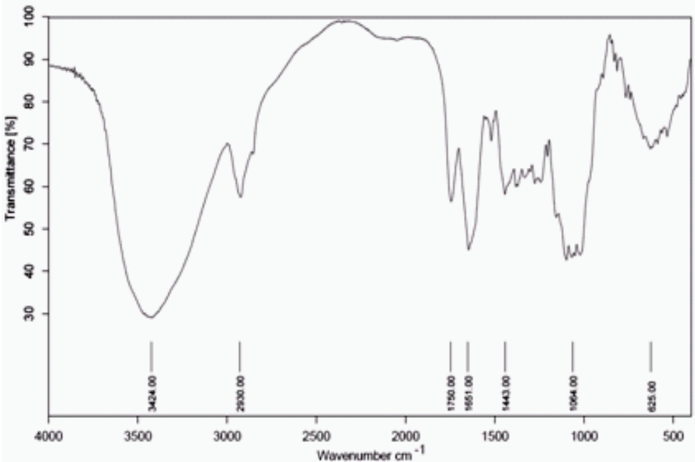
“1057 cm−1 C–O–C stretching of cellulose [23,48] 625 cm−1 bending modes of aromatic compounds [49]”
BackgroundIftekhar, S., Srivastava, V., & Sillanpää, M. E. T. (2020) · Elsevier eBooks · doi:10.1016/b978-0-12-819216-0.00007-2 · Cited by 30
Akbas, Y. A., Yuşan, S., Sert, Ş., & Aytaş, Ş. (2021) · Environmental Science and Pollution Research · doi:10.1007/s11356-021-14662-3 · Cited by 27
“…and inorganic: Platanus orientalis leaf powder (Ser et al. 2008), montmorillonite (Klika et al. 2016), ferric oxide (Dubey and Rao 2011), tangerine (Citrus reticulate) peel (Torab-Mostaedi, 2013), granulated zeolites (Suboti and Bronic 1986), and brown marine alga (Vijayaraghavan et al. 2010).”
BackgroundHuang, T., Zhang, S., Xie, J., Zhou, L., & Liu, L. (2021) · Journal of Environmental Sciences · doi:10.1016/j.jes.2021.01.028 · Cited by 24
El-Amier, Y. A., Elsayed, A. A., El-Esawi, M. A., Noureldeen, A., Darwish, H., & Fakhry, H. (2021) · Sustainability · doi:10.3390/su13116390 · Cited by 25
“As in the Figure, there was a clear shift from wavenumber at 1043 cm−1 in the root sample to 1057 cm−1 in Cr bio-sorbed root, which attributed to lignin’s -OCH3 group stretching vibration appearing in cellulose [26].”
BackgroundKinetics, equilibrium and thermodynamics of cerium removal by adsorption on low-rank coal
Javed, T., Khalid, N., & Mirza, M. L. (2017) · Desalination and Water Treatment · doi:10.5004/dwt.2017.21357 · Cited by 21
Removal of lanthanum and cerium from aqueous solution using chitosan-functionalized magnetite-pectin
Yacouba, A.-R. C., Oral, A. E., Sert, Ş., Kaptanoğlu, İ. G., Natatou, I., Yuşan, S., & Aytaş, Ş. (2024) · Discover Water · doi:10.1007/s43832-023-00054-w · Cited by 20
Akbas, Y. A., & Yuşan, S. (2019) · Journal of Radioanalytical and Nuclear Chemistry · doi:10.1007/s10967-019-06979-8 · Cited by 20
Hamza, M. F., Abdellah, W. M., Zaki, D. I., Wei, Y., Althumayri, K., Brostow, W., & Hamad, N. A. (2023) · Sustainability · doi:10.3390/su15032843 · Cited by 17
Liu, C., Yan, C., Zhou, S., & Ge, W. (2017) · Water Science & Technology · doi:10.2166/wst.2017.144 · Cited by 15
Bouchmila, I., Kefi, B. B., Souissi, R., & Abdellaoui, M. (2019) · Journal of Materials Research and Technology · doi:10.1016/j.jmrt.2018.10.018 · Cited by 13
Zhang, Y., Hamza, M. F., Vincent, T., Roux, J., Faur, C., & Guibal, E. (2021) · Chemical Engineering Journal · doi:10.1016/j.cej.2021.133214 · Cited by 12
Hamza, M. F., Guibal, E., Abdel‐Rahman, A. A. ‐., Salem, M., Khalafalla, M. S., Wei, Y., & Yin, X. (2022) · Molecules · doi:10.3390/molecules27217562 · Cited by 13
Albayari, M., Nordin, N., Adnan, R., Khalili, F. I., & Nazal, M. K. (2023) · Biomass Conversion and Biorefinery · doi:10.1007/s13399-023-04492-3 · Cited by 13
“Due to the possibility of insoluble hydroxides forming and interfering with sorption at higher pH values, they are neither considered nor advised [48, 49].”
Barbinta-Patrascu, M. E., Badea, N. M., Ungureanu, C., Iordache, S.-M., Constantin, M., Purcar, V., Rau, I. B., & Pîrvu, C. (2017) · Journal of Nanomaterials · doi:10.1155/2017/4214017 · Cited by 14
Imam, D. M., Rizk, S. E., & Attallah, M. F. (2019) · Particulate Science And Technology · doi:10.1080/02726351.2019.1636914 · Cited by 9
Bendiaf, H., Abderrahim, O., Villemin, D., & Didi, M. A. (2017) · Journal of Radioanalytical and Nuclear Chemistry · doi:10.1007/s10967-017-5244-8 · Cited by 13
Recovery of Ce and La from phosphogypsum leachate by adsorption using grape wastes
da Silva, R. N. F., Mello, P. A., Holkem, A. P., Silva, L. F. O., Oliveira, M. L. S., Nawaz, A., Manoharadas, S., & Dotto, G. L. (2023) · Environmental Science and Pollution Research · doi:10.1007/s11356-023-30632-3 · Cited by 7
Orabi, F. M. A., Khalili, F. I., & Ismail, L. S. (2021) · Desalination and Water Treatment · doi:10.5004/dwt.2021.27730 · Cited by 7
Ismail, L. S., & Khalili, F. I. (2021) · Desalination and Water Treatment · doi:10.5004/dwt.2021.27371 · Cited by 7
“2 illustrates the FTIR spectra over the range 400–4,000 cm–1 and specific bands are found in Table 2 [34,35].”
BackgroundPreparation of CeO 2 @C nanomaterials by adsorption of metal ions on microbial waste
Fan, W., Feng, N., Xu, G., Zhang, X., Zhao, X. M., Xu, G., Wu, H., Qiu, G., & Xie, J. (2022) · Nanotechnology · doi:10.1088/1361-6528/ac6885 · Cited by 6
“…for other biosorbents, such as modi fi ed rice husk ( 122.51 mg · g − 1 ) [ 30 ] , Tangerine ( Citrus reticulata ) peel ( 162.00 mg · g − 1 ) [ 31 ] , grapefruit peel ( 159.30 mg · g − 1 ) [ 32 ] , Modi fi ed Pinus brutia leaf powder ( 62.10 mg · g − 1 ) [ 33 ] , and Spirulina biomass ( 38.20…”
InfluentialPhysicochemical Behavior of Uranium and Lanthanum in the Presence of Abies religiosa Leaf Biomass
Jiménez-Reyes, M., Ramírez, F. D. M., & Solache‐Ríos, M. (2020) · Water Air & Soil Pollution · doi:10.1007/s11270-020-04822-5 · Cited by 7
“The 3 > pHinitial < 5 is optimal for the adsorption with Abies religiosa leaf power, and at pH > 4, the deprotonated carboxylic and OH groups may bind the positively charged ions (Torab-Mostaedi 2013; Torab-Mostaedi et al. 2015).”
BackgroundMethodInfluentialSre, J., Varshini, C. J. S., & Das, N. (2015) · Cited by 6
Şenol, Z. M. (2024) · Cumhuriyet Science Journal · doi:10.17776/csj.1452166 · Cited by 5
From biomass to biosorbents: A review of plant-based materials for radionuclide removal from water
Ripon, R. I., Begum, Z. A., & Rahman, I. M. M. (2025) · Chemical Engineering Journal · doi:10.1016/j.cej.2025.164735 · Cited by 5
Raccuia, S. G. M., Zanda, E., Bretti, C., Formica, M., Macedi, E., Melchior, A., Tolazzi, M., Pettignano, A., Muratore, N., Lascari, D., et al. (2025) · Journal of Industrial and Engineering Chemistry · doi:10.1016/j.jiec.2025.09.008 · Cited by 5
SORPTION OF CERIUM(III) IONS ONTO CHELATING POLYMERIC SORBENT
Alieva, A. F., Гусейнов, Ф. Э., Shamilov, N. T., Afandiyeva, N. T., & Chyragov, F. M. (2019) · IZVESTIYA VYSSHIKH UCHEBNYKH ZAVEDENIY KHIMIYA KHIMICHESKAYA TEKHNOLOGIYA · doi:10.6060/ivkkt.20196208.5898 · Cited by 4
Bouchmila, I., Kefi, B. B., Djebali, K., & Souissi, R. (2022) · Microchemical Journal · doi:10.1016/j.microc.2022.107182 · Cited by 4
USING TANGERINE PEEL AS A SORPTION MATERIALS TO REMOVING POLLUTANTS FROM WATER ENVI-RONMENTS
Шайхиев, И. Г., Sverguzova, S. V., Шайхиева, К. И., Cisse, K., & Voronina, Y. S. (2023) · chemistry of plant raw material · doi:10.14258/jcprm.20230111931 · Cited by 6
Bouchmila, I., Kefi, B. B., Souissi, R., & Abdellaoui, M. (2018) · Chemistry Africa · doi:10.1007/s42250-018-0022-8 · Cited by 3
Study on the sorption properties of (NH4)2TiOF4 particles
Sofronov, D. S., Blank, T., Khimchenko, S., Lebedynskiy, A. M., Mateychenko, P. V., Varchenko, V., Cherniakova, M., Rucki, M., & Żurowski, W. (2022) · Chemical Engineering Journal · doi:10.1016/j.cej.2022.137559 · Cited by 3
Hanafiah, M. A. K. M., Ariff, N. F. M., Ibrahim, S. C., Ngah, W. S. W., & Hussin, Z. M. (2020) · Desalination and Water Treatment · doi:10.5004/dwt.2020.26266 · Cited by 3
Kadari, M., Makhlouf, M., Kaid, M., Benmaamar, Z., & Villemin, D. (2022) · Advances in Materials and Processing Technologies · doi:10.1080/2374068x.2022.2144209
“Cerium is the most abundant element of the lanthanides (approximately 0.0046% of the earth’s crust) and the most reactive with the exception of Europium [21].”
BackgroundInfluentialAmmar, H., Metwally, A. M., Fadel, D. A., & Ali, H. M. (2026) · Separation Science and Technology · doi:10.1080/01496395.2026.2734851
Metadata
- Authors
- Torab-Mostaedi, M.
- Affiliations
- Nuclear Fuel Cycle Research School, Nuclear Science and Technology Research Institute, Tehran, Iran
- Venue
- Chemical Industry and Chemical Engineering Quarterly
- Publisher
- National Library of Serbia
- Published
- 2013
- Volume
- 19
- Issue
- 1
- Pages
- 79-88
- ISSN
- 1451-9372 (ISSN-L)
- 2217-7434
- OpenAlex
- W2083735254
- Cited by
- 69
- References
- 5
- Citations by year
- 2026: 1 · 2025: 2 · 2024: 2 · 2023: 6 · 2022: 10 · 2021: 7 · 2020: 9 · 2019: 7 · 2018: 5 · 2017: 5 · 2016: 3 · 2015: 7 · 2014: 3 · 2013: 2
- FWCI
- 3.48
- Type
- journal article
- Language
- en
- Open access
- gold
- doi.org
- Licence
- Locations
- Chemical Industry and Chemical Engineering Quarterly (publishedVersion, cc-by-nc-nd)
- DOAJ (DOAJ: Directory of Open Access Journals) (submittedVersion, cc-by-sa)
- Topics
- Physical Sciences › Environmental Science › Water Science and Technology › Adsorption and biosorption for pollutant removal
- Physical Sciences › Chemistry › Inorganic Chemistry › Radioactive element chemistry and processing
- Physical Sciences › Environmental Science › Water Science and Technology › Coagulation and Flocculation Studies
- Keywords
- biosorption, lanthanum, cerium, tangerine peel, Citrus reticulata, heavy metal removal, adsorption isotherms, adsorption kinetics, adsorption thermodynamics, pH effect, pseudo-second-order kinetics, Langmuir isotherm, Freundlich isotherm, Dubinin-Radushkevich isotherm, carboxyl and hydroxyl groups, endothermic adsorption, agricultural waste biosorbent
About these checks
Registry, retraction, Cites and statistics results are computed, not judged, with one exception: a printed reference that no index lists is read once by a model before it counts as a citation error. Claims are extracted by a model and kept only when their quote appears verbatim in the text; each cited source is then checked, with a model’s help, for whether it says what the claim relies on. Those verdicts can be wrong — read the claim’s quote and the cited source before relying on one.
Statistics and arithmetic are recomputed, not judged.
Confidence bands are shown only for fields calibrated on our annotated test set. None is calibrated yet, so no band is shown.
What counts as a claim ›How we measure confidence ›How we check this ›
Are you an author, or do you see a problem with this page? Request a review
Data sources
Bibliographic data: Semantic Scholar, OpenAlex, Crossref.
Contains information from the Semantic Scholar Academic Graph Datasets, made available under the ODC Attribution License (ODC-BY 1.0).
Semantic Scholar’s data is described in: Kinney, R., et al. (2023). The Semantic Scholar Open Data Platform. arXiv:2301.10140.
