

Are fiscal deficits inflationary in Nigeria? New evidence from bounds testing to cointegration with structural breaks
Open accessThe DOI matches its Crossref record; 44 of the 50 references it cites were found in a registry or an index; 1 of the 11 sources its claims cite were checked for support.
Abstract
The paper models the relationship between fiscal deficit and inflation for Nigeria using annual data from 1980 to 2016 and accounts for structural breaks using the Bai-Perron test.
Overview
CoChat Summary
TL;DR
Using annual Nigerian data from 1980–2016, the paper finds that fiscal deficits are inflationary, especially when structural breaks are allowed for. It concludes that models with structural breaks fit better than those without, and that fiscal deficit, exchange rate, lending rate, and money supply matter for inflation.
Key findings
- In the long run, fiscal deficit has a positive effect on inflation in all models with structural breaks; it is statistically significant in Models 1, 3, and 4, with coefficients of 0.001*, 0.11*, and 0.46 respectively.
- Without structural breaks, the long-run fiscal-deficit coefficient is significant only in Model 3 at 0.124*; the abstract and conclusion both say the deficit is a “major determinant of inflation.”
- The ARDL bounds tests change once breaks are included: without breaks, only Model 5 shows evidence of a long-run relationship, but with breaks the F-statistics are significant for all reported models, including 19.078* for lcpi=f(fd) and 26.284* for lcpi=f(fd, exr).
- In the short run with breaks, fiscal deficit is positive in all estimated models and significant in Model 2, Model 3, and Model 4 at lag 1; the paper reports an error-correction speed of adjustment of 26.5% in the no-break short-run model discussion, and later ECT coefficients of -0.57*, -0.44*, and -0.38* in three short-run break models.
Methods
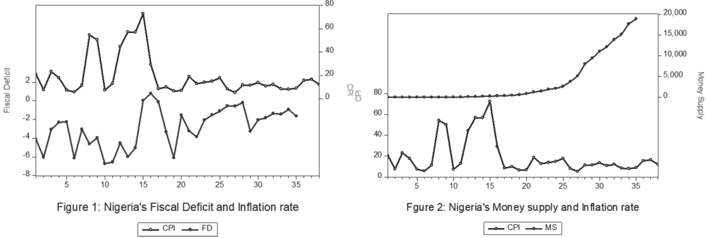
- Annual time-series data for Nigeria covering 1980–2016; variables are CPI (inflation), fiscal deficit as a ratio of GDP, real exchange rate, lending interest rate, and money supply, sourced from the Central Bank of Nigeria Statistical Bulletin and the WDI database.
- Applied unit root tests (ADF, PP, and Vogelsang-Perron structural-break tests), then estimated five ARDL/bounds-test cointegration models, both without and with structural breaks.
- Used Bai-Perron multiple structural break tests to endogenously identify breaks, and then estimated long-run and short-run ARDL/error-correction models; diagnostics reported include F-statistics, adjusted R², Durbin-Watson, Jarque-Bera, ARCH-LM, B-G LM, RESET, CUSUM, and CUSUMSQ.
Limitations
- The paper does not state formal limitations.
- Evident from the text: the data are annual and stop at 2016, so the results may not capture later inflation-fiscal dynamics in Nigeria.
- Evident from the text: some reported tables are incomplete or partially truncated in the provided full text, so not all model details and coefficients are visible here.
Model-written summary. Check it against the paper before relying on it.
Integrity signals
Registry
Cites
Statistics
Figures
Verification
Claims the paper makes
1 Valid · 0 Not valid · 5 Not checked · 33 Own results and interpretations
A result the paper reports from its own data — it cites no other source for it, so there is none to check. The quote shows it is in the paper.
In the paper
“with the inclusion of structural breaks, as specified in the Bai-Perron break test result in Table 3, the conclusion was completely reversed, as there was presence of a long-run relationship among the variables considered in the models.”
boostedstates an association- Asserted: passes — The authors put it forward as true.
- Checkable: passes — It can be checked against evidence.
- Load-bearing: passes — The paper’s conclusions depend on it.
- Based: passes — The paper gives a reason why it holds.
A result the paper reports from its own data — it cites no other source for it, so there is none to check. The quote shows it is in the paper.
In the paper
“The tests identified several breaks in the linear combination of the variables used in this study.”
- Also stated in: § 4. RESULTS AND DISCUSSIONS · plain
“The result shows the several breaks identified by the tests.”
plain- Asserted: passes — The authors put it forward as true.
- Checkable: passes — It can be checked against evidence.
- Load-bearing: passes — The paper’s conclusions depend on it.
- Based: passes — The paper gives a reason why it holds.
- Also stated in: § 4. RESULTS AND DISCUSSIONS · plain
A result the paper reports from its own data — it cites no other source for it, so there is none to check. The quote shows it is in the paper.
In the paper
“evidence of a long-run relationship was found in Model 5.”
plainstates an association- Asserted: passes — The authors put it forward as true.
- Checkable: passes — It can be checked against evidence.
- Load-bearing: unclear — It is unclear whether the paper’s conclusions depend on it.
- Based: passes — The paper gives a reason why it holds.
A result the paper reports from its own data — it cites no other source for it, so there is none to check. The quote shows it is in the paper.
In the paper
“The adjusted R-squared indicates that around 93% of variation in the inflation rate is explained by fiscal deficit, real exchange rate, lending interest rate, and money supply.”
hedgedstates an association- Asserted: passes — The authors put it forward as true.
- Checkable: passes — It can be checked against evidence.
- Load-bearing: unclear — It is unclear whether the paper’s conclusions depend on it.
- Based: passes — The paper gives a reason why it holds.
A result the paper reports from its own data — it cites no other source for it, so there is none to check. The quote shows it is in the paper.
In the paper
“While the Model 2 result was found to be inconclusive”
plain- Asserted: passes — The authors put it forward as true.
- Checkable: passes — It can be checked against evidence.
- Load-bearing: unclear — It is unclear whether the paper’s conclusions depend on it.
- Based: passes — The paper gives a reason why it holds.
17 more claims
Create a free account to see all 39 claims and every source verdict.
- It may state two separate claims as one. 14
- The quote only partly states this claim. 4
- Probably not a substantial claim. 3
Self-check
Percentages, sums and reported differences re-computed from the paper’s own numbers.
Each contradiction between two passages listed here was confirmed by an independent check.
Rated minor: it would not touch a result — a value no result rests on, a p-value that stays on the same side of the significance level, or a conflict that is clerical, resolved elsewhere in the paper, or outside its own findings.
In the paper
§ 3.1 Data
“Since the Jarque-Bera probability values for the variables (with the exception of EXR) are less than 5% the hypothesis of normal distribution cannot be rejected and the series can be regarded as having a normal distribution. However, since the Jarque-Bera probability value for EXR is less than 5% the hypothesis of normal distribution is rejected for EXR.”
§ 3.1 Data
“| (0.152) | (0.406) | (0.858) | (0.000) | (0.110) | (probability) |”
Citations
Cites
Yaşlı Kadınlarda Üreme Sağlığı
Kokanalı, D., & Engin Üstün, Y. (n.d.) · DergiPark (Istanbul University) · Cited by 170,090
Bounds testing approaches to the analysis of level relationships
Pesaran, M. H., Shin, Y., & Smith, R. J. (2001) · Journal of Applied Econometrics · doi:10.1002/jae.616 · Cited by 20,385 · cited 2×
“Following the study by Ouattara (2004), the computed F-statistics provided by Pesaran et al. (2001) are not valid in the presence of I(2) variables because the bounds test is based on the assumption that the variables are I(0) or I(1).”
MethodComputation and analysis of multiple structural change models
Bai, J., & Perron, P. (2003) · Journal of Applied Econometrics · doi:10.1002/jae.659 · Cited by 5,771 · cited 3×
“Regarding the structural break test, Bai and Perron (2003) advocate the determination of multiple breaks among series, rather than the conventional way of determining breaks individually among variables that post a challenge while estimating the variables or while trying to neutralize the effect of the breaks during e…”
BackgroundMethodInfluentialAn Autoregressive Distributed-Lag Modelling Approach to Cointegration Analysis
Pesaran, M. H., & Shin, Y. (2012) · Econometrics and Economic Theory in the 20th Century · doi:10.1017/ccol521633230.011 · Cited by 3,937 · cited 1×
“Sahan and Bektasoglu (2010) observe no long-run relation between inflation and budget deficits, but the relationship changes depending on the developmental level and structural features of the economy.”
BackgroundSome Unpleasant Monetarist Arithmetic
Sargent, T. J. (1981) · Quarterly Review · doi:10.21034/qr.531 · Cited by 1,511
An Autoregressive Distributed-Lag Modelling Approach to Cointegration Analysis
Pesaran, M. H. (2008) · Econometrics and Economic Theory in the 20th Century: The Ragnar Frisch Centennial Symposium · doi:10.1017/ccol0521633230.011 · Cited by 1,484
Monetary policy and price level determinacy in a cash-in-advance economy
Woodford, M. (1994) · Economic Theory · doi:10.1007/bf01215377 · Cited by 753 · cited 2×
“Wosowei (2013) reveals a negative but insignificant relationship between fiscal deficit and gross domestic product.”
BackgroundModern Hyper- and High Inflations
Fischer, S., Sahay, R., & Végh, C. A. (2002) · Journal of Economic Literature · doi:10.1257/002205102760273805 · Cited by 570
Price-level determinacy without control of a monetary aggregate
Woodford, M. (1995) · Carnegie-Rochester Conference Series on Public Policy · doi:10.1016/0167-2231(95)00038-0 · Cited by 472
Long-Term Debt and Optimal Policy in the Fiscal Theory of the Price Level
Cochrane, J. H. (2001) · Econometrica · doi:10.1111/1468-0262.00179 · Cited by 404
Catão, L. A. V., & Terrones, M. E. (2005) · Journal of Monetary Economics · doi:10.1016/j.jmoneco.2004.06.003 · Cited by 334
Is Inflation Always and Everywhere a Monetary Phenomenon?*
Grauwe, P. D., & Polan, M. (2005) · The Scandinavian Journal of Economics · doi:10.1111/j.1467-9442.2005.00406.x · Cited by 274
Stepping on a rake: The role of fiscal policy in the inflation of the 1970s
Sims, C. A. (2011) · European Economic Review · doi:10.1016/j.euroecorev.2010.11.010 · Cited by 205 · cited 3×
“An alternative rationale, which is at the heart of the Fiscal Theory of the Price Level (see, inter alia, Cochrane, 2001; Sims, 2011; Bassetto and Cui, 2018) or, more broadly, of the literature on price level determinacy (see Woodford, 1994), is that under fiscal dominance, newly issued nominal government bonds will c…”
BackgroundEffects of fiscal deficit and money M2 supply on inflation: Evidence from selected economies of Asia
Nguyen, V. B. (2015) · Journal of Economics Finance and Administrative Science · doi:10.1016/j.jefas.2015.01.002 · Cited by 184 · cited 1×
“Nguyen (2015) empirically investigates the effects of fiscal deficit and broad money M2 supply on inflation in Asian countries.”
BackgroundAre fiscal deficits inflationary?
Lin, H., & Chu, H.-P. (2012) · Journal of International Money and Finance · doi:10.1016/j.jimonfin.2012.04.006 · Cited by 179 · cited 2×
“The deficit–inflation relationship is strong in highinflation episodes due to the increase in money creation, and persistent fiscal deficits are inflationary in high and middle-inflation economies and less inflationary in low-inflation economies (Lin and Chu, 2013). In a study that accommodates asymmetry and suits the…”
BackgroundLong-Term Debt and Optimal Policy in the Fiscal Theory of the Price Level
Cochrane, J. H. (2000) · doi:10.2139/ssrn.224441 · Cited by 149 · cited 3×
“The positive relationship between fiscal deficit and inflation follows the proposition of the fiscal theory of price level, which attributes inflation as a fiscal phenomenon (Woodford, 1995; Cochrane, 2001; Sims, 2011).”
BackgroundResultThe fiscal theory of the price level in a world of low interest rates
Bassetto, M., & Cui, W. (2018) · Journal of Economic Dynamics and Control · doi:10.1016/j.jedc.2018.01.006 · Cited by 115 · cited 2×
“An alternative rationale, which is at the heart of the Fiscal Theory of the Price Level (see, inter alia, Cochrane, 2001; Sims, 2011; Bassetto and Cui, 2018) or, more broadly, of the literature on price level determinacy (see Woodford, 1994), is that under fiscal dominance, newly issued nominal government bonds will c…”
BackgroundThe Fiscal Myth of the Price Level
Niepelt, D. (2004) · The Quarterly Journal of Economics · doi:10.1162/003355304772839597 · Cited by 111 · cited 4×
“The monetarist school of thought regards the theory of price as a monetary phenomenon (see, inter alia, McCallum, 2003; Komulainen and Pirttila, 2002; Niepelt, 2004; Grauwe and Polan, 2005; Salami and Kelikume, 2013) and this has also been echoed by Friedman’s (1951) statement that “inflation is always and everywhere…”
BackgroundInfluentialModern Hyper- and High InflationsPreprint
Sahay, R., Végh, C. A., & Fischer, S. L. (2002) · SSRN Electronic Journal · doi:10.2139/ssrn.880323 · Cited by 85
Sources of Inflation in Developing CountriesPreprint
Loungani, P., & Swagel, P. L. (2001) · SSRN Electronic Journal · doi:10.2139/ssrn.880326 · Cited by 76
(2011) · Journal of Emerging Trends in Economics and Management Science · Cited by 74
Deficit sustainability and inflation in EMU: An analysis from the Fiscal Theory of the Price Level
Bajo‐Rubio, O., Roldán, C. D., & Esteve, V. (2009) · European Journal of Political Economy · doi:10.1016/j.ejpoleco.2009.04.001 · Cited by 69 · cited 1×
“In all Economic and Monetary Union (EMU) countries except Finland, evidence supports the sustainability of fiscal policy (Bajo-Rubio et al., 2009).”
BackgroundInflation dynamics and monetary policy strategy: some prospects for the Turkish economy
Us, V. (2004) · Journal of Policy Modeling · doi:10.1016/j.jpolmod.2004.07.001 · Cited by 61 · cited 2×
“…inconsistencies as a result of the non-independence of central banks (see Minea et al., 2012), political instability (see Fischer et al., 2002; Vu, 2004; Catao and Terrones, 2005; and Wimanda et al., 2011), and poor tax systems (see Catao and Terrones, 2005) that tend to reduce seigniorage…”
BackgroundPublic Debt, Money Supply, and Inflation: A Cross-Country Study
Kwon, G., McFarlane, L., & Robinson, W. (2009) · IMF Staff Papers · doi:10.1057/imfsp.2008.26 · Cited by 60 · cited 5×
“The implications of studies from other parts of the world, and especially as expressed by Kwon et al. (2009) for the Nigerian context, are therefore inherent in Nigeria’s profile of burgeoning domestic and foreign debt, increasing price level, and inadequate financial infrastructure to finance…”
BackgroundInfluentialMonetary–fiscal policy interaction and fiscal inflation: A tale of three countries
Kliem, M., Kriwoluzky, A., & Sarferaz, S. (2016) · European Economic Review · doi:10.1016/j.euroecorev.2016.02.023 · Cited by 51 · cited 3×
“2010; Catão and Terrones, 2005; Kliem et al, 2016) have not yielded conclusive results on the deficit–inflation relationship.”
BackgroundAn Empirical Analysis of Fiscal Deficits and Inflation in Nigeria
(2012) · International Business Management · doi:10.3968/j.ibm.1923842820120401.0185 · Cited by 49 · cited 1×
“Ezeabasili et al. (2012) find a positive but insignificant long-run relationship between fiscal deficits and inflation.”
BackgroundExpectations and the inertia of inflation: The case of Indonesia
Wimanda, R. E., Turner, P. M., & Hall, M. J. B. (2010) · Journal of Policy Modeling · doi:10.1016/j.jpolmod.2010.08.009 · Cited by 45
Budget deficits and inflation in thirteen Asian developing countries
Habibullah, M. S., Chee, K. C., & Hamid, B. A. (2011) · Universiti Putra Malaysia Institutional Repository (Universiti Putra Malaysia) · Cited by 42
Fiscal Deficits and InflationPreprint
Catão, L., & Terrones, M. E. (2003) · SSRN Electronic Journal · doi:10.2139/ssrn.879140 · Cited by 41
Budget Deficit and Inflation: A Sensitivity Analysis to Inflation and Money Supply in Iran
Samimi, A. J., & Jamshidbaygi, S. (2011) · Cited by 28
Budget deficit, money growth and inflation: evidence from the colombian case
Lozano-Espitia, I. (2008) · doi:10.32468/be.537 · Cited by 26 · cited 1×
“Lozano (2008) finds that a long-run relationship exists between deficit, money growth, and inflation in Colombia.”
BackgroundAhmad, A. H., & Aworinde, O. B. (2019) · The North American Journal of Economics and Finance · doi:10.1016/j.najef.2019.100999 · Cited by 25
Fiscal Deficits and Macroeconomic Aggregates in Nigeria
Wosowei, E. C. (2013) · Kuwait Chapter of Arabian Journal of Business and Management Review · doi:10.12816/0001235 · Cited by 22 · cited 1×
“Wosowei (2013) reveals a negative but insignificant relationship between fiscal deficit and gross domestic product.”
BackgroundCan inflation targeting promote institutional quality in developing countries
Minea, A., & Villieu, P. (2008) · Cited by 17
Sources of Inflation in Developing Countries
Loungani, P., & Swagel, P. L. (2003) · Cambridge University Press eBooks · doi:10.1017/cbo9780511610141.010 · Cited by 16
Monetary and fiscal policy mix in a small open economy: Evidence from Nigeria
Tule, M. K., Onipede, S. F., & Ebuh, G. U. (2020) · Scientific African · doi:10.1016/j.sciaf.2020.e00346 · Cited by 14 · cited 2×
“Tule et al. (2020) indicate that while an expansionary monetary policy may have contemporaneous positive effects on the economy, expansionary fiscal policy does not automatically translate to growth.”
BackgroundBudget Deficit, Money Growth and Inflation: Evidence from the Colombian CasePreprint
Lozano, I. (n.d.) · RePEc: Research Papers in Economics · Cited by 9
Dynamic Analysis of the Effect of Fiscal Deficit on Inflation in Nigeria
Danlami, I. A., Hidthiir, M. H., & Hassan, S. (2019) · RePEc: Research Papers in Economics · Cited by 8
Money, Deficits, Debts and Inflation in Emerging Countries: Evidence from Turkey
Kia, A. (2010) · Cited by 7
Fasanya, I. O., Adetokunbo, A. M., & Ajayi, F. O. (2018) · SPOUDAI Journal of Economics and Business · Cited by 7
Self-citationIs Inflation Always and Everywhere a Monetary Phenomenon? The Case of Nigeria
Salami, D., & Kelikume, I. (2013) · RePEc: Research Papers in Economics · Cited by 6
U.S. fiscal indicators, inflation and output
Aksoy, Y., & Melina, G. (2011) · The North American Journal of Economics and Finance · doi:10.1016/j.najef.2011.02.001 · Cited by 5 · cited 7×
“For example, empirical studies of the United States (Aksoy and Melina, 2011; Klein and Linnemann, 2020) and of other industrial or developed countries (Sahan and Bektasoglu, 2010; Catão and Terrones, 2005; Kliem et al, 2016) have not yielded conclusive results on the deficit–inflation relationship. Meanwhile, empirica…”
BackgroundInfluentialSamimi, A. J. (2000) · Cited by 4
The time-varying effect of fiscal policy on inflation: Evidence from historical US data
Klein, M., & Linnemann, L. (2019) · Economics Letters · doi:10.1016/j.econlet.2019.108823 · Cited by 4 · cited 3×
“For example, empirical studies of the United States (Aksoy and Melina, 2011; Klein and Linnemann,”
Background
Cited by
Sumba, J. O., Ochenge, R. O., Mugambi, P. J., & Musafiri, C. M. (2024) · Cogent Economics & Finance · doi:10.1080/23322039.2024.2326451 · Cited by 22
“For instance, political class is likely not to allow undue inflation and declining economic growth since it would affect the voters attitude and government choice during elections (Fasanya et al., 2021).”
Fasanya, I. O., & Adekoya, O. B. (2022) · Scientific African · doi:10.1016/j.sciaf.2022.e01292 · Cited by 13
Self-citationAladejare, S. A. (2022) · Asian Journal of Economic Modelling · doi:10.55493/5009.v10i1.4454 · Cited by 11
The asymmetry effect of budget deficit and inflation in Nigeria
Garba, A. M. (2023) · Journal of Global Economics and Business · doi:10.58934/jgeb.v4i13.143 · Cited by 11
Zermeño, M. Á. T., Preciado, V. H. T., & Venegas-Martínez, F. (2022) · Investigación Administrativa · doi:10.35426/iav51n129.02 · Cited by 10
“, 2019), fiscal policy variables (Asandului et al., 2021; Bordo and Levy, 2021; Fasanya et al., 2021; Ologbenla, 2019), stock market (Jelilov et al.”
Background
Metadata
- Authors
- Fasanya, I., Fajobi, A., & Adetokunbo, A.
- Affiliations
- University of the Witwatersrand (ZA)
- Federal University of Agriculture, Abeokuta (NG)
- Corresponding author
- Fasanya, Ismail
- Venue
- Economic Annals
- Publisher
- National Library of Serbia
- Published
- 2021
- Volume
- 66
- Issue
- 228
- Pages
- 123-147
- ISSN
- 0013-3264 (ISSN-L)
- 1820-7375
- OpenAlex
- W3150471248
- Cited by
- 8
- References
- 50
- Citations by year
- 2026: 1 · 2024: 2 · 2023: 2 · 2022: 3
- FWCI
- 2.65
- Type
- journal article
- Language
- en
- Open access
- diamond
- doi.org
- Licence
- Locations
- Economic Annals (publishedVersion, cc-by-nc-nd)
- RePEc: Research Papers in Economics (submittedVersion)
- DOAJ (DOAJ: Directory of Open Access Journals) (submittedVersion, cc-by-sa)
- Topics
- Social Sciences › Economics, Econometrics and Finance › General Economics, Econometrics and Finance › Monetary Policy and Economic Impact
- Social Sciences › Economics, Econometrics and Finance › Economics and Econometrics › Fiscal Policies and Political Economy
- Social Sciences › Economics, Econometrics and Finance › Economics and Econometrics › Economic and Fiscal Studies
- Keywords
- budget deficit, inflation, Nigeria, structural breaks, Bai-Perron test, ARDL bounds testing, fiscal management, macroeconomic determinants of inflation
About these checks
Registry, retraction, Cites and statistics results are computed, not judged, with one exception: a printed reference that no index lists is read once by a model before it counts as a citation error. Claims are extracted by a model and kept only when their quote appears verbatim in the text; each cited source is then checked, with a model’s help, for whether it says what the claim relies on. Those verdicts can be wrong — read the claim’s quote and the cited source before relying on one.
A language model drew the claims from the paper on 2026-10-10, under version 3 of the claim definition (model deepseek-v4.1-flash, prompt extract-v3).
A second model labelled each claim on 2026-10-10 (model jev-1.13-20260917, definition revision gold-guideline-v0.2).
Statistics and arithmetic are recomputed, not judged.
Confidence bands are shown only for fields calibrated on our annotated test set. None is calibrated yet, so no band is shown.
What counts as a claim ›How we measure confidence ›How we check this ›
Are you an author, or do you see a problem with this page? Request a review
Data sources
Bibliographic data: Semantic Scholar, OpenAlex, Crossref.
Contains information from the Semantic Scholar Academic Graph Datasets, made available under the ODC Attribution License (ODC-BY 1.0).
Semantic Scholar’s data is described in: Kinney, R., et al. (2023). The Semantic Scholar Open Data Platform. arXiv:2301.10140.
