

The DOI matches its Crossref record.
Biplot analysis of trait relations of spinach (Spinacia oleracea L.) landraces
Abstract
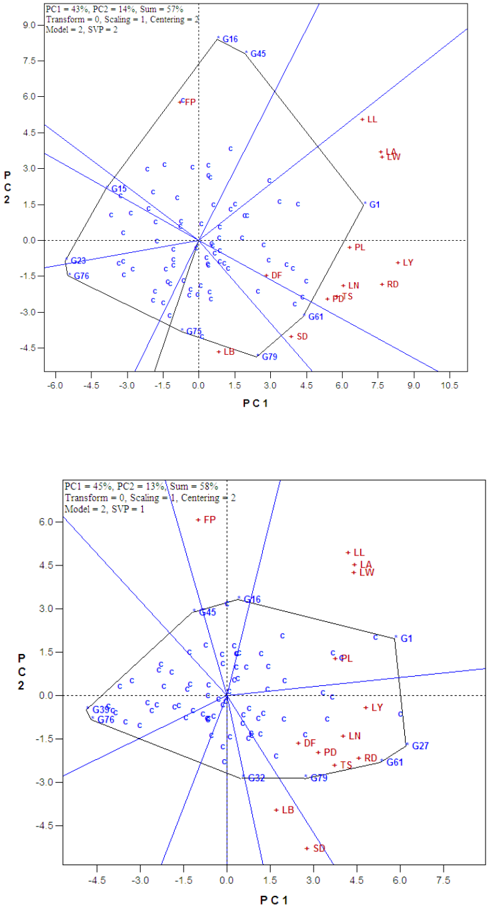
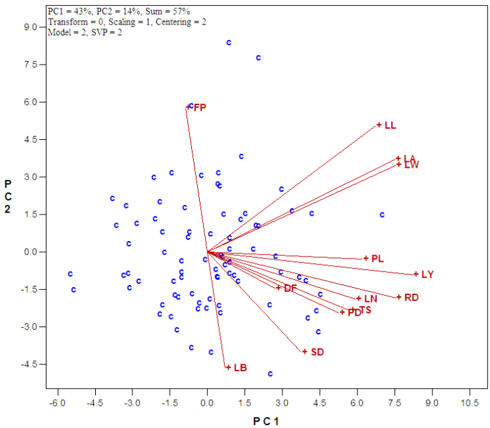
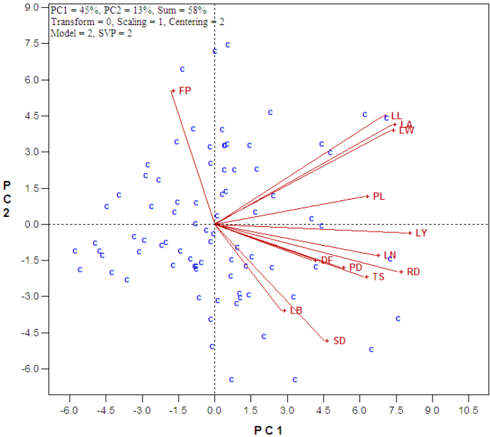
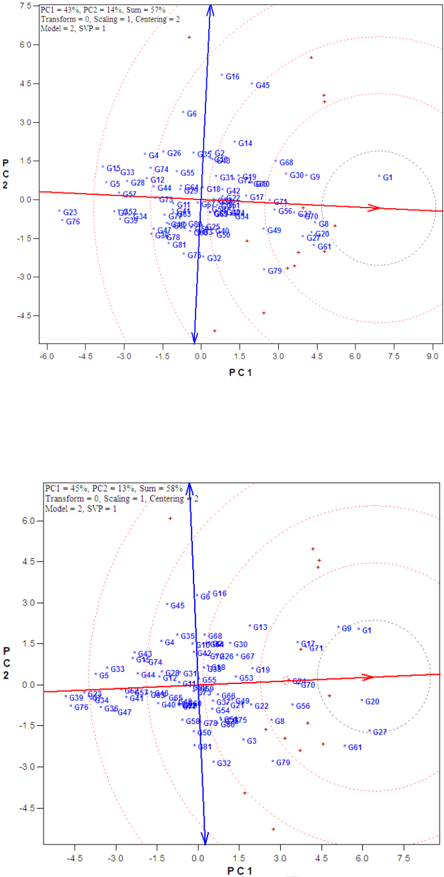
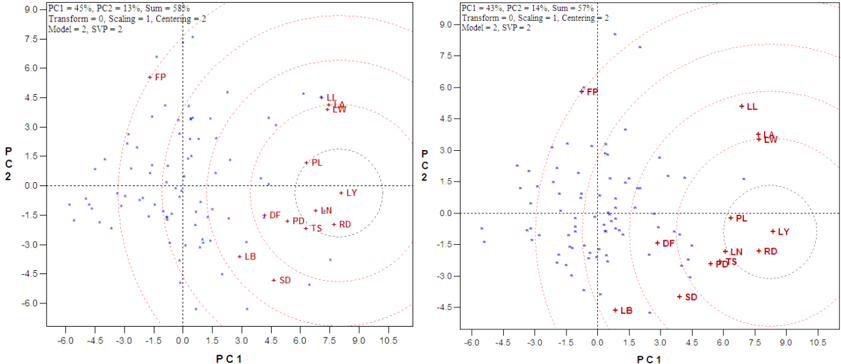
Interest in growing winter spinach (Spinacia oleracea L.) in Iran is increasing due to its good nutritional potential returns relative to other vegetable crops. The objectives of this research were to investigate the interrelationships among different traits of spinach and to evaluate different Iranian spinach landraces with application of the genotype ? trait (GT) biplot methodology in visualizing research data. 81 spinach landraces were grown during 2-years according to randomized complete block design with four replications. Ranking of the genotypes based on the ideal entry revealed that genotypes G1, G20, G7, G8, G9, G27, G49 G70 and G79 were higher in the measured traits and could be good candidates for improving most of the measured traits. Ranking of traits for the leaf yield showed that petiole diameter, petiole length, leaf numbers at flowering, 1000-seed weight and root dry weight were the most discriminating traits which influence spinach leaf yield at both years. There were 9 winning genotypes and 4 which-won-where patterns at the first year while there were 8 winning genotypes and 4 which-won-where patterns at the second year. As a result, the findings from our study are as follows: (i) traits leaf numbers at flowering, leaf length, leaf width, leaf area, petiole diameter and petiole length could be as selection indices for spinach leaf yield improvement, (ii) genotypes G1, G20, G7, G8, G9, G27, G49 G70, and G79 were the most favorable and is thus recommended for commercial release or incorporating in breeding programs; (iii) the GT biplot method can be used to identify superior genotypes in other crops and in other parts of the world.
Overview
The claims and statistics of this paper haven’t been checked yet.
Run the check — free, no account needed. It reads the open-access text and checks the sources it cites.
Integrity signals
Registry
Cites
Statistics
Figures
Verification
Claims the paper makes
The claims and statistics of this paper haven’t been checked yet.
Run the check — free, no account needed. It reads the open-access text and checks the sources it cites.
Claims other papers make about this one
Each is checked against this paper’s own text: does it say what the citing paper says it does?
In the citing paper
“On the other hand, CGT rankings across the different characters can change depending on the interaction type, a phenomenon observed in previous studies by Sabaghnia et al. [36] in Spinacia oleracea and Ebrahimi et al. [37] in Carthamus tinctorius.”
From Thermal processing and geographical origin as drivers of terpenoids variation in Anethum graveolens L. essential oils: A biplot analysis (2025) · cites this paper as [36]
Self-check
Percentages, sums and reported differences re-computed from the paper’s own numbers.
The self-check needs the paper’s full text.
Citations
Cites
No references could be resolved yet.
Research works printed but not linked: 7
- AVSAR B. (2011): Genetic diversity of Turkish spinach cultivars (Spinacia oleracea L.). A Master dissertation, Graduate School of Engineering and Sciences, Izmir Institute of Technology, Turkey.
- MORELOCK T.E., J.C. CORRELL (2008): Spinach In: Handbook of Plant Breeding. Vegetables I, Asteraceae, Brassicaceae, Chenopodicaceae, and Cucurbitaceae Edited by Prohens J, Nuez F, Springer, New York. pp. 189-218.
- MURPHY J.B. (2001): Lutein content of spinach cultivars and breeding lines. National Spinach Conference. 14- 15. November 2001, Fayetteville, AR USA.
- PEARSON O.H. (1983): Heterosis in vegetable crops. In: Frankel R (ed) Heterosis: reappraisal of theory and practice. Monographs Theoretical Applied enetics vol.6 Springer, Berlin, Heidelberg New York, pp. 171-175.
- PROHENS-TOMAS J., F. NUEZ (2008): Vegetables I: Asteraceae, Brassicaceae, Chenopodicaceae, and Cucurbitaceae: 1 (Handbook of Plant Breeding). Springer, 428 pages.
- YAN W., M.S. KANG (2003): GGE Biplot Analysis: A Graphical Tool for Breeders, Geneticists, and Agronomists. CRC Press, Boca Raton, FL.
- YAN W. (2014): Crop Variety Trials: Data Management and Analysis. Wiley-Blackwell, 360 pp. UK.
Cited by
Farmanpour Kalalagh, K., Mohebodini, M., Sabaghnia, N., Beyraghdar Kashkooli, A., & Esmaeili, H. (2025) · PLOS One · doi:10.1371/journal.pone.0327018 · Cited by 4
Self-citation
Metadata
- Authors
- Sabaghnia, N., Mohebodini, M., & Janmohammadi, M.
- Affiliations
- University of Maragheh, Faculty of Agriculture, Department of Agronomy and Plant Breeding, Maragheh, Iran
- Venue
- Genetika
- Publisher
- National Library of Serbia
- Published
- 2016
- Volume
- 48
- Issue
- 2
- Pages
- 675-690
- ISSN
- 0534-0012
- 1820-6069
- Cited by
- 12
- References
- 0
- Language
- en
About these checks
Registry, retraction, Cites and statistics results are computed, not judged, with one exception: a printed reference that no index lists is read once by a model before it counts as a citation error. Claims are extracted by a model and kept only when their quote appears verbatim in the text; each cited source is then checked, with a model’s help, for whether it says what the claim relies on. Those verdicts can be wrong — read the claim’s quote and the cited source before relying on one.
Statistics and arithmetic are recomputed, not judged.
Confidence bands are shown only for fields calibrated on our annotated test set. None is calibrated yet, so no band is shown.
What counts as a claim ›How we measure confidence ›How we check this ›
Are you an author, or do you see a problem with this page? Request a review
How to cite
Cite CoChat for the checks on this page, and the paper for its own findings.
- This page
- CoChat. (2026). Citation check: Biplot analysis of trait relations of spinach (Spinacia oleracea L.) landraces. https://app.cochat.ai/papers/10.2298/gensr1602675s
- The paper
- Sabaghnia, N., Mohebodini, M., & Janmohammadi, M. (2016). Biplot analysis of trait relations of spinach (Spinacia oleracea L.) landraces. Genetika. https://doi.org/10.2298/gensr1602675s
