

Effects of type 2 diabetes on insulin secretion, insulin action, glucose effectiveness, and postprandial glucose metabolism.
Open accessThe DOI matches its Crossref record; 27 of the 27 references it cites were found in a registry or an index.
Abstract
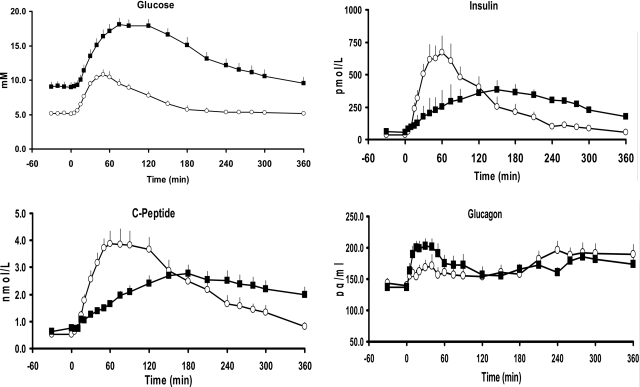
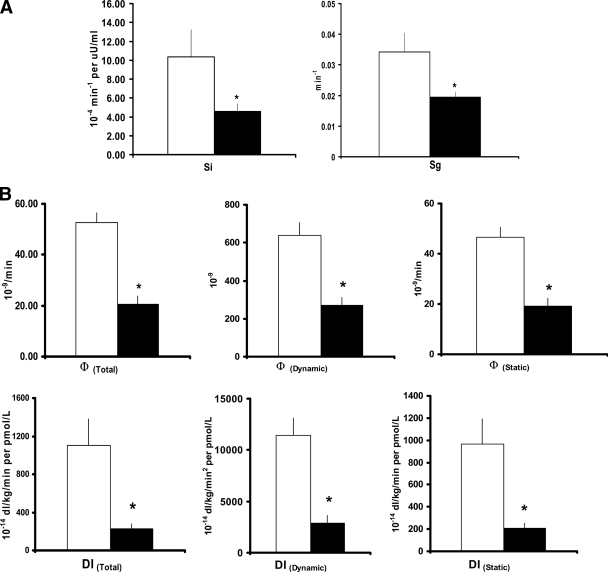
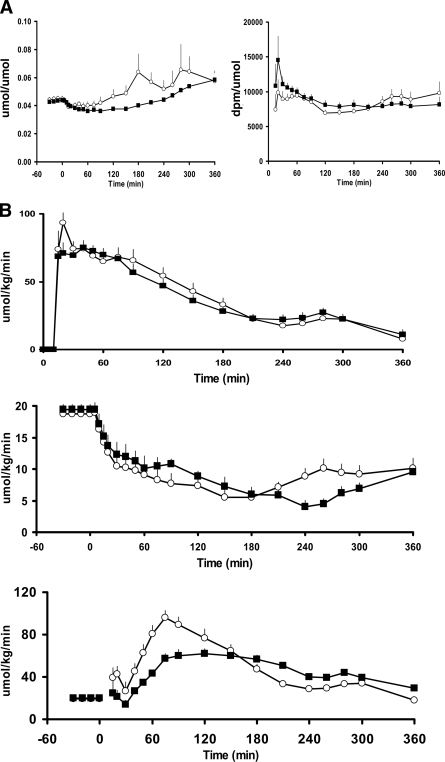
OBJECTIVE: In this study, we sought to determine whether postprandial insulin secretion, insulin action, glucose effectiveness, and glucose turnover were abnormal in type 2 diabetes. RESEARCH DESIGN AND METHODS: Fourteen subjects with type 2 diabetes and 11 nondiabetic subjects matched for age, weight, and BMI underwent a mixed-meal test using the triple-tracer technique. Indexes of insulin secretion, insulin action, and glucose effectiveness were assessed using the oral "minimal" and C-peptide models. RESULTS: Fasting and postprandial glucose concentrations were higher in the diabetic than nondiabetic subjects. Although peak insulin secretion was delayed (P < 0.001) and lower (P < 0.05) in type 2 diabetes, the integrated total postprandial insulin response did not differ between groups. Insulin action, insulin secretion, disposition indexes, and glucose effectiveness all were lower (P < 0.05) in diabetic than in nondiabetic subjects. Whereas the rate of meal glucose appearance did not differ between groups, the percent suppression of endogenous glucose production (EGP) was slightly delayed and the increment in glucose disappearance was substantially lower (P < 0.01) in diabetic subjects during the first 3 h after meal ingestion. Together, these defects resulted in an excessive rise in postprandial glucose concentrations in the diabetic subjects. CONCLUSIONS: When measured using methods that avoid non-steady-state error, the rate of appearance of ingested glucose was normal and suppression of EGP was only minimally impaired. However, when considered in light of the prevailing glucose concentration, both were abnormal. In contrast, rates of postprandial glucose disappearance were substantially decreased due to defects in insulin secretion, insulin action, and glucose effectiveness.
Overview
The claims and statistics of this paper haven’t been checked yet.
Free: it reads the open-access text and checks the first 5 claims that cite a source we can check. Create a free account to check every claim.
Integrity signals
Registry
Cites
Statistics
Figures
Verification
Claims the paper makes
The claims and statistics of this paper haven’t been checked yet.
Free: it reads the open-access text and checks the first 5 claims that cite a source we can check. Create a free account to check every claim.
Claims other papers make about this one
Each is checked against this paper’s own text: does it say what the citing paper says it does?
The cited source says what the claim attributes to it.
In the citing paper
“The set point above the normal glucose concentration of around 5–5.5 mM [1], [28] is in line with the role of the liver as glucose producer under normoglycemic conditions [1], [29].”
From Quantifying the Contribution of the Liver to Glucose Homeostasis: A Detailed Kinetic Model of Human Hepatic Glucose Metabolism (2012) · cites this paper as [28]
Self-check
Percentages, sums and reported differences re-computed from the paper’s own numbers.
The self-check needs the paper’s full text.
Citations
Cites
DeFronzo, R. A., Ferrannini, E., & Simonson, D. C. (1989) · Metabolism · doi:10.1016/0026-0495(89)90129-7 · Cited by 515 · cited 1×
“Fasting hyperglycemia in type 2 diabetes (DM) occurs when endogenous glucose production (EGP) is inappropriately increased and glucose disappearance (Rd) inappropriately decreased when considered in light of prevailing glucose and insulin concentrations (1-4).”
BackgroundMechanisms of the Age-Associated Deterioration in Glucose Tolerance
Basu, R., Breda, E., Oberg, A. L., Powell, C. C., Dalla Man, C., Basu, A., Vittone, J. L., Klee, G. G., Arora, P., Jensen, M. D., et al. (2003) · Diabetes · doi:10.2337/diabetes.52.7.1738 · Cited by 440
Self-citationJensen, M., Kanaley, J., Reed, J., & Sheedy, P. (1995) · The American Journal of Clinical Nutrition · doi:10.1093/ajcn/61.2.274 · Cited by 344 · cited 1×
“At screening, body composition and visceral fat were measured using dual-energy X-ray absorptiometry and a single-cut computed tomographic scan (15).”
MethodEffects of Age and Sex on Postprandial Glucose Metabolism
Basu, R., Dalla Man, C., Campioni, M., Basu, A., Klee, G., Toffolo, G., Cobelli, C., & Rizza, R. A. (2006) · Diabetes · doi:10.2337/db05-1692 · Cited by 334
Self-citationGastaldelli, A., Baldi, S., Pettiti, M., Toschi, E., Camastra, S., Natali, A., Landau, B. R., & Ferrannini, E. (2000) · Diabetes · doi:10.2337/diabetes.49.8.1367 · Cited by 320 · cited 1×
“We and others (2,3,23,24) have reported that the absolute rate of EGP is increased in individuals with severe diabetes as indicated by marked fasting hyperglycemia.”
BackgroundContribution of Abnormal Muscle and Liver Glucose Metabolism to Postprandial Hyperglycemia in NIDDM
Mitrakou, A., Kelley, D., Veneman, T., Jenssen, T., Pangburn, T., Reilly, J., & Gerich, J. (1990) · Diabetes · doi:10.2337/diab.39.11.1381 · Cited by 317
The disposal of an oral glucose load in patients with non-insulin-dependent diabetes
Ferrannini, E., Simonson, D. C., Katz, L. D., Reichard, G., Bevilacqua, S., Barrett, E. J., Olsson, M., & DeFronzo, R. A. (1988) · Metabolism · doi:10.1016/0026-0495(88)90033-9 · Cited by 305 · cited 2×
“Delayed suppression of EGP also has been reported in studies using the dual-tracer approach (5,6).”
ResultFirth, R. G., Bell, P. M., Marsh, H. M., Hansen, I., & Rizza, R. A. (1986) · Journal of Clinical Investigation · doi:10.1172/jci112467 · Cited by 280 · cited 1×
“Whereas postprandial suppression of EGP has consistently been reported to be delayed (5–7), rates of appearance of glucose in the meal (MRa) have been reported to be increased, decreased, or not different from those observed in nondiabetic subjects (5,6,8).”
ResultSelf-citationBock, G., Dalla Man, C., Campioni, M., Chittilapilly, E., Basu, R., Toffolo, G., Cobelli, C., & Rizza, R. (2006) · Diabetes · doi:10.2337/db06-0319 · Cited by 230
Self-citationBasu, A., Basu, R., Shah, P., Vella, A., Johnson, C. M., Nair, K. S., Jensen, M. D., Schwenk, W. F., & Rizza, R. A. (2000) · Diabetes · doi:10.2337/diabetes.49.2.272 · Cited by 204 · cited 2×
“However, it is noteworthy that because hyperglycemia is a potent stimulus of hepatic glucose uptake (19), the fact that MRa was comparable in Figure 2—A: Indexes of net insulin action (Si) and net glucose effectiveness (Sg) observed in diabetic (f) and nondiabetic ( ) subjects after ingestion of a mixed meal.”
BackgroundSelf-citation
Cited by
Items 101–131 of 131
Rigalleau, V., Beauvieux, M.-C., Gallis, J., Gin, H., Schneiter, P., & Tappy, L. (2010) · Diabetes & Metabolism · doi:10.1016/j.diabet.2010.01.007 · Cited by 2
Probabilistic Meal Detection and Estimation in Type 1 Diabetes With Extreme Shape Variability
Sontakke, M., Cameron, F. M., & Bequette, B. W. (2025) · Journal of Diabetes Science and Technology · doi:10.1177/19322968251363234 · Cited by 2
YURCHISHIN, M. L., Finn, A. R., Fowler, L. A., Vere-Whiting, S. L., & Gower, B. A. (2026) · Journal of the Endocrine Society · doi:10.1210/jendso/bvag073 · Cited by 1
Waterman, H. L., Smith, M. S., Farmer, B., Yankey, K. C., Howard, T., Kraft, G., Cherrington, A. D., & Edgerton, D. S. (2026) · Diabetes · doi:10.2337/db26-0103 · Cited by 1
Assessing the Predictive Accuracy of Oral Glucose Effectiveness Index using a Calibration Model
Glicksman, M., Grewal, S., Sortur, S., Abel, B., Auh, S., Gaillard, T., Osei, K., & Muniyappa, R. (2018) · Endocrine · doi:10.1007/s12020-018-1804-0
Diabetes Technology for Precision Therapy in Children, Adults, and Pregnancy
Mazze, R. S., Kong, A. P. S., Petrovski, G., & Basu, R. (2022) · Springer eBooks · doi:10.1007/978-3-030-98927-9_14 · Cited by 1
Self-citationMan, C. D., & Cobelli, C. (2013) · Elsevier eBooks · doi:10.1016/b978-0-12-411557-6.00016-1
Self-citationNyman, E. (2014) · Linköping University Electronic Press eBooks · doi:10.3384/diss.diva-104725
Insulin signaling dynamics in human adipocytes
Nyman, E. (2014)
Short-term aerobic exercise training in type 2 diabetes
Kearney, M. L. (2015) · MOspace Institutional Repository (University of Missouri) · doi:10.32469/10355/50150
Effects of Resistance Exercise on Postprandial Metabolism in Obese Men with Prediabetes
Bittel, A. J. (2018) · Digital Commons@Becker (Washington University School of Medicine) · doi:10.7936/tdvz-6g03 · Cited by 1
Mukherjee, M., Banerjee, N., & Chatterjee, S. (2020) · RSC Advances · doi:10.1039/d0ra00832j
When and how to Use Prandial Insulin with Ultralong-Acting Basal Insulin in T2Dm
Umpierrez, G. E. (2016) · Endocrine Practice · doi:10.1016/s1530-891x(20)42964-7
When and how to Use Ultralong-Acting Basal Insulin in T2Dm
Garber, A. J. (2016) · Endocrine Practice · doi:10.1016/s1530-891x(20)42963-5
When and how to Use A Glp-1 ra With Long- or Ultralong-Acting Basal Insulin in T2Dm
Bode, B. W. (2016) · Endocrine Practice · doi:10.1016/s1530-891x(20)42965-9
Garber, A. J. (2016) · Endocrine Practice · doi:10.4158/1934-2403-22.s5.1
Cobelli, C., & Man, C. D. (2021) · Journal of Diabetes Science and Technology · doi:10.1177/19322968211060069
Self-citationGrafoscopio, una radiografía de El Prado
Gallardo, H. P. (2004) · Descubrir el arte
A Novel Method for Generation of In Silico Subjects with Type 2 Diabetes
VISENTIN, R., & Lazzari, M. D. (2021) · Annual International Conference of the IEEE Engineering in Medicine and Biology Society (EMBC) · doi:10.1109/embc46164.2021.9629678
Current literature in diabetes
(2009) · Diabetes/Metabolism Research and Reviews · doi:10.1002/dmrr.1037
Glucose Controlin Type 2 Diabetes: In Silico Study of Sub-Optimal Adherence to Insulin Therapy
VISENTIN, R., Cobelli, C., Sieber, J., & Man, C. D. (2022) · International Conference on Systems and Control (ICSC) · doi:10.1109/icsc57768.2022.9993828
Self-citationFeyat, M. S., & Yanık, T. (2023) · Research Square · doi:10.21203/rs.3.rs-3024860/v1
The Story of Diabetes and its Causes
Malboosbaf, R., & Hatami, N. (2023) · BENTHAM SCIENCE PUBLISHERS eBooks · doi:10.2174/9789815196535123010004
Obesity and insulin resistance: pathophysiology guiding precision therapy
Basu, A., & Basu, R. (2023) · Elsevier eBooks · doi:10.1016/b978-0-323-91707-0.00008-5
Self-citationPerazzolo, S., Galderisi, A., Carr, A. L. J., Dayan, C. M., & Cobelli, C. (2025) · Journal of Diabetes Science and Technology · doi:10.1177/19322968251365274
“17 Finally, postprocessing is now streamlined: AOMM generates a single spreadsheet with results from all subjects, avoiding the need to open and extract each file manually.”
Self-citationRenuse, S., Benson, L. M., Vanderboom, P. M., RUCHI, F., Yadav, Y. R., Johnson, K. L., Brown, B. C., Peterson, J. A., Basu, R., McCormick, D., et al. (2022) · Figshare · doi:10.6084/m9.figshare.19802413
Self-citationWang, C., Kanaley, J. A., Chen, J., & Tan, J. (2026) · Frontiers in Physiology · doi:10.3389/fphys.2026.1907805
Bhagwandin, C. (2014) · UA Campus Repository (The University of Arizona)
Gli standard di cura terzo step: incretina + metformina
Giandalia, A., Romeo, E. L., Zingale, R., Alecci, U., & Russo, G. T. (2014) · MEDIA - Aggiornamento e formazione in diabetologia e malattie metaboliche
Metadata
- Authors
- Basu, A., Dalla Man, C., Basu, R., Toffolo, G., Cobelli, C., & Rizza, R. A.
- Affiliations
- Mayo Clinic (US)
- Department of Information Engineering, University of Padova, Padua, Italy.
- University of Padua (IT)
- Corresponding author
- Basu, Ananda
- Venue
- Diabetes Care
- Publisher
- American Diabetes Association
- Published
- 2009-02-05
- Volume
- 32
- Issue
- 5
- Pages
- 866-872
- ISSN
- 0149-5992 (ISSN-L)
- 1935-5548
- PMC
- PMC2671126
- OpenAlex
- W2160873546
- Cited by
- 129
- References
- 27
- Citations by year
- 2026: 3 · 2025: 6 · 2024: 6 · 2023: 7 · 2022: 10 · 2021: 12 · 2020: 8 · 2019: 5 · 2018: 6 · 2017: 3 · 2016: 10 · 2015: 12 · 2014: 14 · 2013: 9 · 2012: 5
- FWCI
- 5.75
- Type
- journal article
- Language
- en
- Open access
- hybrid
- doi.org
- Licence
- Locations
- Diabetes Care (publishedVersion, cc-by-nc-nd)
- PubMed Central (publishedVersion, cc-by-nc-nd)
- PubMed (publishedVersion)
- Padua Research Archive (University of Padova) (submittedVersion)
- Funders
- American Diabetes Association
- U.S. Public Health Service (DK29953, R-00585)
- National Institute of Diabetes and Digestive and Kidney Diseases (R01DK029953, DK 29953, R37DK029953)
- National Center for Research Resources (U 54RR 24150-1, UL1RR024150)
- Topics
- Health Sciences › Medicine › Endocrinology, Diabetes and Metabolism › Pancreatic function and diabetes
- Health Sciences › Medicine › Endocrinology, Diabetes and Metabolism › Diabetes Treatment and Management
- Health Sciences › Medicine › Endocrinology, Diabetes and Metabolism › Diabetes, Cardiovascular Risks, and Lipoproteins
- Keywords
- type 2 diabetes, insulin secretion, insulin action, glucose effectiveness, postprandial glucose metabolism, glucose turnover, endogenous glucose production, glucose disappearance, mixed meal tolerance test, disposition index, C-peptide
- MeSH terms
- Insulin Secretion, Blood Glucose, C-Peptide, Diabetes Mellitus, Type 2, Fasting, Glucose, Humans, Infusions, Intravenous, Insulin, Kinetics, Reference Values, Postprandial Period
About these checks
Registry, retraction, Cites and statistics results are computed, not judged, with one exception: a printed reference that no index lists is read once by a model before it counts as a citation error. Claims are extracted by a model and kept only when their quote appears verbatim in the text; each cited source is then checked, with a model’s help, for whether it says what the claim relies on. Those verdicts can be wrong — read the claim’s quote and the cited source before relying on one.
Statistics and arithmetic are recomputed, not judged.
Confidence bands are shown only for fields calibrated on our annotated test set. None is calibrated yet, so no band is shown.
What counts as a claim ›How we measure confidence ›How we check this ›
Are you an author, or do you see a problem with this page? Request a review
Data sources
Bibliographic data: Semantic Scholar, OpenAlex, Crossref.
Contains information from the Semantic Scholar Academic Graph Datasets, made available under the ODC Attribution License (ODC-BY 1.0).
Semantic Scholar’s data is described in: Kinney, R., et al. (2023). The Semantic Scholar Open Data Platform. arXiv:2301.10140.
