

Multivariate curve resolution with autoencoders for CARS microspectroscopy
Open accessThe DOI matches its Crossref record; 16 of the 16 references it cites were found in a registry or an index.
Abstract
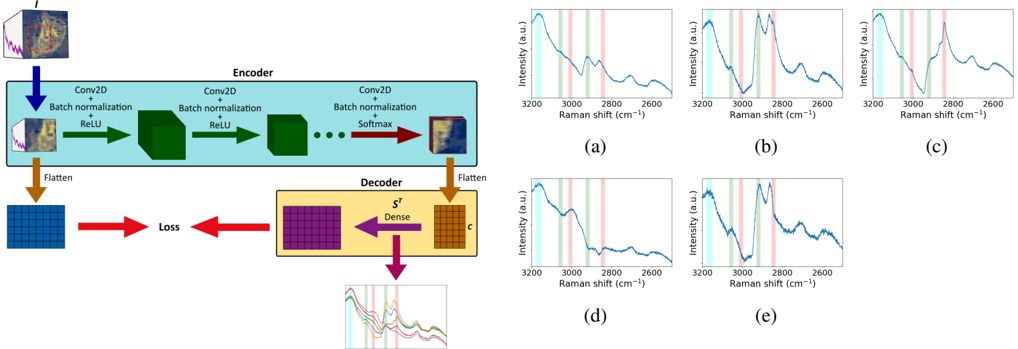
Coherent anti-Stokes Raman scattering (CARS) microspectroscopy is a powerful tool for label-free cell imaging thanks to its ability to acquire a rich amount of information. An important family of operations applied to such data is multivariate curve resolution (MCR). It aims to find main components of a dataset and compute their spectra and concentrations in each pixel. Recently, autoencoders began to be studied to accomplish MCR with dense and convolutional models. However, many questions, like the results variability or the reconstruction metric, remain open and applications are limited to hyperspectral imaging. In this article, we present a nonlinear convolutional encoder combined with a linear decoder to apply MCR to CARS microspectroscopy. We conclude with a study of the result variability induced by the encoder initialization.
Overview
The claims and statistics of this paper haven’t been checked yet.
Free: it reads the open-access text and checks the first 5 claims that cite a source we can check. Create a free account to check every claim.
Integrity signals
Registry
Cites
Statistics
Figures
Verification
Claims the paper makes
The claims and statistics of this paper haven’t been checked yet.
Free: it reads the open-access text and checks the first 5 claims that cite a source we can check. Create a free account to check every claim.
Claims other papers make about this one
Each is checked against this paper’s own text: does it say what the citing paper says it does?
The cited source says what the claim attributes to it.
In the citing paper
“Yet, despite initial explorations (67, 68), the utility of unmixing AEs for Raman spectroscopy data remains largely unexplored.”
From Hyperspectral unmixing for Raman spectroscopy via physics-constrained autoencoders (2024) · cites this paper as [68]
Self-check
Percentages, sums and reported differences re-computed from the paper’s own numbers.
The self-check needs the paper’s full text.
Citations
Cites
PyTorch: An Imperative Style, High-Performance Deep Learning Library
Paszke, A., Gross, S., Massa, F., Lerer, A., Bradbury, J., Chanan, G., Killeen, T., Lin, Z., Gimelshein, N., Antiga, L., et al. (2019) · arXiv · doi:10.48550/arxiv.1912.01703 · Cited by 31,473
How Does Batch Normalization Help Optimization?
Santurkar, S., Tsipras, D., Ilyas, A., & Madry, A. (2018) · arXiv · doi:10.48550/arxiv.1805.11604 · Cited by 1,092
Interactive self-modeling mixture analysis
Windig, W., & Guilment, J. (1991) · Analytical Chemistry · doi:10.1021/ac00014a016 · Cited by 1,028
Multivariate Curve Resolution (MCR). Solving the mixture analysis problem
de Juan, A., Jaumot, J., & Tauler, R. (2014) · Anal. Methods · doi:10.1039/c4ay00571f · Cited by 700
Convolutional Autoencoder for Spectral–Spatial Hyperspectral Unmixing
Palsson, B., Ulfarsson, M. O., & Sveinsson, J. R. (2021) · IEEE Transactions on Geoscience and Remote Sensing · doi:10.1109/tgrs.2020.2992743 · Cited by 265
Hyperspectral Unmixing Using a Neural Network Autoencoder
Palsson, B., Sigurdsson, J., Sveinsson, J. R., & Ulfarsson, M. O. (2018) · IEEE Access · doi:10.1109/access.2018.2818280 · Cited by 256
uDAS: An Untied Denoising Autoencoder With Sparsity for Spectral Unmixing
Qu, Y., & Qi, H. (2019) · IEEE Transactions on Geoscience and Remote Sensing · doi:10.1109/tgrs.2018.2868690 · Cited by 251
Raman and coherent anti-Stokes Raman scattering microspectroscopy for biomedical applications
Krafft, C. (2012) · Journal of Biomedical Optics · doi:10.1117/1.jbo.17.4.040801 · Cited by 165
Nonlinear Unmixing of Hyperspectral Data via Deep Autoencoder Networks
Wang, M., Zhao, M., Chen, J., & Rahardja, S. (2019) · IEEE Geoscience and Remote Sensing Letters · doi:10.1109/lgrs.2019.2900733 · Cited by 147
Hyperspectral image unmixing using autoencoder cascade
Guo, R., Wang, W., & Qi, H. (2015) · 2015 7th Workshop on Hyperspectral Image and Signal Processing: Evolution in Remote Sensing (WHISPERS) · doi:10.1109/whispers.2015.8075378 · Cited by 132
Stacked Nonnegative Sparse Autoencoders for Robust Hyperspectral Unmixing
Su, Y., Marinoni, A., Li, J., Plaza, J., & Gamba, P. (2018) · IEEE Geoscience and Remote Sensing Letters · doi:10.1109/lgrs.2018.2841400 · Cited by 128
Camp, C. H. (2019) · Journal of Research of the National Institute of Standards and Technology · doi:10.6028/jres.124.018 · Cited by 90
Rosasco, G. J., & Hurst, W. S. (1985) · Physical Review A · doi:10.1103/physreva.32.281 · Cited by 43
Ultra-multiplex CARS spectroscopic imaging with 1-millisecond pixel dwell time
Kano, H., Maruyama, T., Kano, J., Oka, Y., Kaneta, D., Ben, T. G.-D., Leproux, P., Couderc, V., & Noguchi, M. (2019) · OSA Continuum · doi:10.1364/osac.2.001693 · Cited by 38
Self-citationBen, T. G.-D., Rajaofara, Z., Couderc, V., Sol, V., Kano, H., Leproux, P., & Petit, J.-M. (2019) · Scientific Reports · doi:10.1038/s41598-019-50453-0 · Cited by 32
Self-citationFast epi-detected broadband multiplex CARS and SHG imaging of mouse skull cells
Capitaine, E., Moussa, N. O., Louot, C., Bardet, S. M., Kano, H., Duponchel, L., Lévêque, P., Couderc, V., & Leproux, P. (2017) · Biomedical Optics Express · doi:10.1364/boe.9.000245 · Cited by 29
Self-citation
Research works printed but not linked: 1
- [14]14. Charles H Camp Jr, "Pymcr: A python library for multi- variatecurve resolution analysis with alternating regres- sion (mcr-ar)," Journal of Research of the National In- stitute of Standards and Technology, vol. 124, pp. 1-10, 2019.
Cited by
Hyperspectral unmixing for Raman spectroscopy via physics-constrained autoencoders
Georgiev, D., Fernández-Galiana, Á., Vilms Pedersen, S., Papadopoulos, G., Xie, R., Stevens, M. M., & Barahona, M. (2024) · Proceedings of the National Academy of Sciences · doi:10.1073/pnas.2407439121 · Cited by 50
Metadata
- Authors
- Boildieu, D., Helbert, D., Magnaudeix, A., Leproux, P., & Carré, P.
- Affiliations
- Centre National de la Recherche Scientifique (FR)
- Venue
- Electronic Imaging
- Published
- 2023-01-16
- Volume
- 35
- Issue
- 14
- Pages
- 168-1-168-4
- ISSN
- 2470-1173 (ISSN-L)
- OpenAlex
- W4307464795
- Cited by
- 1
- References
- 16
- Citations by year
- 2024: 1
- FWCI
- 0.13
- Type
- journal article
- Language
- en
- Open access
- hybrid
- dx.doi.org
- Licence
- cc-by
- Locations
- Electronic Imaging (publishedVersion, cc-by)
- HAL (submittedVersion, other-oa)
- Topics
- Physical Sciences › Chemistry › Analytical Chemistry › Spectroscopy and Chemometric Analyses
- Life Sciences › Biochemistry, Genetics and Molecular Biology › Biophysics › Spectroscopy Techniques in Biomedical and Chemical Research
- Physical Sciences › Computer Science › Computer Vision and Pattern Recognition › Remote-Sensing Image Classification
- Keywords
- multivariate curve resolution, coherent anti-Stokes Raman scattering, autoencoder, convolutional encoder, label-free cell imaging, hyperspectral imaging
About these checks
Registry, retraction, Cites and statistics results are computed, not judged, with one exception: a printed reference that no index lists is read once by a model before it counts as a citation error. Claims are extracted by a model and kept only when their quote appears verbatim in the text; each cited source is then checked, with a model’s help, for whether it says what the claim relies on. Those verdicts can be wrong — read the claim’s quote and the cited source before relying on one.
Statistics and arithmetic are recomputed, not judged.
Confidence bands are shown only for fields calibrated on our annotated test set. None is calibrated yet, so no band is shown.
What counts as a claim ›How we measure confidence ›How we check this ›
Are you an author, or do you see a problem with this page? Request a review
Data sources
Bibliographic data: Semantic Scholar, OpenAlex, Crossref.
Contains information from the Semantic Scholar Academic Graph Datasets, made available under the ODC Attribution License (ODC-BY 1.0).
Semantic Scholar’s data is described in: Kinney, R., et al. (2023). The Semantic Scholar Open Data Platform. arXiv:2301.10140.
