

The DOI matches its Crossref record.
Implementation of Deep Learning in Education: Towards Mindful, Meaningful, and Joyful Learning Experiences
Open accessAbstract
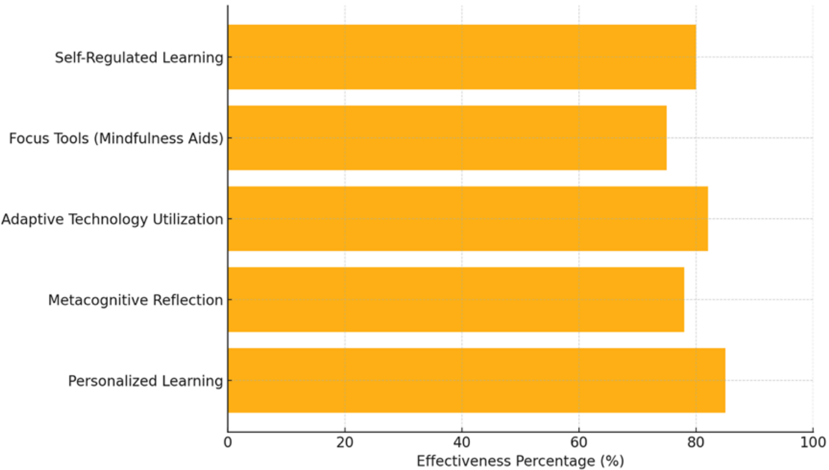
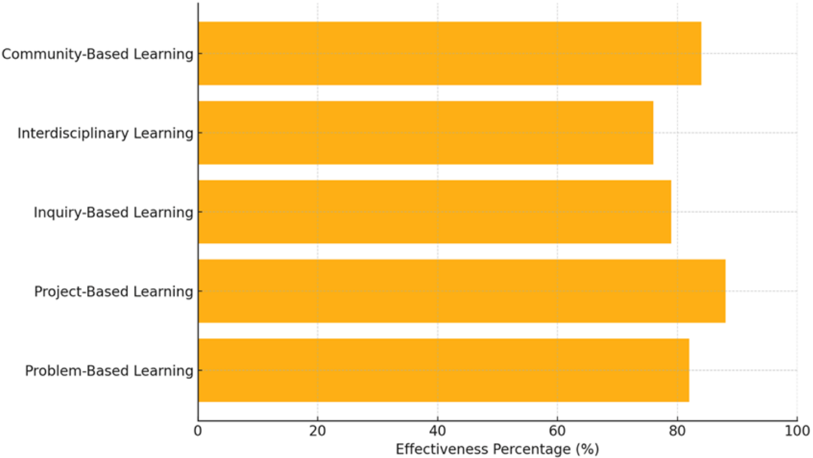
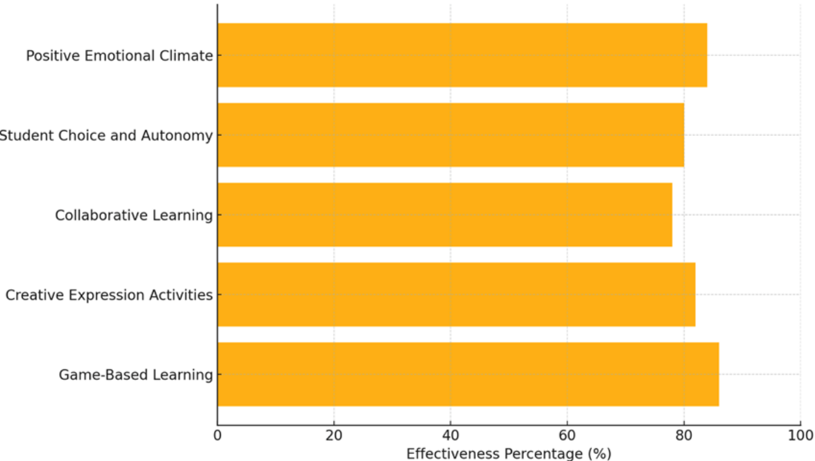
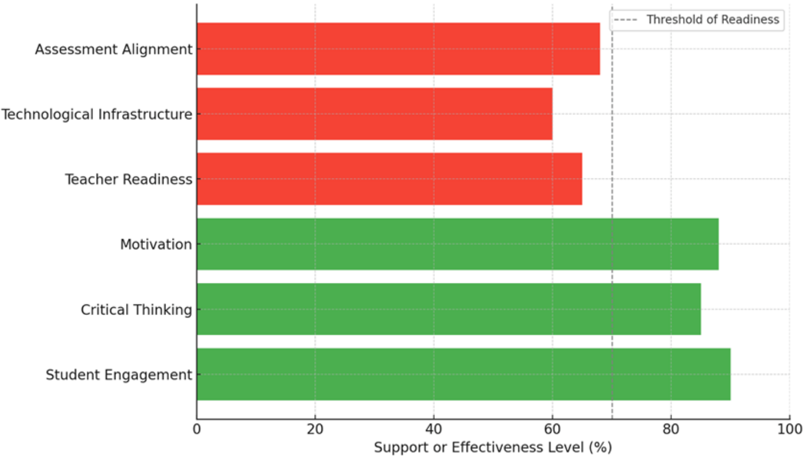
The deep learning approach in education has emerged as a promising pedagogical framework for transforming the learning experience to be more holistic, reflective, and aligned with the needs of the twenty‑first century. This study seeks to conceptually explore how the principles of mindful, meaningful, and joyful learning may be integrated through deep learning–based instructional strategies. The methodology comprises a systematic literature review and a conceptual analysis of pertinent academic publications, research reports, and innovative educational practices. Findings reveal that strategies such as personalized learning, project‑based learning, game‑based learning, and community engagement effectively enhance student engagement, critical thinking skills, and intrinsic motivation. Nonetheless, the implementation of deep learning approaches continues to encounter significant challenges, including educator preparedness, limitations in technological infrastructure, and the misalignment of conventional assessment systems. This article recommends the enactment of progressive policy support, the enhancement of professional capacity among educators, and further empirical research to evaluate the efficacy of deep learning strategies across broader contexts. It is anticipated that these findings will contribute to the advancement of more adaptive, inclusive, and empowering educational policies and practices.
Overview
The claims and statistics of this paper haven’t been checked yet.
Run the check — free, no account needed. It reads the open-access text and checks the sources it cites.
Integrity signals
Registry
Cites
Statistics
Figures
Verification
Claims the paper makes
The claims and statistics of this paper haven’t been checked yet.
Run the check — free, no account needed. It reads the open-access text and checks the sources it cites.
Claims other papers make about this one
Each is checked against this paper’s own text: does it say what the citing paper says it does?
The source backs part of the claim, not all of it — or backs it for a different population, condition or comparison.
In the citing paper
“This aligns with the view of (Andayanie et al., 2025), who assert that student-centered learning is effective when students are given opportunities to participate through media that support two-way communication and active learning experiences.”
From Wordwall and Interactive Flat Panel (IFP) as Student-Centered, Deep Learning-Based Media for Islamic Education in Elementary Schools (2026) · cites this paper as Andayanie et al., 2025
Experimental — accuracy not yet measuredThe cited source says what the claim attributes to it.
In the citing paper
“Furthermore, the implementation of studentcentered learning positions the teacher as a facilitator who guides students in discovering meaning, rather than merely a conveyor of information (Aji et al., 2023; Andayanie et al., 2025).”
From Wordwall and Interactive Flat Panel (IFP) as Student-Centered, Deep Learning-Based Media for Islamic Education in Elementary Schools (2026) · cites this paper as Andayanie et al., 2025
Self-check
Percentages, sums and reported differences re-computed from the paper’s own numbers.
The self-check needs the paper’s full text.
Citations
Cites
Still being checked.
Research works printed but not linked: 15
- Andini, S. J., Farica, M. C., & Asmawulan, T. (2025). Belajar Sambil Bermain: Cara Sekolah Mendukung Motorik Kasar Anak Usia Dini. Early Childhood Rese- arch Journal (ECRJ), 7(2), 178-186. https://doi.org/10.23917/ecrj.v7i2.8794 · DOI
- Bhakti, Y. A., Ghiffari, M. F., & Salsabil, A. (2019). Joyful Learning and Students' Well-Being: A Systematic Review. Inter- national Journal of Evaluation and Rese- arch in Education (IJERE), 8(4), 640- 647.
- Darling-Hammond, L., & McLaughlin, M. W. (1995). Policies That Support Professio- nal Development in an Era of Reform. Phi Delta Kappan, 76(8), 597-604.
- Fitriansyah, R., Fatinah, L., & Syahril, M. (2020). Critical Review: Professional De- velopment Programs to Face Open Edu- cational Resources in Indonesia. Indone- sian Journal on Learning and Advanced Education (IJOLAE), 2(2), 109-119. https://doi.org/10.23917/ijolae.v2i2.9662 · DOI
- Haryono, E. R., Kurniawan, R., & Sariman. (2024). Konsep Deep Learning Sebagai Pilar dalam Strategi Pendidikan Berkua- litas. Meta Nusantara, 1(1), 1-10.
- Johnson, D. W., & Johnson, R. T. (2009). An Elaboration of Social Interdependence Theory. In Handbook of Motivation at School (pp. 27-49). Routledge.
- Kapp, K. M. (2012). The Gamification of Le- arning and Instruction: Game-Based Me- thods and Strategies for Training and Education. John Wiley & Sons.
- Kontesa, D. A., Minsih, M., & Fuadi, D. (2023). Penerapan Pendekatan Pembela- jaran Active Deep Learner Experience dalam Membangun Kemandirian Belajar Siswa Sekolah Dasar. Jurnal Elementa- ria Edukasia, 6(3), 1416-1427. https://doi.org/10.31949/jee.v6i3.6638 · DOI
- Langer, E. J., Blank, A., & Chanowitz, B. (1989). The Mindlessness of Ostensibly Thoughtful Action: The Role of "Place- bic" Information in Interpersonal Interac- tion. Journal of Personality and Social Psychology, 36(6), 635-642.
- Levin, B. (2010). What Exactly Do We Mean by "Student-Centered Learning"? Educa- tion Canada, 50(1), 12-16.
- Pane, J. F., Steiner, E. D., Baird, M. D., & Ha- milton, L. S. (2017). Informed Design of Personalized Learning Technologies in Elementary and Secondary Education: A Review of the Evidence. RAND Corpora- tion.
- Rahmawati, N., Prasetiyo, W. H., Wicaksono, R. B., Muthali'in, A., Huda, M., & Atang, A. (2022). Pemanfaatan Sudut Baca da- lam Meningkatkan Literasi Kewargane- garaan Siswa di Era Digital. Buletin KKN Pendidikan, 4(1), 99-107. https://doi.org/10.23917/bkkn- dik.v4i1.17822 · DOI
- Sabardila, A., Budiargo, A. D., Wiratmoko, G., Himawan, J. A., Triutami, A., Intan- sari, A., Setiyowati, D., Cahyani, D. H. T., Handayani, R., & Suistri, S. (2020). Pembentukan Karakter Peduli Lingkun- gan Melalui Kegiatan Penghijauan pada Siswa MIM Derasan Sempu, Boyolali. Buletin KKN Pendidikan, 1(2), 35-41. https://doi.org/10.23917/bkkn- dik.v1i2.10763 · DOI
- Sawyer, R. K. (2011). Explaining Creativity: The Science of Human Innovation. Ox- ford University Press.
- Wardhani, J. D., Katoningsih, S., Asmawulan, T., Nasywa, N. M., & Mahaeswari, A. C. (2023). Penguatan Keterampilan dengan Stimulasi Literasi Berbasis TIK bagi Guru Ikatan Guru Aisyiyah Bustanul Athfal (IGABA) Kartasura. Buletin KKN Pendidikan, 5(1), 12-20. https://doi.org/10.23917/bkkn- dik.v5i1.22722 · DOI
Cited by
Sorted by citations
Baharsyah, A. T., Kusumawati, R., & Mushoffa, A. (2026) · Jurnal Progress: Wahana Kreativitas dan Intelektualitas · doi:10.31942/pgrs.v14i1.15219
“Furthermore, the implementation of student-centered learning positions the teacher as a facilitator who guides students in discovering meaning, rather than merely a conveyor of information (Aji et al., 2023; Andayanie et al., 2025).”
Metadata
- Authors
- Andayanie, L. M., Adhantoro, M. S., Purnomo, E., & Kurniaji, G. T.
- Affiliations
- Muhammadiyah University of Surakarta (ID)
- Universitas Gadjah Mada (ID)
- Venue
- Journal of Deep Learning
- Publisher
- Universitas Muhammadiyah Surakarta
- Published
- 2025-06-19
- Pages
- 47-56
- ISSN
- 3110-7591 (ISSN-L)
- OpenAlex
- W7118195069
- Cited by
- 21
- References
- 0
- Citations by year
- 2026: 20 · 2025: 1
- FWCI
- 64.97
- Type
- journal article
- Language
- en
- Open access
- hybrid
- doi.org
- Locations
- Journal of Deep Learning (publishedVersion, cc-by)
- Topics
- Social Sciences › Education › Educational Curriculum and Learning Methods
- Social Sciences › Psychology › Developmental and Educational Psychology › Innovative Teaching and Learning Methods
- Social Sciences › Psychology › Developmental and Educational Psychology › Educational methodologies and cognitive development
- Keywords
- deep learning pedagogy, mindful learning, meaningful learning, joyful learning, personalized learning, project-based learning, game-based learning, community participation, student engagement, critical thinking, intrinsic motivation, teacher readiness, educational technology infrastructure, evaluation system, education policy, teacher professional development
About these checks
Registry, retraction, Cites and statistics results are computed, not judged, with one exception: a printed reference that no index lists is read once by a model before it counts as a citation error. Claims are extracted by a model and kept only when their quote appears verbatim in the text; each cited source is then checked, with a model’s help, for whether it says what the claim relies on. Those verdicts can be wrong — read the claim’s quote and the cited source before relying on one.
Statistics and arithmetic are recomputed, not judged.
Confidence bands are shown only for fields calibrated on our annotated test set. None is calibrated yet, so no band is shown.
What counts as a claim ›How we measure confidence ›How we check this ›
Are you an author, or do you see a problem with this page? Request a review
How to cite
Cite CoChat for the checks on this page, and the paper for its own findings.
- This page
- CoChat. (2026). Citation check: Implementation of Deep Learning in Education: Towards Mindful, Meaningful, and Joyful Learning Experiences. https://app.cochat.ai/papers/10.23917/jdl.v1i1.11157
- The paper
- Andayanie, L. M., Adhantoro, M. S., Purnomo, E., & Kurniaji, G. T. (2025). Implementation of Deep Learning in Education: Towards Mindful, Meaningful, and Joyful Learning Experiences. Journal of Deep Learning. https://doi.org/10.23917/jdl.v1i1.11157
