

The DOI matches its Crossref record; 16 of the 19 references it cites were found in a registry or an index.
Understanding Faculty Attitudes about Distance Education: The Importance of Excitement and Fear
Open accessAbstract
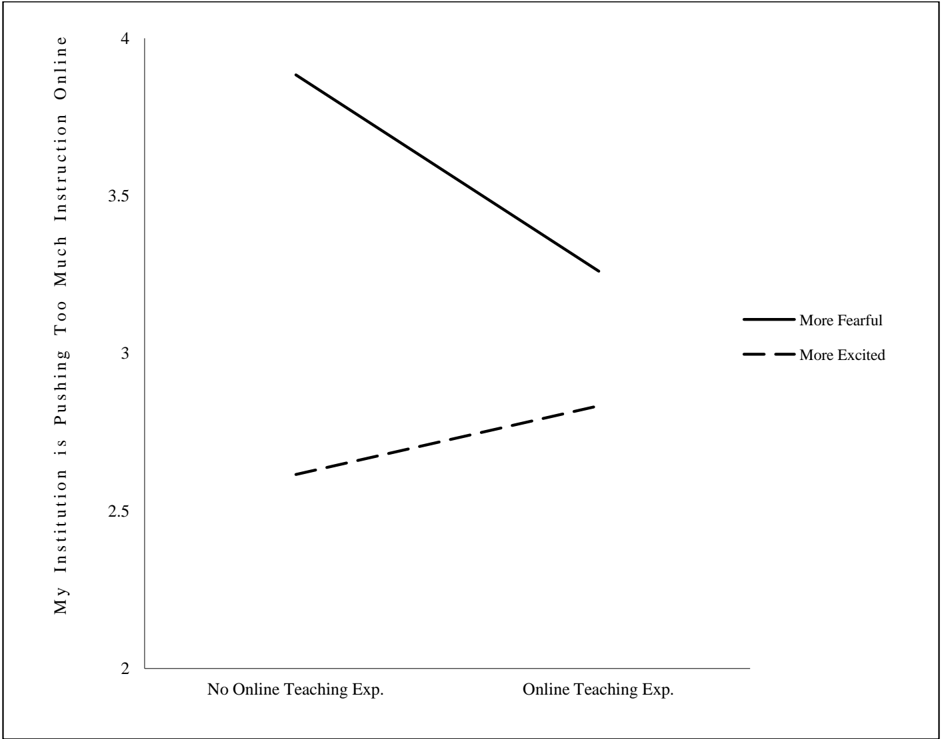
The purpose of the present study is to further understand faculty attitudes about distance education by exploring the psychological processes through which these attitudes are influenced. We explored the following research question: Do feelings of excitement versus fear mediate and/or moderate the relationship between online teaching experience and various faculty attitudes about online education? Survey data from 152 part- and full-time faculty from a midsize public university in the Mid-Atlantic region of the United States was utilized. Multiple regression analyses revealed that excitement versus fear mediates the relationship between online teaching experience and all of our outcome variables, and that excitement versus fear moderates the relationship between online teaching experience and the extent to which faculty feel that their institution is pushing too much instruction online. Our results demonstrate the importance of excitement versus fear in explaining why some faculty have negative rather than positive attitudes about distance education. Our results suggest that university administrators may find it helpful to implement policies and practices that instill a sense of excitement about distance education in all faculty.
Overview
The claims and statistics of this paper haven’t been checked yet.
Run the check — free, no account needed. It reads the open-access text and checks the sources it cites.
Integrity signals
Registry
Cites
Statistics
Figures
Verification
Claims the paper makes
The claims and statistics of this paper haven’t been checked yet.
Run the check — free, no account needed. It reads the open-access text and checks the sources it cites.
Claims other papers make about this one
Each is checked against this paper’s own text: does it say what the citing paper says it does?
The source backs part of the claim, not all of it — or backs it for a different population, condition or comparison.
In the citing paper
“And yet, instructors' trust and distrust can significantly influence their decisions to adopt GenAI, how they use it in their teaching, and their overall attitudes and practices, which in turn shape students' perceptions and trust in GenAI [19, 36, 50, 68, 73, 90].”
From Understanding the Practices, Perceptions, and (Dis)Trust of Generative AI among Instructors: A Mixed-methods Study in the U.S. Higher Education (2025) · cites this paper as [19]
Experimental — accuracy not yet measured
Self-check
Percentages, sums and reported differences re-computed from the paper’s own numbers.
The self-check needs the paper’s full text.
Citations
Cites
Baron, R. M., & Kenny, D. A. (1986) · Journal of Personality and Social Psychology · doi:10.1037/0022-3514.51.6.1173 · Cited by 91,532 · cited 2×
“To test whether or not feelings of excitement versus fear mediated the relationship between online teaching experience and our three outcome variables, multiple regression analyses were conducted using the three-step method suggested by Baron and Kenny (1986), which is outlined below.”
MethodGrowing by Degrees: Online Education in the United States, 2005.
Allen, I. E., & Seaman, J. (2005) · Cited by 414
Literature Review--Faculty Participation in Online Distance Education: Barriers and Motivators.
Maguire, L. L. (2005) · Cited by 233
Rockwell, S. K., Schauer, J., Fritz, S. M., & Marx, D. B. (1999) · Lincoln (University of Nebraska) · Cited by 196
Shea, P. (2007) · Online Learning · doi:10.24059/olj.v11i2.1728 · Cited by 156
Conflicted: Faculty and Online Education, 2012.
Allen, I. E., & Seaman, J. (2012) · Cited by 141
Schifter, C. C. (2000) · Online Learning · doi:10.24059/olj.v4i1.1907 · Cited by 131
Perceptions of Higher Education Faculty Members on the Value of Distance Education
Ulmer, L. W., Watson, L. W., & Derby, D. C. (2007) · Quarterly review of distance education · doi:10.1108/qrde-02-2007-0007 · Cited by 89 · cited 1×
“Ulmer et al. (2007) showed interesting findings regarding faculty perceptions of online education.”
BackgroundFactors Affecting Faculty Members’ Decision to Teach or Not to Teach Online in Higher Education
Zhen, Y., Garthwait, A., & Pratt, P. A. (2008) · Cited by 55
Research works printed but not linked: 1
- Bollinger, D., Inan, F., & Wasilik, O. (2014). Development and validation of the online instructor satisfaction measure. Educational Technology & Society, 17(2), 183-195.
Cited by
Hong, W. C. H. (2023) · Journal of Educational Technology and Innovation · doi:10.61414/jeti.v5i1.103 · Cited by 328
“As an example, prior to COVID, most educators never imagined having the need to convene classes online, even less likely to prefer it (Bunk et al., 2015).”
BackgroundExamining the Effect of Proctoring on Online Test Scores.
Alessio, H., Malay, N. J., Maurer, K., Bailer, A., & Rubin, B. (2017) · Online Learning · doi:10.24059/olj.v21i1.885 · Cited by 146
Lyu, W., Zhang, S., Chung, T., Sun, Y., & Zhang, Y. (2025) · Computers and Education: Artificial Intelligence · doi:10.1016/j.caeai.2025.100383 · Cited by 68
“And yet, instructors’ trust and distrust can significantly influence their decisions to adopt GenAI, how they use it in their teaching, and their overall attitudes and practices, which in turn shape students’ perceptions and trust in GenAI [19, 36, 50, 68, 73, 90].”
Kono, K. G., & Taylor, S. (2021) · Online Learning · doi:10.24059/olj.v25i1.2484 · Cited by 31
“Recognizing this fact, some faculty have resisted the move to online learning due to concerns that student equity or engagement will suffer (Wingo et al., 2017), or that they cannot afford the time required to design and teach an online course that sustains equity and engagement (Bunk et al., 2015).”
BackgroundRacovita-Szilagyi, L., Muñoz, D. C., & Diaconu, M. (2018) · European Journal of Social Work · doi:10.1080/13691457.2018.1461066 · Cited by 27
“…online courses, having less pedagogical knowledge required to effectively provide students with a well-rounded educational experience, and perceived institutional pressure to increase online educational offerings (Bunk, Li, Smidt, Bidetti, & Malize, 2015; Seirup et al., 2016; Smidt et al., 2014).”
BackgroundThe future of language education: Teachers’ perceptions about the surge of AI writing tools
Zimotti, G., Frances, C., & Whitaker, L. (2024) · Technology in Language Teaching & Learning · doi:10.29140/tltl.v6n1.1136 · Cited by 33
Distance Educators Attitudes and Actions towards Inclusive Teaching Practices
Cash, C., Cox, T., & Hahs‐Vaughn, D. L. (2021) · Journal of the Scholarship of Teaching and Learning · doi:10.14434/josotl.v21i2.27949 · Cited by 15
Ardiyanto, A., Mulyadin, T., Santi, A. M., & Dharma, I. G. B. B. (2021) · Higher Learning Research Communications · doi:10.18870/hlrc.v11i1.1232 · Cited by 9
“Some of them also have inaccurate assumptions regarding limited in-person experience and skepticism regarding the achievement of learning outcomes acquired through distance education (Bunk et al., 2015; Palmer et al., 2014).”
BackgroundBaldwin, S. J. (2017) · ScholarWorks (Boise State University) · doi:10.18122/b28t4w · Cited by 12
Kalaycıoğlu, D. B., Toprak, A. Ö., Eyerci, C., Uğur, Z. B., Güç, A., YILDIZ, S., Toprak, M., Demir, Z., Demir, Ö., Yildiz, Ö. F., et al. (2022) · Journal of Educational Technology and Online Learning · doi:10.31681/jetol.975896 · Cited by 6
Barriers to online library instruction in academic libraries: A qualitative study
Peacock, R. (2025) · The Journal of Academic Librarianship · doi:10.1016/j.acalib.2025.103021 · Cited by 4
Isom, E., Dowda, R., & Olt, P. A. (2021) · International Journal for the Advancement of Counselling · doi:10.1007/s10447-021-09450-0 · Cited by 5
Lived Experiences of Physical Education Instructors in Facilitating Distance Learning Education
Daw-as, D. M., & Magat, S. M. C. (2022) · International Journal of Physical Education Fitness and Sports · doi:10.34256/ijpefs2242 · Cited by 4
“Teachers’ outlook resonates positively or negatively with a particular belief, idea, and practice [36].”
BackgroundUzaktan Eğitim Sisteminin Başarısını Etkileyen Faktörlerin Belirlenmesi
Eren, A. (2024) · Buca eğitim fakültesi dergisi (Online)/Buca Eğitim Fakültesi dergisi · doi:10.53444/deubefd.1358870 · Cited by 3
Utilization of Information Technology as Instructional Support in Higher Education – A Case Study
Gordon, L. C., Gratz, E., Kung, D., Moore, L. C., & Urbizagastegui, S. (2018) · Communications of the IIMA · doi:10.58729/1941-6687.1397 · Cited by 3
“…develop new ideas, use new technology, and generally improve their teaching expertise (Betts, 1998; Bunk, et al., 2015; Schifer, 2000; and Shea, 2007), but most faculty were influenced by the desire to better serve students (Betts, 1998; Bunk et al., 2015; Hiltz, Shea & Kim, 2007; Maguire, 2005).”
BackgroundStefaniak, J. E., & Gilstrap, S. (2024) · doi:10.59668/723.13041 · Cited by 2
Alnajjar, H., Asif, U., Bano, N., Alshammari, F., & Ma, K. (2020) · doi:10.47275/0032-745x-s2-024 · Cited by 2
Dickerson, L. A. (2021) · Cited by 2
Online Exam System and Real Time Proctoring
Ghatol, P. A., Kanitkar, R., Barbade, C., Pophale, P., Khandekar, A., & Dewase, S. (2022) · International Journal of Advanced Research in Science Communication and Technology · doi:10.48175/ijarsct-3587 · Cited by 1
Lewing, J. M., & Bunkowski, L. (2023) · Springer eBooks · doi:10.1007/978-3-031-36632-1_4 · Cited by 1
The Evolution of Nursing Faculty During Unprecedented Times
Canillas-Dufau, T. (2020) · Iris Journal of Nursing & Care · doi:10.33552/ijnc.2020.03.000557 · Cited by 1
Yaman, F., & Yaman, N. D. (2023) · Kastamonu Eğitim Dergisi · doi:10.24106/kefdergi.1271523
“Research on attitudes towards distance education show that individuals have positive (Ağır, 2007; Bunk, Li, Smidt, Bidetti & Malize, 2015; Dündar et al., 2017; Kaban, 2021) or negative attitudes (Nasser & Abouchedid, 2000).”
Online Education Innovation Strategies to Gain Support and Accomplish Team Goals
Evanick, J. (2023) · Lecture notes in networks and systems · doi:10.1007/978-3-031-41637-8_15
Metadata
- Authors
- Bunk, J., Li, R., Smidt, E., Bidetti, C., & Malize, B.
- Affiliations
- West Chester University (US)
- ORCID
- Li, Rui
- Venue
- Online Learning
- Publisher
- The Online Learning Consortium
- Published
- 2015-07-30
- Volume
- 19
- Issue
- 4
- ISSN
- 1092-8235 (ISSN-L)
- 2472-5730
- 2472-5749
- OpenAlex
- W2139518031
- Cited by
- 28
- References
- 19
- Citations by year
- 2025: 3 · 2024: 3 · 2023: 4 · 2022: 3 · 2021: 7 · 2020: 3 · 2018: 2 · 2017: 2 · 2015: 1
- FWCI
- 8.34
- Type
- journal article
- Language
- en
- Open access
- diamond
- doi.org
- Licence
- cc-by
- Locations
- Online Learning (publishedVersion, cc-by)
- DOAJ (DOAJ: Directory of Open Access Journals) (submittedVersion)
- Topics
- Social Sciences › Education › Online and Blended Learning
- Social Sciences › Education › Digital Transformation of Higher Education
- Social Sciences › Education › Evaluation of Teaching Practices
- Keywords
- faculty attitudes, distance education, online teaching experience, excitement, fear, mediation, moderation, online instruction, university administrators, university faculty
About these checks
Registry, retraction, Cites and statistics results are computed, not judged, with one exception: a printed reference that no index lists is read once by a model before it counts as a citation error. Claims are extracted by a model and kept only when their quote appears verbatim in the text; each cited source is then checked, with a model’s help, for whether it says what the claim relies on. Those verdicts can be wrong — read the claim’s quote and the cited source before relying on one.
Statistics and arithmetic are recomputed, not judged.
Confidence bands are shown only for fields calibrated on our annotated test set. None is calibrated yet, so no band is shown.
What counts as a claim ›How we measure confidence ›How we check this ›
Are you an author, or do you see a problem with this page? Request a review
