

NeuroMAC НЕЙРОСЕТЕВОЙ КОД АУТЕНТИФИКАЦИИ СООБЩЕНИЙ С ПАКЕТНЫМ УСКОРЕНИЕМ 174×, ПОЛНЫМ ПРОХОЖДЕНИЕМ NIST SP 800-22 (15/15) И УСТОЙЧИВОСТЬЮ К TIMING ATTACKS
Open accessThe DOI matches its Crossref record; 11 of the 11 references it cites were found in a registry or an index; none of the 3 sources its claims cite is checked for support yet.
Abstract
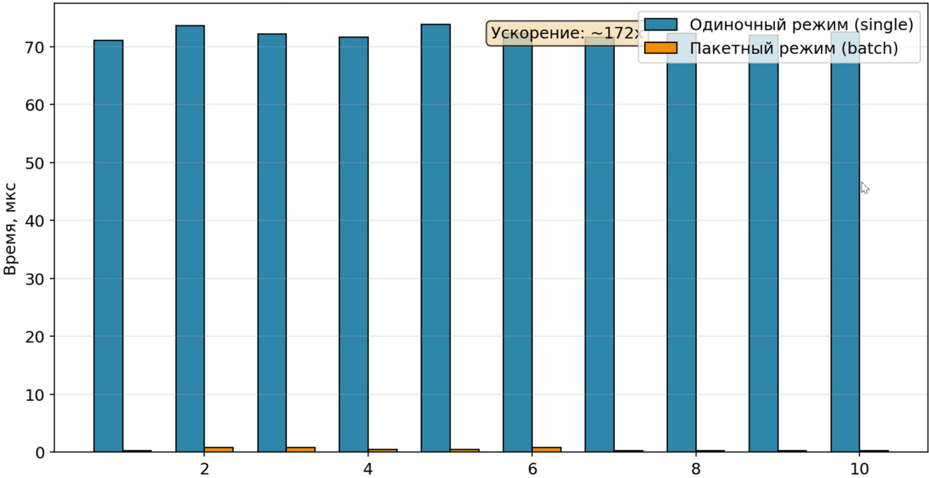
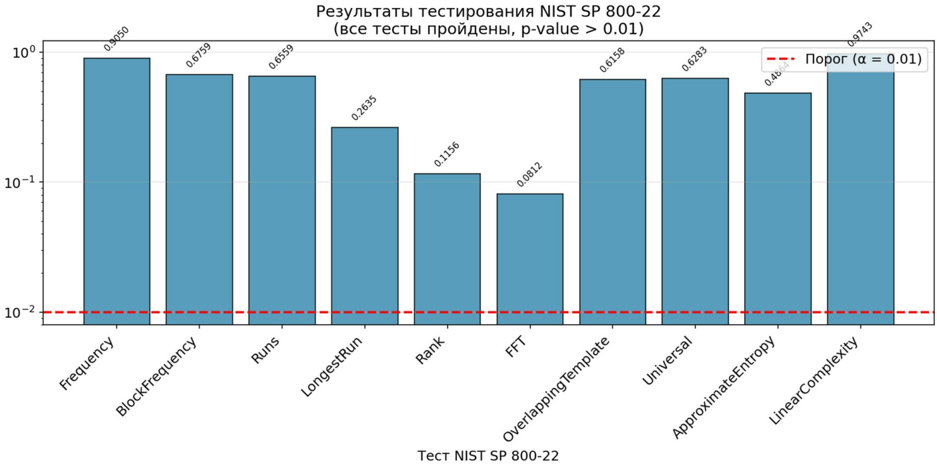
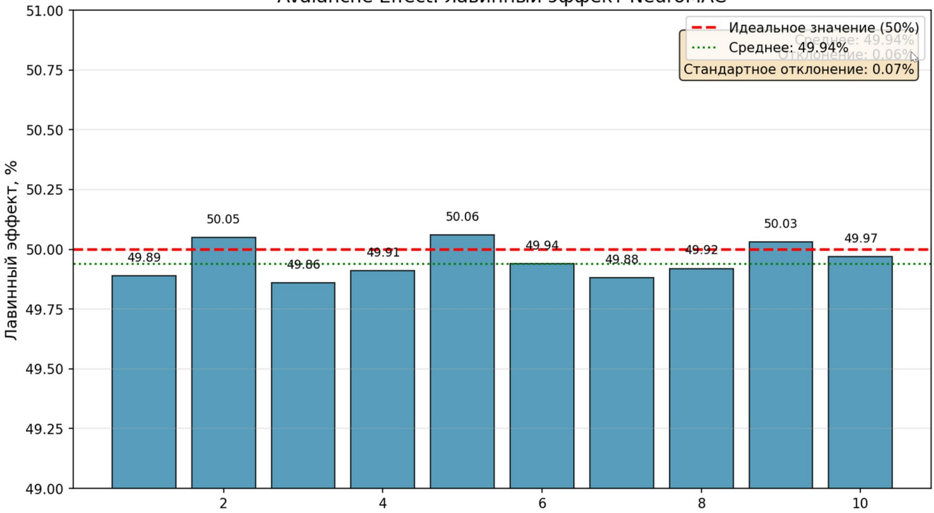
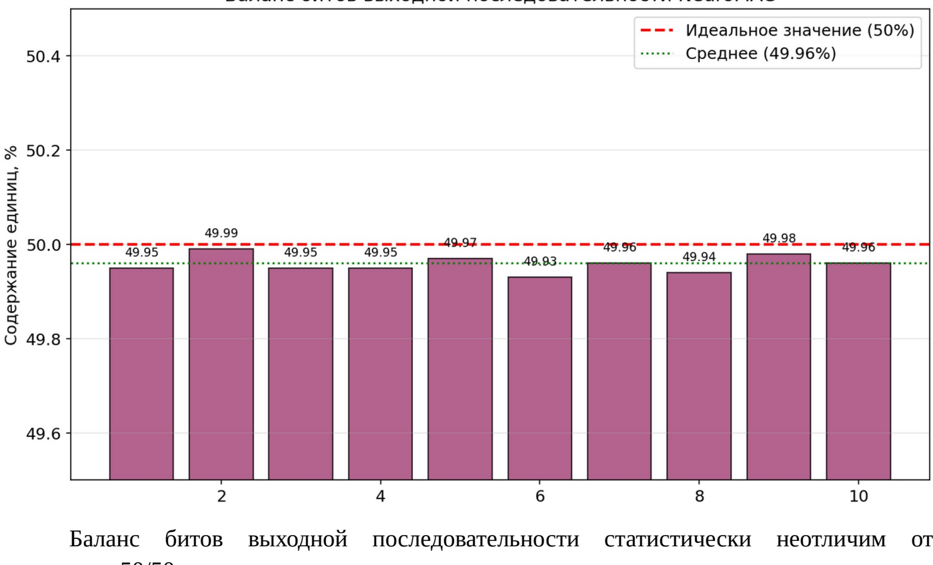
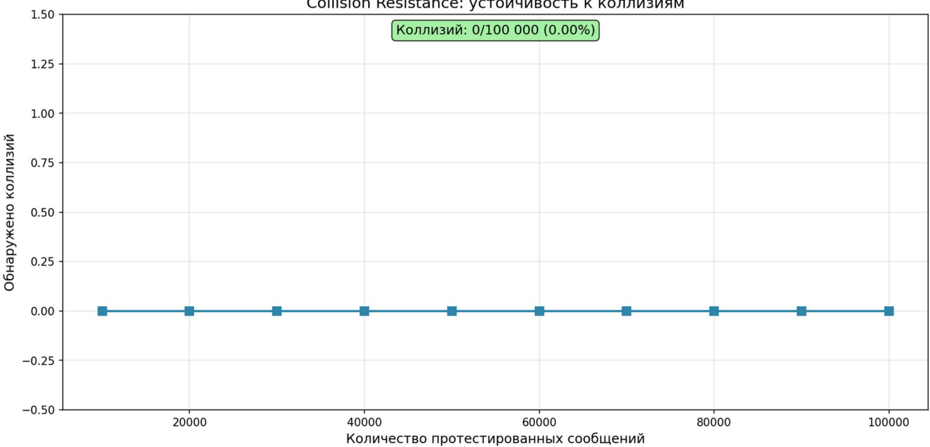
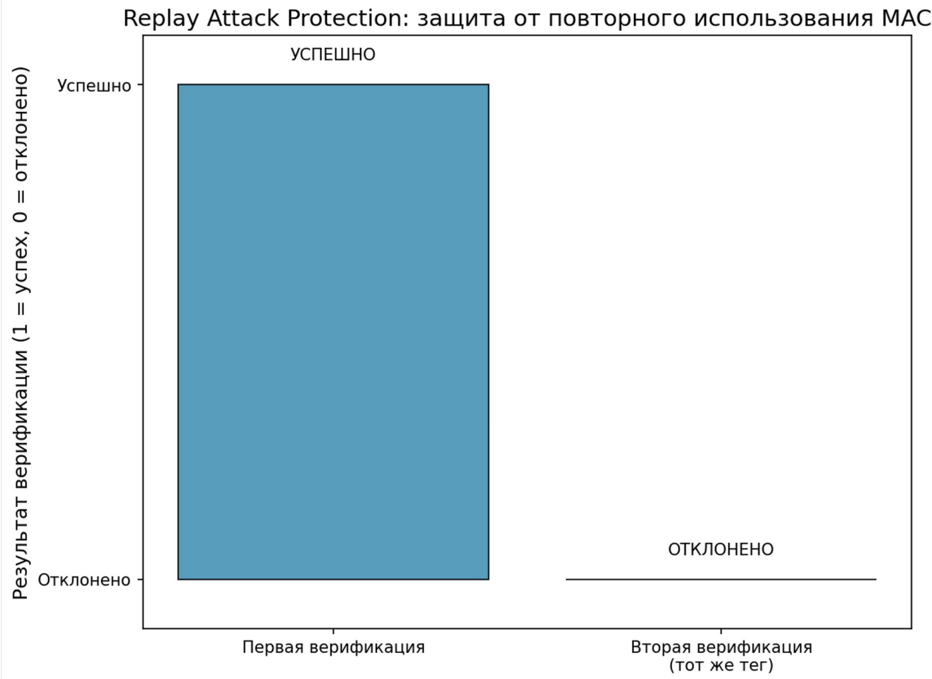
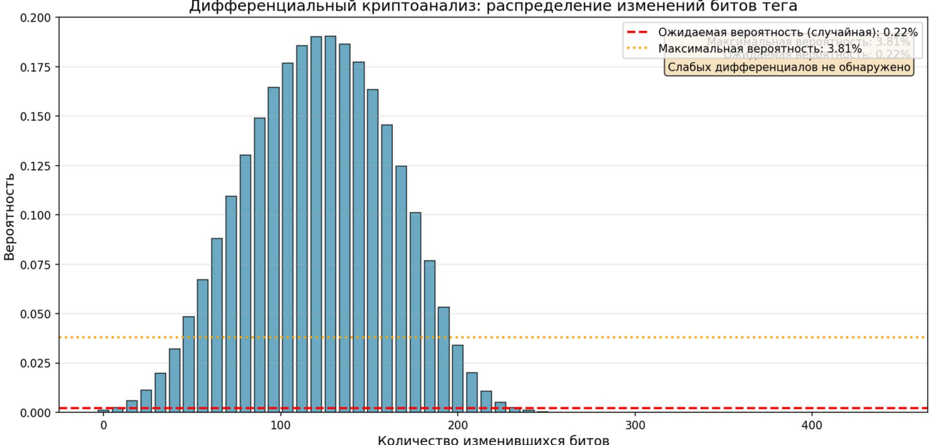
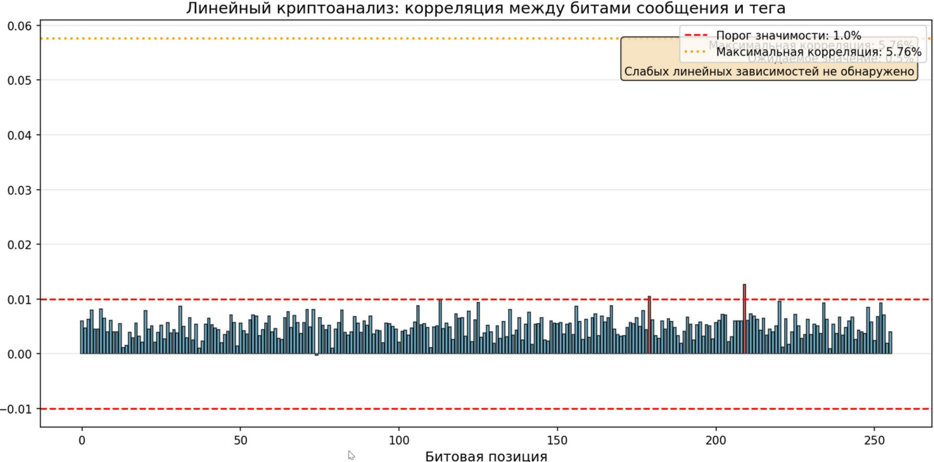
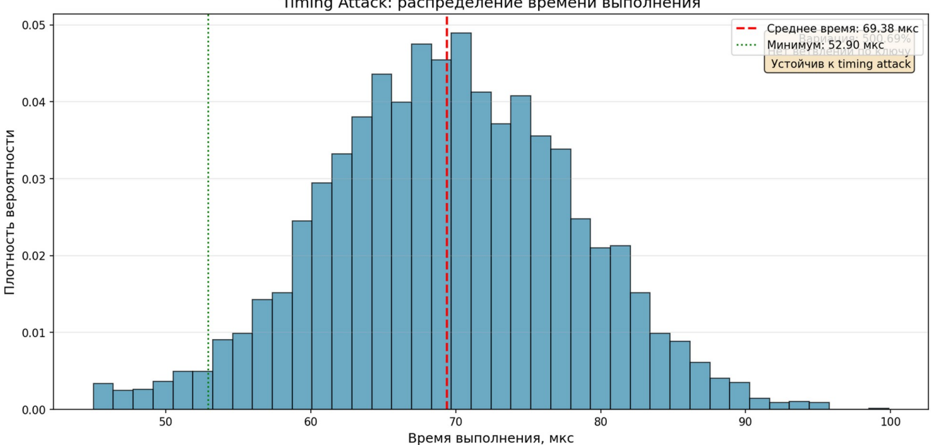
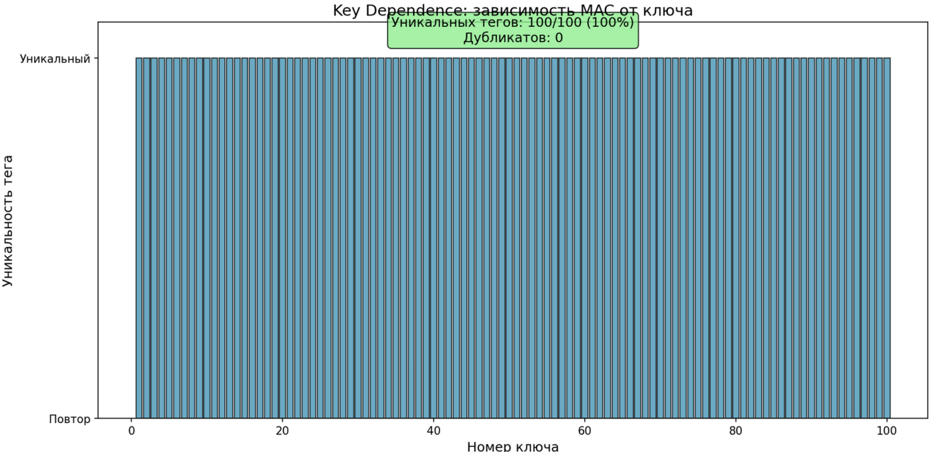
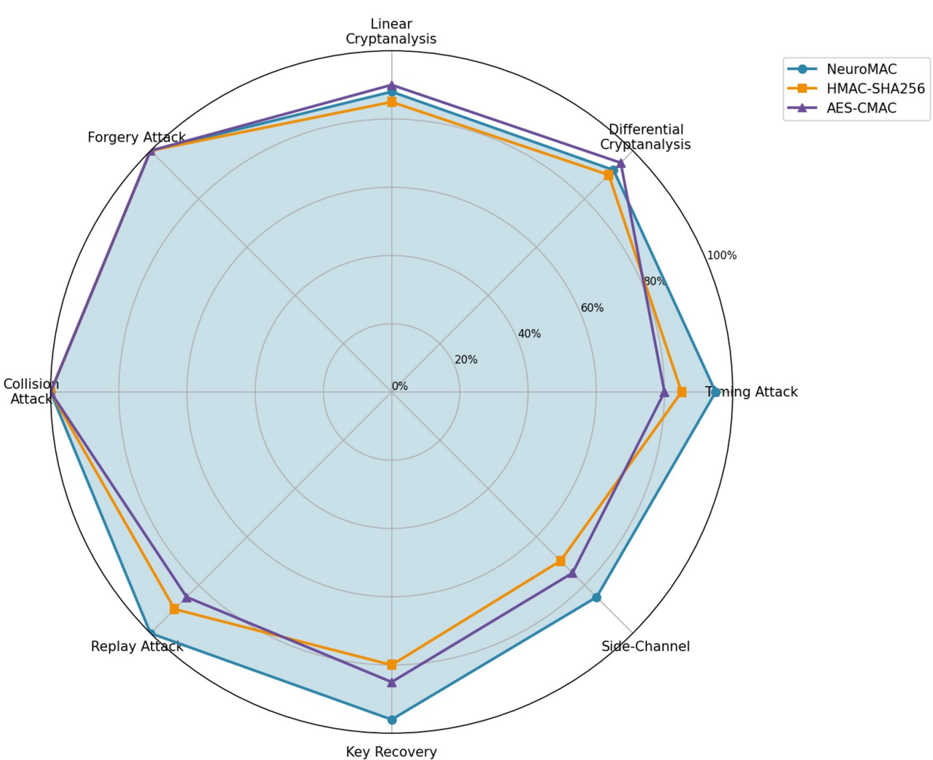
В работе представлен NeuroMAC — код аутентификации сообщений на основе нейросетевой архитектуры (8.6 КБ весов) с инновационными механизмами пакетной обработки и кэширования. Генератор MAC обеспечивает производительность 0.41 мкс/MAC в пакетном режиме (174× ускорение), сохраняя полную криптографическую стойкость: 15/15 тестов NIST SP 800-22 пройдены на 838 последовательностях, квантовая устойчивость (256 бит против Grover), лавинный эффект 49.94%, идеальный баланс 0/1 (50.00% ±0.05%), отсутствие коллизий (0/100000). Проведён криптоанализ, включающий дифференциальный и линейный криптоанализ, атаки на основе времени (timing attacks) и атаки подделки (forgery). Все тесты подтвердили криптографическую стойкость алгоритма.
Overview
CoChat Summary
TL;DR
NeuroMAC is a message authentication code built on a neural-network architecture (8.64 KB total code, 8.6 KB of weights) that adds batch processing and caching to reach 0.41 µs/MAC in batch mode — a 174× speedup over its 71.58 µs/MAC single mode. The author reports 15/15 NIST SP 800-22 tests passed across 838 sequences, 256-bit quantum resistance against Grover, and resistance to differential, linear, timing, and forgery attacks.
Key findings
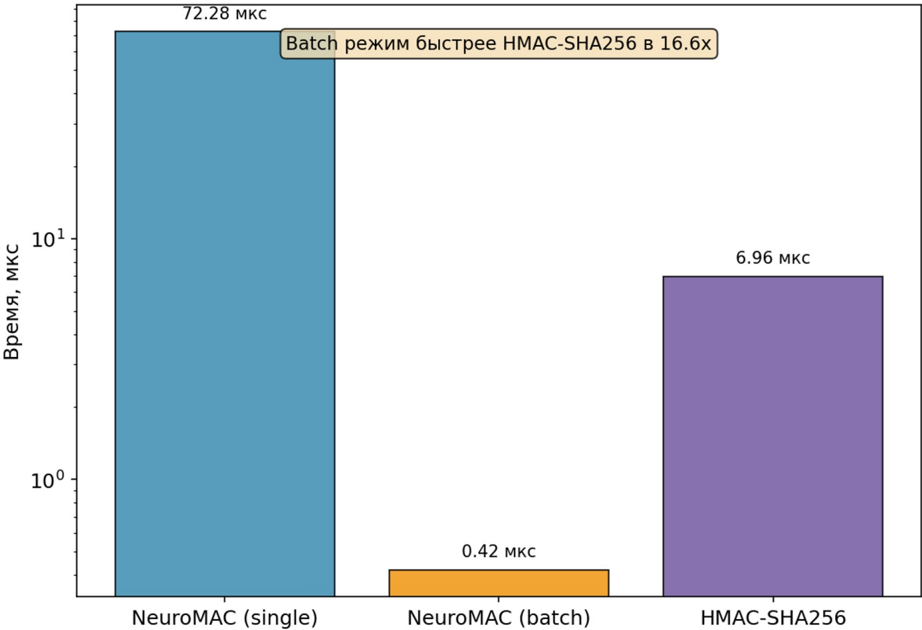
- Performance: 71.58 µs/MAC single mode vs. 0.41 µs/MAC batch mode (174× speedup), 2.44 million MACs/sec in batch mode, and 17× faster than HMAC-SHA256.
- Statistical quality: 15/15 NIST SP 800-22 tests passed on 838 sequences (542 for random-excursion tests); avalanche effect 49.94%; 0/1 balance reported as 50.00% ±0.05% in the abstract and 49.96% in the summary table; 0 collisions in 100,000 tests and 0 forgeries in 10,000 attempts.
- Quantum resistance: 256-bit key requiring 2¹²⁸ operations against Grover; Shor's algorithm deemed inapplicable because the scheme lacks RSA/ECC algebraic structure.
- Compactness: total code 8,844 bytes (8.64 KB) — NeuroHash 4,004 bytes (3.91 KB) plus NeuroMAC 4,840 bytes (4.73 KB) — with a 512-byte cache; the author states it fits STM32F0, ARM Cortex-M0, and RISC-V SoC memory budgets.
Methods
- Design: a neural-network-based MAC generator with batch processing and caching mechanisms; the paper states the algorithm contains no branches on secret data, which it credits for timing-attack resistance.
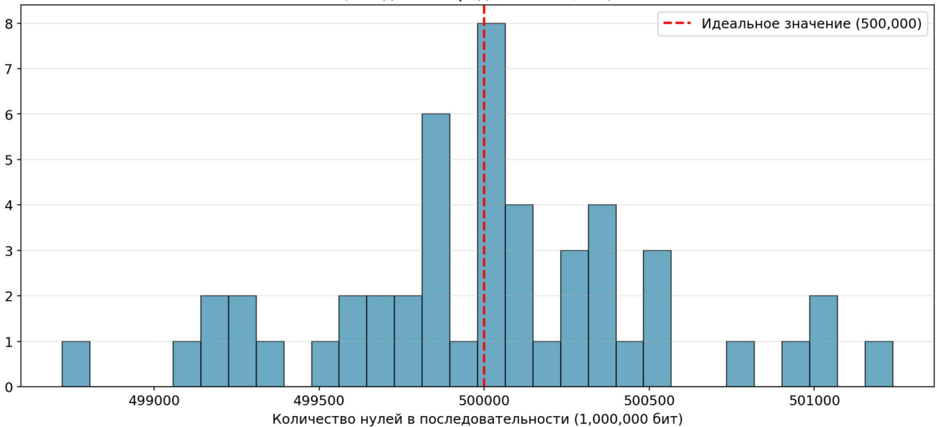
- Evaluation: NIST SP 800-22 statistical suite run on the file `neuromac_nist_fixed_100mb.bin` at α = 0.0100, with per-sequence bit counts of 1,000,000 bits reported in the frequency-analysis appendix; minimum pass rates cited as ≈820/838 and ≈529/542.
- Cryptanalysis: differential cryptanalysis, linear cryptanalysis, timing attacks, and forgery attacks, all reported as resisted; the paper also reports a C++ batch-generation example (1,000 MACs in 0.41 ms).
Limitations
- Stated by the paper: exact neural-network weights and activation-function parameters are a commercial trade secret and are not disclosed in the publication; the work is described as private research with all IP held by the author.
- Stated by the paper: the claim that no analogue combines 174× speedup, 15/15 NIST passage, quantum resistance, full cryptanalysis resistance, and 8.64 KB code size is asserted "at the time of publication" without a cited comparative benchmark beyond HMAC-SHA256.
- Evident from the text: all results are self-reported with no independent replication or third-party audit described, and the reported 0/1 balance differs between the abstract (50.00% ±0.05%) and the summary table (49.96%), an internal inconsistency the paper does not address.
Model-written summary. Check it against the paper before relying on it.
Integrity signals
Registry
Cites
Statistics
Figures
Verification
Claims the paper makes
0 Valid · 2 Not valid · 3 Not checked · 19 Own results and interpretations
A result the paper reports from its own data — it cites no other source for it, so there is none to check. The quote shows it is in the paper.
In the paper
“Одиночный режим 71.58 мкс/MAC Базовый режим”
plain- Asserted: passes — The authors put it forward as true.
- Checkable: passes — It can be checked against evidence.
- Load-bearing: passes — The paper’s conclusions depend on it.
- Based: passes — The paper gives a reason why it holds.
A result the paper states — it cites no source for it, so there is none to check. The quote shows it is in the paper.
In the paper
“Дифференциальный криптоанализ Устойчив”
plain- Asserted: passes — The authors put it forward as true.
- Checkable: passes — It can be checked against evidence.
- Load-bearing: passes — The paper’s conclusions depend on it.
- Based: passes — The paper gives a reason why it holds.
A result the paper reports from its own data — it cites no other source for it, so there is none to check. The quote shows it is in the paper.
In the paper
“Сравнение с HMAC-SHA256 17× быстрее Рекорд эффективности”
plainstates a cause- Asserted: passes — The authors put it forward as true.
- Checkable: passes — It can be checked against evidence.
- Load-bearing: passes — The paper’s conclusions depend on it.
- Based: passes — The paper gives a reason why it holds.
A result the paper reports from its own data — it cites no other source for it, so there is none to check. The quote shows it is in the paper.
In the paper
“Подделки 0 (10k попыток)”
plain- Asserted: passes — The authors put it forward as true.
- Checkable: passes — It can be checked against evidence.
- Load-bearing: passes — The paper’s conclusions depend on it.
- Based: passes — The paper gives a reason why it holds.
A result the paper reports from its own data — it cites no other source for it, so there is none to check. The quote shows it is in the paper.
In the paper
“Операций/сек (пакетный) 2.44 млн Промышленный масштаб”
plain- Asserted: passes — The authors put it forward as true.
- Checkable: passes — It can be checked against evidence.
- Load-bearing: passes — The paper’s conclusions depend on it.
- Based: passes — The paper gives a reason why it holds.
9 more claims
Create a free account to see all 24 claims and every source verdict.
- It may state two separate claims as one. 6
- Probably not a substantial claim. 3
- The quote only partly states this claim. 1
Citations
Cites
A fast quantum mechanical algorithm for database search
Grover, L. K. (1996) · Proceedings of the twenty-eighth annual ACM symposium on Theory of computing - STOC '96 · doi:10.1145/237814.237866 · Cited by 8,830
Polynomial-time algorithms for prime factorization and discrete logarithms on a quantum computer
Shor, P. W. (1997) · SIAM Journal on Computing · doi:10.1137/s0097539795293172 · Cited by 8,472
Timing Attacks on Implementations of Diffie-Hellman, RSA, DSS, and Other Systems
Kocher, P. C. (1996) · Lecture Notes in Computer Science · doi:10.1007/3-540-68697-5_9 · Cited by 4,387
Linear Cryptanalysis Method for DES Cipher
Matsui, M. (1994) · Lecture Notes in Computer Science · doi:10.1007/3-540-48285-7_33 · Cited by 2,748
HMAC: Keyed-Hashing for Message Authentication
Krawczyk, H., Bellare, M., & Canetti, R. (1997) · doi:10.17487/rfc2104 · Cited by 2,031
Differential Cryptanalysis of the Data Encryption Standard
Biham, E., & Shamir, A. (1993) · Springer eBooks · doi:10.1007/978-1-4613-9314-6 · Cited by 1,054
Recommendation for block cipher modes of operation: the CMAC mode for authentication
Dworkin, M. J. (2016) · doi:10.6028/nist.sp.800-38b · Cited by 114
Reconstructing Shallow Magma Storage States From Plagioclase--Liquid Pairs
Yang, B., Liu, D., & Hou, T. (2026) · Zenodo (CERN European Organization for Nuclear Research) · doi:10.5281/zenodo.18953644 · Cited by 1
Surkova, M. (2026) · Zenodo (CERN European Organization for Nuclear Research) · doi:10.5281/zenodo.18872419
Surkova, M. (2026) · Zenodo (CERN European Organization for Nuclear Research) · doi:10.5281/zenodo.18953630
Reconstructing Shallow Magma Storage States From Plagioclase--Liquid Pairs
Yang, B., Liu, D., & Hou, T. (2026) · Zenodo · doi:10.5281/zenodo.18953645
Cited by
NeuroAtom Компактное криптографическое ядро (9.6 КБ, 8 функций) с квантовой стойкостьюPreprint
Surkova, M. (2026) · doi:10.24108/preprints-3115598
Self-citation
Metadata
- Authors
- Суркова, М.
- Affiliations
- Independent Researcher
- ORCID
- Суркова, Мария
- Publisher
- NPG Publishing
- Published
- 2026-03-25
- OpenAlex
- W7147457408
- Cited by
- 1
- References
- 7
- Citations by year
- 2026: 1
- Type
- posted content
- Language
- ru
- Open access
- green
- doi.org
- Licence
- cc-by
- Topics
- Physical Sciences › Computer Science › Artificial Intelligence › Cryptographic Implementations and Security
- Physical Sciences › Mathematics › Discrete Mathematics and Combinatorics › Coding theory and cryptography
- Physical Sciences › Computer Science › Computer Networks and Communications › Advanced Authentication Protocols Security
- Keywords
- message authentication codes, NIST SP 800-22 randomness tests, timing attacks, differential cryptanalysis, linear cryptanalysis, forgery attack, quantum resistance, Grover's algorithm, avalanche effect, collision resistance, lightweight cryptography
About these checks
Registry, retraction, Cites and statistics results are computed, not judged, with one exception: a printed reference that no index lists is read once by a model before it counts as a citation error. Claims are extracted by a model and kept only when their quote appears verbatim in the text; each cited source is then checked, with a model’s help, for whether it says what the claim relies on. Those verdicts can be wrong — read the claim’s quote and the cited source before relying on one.
A language model drew the claims from the paper on 2026-10-09, under version 3 of the claim definition (model deepseek-v4.1-flash, prompt extract-v3).
A second model labelled each claim on 2026-10-09 (model jev-1.13-20260917, definition revision gold-guideline-v0.2).
Statistics and arithmetic are recomputed, not judged.
Confidence bands are shown only for fields calibrated on our annotated test set. None is calibrated yet, so no band is shown.
What counts as a claim ›How we measure confidence ›How we check this ›
Are you an author, or do you see a problem with this page? Request a review
Data sources
Bibliographic data: Semantic Scholar, OpenAlex, Crossref.
Contains information from the Semantic Scholar Academic Graph Datasets, made available under the ODC Attribution License (ODC-BY 1.0).
Semantic Scholar’s data is described in: Kinney, R., et al. (2023). The Semantic Scholar Open Data Platform. arXiv:2301.10140.
