

The DOI matches its Crossref record; 1 of the 1 references it cites were found in a registry or an index.
The Influence of Transformative Learning, Affective Commitment, Digital Transformation, Capability Dynamic, Ambidexterity, and Education Policy Toward Educational Leadership: A Case from Indonesia
Abstract
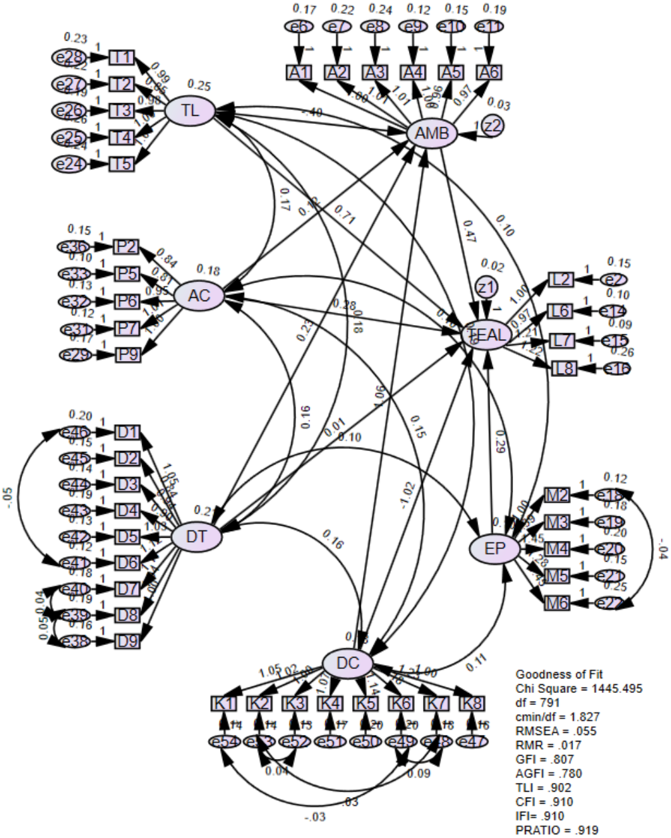
Purpose: The implications of external environment changes and the presence of a new generation of students in the school to the school leadership are often overlooked. Very few studies elaborate on the need to shape educational leadership concepts and practices to deal with the changes. The study intention is to identify the influences of transformative learning, affective commitment, digital transformation, capability dynamic, and the ambidexterity to educational leadership, and to craft the educational leadership based on Indonesia context. Design/Methodology/Approach: The study is using Covariance Based Structural Equation Modelling (CB-SEM), the data is collected through a Likert based questionnaire from 271 respondents and it is processed by SPSS and AMOS. Findings: Transformative Ethics Agile (TEA) Leadership as educational leadership is influenced by Ambidexterity, transformative learning, affective commitment, and educational policy. Digital transformation and capability dynamic have insignificant influences, however ambidexterity mediating the influence of dynamic capability to TEA Leadership. Research Implications: The research contributes to renewing educational leadership concepts by putting emphasis on transformative, ethics, and agile elements. The variables that must be put into attention for leading school during changing time, specifically ambidexterity, transformative learning, affective commitment, and educational policy. The research highlights the importance of context on educational leadership. Originality/Values: The research contributes to the identification of variables that influence the effectiveness of school leadership and by doing that able to facilitate the strategy of leadership development for school management. The values of the research are on the mapping of factors contribute to educational leadership and lead the practical aspects of managing school in the changing time.
Overview
The claims and statistics of this paper haven’t been checked yet.
Run the check — free, no account needed. It reads the open-access text and checks the sources it cites.
Integrity signals
Registry
Cites
Statistics
Figures
Verification
Claims the paper makes
The claims and statistics of this paper haven’t been checked yet.
Run the check — free, no account needed. It reads the open-access text and checks the sources it cites.
Claims other papers make about this one
Each is checked against this paper’s own text: does it say what the citing paper says it does?
The source backs part of the claim, not all of it — or backs it for a different population, condition or comparison.
In the citing paper
“Aprendizaje organizacional adaptativo Permite a las universidades responder a la incertidumbre mediante la memoria colectiva y la innovación contextual.”
From Del liderazgo a la organización que aprende: una revisión sistemática desde la transcomplejidad en educación superior (2026) · cites this paper as Primahendra et al. (2024)
Experimental — accuracy not yet measuredIn the citing paper
“Transcomplejidad educativa Integra los planos individual, organizativo y societal en una visión de aprendizaje continuo.”
From Del liderazgo a la organización que aprende: una revisión sistemática desde la transcomplejidad en educación superior (2026) · cites this paper as Primahendra et al. (2024)
Self-check
Percentages, sums and reported differences re-computed from the paper’s own numbers.
The self-check needs the paper’s full text.
Citations
Cites
Digital technology use during COVID ‐19 pandemic: A rapid review
Vargo, D., Zhu, L., Benwell, B., & Yan, Z. (2021) · Human Behavior and Emerging Technologies · doi:10.1002/hbe2.242 · Cited by 459
Research works printed but not linked: 53
- Adiza, G. R., & Diete-spiff, M. (2020). Leadership Ambidexterity and Employee Normative Commitment of Hotels in Bayelsa State, Nigeria . 6(2), 1–14.
- 10.20525/ijrbs.v10i6.1377 · DOI
- Agung Gede Oka Wisnumurti, A., Ketut Darma, I., & Nyoman Reni Suasih, N. (2018). Government Policy of Indonesia to Managing Demographic Bonus and Creating Indonesia Gold in 2045. IOSR Journal Of Humanities And Social Science (IOSR-JHSS, 23(1), 23–34. https://doi.org/10.9790/0837-2301072334 · DOI
- 10.12973/eu-jer.7.2.169 · DOI · Paper page
- 10.1186/s13731-018-0081-8 · DOI
- 10.1111/j.2044-8325.1990.tb00506.x · DOI
- 10.1016/j.dib.2021.107659 · DOI
- 10.1177/0149206309350776 · DOI · Paper page
- 10.1108/EBR-05-2018-0102 · DOI
- 10.1080/08995605.2017.1420974 · DOI
- 10.1080/09585192.2016.1201125 · DOI
- 10.1016/j.techfore.2021.121092 · DOI
- 10.1057/s41303-016-0032-z · DOI
- 10.1002/1097-0266(200010/11)21:10/11<1105::AID-SMJ133>3.0.CO;2-E · DOI
- 10.1007/978-3-658-20157-9 · DOI
- 10.1007/s11159-020-09859-6 · DOI
- 10.2307/2313521 · DOI
- 10.1109/ACCESS.2020.2975542 · DOI
- 10.1108/MD-05-2016-0338 · DOI
- 10.1097/HMR.0000000000000174 · DOI
- 10.1177/1741143219859002 · DOI
- 10.1017/jie.2018.11 · DOI
- 10.1007/s10869-017-9509-6 · DOI
- 10.1504/IJMDA.2017.10008574 · DOI
- 10.1108/ER-09-2017-0228 · DOI
- 10.1111/1748-8583.12164 · DOI
- 10.1177/001316447003000308 · DOI · Paper page
- 10.2991/assehr.k.210202.016 · DOI
- 10.1016/j.jvb.2016.10.004 · DOI
- 10.1080/03050068.2011.555941 · DOI
- 10.1016/S1053-4822(00)00053-X · DOI
- 10.1002/ace.7401 · DOI · Paper page
- 10.1007/978-3-319-66893-2 · DOI
- 10.1007/978-3-030-54750-9_3 · DOI
- 10.3102/0002831208320573 · DOI
- 10.2139/ssrn.2285704 · DOI
- 10.1007/s10460-004-8273-1 · DOI
- Prejean, E. A., Kilcoyne, M. S., Liao, W., & Parker, C. (2019). Is Higher Education Talking and Walking Agile Management : A Review of the Literature. 2(7), 8–18.
- 10.35609/jmmr.2019.4.3(7) · DOI
- 10.5902/1983465941355 · DOI
- 10.1016/j.jbusres.2020.05.046 · DOI
- 10.31800/jtp.kw.v6n1.p60--73 · DOI
- 10.1177/1548051819842796 · DOI
- 10.1108/IJPSM-03-2017-0078 · DOI
- 10.1080/14623943.2020.1821635 · DOI
- 10.1177/1052684619873343 · DOI
- 10.1080/02601370701219475 · DOI
- 10.1142/9789812834478_0002 · DOI
- 10.1080/09585192.2019.1688376 · DOI
- 10.1016/j.procs.2021.11.066 · DOI
- 10.1177/1056492620916549 · DOI
- 10.1111/joop.12235 · DOI
- 10.3390/ijerph16132380 · DOI
Cited by
GARCIA, M. A. (2026) · Espacios · doi:10.48082/espacios-a26v47n01r04 · Cited by 2
Metadata
- Authors
- Primahendra, R., Purba, J. T., Ugut, G. S. S., & Budiono, S.
- Venue
- Revista de Gestão Social e Ambiental
- Published
- 2024-04-17
- Volume
- 18
- Issue
- 8
- Pages
- e05979
- ISSN
- 1981-982X
- Cited by
- 4
- References
- 1
About these checks
Registry, retraction, Cites and statistics results are computed, not judged, with one exception: a printed reference that no index lists is read once by a model before it counts as a citation error. Claims are extracted by a model and kept only when their quote appears verbatim in the text; each cited source is then checked, with a model’s help, for whether it says what the claim relies on. Those verdicts can be wrong — read the claim’s quote and the cited source before relying on one.
Statistics and arithmetic are recomputed, not judged.
Confidence bands are shown only for fields calibrated on our annotated test set. None is calibrated yet, so no band is shown.
What counts as a claim ›How we measure confidence ›How we check this ›
Are you an author, or do you see a problem with this page? Request a review
