

The DOI matches its Crossref record; 16 of the 17 references it cites were found in a registry or an index.
Complementary feeding practices in Mexican healthy infants: How close are they to the current guidelines?
Open accessAbstract
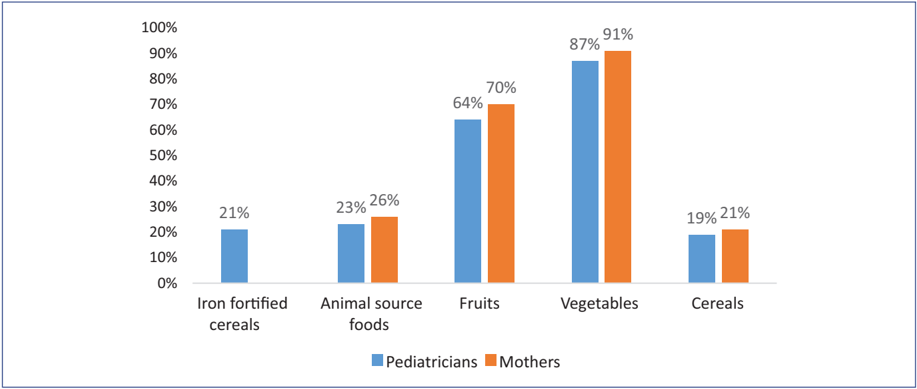
Background: The foundations for the growth and optimal development of every human being are laid in the first 2 years of life. Exclusive breastfeeding (EBF) up to 6 months of age and the introduction of complementary feeding (CF) from this age are considered the preventive interventions with the most significant impact on a child's life. The objective of this study was to determine if pediatricians base their recommendations by following the Guidelines for CF in Healthy Infants (GCFHI) and if mothers have any awareness and knowledge of these recommendations. Methods: Surveys based on the GCFHI were conducted in a group of mothers (n = 377) and pediatricians (n = 104) living in Mexico. Results: Not all pediatricians recommended the EBF, and 76% recommended infant formula before 6 months of age. Regarding mothers, 76.9% practiced the EBF for the first 6 months. Vegetables were the leading starting food of CF suggested by pediatricians and mothers (87% and 91%, respectively), contrasting with food sources of iron (44%), which are the foods of choice according to the GCFHI. The practices performed by the mothers were statistically different from the recommendations of the pediatricians. Conclusions: The results reflect a lack of updating regarding CF. It is imperative to reinforce efforts to maintain the EBF for 6 months and to continue it together with the CF, as well as to promote the beginning of CF based on macro- and micro-nutrients.
Overview
The claims and statistics of this paper haven’t been checked yet.
Run the check — free, no account needed. It reads the open-access text and checks the sources it cites.
Integrity signals
Registry
Cites
Statistics
Figures
Verification
Claims the paper makes
The claims and statistics of this paper haven’t been checked yet.
Run the check — free, no account needed. It reads the open-access text and checks the sources it cites.
Claims other papers make about this one
Each is checked against this paper’s own text: does it say what the citing paper says it does?
The cited source says what the claim attributes to it.
In the citing paper
“Breastfeeding must be complemented after 6 months of age because breast milk is no longer sufficient for the nutritional needs of the infant [21].”
From Knowledge, attitudes and practices of mothers and caregivers on infant and young child feeding in peri-urban zones of Bobo-dioulasso in Burkina Faso (2020) · cites this paper as [21]
The cited source says what the claim attributes to it.
In the citing paper
“Delaying complementary feeding beyond 6 months leads to the risk of growth retardation, malnutrition, anemia, and zinc deficiency [21].”
From Knowledge, attitudes and practices of mothers and caregivers on infant and young child feeding in peri-urban zones of Bobo-dioulasso in Burkina Faso (2020) · cites this paper as [21]
Self-check
Percentages, sums and reported differences re-computed from the paper’s own numbers.
The self-check needs the paper’s full text.
Citations
Cites
Fewtrell, M. S., Bronský, J., Campoy, C., Domellöf, M., Embleton, N. D., Mis, N. F., Hojsak, I., Hulst, J. M., Indrio, F., Lapillonne, A., et al. (2016) · Journal of Pediatric Gastroenterology and Nutrition · doi:10.1097/mpg.0000000000001454 · Cited by 1,113
Complementary Feeding: A Commentary by the ESPGHAN Committee on Nutrition
Agostoni, C. V., Decsi, T., Fewtrell, M. S., Goulet, O., Kolaček, S., Koletzko, B. V., Michaelsen, K. F., Moreno, L. A., Puntis, J. W. L., Rigo, J., et al. (2008) · Journal of Pediatric Gastroenterology and Nutrition · doi:10.1097/01.mpg.0000304464.60788.bd · Cited by 997
Optimal duration of exclusive breastfeeding
Kramer, M. S., & Kakuma, R. (2002) · Cochrane Database of Systematic Reviews · doi:10.1002/14651858.cd003517 · Cited by 713
Variables Associated With Breastfeeding Duration
Thulier, D., & Mercer, J. (2009) · Journal of Obstetric, Gynecologic & Neonatal Nursing · doi:10.1111/j.1552-6909.2009.01021.x · Cited by 607
EAACI Food Allergy and Anaphylaxis Guidelines. Primary prevention of food allergy
Muraro, A. M., Halken, S., Arshad, S. H., Beyer, K., Dubois, A. E. J., Toit, G. D., Eigenmann, P., Grimshaw, K. E. C., Hoest, A., Lack, G., et al. (2014) · Allergy · doi:10.1111/all.12398 · Cited by 475
Welsh, J. A., Cogswell, M. E., Rogers, S., Rockett, H. R. H., Mei, Z., & Grummer‐Strawn, L. M. (2005) · PEDIATRICS · doi:10.1542/peds.2004-1148 · Cited by 295
Pearce, J., Taylor, M. A., & Langley‐Evans, S. C. (2013) · International Journal of Obesity · doi:10.1038/ijo.2013.99 · Cited by 264
Jedrychowski, W. A., Perera, F. P., Jankowski, J., Butscher, M., Mróz, E., Flak, E., Kaim, I., Lisowska‐Miszczyk, I., Skarupa, A., & Sowa, A. (2011) · European Journal of Pediatrics · doi:10.1007/s00431-011-1507-5 · Cited by 171
Support for breastfeeding mothers: a systematic review
Sikorski, J., Renfrew, M. J., Pindoria, S., & Wade, A. M. (2003) · Paediatric and Perinatal Epidemiology · doi:10.1046/j.1365-3016.2003.00512.x · Cited by 166
Shamah‐Levy, T., Cuevas‐Nasú, L., Pineda, E. B. G., Gómez, L. M., Morales‐Ruán, M. D. C., Hernández‐Ávila, M., & Rivera, J. Á. (2018) · Salud Pública de México · doi:10.21149/8815 · Cited by 137
Metodología de Investigación Científica Cualitativa
Peña, A. Q. (2006) · Cited by 57
Reaching consensus on a ‘vegetables first’ approach to complementary feeding
Chambers, L. C., Hetherington, M. M., Cooke, L. J., Coulthard, H., Fewtrell, M. S., Emmett, P. M., Lowdon, J., Blissett, J. M., Lanigan, J., Baseley, C., et al. (2016) · Nutrition Bulletin · doi:10.1111/nbu.12220 · Cited by 34
Deming, D. M., Afeiche, M. C., Reidy, K., Eldridge, A. L., & Villalpando‐Carrión, S. (2015) · BMC Nutrition · doi:10.1186/s40795-015-0035-5 · Cited by 29
The burden of suboptimal breastfeeding in Mexico: Maternal health outcomes and costs
Unar‐Munguía, M., Stern, D., Colchero, M. A., & de Cosío, T. G. (2018) · Maternal and Child Nutrition · doi:10.1111/mcn.12661 · Cited by 19
Growth in the First Two Years of Life
Bier, D. M. (2008) · KARGER eBooks · doi:10.1159/000113364 · Cited by 10
Frühauf, P. (2018) · Pediatrie pro praxi · doi:10.36290/ped.2018.041 · Cited by 5
Research works printed but not linked: 4
- Serra JD, Villares JM. Alimentación complementaria: puesta al día. Pe- diatr Integral 2017;21:47.e1-4.
- Romero-Velarde E, Villalpando-Carrión S, Pérez-Lizaur AB, Gerez ML, Rivera CG, Navarrete GE, et al. Consenso para las prácticas de alimentación com- plementaria en lactantes sanos. Bol Med Hosp Infant Mex. 2016;73:338-56.
- Cuadros-Mendoza CA, Luna MA, Barrios EM, Mondragón FZ, León JF, Bustamante RC, et al. Actualidades en alimentación complementaria. Acta Pediatr Mex. 2017;38:182-201.
- López AM, Serra JD; Comité de Nutrición de la AEP. Importancia de la ferropenia en el niño pequeño: repercusiones y prevención. Pediatr. 2011;74:e1-415.
Cited by
Are Complementary Feeding Practices Aligned with Current Recommendations? A Narrative Review
Nantel, A., & Gingras, V. (2023) · Children · doi:10.3390/children10050794 · Cited by 27
Université Nazi Boni, 0. B. B.-D. 0. B. F., Hien, A., Centre Muraz, 0. B. 3. B.-D. 0. B. F., Some, J., Institut de Recherche en Sciences de la Santé (IRSS), O., Traore, I., Université Nazi Boni, 0. B. B.-D. 0. B. F., Centre Muraz, 0. B. 3. B.-D. 0. B. F., Meda, C., Centre Muraz, 0. B. 3. B.-D. 0. B. F., et al. (2020) · African Journal of Food, Agriculture, Nutrition and Development · doi:10.18697/ajfand.94.19820 · Cited by 7
Ladino, L., Vázquez-Frías, R., Montealegre, L., Bagés-Mesa, M. C., Ochoa-Ortiz, E., & Medina‐Bravo, P. (2022) · Revista de Gastroenterología de México (English Edition) · doi:10.1016/j.rgmxen.2021.02.003 · Cited by 7
The social representations of complementary feeding
Brunet, G., Vidal, L., Bové, I., Girona, A., Iragola, V., Ceriani, F., Rodríguez, R., Martínez, A., Fuletti, D., & Ares, G. (2021) · Appetite · doi:10.1016/j.appet.2021.105324 · Cited by 5
Ladino, L., Vázquez-Frías, R., Montealegre, L., Bagés-Mesa, M. C., Ochoa-Ortiz, E., & Medina‐Bravo, P. (2022) · Revista de Gastroenterología de México · doi:10.1016/j.rgmx.2021.02.013 · Cited by 3
Metadata
- Authors
- Ortega-Cisneros, C. M., Vidaña-Pérez, D., Basto-Abreu, A., Iglesias-Leboreiro, J., Venegas-Andrade, A., Rodriguez-Santaolaya, P., López-Arzate, L. V., & Blanco-Montero, A.
- Affiliations
- Hospital Español (MX)
- Instituto Nacional de Salud Pública (MX)
- ORCID
- Basto-Abreu, Ana
- Venue
- Boletín Médico del Hospital Infantil de México
- Publisher
- Publicidad Permanyer, SLU
- Published
- 2019-10-11
- Volume
- 76
- Issue
- 6
- Pages
- 265-272
- ISSN
- 0539-6115 (ISSN-L)
- OpenAlex
- W2988201283
- Cited by
- 10
- References
- 17
- Citations by year
- 2024: 1 · 2023: 4 · 2022: 2 · 2021: 2 · 2020: 1
- FWCI
- 0.95
- Type
- journal article
- Language
- es
- Open access
- diamond
- doi.org
- Licence
- cc-by-nc-nd
- Locations
- Boletín Médico del Hospital Infantil de México (publishedVersion, cc-by-nc-nd)
- PubMed (publishedVersion)
- Topics
- Health Sciences › Medicine › Epidemiology › Breastfeeding Practices and Influences
- Health Sciences › Nursing › Nutrition and Dietetics › Infant Nutrition and Health
- Health Sciences › Nursing › Nutrition and Dietetics › Child Nutrition and Water Access
- Keywords
- complementary feeding, exclusive breastfeeding, infant feeding guidelines, pediatrician recommendations, infant formula introduction, iron-rich foods, vegetable introduction, healthy infants
- MeSH terms
- Pediatricians, Adolescent, Adult, Breast Feeding, Cross-Sectional Studies, Educational Status, Female, Humans, Infant, Infant Nutritional Physiological Phenomena, Health Knowledge, Attitudes, Practice, Male, Mexico, Middle Aged, Mothers, Nutrition Surveys, Nutritional Requirements, Vegetables, Guideline Adherence, Infant Formula, Young Adult
About these checks
Registry, retraction, Cites and statistics results are computed, not judged, with one exception: a printed reference that no index lists is read once by a model before it counts as a citation error. Claims are extracted by a model and kept only when their quote appears verbatim in the text; each cited source is then checked, with a model’s help, for whether it says what the claim relies on. Those verdicts can be wrong — read the claim’s quote and the cited source before relying on one.
Statistics and arithmetic are recomputed, not judged.
Confidence bands are shown only for fields calibrated on our annotated test set. None is calibrated yet, so no band is shown.
What counts as a claim ›How we measure confidence ›How we check this ›
Are you an author, or do you see a problem with this page? Request a review
