

The DOI matches its Crossref record.
Group 10 Allergens (Tropomyosins) from House-Dust Mites May Cause Covariation of Sensitization to Allergens from Other Invertebrates
Abstract
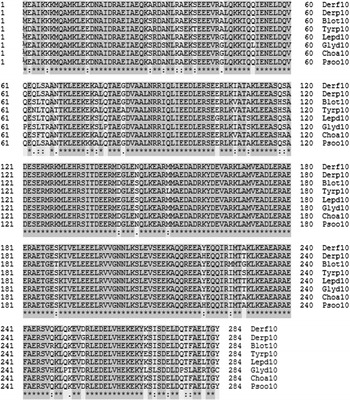
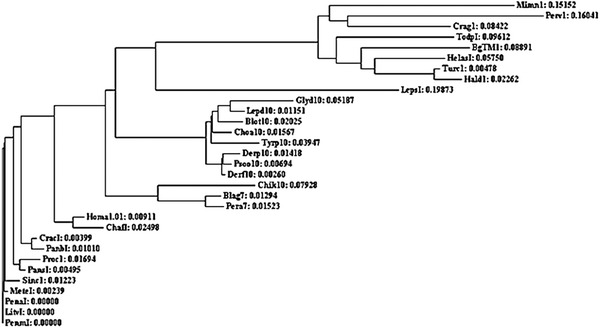
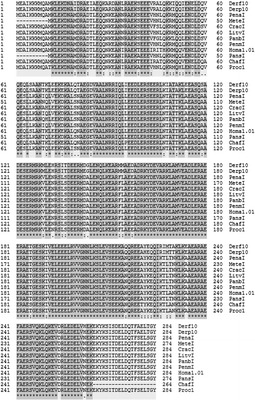
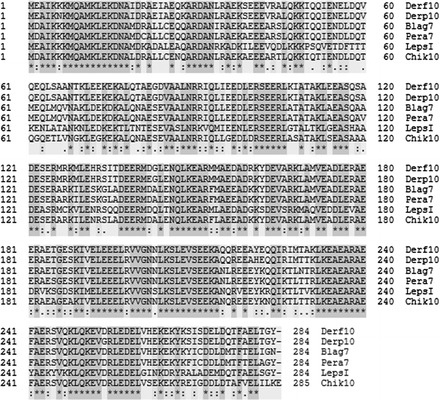
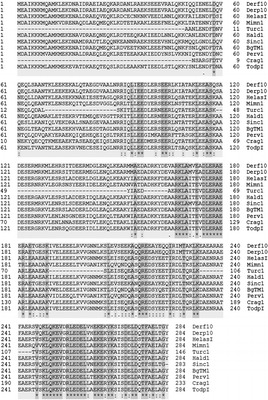
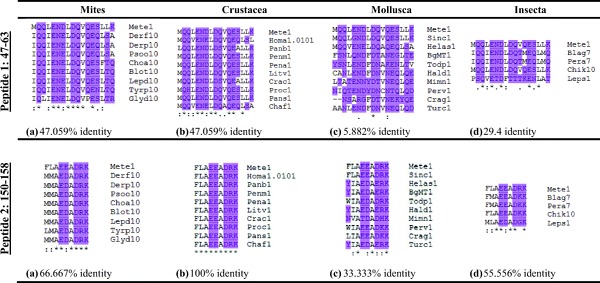
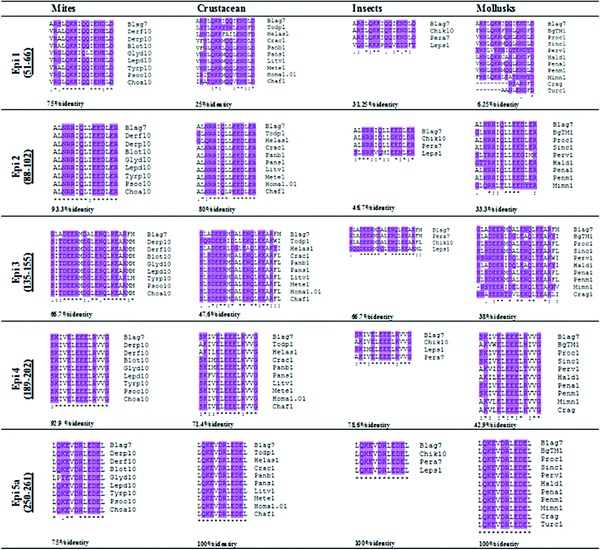
Group 10 allergens (tropomyosins) have been assumed to be a major cause of cross-reactivity between house-dust mites (HDMs) and other invertebrates. Despite all of the published data regarding the epidemiology, percent IgE binding and level of sensitization in the population, the role of tropomyosin as a cross-reactive allergen in patients with multiple allergy syndrome still remains to be elucidated. Homology between amino acid sequences reported in allergen databases of selected invertebrate tropomyosins was determined with Der f 10 as the reference allergen. The 66.9 and 54.4% identities were found with selected crustacean and insect species, respectively, whereas only 20.4% identity was seen with mollusks. A similar analysis was performed using reported B-cell IgE-binding epitopes from Met e1 (shrimp allergen) and Bla g7 (cockroach allergen) with other invertebrate tropomyosins. The percent identity in linear sequences was higher than 35% in mites, crustaceans, and cockroaches. The polar and hydrophobic regions in these groups were highly conserved. These findings suggest that tropomyosin may be a major cause of covariation of sensitization between HDMs, crustaceans, and some species of insects and mollusks.
Overview
The claims and statistics of this paper haven’t been checked yet.
Run the check — free, no account needed. It reads the open-access text and checks the sources it cites.
Integrity signals
Registry
Cites
Statistics
Figures
Verification
Claims the paper makes
The claims and statistics of this paper haven’t been checked yet.
Run the check — free, no account needed. It reads the open-access text and checks the sources it cites.
Claims other papers make about this one
Each is checked against this paper’s own text: does it say what the citing paper says it does?
In the citing paper
“Tropomyosins may be involved in cross-reactions between crustaceans, mollusks, dust mites, cockroaches, and nematodes such as Ascaris lumbricoides (Asc l 3).”
From Parasites and allergies: a complex bidirectional relationship from evolutionary origins to modern therapeutics (2026) · cites this paper as Shafique et al. 2012
In the citing paper
“Tropomyosins are among the most important examples of cross-reactive invertebrate allergens. They are characterized by high thermostability, resistance to digestion, and strong structural conservation across different invertebrate species.”
From Parasites and allergies: a complex bidirectional relationship from evolutionary origins to modern therapeutics (2026) · cites this paper as Shafique et al. 2012
In the citing paper
“The homology between Ascaris tropomyosin and mite tropomyosins, including Der p 10 and Blo t 10, may contribute to cross-reactive IgE responses and complicate the interpretation of dust mite sensitization in parasite-exposed individuals (Cheng et al. 2022; Shafique et al. 2012; Sousa-Santos et al. 2020).”
From Parasites and allergies: a complex bidirectional relationship from evolutionary origins to modern therapeutics (2026) · cites this paper as Shafique et al. 2012
Self-check
Percentages, sums and reported differences re-computed from the paper’s own numbers.
The self-check needs the paper’s full text.
Citations
Cites
No references could be resolved yet.
Research works printed but not linked: 112
- 10.1016/S0091-6749(97)70292-6 · DOI
- 10.1016/0091-6749(84)90281-1 · DOI
- 10.1007/s11882-002-0074-2 · DOI
- 10.1111/j.1365-2222.1994.tb00246.x · DOI
- 10.1067/mai.2001.113670 · DOI
- 10.1016/0021-8707(67)90045-7 · DOI
- 10.3347/kjp.2009.47.S.S143 · DOI
- Vestergaard H.S., 1994, EAACI, 94, 445
- 10.1016/S1081-1206(10)62865-7 · DOI
- 10.1067/mai.2001.112264 · DOI
- 10.1046/j.1365-2222.2000.00900.x · DOI
- 10.1034/j.1398-9995.1999.00913.x · DOI
- 10.1034/j.1398-9995.2001.056008723.x · DOI
- 10.1016/j.molimm.2008.07.034 · DOI
- 10.1111/j.1365-2362.2008.02048.x · DOI
- 10.1159/000059398 · DOI
- 10.1016/S0091-6749(95)70035-8 · DOI
- 10.1046/j.1365-2745.2002.01449.x · DOI
- 10.1159/000070212 · DOI
- 10.1034/j.1398-9995.2003.00167.x · DOI
- Asturias J.A., 1999, J Immunol, 162, 4342, 10.4049/jimmunol.162.7.4342 · DOI
- 10.1111/j.1365-2222.2005.02214.x · DOI
- 10.1128/CDLI.11.2.320-324.2004 · DOI
- 10.1111/j.1398-9995.1997.tb02594.x · DOI
- 10.1016/0091-6749(93)90061-J · DOI
- 10.1016/j.jaci.2009.11.043 · DOI
- Bessot J.C., 2010, Eur Ann Allergy Clin Immunol, 42, 3
- 10.1111/j.0141-9838.2004.00717.x · DOI
- 10.1159/000024201 · DOI
- 10.4161/bioa.1.4.17897 · DOI
- 10.1016/S0167-4781(98)00006-2 · DOI
- 10.1371/journal.pone.0022860 · DOI
- 10.1159/000236802 · DOI
- 10.1016/S1081-1206(10)62572-0 · DOI
- 10.1007/s10126-002-0082-1 · DOI
- Shanti K.N., 1993, J Immunol, 151, 5354, 10.4049/jimmunol.151.10.5354 · DOI
- 10.1159/000236803 · DOI
- 10.1111/j.1365-2222.2005.02345.x · DOI
- Jimenez S., 2007, All Clin Immun Int, 19, 233
- 10.1111/j.1365-2222.2011.03798.x · DOI
- 10.2174/092986607780782777 · DOI
- 10.1017/S0031182003003044 · DOI
- 10.1111/j.1398-9995.1981.tb01568.x · DOI
- Moustafa E.H., 1998, J Egypt Soc Parasitol, 28, 777
- 10.1111/j.1365-2133.1980.tb07258.x · DOI
- 10.4269/ajtmh.1995.52.539 · DOI
- Tarigan S., 2006, J Ilmu Ternak Dan Veteriner, 11, 52
- 10.1016/0020-1790(90)90010-R · DOI
- 10.1002/mnfr.200400015 · DOI
- 10.1023/A:1005352410725 · DOI
- 10.1016/S0091-6749(98)70027-2 · DOI
- 10.1016/j.molimm.2011.06.216 · DOI
- 10.1016/S0091-6749(96)80011-X · DOI
- 10.1271/bbb.62.1337 · DOI
- 10.1046/j.1365-2222.2001.01165.x · DOI
- 10.1016/j.jaci.2008.07.023 · DOI
- Food and Agriculture Organization/World Health Organization FAO/WHO, 2001, Report of a Joint FAO/WHO Expert Consultation of Allergenicity of Foods Derived from Biotechnology., 22
- 10.1159/000237558 · DOI
- 10.1016/0091-6749(93)90061-J · DOI
- 10.1111/j.1398-9995.1998.tb04959.x · DOI
- 10.1111/j.1398-9995.1996.tb00043.x · DOI
- 10.4315/0362-028X-63.7.940 · DOI
- 10.1111/j.1750-3841.2009.01391.x · DOI
- Iparraguirre A., 2009, J Investig Allergol Clin Immunol, 19, 409
- Villalta D., 2010, Eur Ann Allergy Clin Immunol, 42, 20
- Castillo R., 1994, Allergol Immunopathol (Madr), 22, 83
- 10.1111/j.1398-9995.1995.tb02499.x · DOI
- 10.1186/2045-7022-1-S1-P70 · DOI
- Hoffman D.R., 1981, Ann Allergy, 47, 17
- 10.1016/0091-6749(87)90121-7 · DOI
- 10.1016/S0091-6749(95)70259-8 · DOI
- 10.1007/s00405-011-1826-1 · DOI
- 10.1007/s11033-007-9075-5 · DOI
- Pajno G.B., 1994, Rev Fr Allergol, 34, 141
- Didier A., 1996, Rev fr Allergol, 36, 466
- 10.1111/j.1398-9995.1998.tb03863.x · DOI
- 10.1111/j.1398-9995.1998.tb03862.x · DOI
- 10.1159/000234476 · DOI
- 10.1046/j.1365-2222.2003.01722.x · DOI
- Bessot J.C., 2010, Eur Ann Allergy Clin Immunol, 42, 3
- 10.1111/j.1398-9995.1995.tb01174.x · DOI
- 10.1034/j.1398-9995.2003.23777.x · DOI
- 10.1159/000082579 · DOI
- 10.1016/S0301-0546(09)71115-2 · DOI
- 10.1016/0091-6749(89)90100-0 · DOI
- 10.3347/kjp.2006.44.1.73 · DOI
- 10.1146/annurev.ento.47.091201.145106 · DOI
- 10.1016/S0091-6749(95)70303-9 · DOI
- 10.1159/000237134 · DOI
- 10.1111/j.1398-9995.1998.tb03993.x · DOI
- Tandon N., 1990, Ann Allergy, 64, 155
- Kang B.C., 1989, Ann Allergy, 63, 207
- Kang B.C., 1992, Ann Allergy, 68, 237
- 10.1111/j.1365-2222.2005.02214.x · DOI
- Galindo P.A., 1999, J Investig Allergol Clin Immunol, 9, 117
- 10.1111/j.1398-9995.1989.tb00451.x · DOI
- Yamashita N., 1989, Ann Allergy, 63, 423
- Morsy T.A., 2000, J Egypt Soc Parasitol, 30, 83
- 10.1111/j.1398-9995.1997.tb00973.x · DOI
- 10.1016/j.jaci.2007.12.1147 · DOI
- WilliamR. Pearson and the University of Virginia FASTA Program. Available online at fasta.bioch.virginia.edu/fasta_www2/fasta_www.cgi; accessed March 12, 2012.
- Schein C.H., 2010, Bioinform Biol Insights, 11, 113
- 10.1002/mnfr.200500270 · DOI
- 10.1097/ACI.0b013e3282f4177e · DOI
- 10.1159/000024026 · DOI
- 10.1002/mnfr.200500274 · DOI
- 10.1016/S1471-4906(03)00075-9 · DOI
- 10.1093/bioinformatics/bti700 · DOI
- 10.1159/000063861 · DOI
- 10.1016/j.iac.2006.11.005 · DOI
- 10.1093/toxsci/kfi277 · DOI
- 10.4049/jimmunol.176.8.4852 · DOI
Cited by
Sorted by citations
Packi, K., Świerczewski, D., Klimczak, S., Ochab, D., Gałęziewska, J., Gromek, P., Kruczkowska, W., Płuciennik, E., Kałuzińska-Kołat, Ż., & Kołat, D. (2026) · Antonie van Leeuwenhoek · doi:10.1007/s10482-026-02425-4
Metadata
- Authors
- Shafique, R. H., Inam, M., Ismail, M., & Chaudhary, F. R.
- Venue
- Allergy & Rhinology
- Publisher
- SAGE Publications
- Published
- 2012-01
- Volume
- 3
- Issue
- 2
- ISSN
- 2152-6575
- 2152-6567
- PMC
- PMC3548612
- Cited by
- 39
- References
- 0
- Language
- en
About these checks
Registry, retraction, Cites and statistics results are computed, not judged, with one exception: a printed reference that no index lists is read once by a model before it counts as a citation error. Claims are extracted by a model and kept only when their quote appears verbatim in the text; each cited source is then checked, with a model’s help, for whether it says what the claim relies on. Those verdicts can be wrong — read the claim’s quote and the cited source before relying on one.
Statistics and arithmetic are recomputed, not judged.
Confidence bands are shown only for fields calibrated on our annotated test set. None is calibrated yet, so no band is shown.
What counts as a claim ›How we measure confidence ›How we check this ›
Are you an author, or do you see a problem with this page? Request a review
How to cite
Cite CoChat for the checks on this page, and the paper for its own findings.
- This page
- CoChat. (2026). Citation check: Group 10 Allergens (Tropomyosins) from House-Dust Mites May Cause Covariation of Sensitization to Allergens from Other Invertebrates. https://app.cochat.ai/papers/10.2500/ar.2012.3.0036
- The paper
- Shafique, R. H., Inam, M., Ismail, M., & Chaudhary, F. R. (2012). Group 10 Allergens (Tropomyosins) from House-Dust Mites May Cause Covariation of Sensitization to Allergens from Other Invertebrates. Allergy & Rhinology. https://doi.org/10.2500/ar.2012.3.0036
