

Modulation of Staphylococcus aureus antibacterial activity based on silver concentration in ZnO/Ag system
Open accessThe DOI matches its Crossref record; 41 of the 41 references it cites were found in a registry or an index; none of the 28 sources its claims cite is checked for support yet.
Abstract
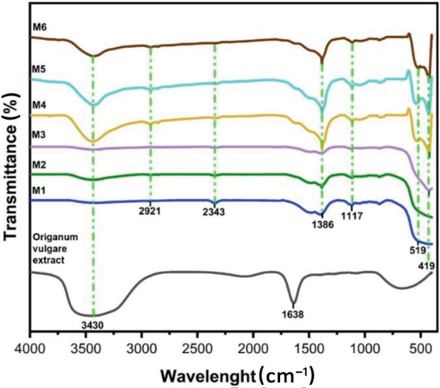
The use and development of green synthesis methods have emerged as a sustainable strategy for producing nanomaterials. These involve using plant extracts as natural reducing and stabilizing agents. In this study, an antibacterial investigation was conducted on zinc oxide (ZnO) and zinc oxide/silver (ZnO/Ag) nanostructures at various silver (Ag) concentrations (0.5, 1, 2, 3, and 8 wt%), synthesized using an infusion of Origanum vulgare combined with the solid-state method at 500°C. The synthesized products were characterized using X-ray diffraction (XRD), identifying the hexagonal wurtzite phase (ZnO) with a preferential orientation on the [101] direction and a crystallite size of 30.63 nm, and the corresponding Ag phase with a preferential orientation in [111] direction, which exhibited an increase in crystallite size from 29.66 to 72.26 nm depending on the Ag concentration. Fourier transform infrared spectroscopy (FTIR) confirmed the presence of functional groups from the extract in the initial samples and their elimination after thermal treatment. Transmission electron microscopy (TEM) analysis showed that the synthesized nanoparticles (NPs) are mostly spherical and semi-spherical, with uniform sizes ranging from 19 to 26 nm, depending on the Ag concentration. High-resolution TEM (HRTEM) and fast fourier transform (FFT) allowed for the identification of interplanar distances and crystal planes, confirming the crystalline nature and growth direction of the samples. Finally, the nanomaterials were subjected to antibacterial tests against Staphylococcus aureus and Escherichia coli . The results showed that the samples containing 2% and 3 wt% Ag exhibited the optimal antibacterial activity against S. aureus. In contrast, the inhibition observed against E. coli was lower and more variable, suggesting that the antibacterial performance is bacterium-dependent, likely due to structural differences in their cell walls.
Overview
CoChat Summary
TL;DR
ZnO and ZnO/Ag nanostructures were synthesized via *Origanum vulgare* green synthesis combined with solid-state calcination at 500°C, and their antibacterial activity against *S. aureus* and *E. coli* was tested across 0.5–8 wt% Ag. Moderate Ag loading (2–3 wt%) optimally enhanced activity against *S. aureus*, while pure ZnO was more effective against *E. coli* than the ZnO/Ag composites.
Key findings
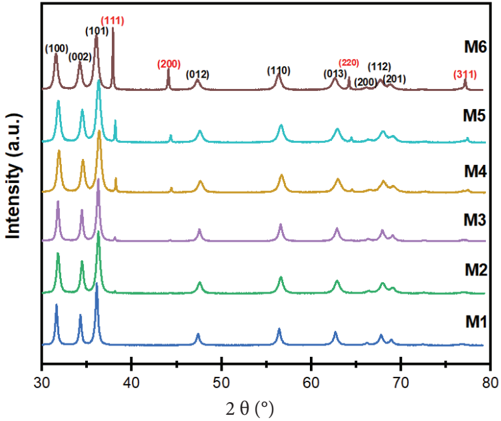
- XRD confirmed hexagonal wurtzite ZnO and cubic Ag phases; ZnO crystallite size was 30.63 nm for pure ZnO (M1), while Ag crystallite size increased from 29.66 to 72.26 nm as Ag concentration increased.
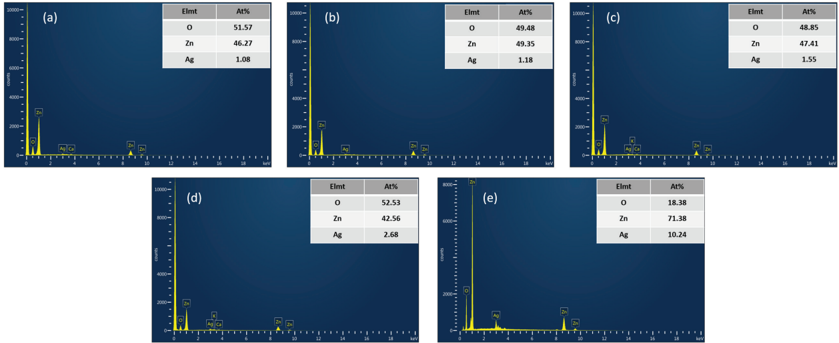
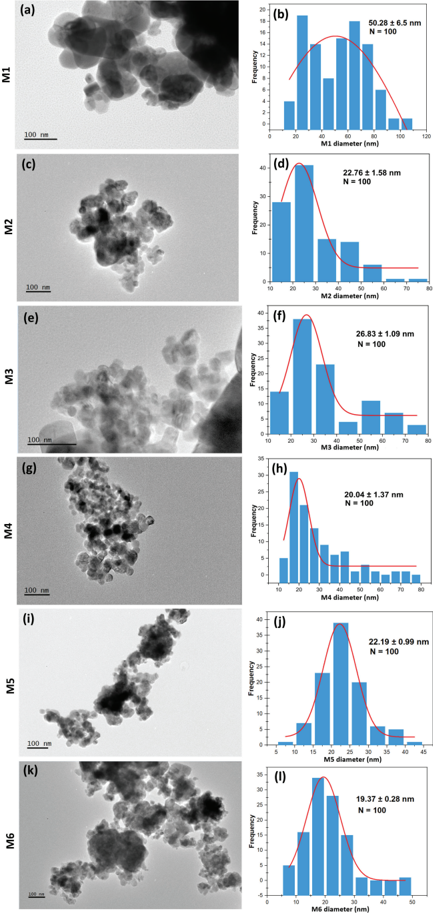
- TEM showed mostly spherical/semispherical nanoparticles with average sizes decreasing from 50.28 ± 6.5 nm (M1) to 19.37 ± 0.28 nm (M6, 8 wt% Ag); EDS showed atomic Ag rising from 1.08% to 10.24% across samples.
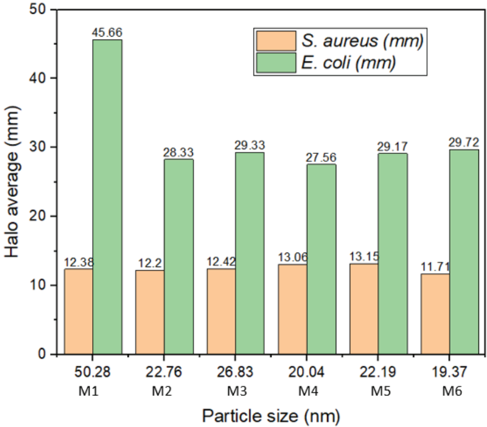
- Against *S. aureus*, optimal inhibition occurred at 2–3 wt% Ag: M4 = 13.06 ± 0.29 mm and M5 = 13.15 ± 0.56 mm, versus M1 = 12.38 ± 0.50 mm; M6 (8 wt% Ag) decreased to 11.71 ± 0.45 mm.
- Against *E. coli*, pure ZnO (M1) gave the largest inhibition zone at 45.66 ± 2.45 mm; adding Ag reduced activity to 28.33 ± 2.78 mm (M2) and 27.56–29.33 mm (M3–M5), with M6 at 29.72 ± 3.67 mm.
Methods
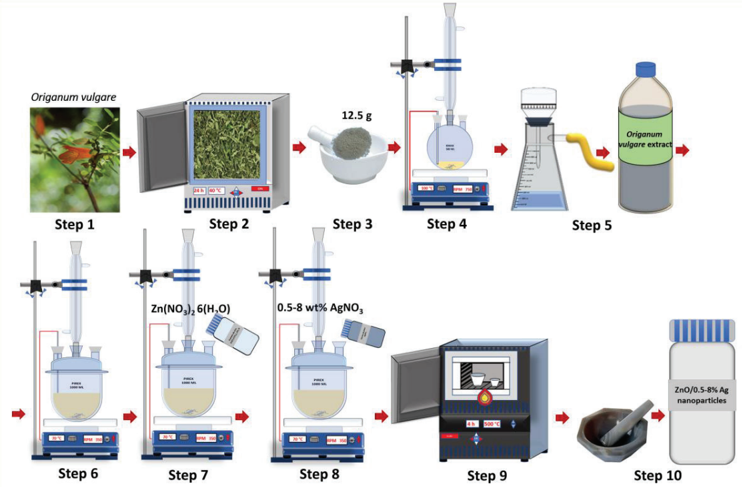
- ZnO and ZnO/Ag nanoparticles were synthesized using an *Origanum vulgare* leaf infusion with zinc nitrate hexahydrate and silver nitrate at 0.5, 1, 2, 3, and 8 wt% Ag, stirred for 4 h and calcined at 500°C for 4 h; samples were labeled M1 (pure ZnO) and M2–M6.
- Characterization included XRD (Bruker D8 Discover, Cu-Kα), FTIR (ATR, 4000–400 cm⁻¹), TEM/HRTEM/FFT (JEOL 2010 FEG, 200 kV), EDS, and ImageJ v1.54 for particle size analysis.
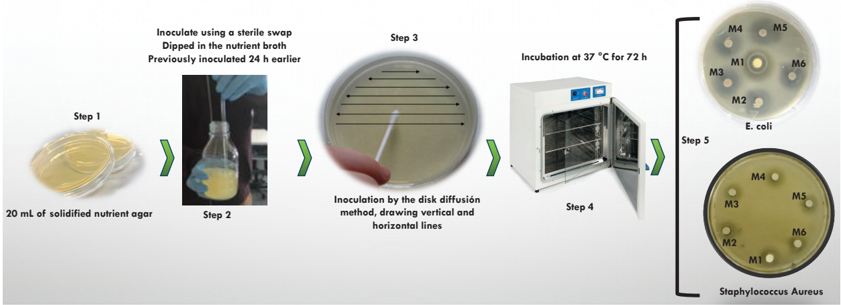
- Antibacterial activity was evaluated by disk diffusion against *S. aureus* ATCC 25923 and *E. coli* ATCC 25922 using 0.06 g powder disks (5 mm diameter, 3 mm height), incubation at 37°C, and inhibition zones measured in triplicate and averaged with ImageJ.
Limitations
- The paper states that further studies on biocompatibility and cytotoxicity are still needed.
- Evident from the text: antibacterial testing was limited to two bacterial strains and an in vitro disk diffusion assay, with no MIC/MBC values reported for this study.
- Evident from the text: *E. coli* results were more variable, e.g., M6 had a standard deviation of 3.67 mm, and the main-text section 2.3 “Antibacterial evaluation” lacks detailed protocol content, which appears mainly in the figure caption.
Model-written summary. Check it against the paper before relying on it.
Integrity signals
Registry
Cites
Statistics
Figures

Verification
Claims the paper makes
0 Valid · 0 Not valid · 18 Not checked · 55 Own results and interpretations
A result the paper reports from its own data — it cites no other source for it, so there is none to check. The quote shows it is in the paper.
In the paper
“It was also observed that the diffractograms for samples M4-M6, corresponding to ZnO/ Ag, showed additional peaks indexed according to the PDF card 04-0783 for the cubic phase of Ag.”
§ Modulation of Staphylococcus aureus antibacterial activity based on silver concentration in ZnO/Ag system > 3.1. Structural analysis by X-Ray diffraction
plain- Asserted: passes — The authors put it forward as true.
- Checkable: passes — It can be checked against evidence.
- Load-bearing: unclear — It is unclear whether the paper’s conclusions depend on it.
- Based: passes — The paper gives a reason why it holds.
A result the paper reports from its own data — it cites no other source for it, so there is none to check. The quote shows it is in the paper.
In the paper
“2 θ (°) 38.07°, 44.25°, 64.38°, and 77.34°, corresponding to the planes (111), ( 200), (220), and (311), respectively, marked in red.”
§ Modulation of Staphylococcus aureus antibacterial activity based on silver concentration in ZnO/Ag system > 3.1. Structural analysis by X-Ray diffraction
plainstates an association- Asserted: passes — The authors put it forward as true.
- Checkable: passes — It can be checked against evidence.
- Load-bearing: unclear — It is unclear whether the paper’s conclusions depend on it.
- Based: passes — The paper gives a reason why it holds.
A result the paper reports from its own data — it cites no other source for it, so there is none to check. The quote shows it is in the paper.
In the paper
“In sample M5, corresponding to an Ag content of 3 wt%, an average particle size distribution of 22.19 ± 0.99 nm was obtained.”
§ Modulation of Staphylococcus aureus antibacterial activity based on silver concentration in ZnO/Ag system > 3.3. Morphological determination by transmission electron microscopy
plain- Asserted: passes — The authors put it forward as true.
- Checkable: passes — It can be checked against evidence.
- Load-bearing: passes — The paper’s conclusions depend on it.
- Based: passes — The paper gives a reason why it holds.
A result the paper reports from its own data — it cites no other source for it, so there is none to check. The quote shows it is in the paper.
In the paper
“In Figures 6(a, b), the results for M1 are shown, where agglomerates composed of quasi-spherical structures with an average size of 50.28 ± 6.5 nm are visible.”
§ Modulation of Staphylococcus aureus antibacterial activity based on silver concentration in ZnO/Ag system > 3.3. Morphological determination by transmission electron microscopy
plain- Asserted: passes — The authors put it forward as true.
- Checkable: passes — It can be checked against evidence.
- Load-bearing: passes — The paper’s conclusions depend on it.
- Based: passes — The paper gives a reason why it holds.
A result the paper reports from its own data — it cites no other source for it, so there is none to check. The quote shows it is in the paper.
In the paper
“For sample M3, a greater dispersion among the morphologies (quasi-spherical and faceted particles) is observed, with dimensions ranging from 26.83 ± 1.09 nm”
§ Modulation of Staphylococcus aureus antibacterial activity based on silver concentration in ZnO/Ag system > 3.3. Morphological determination by transmission electron microscopy
plain- Asserted: passes — The authors put it forward as true.
- Checkable: passes — It can be checked against evidence.
- Load-bearing: unclear — It is unclear whether the paper’s conclusions depend on it.
- Based: passes — The paper gives a reason why it holds.
30 more claims
Create a free account to see all 73 claims and to verify the 28 references still open.
- It may state two separate claims as one. 33
- Probably not a substantial claim. 14
Self-check
Percentages, sums and reported differences re-computed from the paper’s own numbers.
Each contradiction between two passages listed here was confirmed by an independent check.
Rated major: it would touch a result — a value a result rests on, reported and recomputed p-values on opposite sides of the significance level, two passages that conflict with no sign which is right, or a cited work retracted before this paper was published.
In the paper
§ Modulation of Staphylococcus aureus antibacterial activity based on silver concentration in ZnO/Ag system > 4. Conclusions
“Notably, antibacterial performance was found to be bacterium-dependent, showing better efficacy against S. aureus than E. coli”
§ Modulation of Staphylococcus aureus antibacterial activity based on silver concentration in ZnO/Ag system > 4. Conclusions
“| M4 | S. aureus | 13.38 | 12.8 | 13 | 13.06 | 0.29 | | | E. coli | 26.77 | 26.87 | 29.04 | 27.56 | 1.28 |”
Rated minor: it would not touch a result — a value no result rests on, a p-value that stays on the same side of the significance level, or a conflict that is clerical, resolved elsewhere in the paper, or outside its own findings.
In the paper
§ Modulation of Staphylococcus aureus antibacterial activity based on silver concentration in ZnO/Ag system > 1. Introduction
“showing inhibition zones against E. coli (9.38 mm) and S. aureus (14.46 mm)”
§ Modulation of Staphylococcus aureus antibacterial activity based on silver concentration in ZnO/Ag system > 3.5. Evaluation of antibacterial performance as a function of Ag concentration
“Rajith et al. [26] utilized Calotropis gigantea in a solution combustion method, reporting smaller inhibition zones (14.46 mm for S. aureus and 9.58 mm for E. coli).”
Rated minor: it would not touch a result — a value no result rests on, a p-value that stays on the same side of the significance level, or a conflict that is clerical, resolved elsewhere in the paper, or outside its own findings.
In the paper
§ Modulation of Staphylococcus aureus antibacterial activity based on silver concentration in ZnO/Ag system > 3.5. Evaluation of antibacterial performance as a function of Ag concentration
“Rajith et al. [26] utilized Calotropis gigantea in a solution combustion method, reporting smaller inhibition zones (14.46 mm for S. aureus and 9.58 mm for E. coli).”
§ Modulation of Staphylococcus aureus antibacterial activity based on silver concentration in ZnO/Ag system > 3.5. Evaluation of antibacterial performance as a function of Ag concentration
“sample M4), which exhibited the highest activity (13.06 mm, SD = 0.29 mm)”
Rated minor: it would not touch a result — a value no result rests on, a p-value that stays on the same side of the significance level, or a conflict that is clerical, resolved elsewhere in the paper, or outside its own findings.
In the paper
§ Modulation of Staphylococcus aureus antibacterial activity based on silver concentration in ZnO/Ag system > 3.5. Evaluation of antibacterial performance as a function of Ag concentration
“Morphological analysis via TEM and HRTEM revealed a progressive reduction in the size of the NPs as the concentration of Ag increased”
§ Modulation of Staphylococcus aureus antibacterial activity based on silver concentration in ZnO/Ag system > 3.3. Morphological determination by transmission electron microscopy
“In contrast, the micrographs for sample M2 show agglomerates of spherical and quasi-spherical structures, with an average size distribution of 22.76 ± 1.58 nm.For sample M3, a greater dispersion among the morphologies (quasi-spherical and faceted particles) is observed, with dimensions ranging from 26.83 ± 1.09 nm”
Rated minor: it would not touch a result — a value no result rests on, a p-value that stays on the same side of the significance level, or a conflict that is clerical, resolved elsewhere in the paper, or outside its own findings.
In the paper
§ Modulation of Staphylococcus aureus antibacterial activity based on silver concentration in ZnO/Ag system > 3.5. Evaluation of antibacterial performance as a function of Ag concentration
“sample M4), which exhibited the highest activity (13.06 mm, SD = 0.29 mm)”
§ Modulation of Staphylococcus aureus antibacterial activity based on silver concentration in ZnO/Ag system > 3.5. Evaluation of antibacterial performance as a function of Ag concentration
“Sample M5 (3 wt% Ag) showed a comparable average inhibition (13.15 mm)”
Citations
Cites
Methods for in vitro evaluating antimicrobial activity: A review
Balouiri, M., Sadiki, M., & Ibnsouda, S. K. (2016) · Journal of Pharmaceutical Analysis · doi:10.1016/j.jpha.2015.11.005 · Cited by 8,044
Green synthesis of nanoparticles: Current developments and limitations
Ying, S., Guan, Z., Ofoegbu, P. C., Clubb, P., Rico, C., He, F., & Hong, J. (2022) · Environmental Technology & Innovation · doi:10.1016/j.eti.2022.102336 · Cited by 1,677
A review on green synthesis of zinc oxide nanoparticles – An eco-friendly approach
Agarwal, H., Venkat Kumar, S., & Rajeshkumar, S. (2017) · Resource-Efficient Technologies · doi:10.1016/j.reffit.2017.03.002 · Cited by 1,037
Jamdagni, P., Khatri, P., & Rana, J. S. (2018) · Journal of King Saud University - Science · doi:10.1016/j.jksus.2016.10.002 · Cited by 818
Mustapha, S., Ndamitso, M. M., Abdulkareem, A. S., Tijani, J. O., Shuaib, D. T., Mohammed, A. K., & Sumaila, A. O. (2019) · Advances in Natural Sciences Nanoscience and Nanotechnology · doi:10.1088/2043-6254/ab52f7 · Cited by 643
Bandeira, M., Giovanela, M., Roesch-Ely, M., Devine, D. M., & da Silva Crespo, J. (2020) · Sustainable Chemistry and Pharmacy · doi:10.1016/j.scp.2020.100223 · Cited by 546
Mechanistic study on antibacterial action of zinc oxide nanoparticles synthesized using green route
Agarwal, H., Menon, S., Venkat Kumar, S., & Rajeshkumar, S. (2018) · Chemico-Biological Interactions · doi:10.1016/j.cbi.2018.03.008 · Cited by 447
Shaik, M., Khan, M., Kuniyil, M., Al-Warthan, A., Alkhathlan, H., Siddiqui, M., Shaik, J., Ahamed, A., Mahmood, A., Khan, M., et al. (2018) · Sustainability · doi:10.3390/su10040913 · Cited by 343
Panchal, P., Paul, D. R., Sharma, A., Choudhary, P., Meena, P., & Nehra, S. P. (2020) · Journal of Colloid and Interface Science · doi:10.1016/j.jcis.2019.12.079 · Cited by 240
Akintelu, S. A., & Folorunso, A. S. (2020) · BioNanoScience · doi:10.1007/s12668-020-00774-6 · Cited by 230
Zare, M., Namratha, K., Alghamdi, S., Mohammad, Y. H. E., Hezam, A., Zare, M., Drmosh, Q. A., Byrappa, K., Chandrashekar, B. N., Ramakrishna, S., et al. (2019) · Scientific Reports · doi:10.1038/s41598-019-44309-w · Cited by 213
Elumalai, K., Velmurugan, S., Ravi, S., Kathiravan, V., & Raj, G. A. (2015) · Advanced Powder Technology · doi:10.1016/j.apt.2015.09.008 · Cited by 201
Tamanna, N. J., Hossain, M. S., Bahadur, N. M., & Ahmed, S. (2024) · Results in Chemistry · doi:10.1016/j.rechem.2024.101313 · Cited by 185
Skłodowski, K., Chmielewska-Deptuła, S. J., Piktel, E., Wolak, P., Wollny, T., & Bucki, R. (2023) · International Journal of Molecular Sciences · doi:10.3390/ijms24032104 · Cited by 171
Noohpisheh, Z., Amiri, H., Farhadi, S., & Mohammadi-gholami, A. (2020) · Spectrochimica Acta Part A: Molecular and Biomolecular Spectroscopy · doi:10.1016/j.saa.2020.118595 · Cited by 149
Silver-zinc oxide nanocomposite: From synthesis to antimicrobial and anticancer properties
Mousavi-Kouhi, S. M., Beyk-Khormizi, A., Amiri, M. S., Mashreghi, M., & Taghavizadeh Yazdi, M. E. (2021) · Ceramics International · doi:10.1016/j.ceramint.2021.04.160 · Cited by 143
Selvanathan, V., Aminuzzaman, M., Tan, L. X., Win, Y. F., Guan Cheah, E. S., Heng, M. H., Tey, L.-H., Arullappan, S., Algethami, N., Alharthi, S. S., et al. (2022) · Journal of Materials Research and Technology · doi:10.1016/j.jmrt.2022.08.028 · Cited by 141
Shahzad, M., Ahmad, F., Ibraheem, M., Shakoor, A., Ramay, S. M., Raza, M. R., & Atiq, S. (2025) · RSC Advances · doi:10.1039/d4ra08894h · Cited by 106
Taha, A., Ben Aissa, M., & Da’na, E. (2020) · Molecules · doi:10.3390/molecules25071586 · Cited by 97
Biomedical applications of zinc oxide nanoparticles
Barui, A. K., Kotcherlakota, R., & Patra, C. R. (2018) · Elsevier eBooks · doi:10.1016/b978-0-12-813661-4.00006-7 · Cited by 88
Kayani, Z. N., Manzoor, F., Zafar, A., Mahmood, M., Rasheed, M., & Anwar, M. (2020) · Optical and Quantum Electronics · doi:10.1007/s11082-020-02460-z · Cited by 71
Green synthesis of silver nanoparticles for application in cosmetics
Arroyo, G. V., Madrid, A. T., Gavilanes, A. F., Naranjo, B., Debut, A., Arias, M. T., & Angulo, Y. (2020) · Journal of Environmental Science and Health, Part A · doi:10.1080/10934529.2020.1790953 · Cited by 68
Khan, A., Kamal, T., Saad, M., Ameen, F., A. Bhat, S., Ahamad Khan, M., & Rahman, F. (2023) · Spectrochimica Acta Part A: Molecular and Biomolecular Spectroscopy · doi:10.1016/j.saa.2022.122296 · Cited by 65
Hambardzumyan, S., Sahakyan, N. Z., Petrosyan, M. T., Nasim, M. J., Jacob, C., & Trchоunian, A. (2020) · AMB Express · doi:10.1186/s13568-020-01100-9 · Cited by 60
Rajith Kumar, C. R., Betageri, V. S., Nagaraju, G., Pujar, G. H., Onkarappa, H. S., & Latha, M. S. (2020) · Journal of Inorganic and Organometallic Polymers and Materials · doi:10.1007/s10904-020-01507-8 · Cited by 44
Thatikayala, D., Banothu, V., Kim, J., Shin, D. S., Vijayalakshmi, S., & Park, J. (2020) · Journal of Materials Science: Materials in Electronics · doi:10.1007/s10854-020-03093-4 · Cited by 33
Khanjari, Z., Chamani, E., Heydaryan, K., Mizwari, Z. M., Salmani, F., Farimani, A. R., Siami‐Aliabad, M., Kiani, Z., Mohammadparast‐Tabas, P., & Mortazavi‐Derazkola, S. (2024) · Materials Today Communications · doi:10.1016/j.mtcomm.2024.109214 · Cited by 29
Jakinala, P., Naik Lavudi, H., Angali, N., Ganderla, S., Inampudi, K. K., Balaji Andugulapati, S., Srinivas, M., & Rao Katika, M. (2023) · Inorganic Chemistry Communications · doi:10.1016/j.inoche.2023.110735 · Cited by 25
Synthesis and characterization (optical and antibacterial) of silver doped zinc oxide nanoparticles
Islam, M. B., Haque, M. J., Shehab, N. M., & Rahman, M. S. (2023) · Open Ceramics · doi:10.1016/j.oceram.2023.100370 · Cited by 23
Ghaffari, S.-B., Sarrafzadeh, M.-H., Salami, M., & Alvandi, A. (2024) · Journal of Drug Delivery Science and Technology · doi:10.1016/j.jddst.2023.105221 · Cited by 22
Ag nanoparticles decorated hybrid microspheres for superior antibacterial properties
Chen, B., Jiang, Y., Zhao, M., Wang, W., Chu, Z., Huo, R., Hu, F., Zhou, W., He, T., & Qian, H. (2019) · Materials Letters · doi:10.1016/j.matlet.2019.127057 · Cited by 22
Murtaza, M., Islam, M. U., Danish, M., Waqas, M., Ahmad, F., Atiq, S., Alsharef, M., & Althobaiti, A. (2025) · Ionics · doi:10.1007/s11581-025-06342-w · Cited by 17
Madni, M. N., Ahmad, F., Danish, M., Jahangeer, M., Islam, M. U., Adnan, M., Atiq, S., Shakoor, A., & Althobaiti, A. (2025) · Solid State Ionics · doi:10.1016/j.ssi.2025.116782 · Cited by 16
Usman, M., Waqas, M., Ahmad, F., Danish, M., Rana, A. M., Sadiq, I., Qaiser, R., Atiq, S., & Althobaiti, A. (2025) · Ionics · doi:10.1007/s11581-024-06025-y · Cited by 15
Adeyemi, D. K., Adeluola, A. O., Akinbile, M. J., Johnson, O. O., & Ayoola, G. A. (2020) · African Journal of Clinical and Experimental Microbiology · doi:10.4314/ajcem.v21i2.4 · Cited by 15
Pandia-Estrada, S., Romero-Santivañez, R., Céspedes-Chombo, R., & Solari-Godiño, A. (2021) · Scientia Agropecuaria · doi:10.17268/sci.agropecu.2021.026 · Cited by 9
Khan, M. A., Shahbaz, K., Mustafa, G., Ramay, S. M., Ahmad, F., & Atiq, S. (2024) · Materials Science and Engineering B · doi:10.1016/j.mseb.2024.117959 · Cited by 8
Ghosh, T., Chattopadhyay, A., Pramanik, S., Das, A., Mukherjee, S., Das, S., Mandal, A. C., Dhak, D., & Kuiri, P. K. (2022) · Materials Technology · doi:10.1080/10667857.2022.2029290 · Cited by 7
Greenly engineered bimetallic Ag-ZnO nanohybrids for synergistic antibacterial enhancement
Habes Almutairi, H. (2024) · Journal of Saudi Chemical Society · doi:10.1016/j.jscs.2024.101899 · Cited by 4
Synthesis of ZnO-Ag Nanostructures with Origanum vulgare, Combined with the Solid-State Method
Martín, M. P. M., Muñoz-Pérez, J. E., Alatorre, J. A. A., Villaseñor-Cerón, L. S., Mendoza-Anaya, D., & Rodríguez-Lugo, V. (2025) · Crystals · doi:10.3390/cryst15040313 · Cited by 2
Self-citationAntibacterial Effects of Synthesized ZnO: Ag Nanoparticles against Listeria monocytogenes
Jalali, M. D., Issazadeh, K., Ziabari, A. A., & Mirpour, M. (2020) · Journal of Complementary Medicine Research · doi:10.5455/jcmr.2020.11.03.11 · Cited by 1
Research works printed but not linked: 2
- García-Pérez, E., Castro-Álvarez, F.F., Gutiérrez-Uribe, García-Lara., S., 2012. Revista Mexicana de Ciencias Agrícolas. Mexican Journal of Agricultural Sciences, 3, 339-53. https://redalyc.org/pdf/2631/263123201010.pdf
- Foroughbakhch, R., Alvarado-Vázquez, M.A., Guzman, M.A., Luis Hernandez- Piñero, J., 2014. Palynological characterization of oregano species from the genera Lippia (Verbenaceae) and Poliomintha (Lamiaceae) from Nuevo León. Ciencia UANL, 17, 49-56. http://eprints.uanl.mx/6918/
Metadata
- Authors
- Martín, M. P. M., Sanchez-Campos, D., Arenas-Alatorre, J., Meza-Pardo, I. G., Mendoza-Anaya, D., Jiménez-González, A., & Rodriguez-Lugo, V.
- Affiliations
- Universidad Autónoma del Estado de Hidalgo (MX)
- Institute of Physics, Autonomous University of San Luis Potosí, Av. Parque Chapultepec, Privadas del Pedregal, San Luis Potosí, SLP, Mexico,
- Institute of Physics, National Autonomous University of Mexico, University City, Coyoacán, Mexico City, Mexico,
- Autonomous University of San Luis Potosí (MX)
- Instituto Nacional de Investigaciones Nucleares (MX)
- Universidad Politécnica de Pachuca (MX)
- Academic Area of Earth and Materials Sciences, Institute of Basic Sciences and Engineering, Autonomous University of the State of Hidalgo, Mineral de la Reforma, Pachuca–Tulancingo Highway, km 4.5, Hidalgo, Mexico,
- Venue
- Arabian Journal of Chemistry
- Publisher
- Scientific Scholar
- Published
- 2026-02-24
- Volume
- 19
- Pages
- 4802025
- ISSN
- 1878-5352 (ISSN-L)
- 1878-5379
- OpenAlex
- W7131276807
- Semantic Scholar
- 58d95b67f789e753df3001480041dc071ea4e42b
- Cited by
- 0
- References
- 40
- FWCI
- 0.00
- Type
- journal article
- Language
- en
- Open access
- hybrid
- doi.org
- Licence
- cc-by-nc-sa
- Locations
- Arabian Journal of Chemistry (publishedVersion, cc-by-nc-sa)
- Topics
- Physical Sciences › Materials Science › Materials Chemistry › Nanoparticles: synthesis and applications
- Life Sciences › Agricultural and Biological Sciences › Food Science › Essential Oils and Antimicrobial Activity
- Physical Sciences › Materials Science › Materials Chemistry › ZnO doping and properties
- Keywords
- zinc oxide nanoparticles, silver nanoparticles, silver content, antibacterial activity, Staphylococcus aureus, Escherichia coli, oregano, green synthesis, plant extract reducing agent, solid-state synthesis, crystallite size, nanoparticle morphology
About these checks
Registry, retraction, Cites and statistics results are computed, not judged, with one exception: a printed reference that no index lists is read once by a model before it counts as a citation error. Claims are extracted by a model and kept only when their quote appears verbatim in the text; each cited source is then checked, with a model’s help, for whether it says what the claim relies on. Those verdicts can be wrong — read the claim’s quote and the cited source before relying on one.
A language model drew the claims from the paper on 2026-11-27, under version 3 of the claim definition (model deepseek-v4.1-flash, prompt extract-v3).
A second model labelled each claim on 2026-11-27 (model jev-1.13-20260917, definition revision gold-guideline-v0.2).
Statistics and arithmetic are recomputed, not judged.
Confidence bands are shown only for fields calibrated on our annotated test set. None is calibrated yet, so no band is shown.
What counts as a claim ›How we measure confidence ›How we check this ›
Are you an author, or do you see a problem with this page? Request a review
Data sources
Bibliographic data: Semantic Scholar, OpenAlex, Crossref.
Contains information from the Semantic Scholar Academic Graph Datasets, made available under the ODC Attribution License (ODC-BY 1.0).
Semantic Scholar’s data is described in: Kinney, R., et al. (2023). The Semantic Scholar Open Data Platform. arXiv:2301.10140.
