

Tidying up the conformational ensemble of a disordered peptide by computational prediction of spectroscopic fingerprints
Open accessPreprint — published as 10.1039/d3sc02202a · Paper page
The DOI matches its Crossref record; 1 of the 1 references it cites were found in a registry or an index.
Abstract
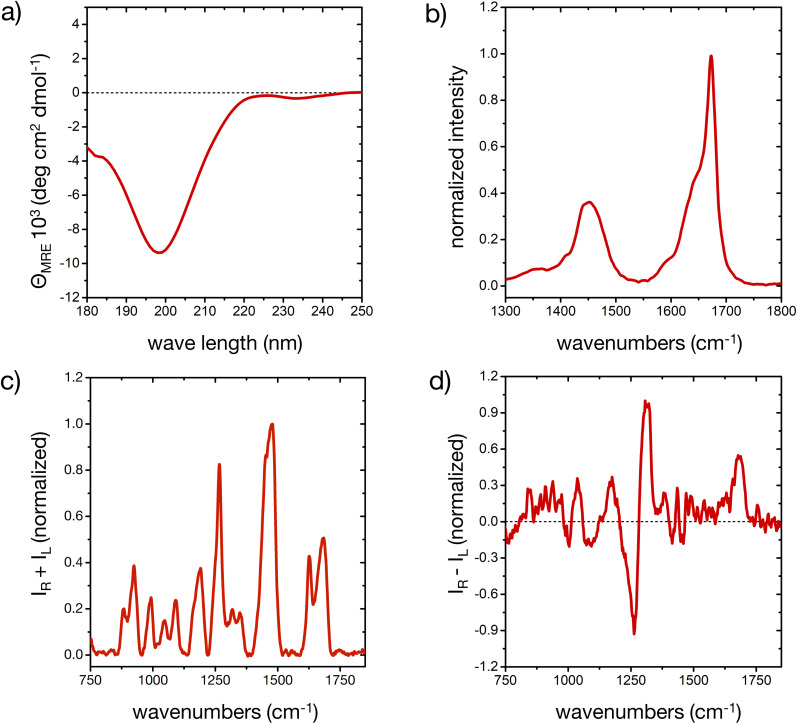
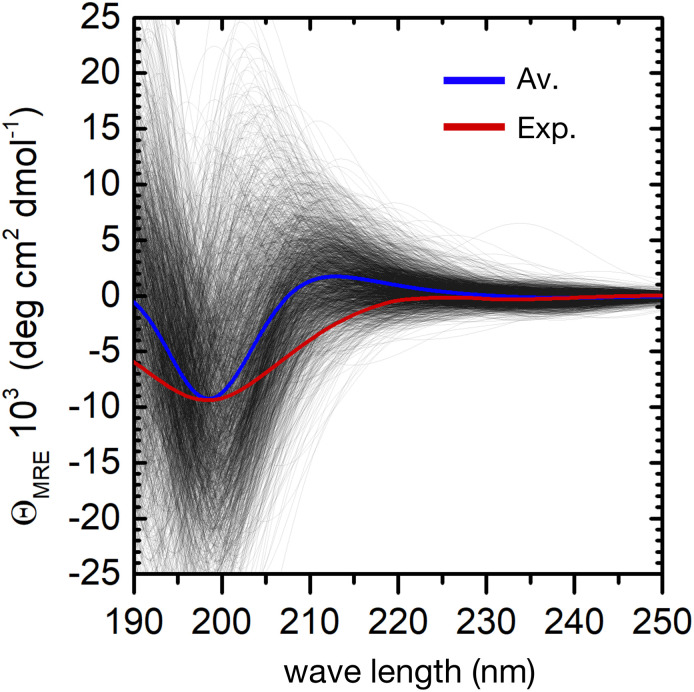
The most advanced structure prediction methods are powerless in exploring the conformational ensemble of disordered peptides and proteins and for this reason the "protein folding problem" remains unsolved. We present a novel methodology that enables the accurate prediction of spectroscopic fingerprints (Circular Dichroism, Infrared, Raman, and Raman Optical Activity), and by this allows for "tidying up" the conformational ensembles of disordered peptides and disordered regions in proteins. This concept is elaborated for and applied to a dodecapeptide, whose spectroscopic fingerprint is measured and theoretically predicted by means of enhanced-sampling Molecular Dynamics coupled with Quantum Mechanical calculations. Following this approach, we demonstrate that peptides lacking a clear propensity for ordered secondary-structure motifs are not randomly, but only conditionally disordered. This means that their conformational landscape, or phase-space, can be well represented by a basis-set of conformers including about 10 to 100 structures. The implications of this finding have profound consequences both for the interpretation of experimental electronic and vibrational spectral features of peptides in solution and for the theoretical prediction of these features using accurate and computationally expensive techniques. The here-derived methods and conclusions are expected to fundamentally impact the rationalization of so-far elusive structure-spectra relationships for disordered peptides and proteins, towards improved and versatile structure prediction methods.
Overview
The claims and statistics of this paper haven’t been checked yet.
Free: it reads the open-access text and checks the first 5 claims that cite a source we can check. Create a free account to check every claim.
Integrity signals
Registry
Cites
Statistics
Figures
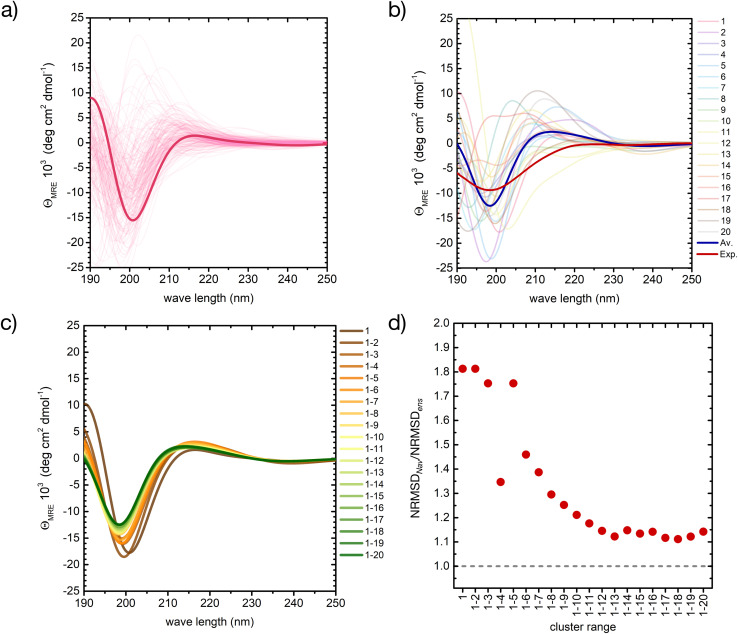
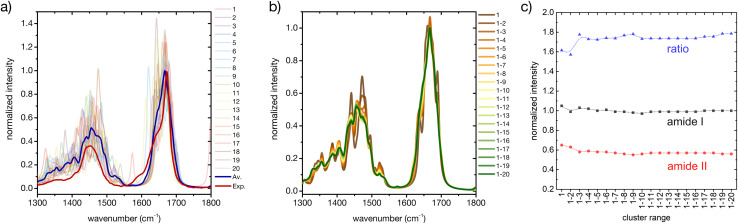
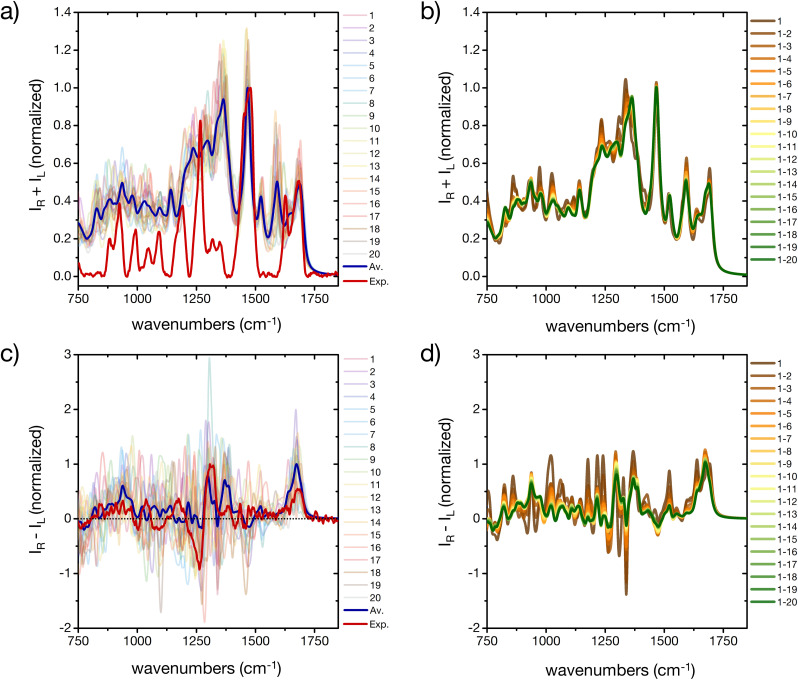
Verification
Claims the paper makes
The claims and statistics of this paper haven’t been checked yet.
Free: it reads the open-access text and checks the first 5 claims that cite a source we can check. Create a free account to check every claim.
Self-check
Percentages, sums and reported differences re-computed from the paper’s own numbers.
The self-check needs the paper’s full text.
Citations
Cites
Highly accurate protein structure prediction with AlphaFold
Jumper, J., Evans, R., Pritzel, A., Green, T., Figurnov, M., Ronneberger, O., Tunyasuvunakool, K., Bates, R., Žídek, A., Potapenko, A., et al. (2021) · Nature · doi:10.1038/s41586-021-03819-2 · Cited by 43,764
Metadata
- Authors
- Michaelis, M., Cupellini, L., Mensch, C., Perry, C. C., Delle Piane, M., & Colombi Ciacchi, L.
- Affiliations
- University of Bremen (DE)
- University of Pisa (IT)
- University of Antwerp (BE)
- University of Bremen
- Corresponding author
- Cupellini, Lorenzo
- Venue
- Chemical Science
- Publisher
- American Chemical Society (ACS)
- Published
- 2022-08-09
- Volume
- 14
- Issue
- 32
- Pages
- 8483-8496
- ISSN
- 2041-6520 (ISSN-L)
- PMC
- PMC10430726
- OpenAlex
- W4384914745
- Cited by
- 6
- References
- 1
- Citations by year
- 2026: 2 · 2025: 4
- FWCI
- 0.53
- Type
- journal article
- Language
- en
- Open access
- diamond
- doi.org
- Licence
- Locations
- Chemical Science (publishedVersion, cc-by-nc)
- ChemRxiv (acceptedVersion, cc-by)
- PubMed Central (publishedVersion, cc-by-nc)
- PubMed (publishedVersion)
- CINECA IRIS Institutial research information system (University of Pisa) (submittedVersion, cc-by-nc)
- PORTO@Iris (submittedVersion, cc-by-nc)
- Nottingham Trent University's Institutional Repository (Nottingham Trent Repository) (submittedVersion)
- Funders
- Deutsche Forschungsgemeinschaft (CO 1043/17-1, GRK 2247)
- Air Force Office of Scientific Research (FA9550-16-1-0213)
- Topics
- Life Sciences › Biochemistry, Genetics and Molecular Biology › Molecular Biology › Protein Structure and Dynamics
- Physical Sciences › Chemistry › Spectroscopy › Molecular spectroscopy and chirality
- Physical Sciences › Chemistry › Organic Chemistry › Chemical Synthesis and Analysis
- Keywords
- intrinsically disordered peptides, conformational ensembles, spectroscopic fingerprints, circular dichroism, infrared spectroscopy, Raman spectroscopy, Raman optical activity, enhanced sampling molecular dynamics, quantum chemical calculations, structure-spectra relationship, protein folding problem
About these checks
Registry, retraction, Cites and statistics results are computed, not judged, with one exception: a printed reference that no index lists is read once by a model before it counts as a citation error. Claims are extracted by a model and kept only when their quote appears verbatim in the text; each cited source is then checked, with a model’s help, for whether it says what the claim relies on. Those verdicts can be wrong — read the claim’s quote and the cited source before relying on one.
Statistics and arithmetic are recomputed, not judged.
Confidence bands are shown only for fields calibrated on our annotated test set. None is calibrated yet, so no band is shown.
What counts as a claim ›How we measure confidence ›How we check this ›
Are you an author, or do you see a problem with this page? Request a review
Data sources
Bibliographic data: Semantic Scholar, OpenAlex, Crossref.
Contains information from the Semantic Scholar Academic Graph Datasets, made available under the ODC Attribution License (ODC-BY 1.0).
Semantic Scholar’s data is described in: Kinney, R., et al. (2023). The Semantic Scholar Open Data Platform. arXiv:2301.10140.
