

The DOI matches its Crossref record; 1 of the 1 references it cites were found in a registry or an index.
The Single Component Flavin Reductase/Flavin Dependent Halogenase AetF is a Versatile Catalyst for Selective Bromination and Iodination of Arenes and Olefins
Open accessPreprint — published as 10.1002/anie.202214610 · Paper page
Abstract
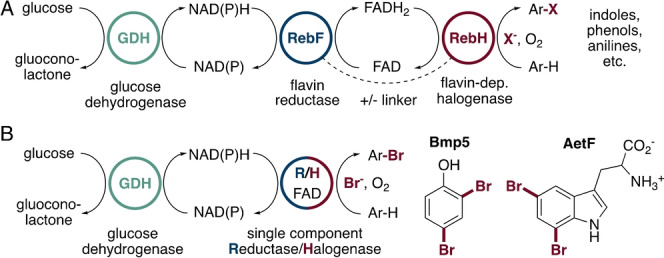
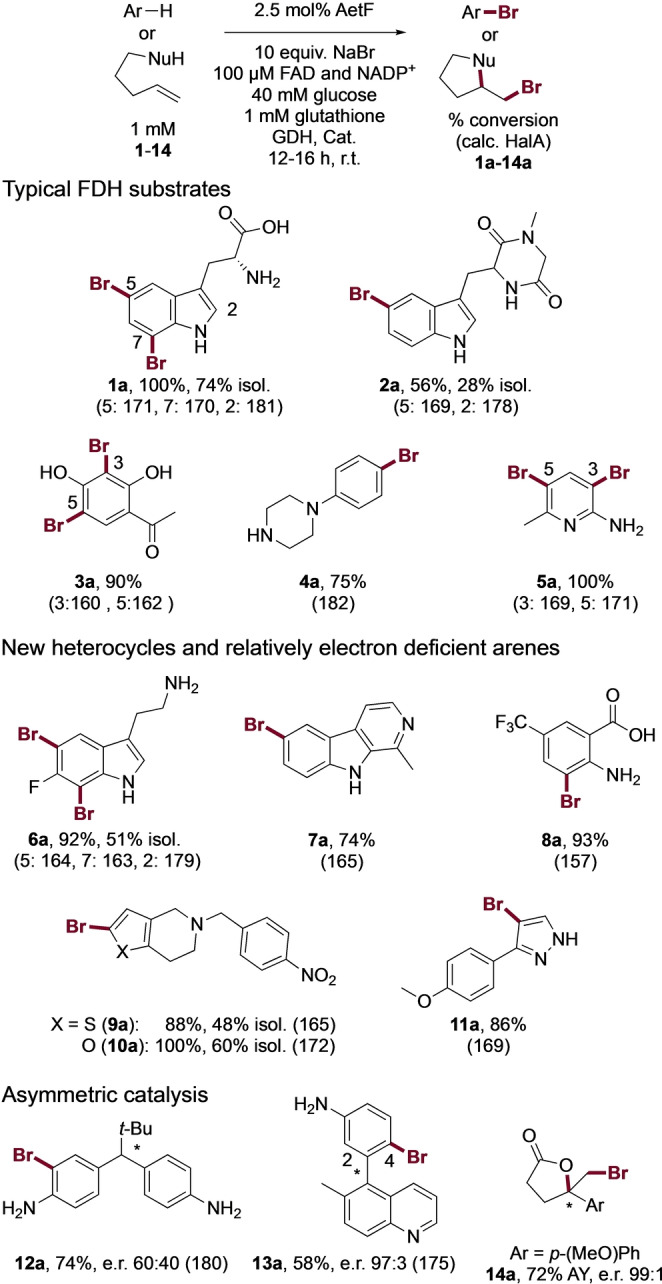
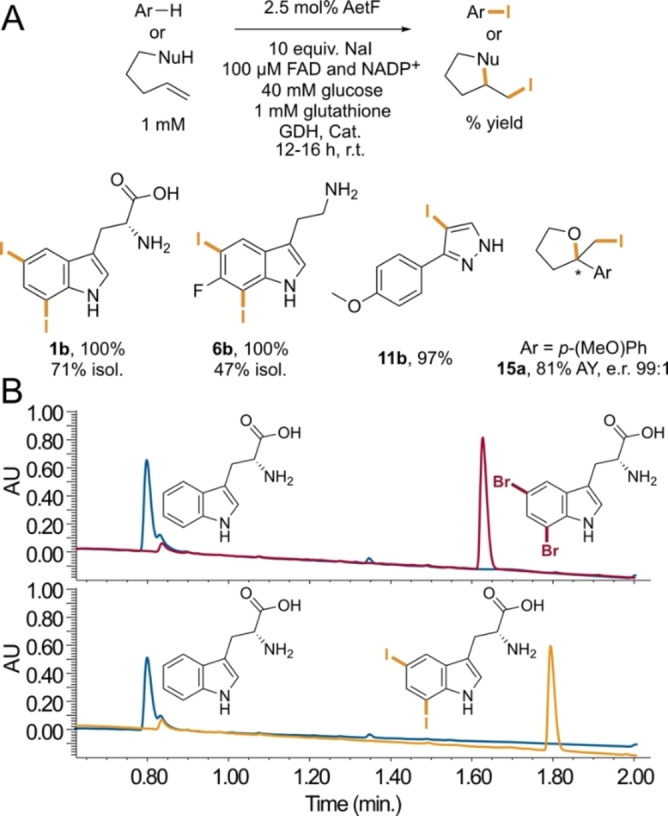
Flavin-dependent halogenases (FDHs) natively catalyze selective halogenation of electron rich aromatic and enolate groups. Nearly all FDHs reported to date require a separate flavin reductase to supply the FADH2¬ required by these enzymes. This requirement complicates biocatalysis applications since flavin reductases are not widely available, they add to the protein waste that must be removed during product isolation, and they can lead to undesired background reactions. In this study, we establish that the single component flavin reductase/flavin dependent halogenase AetF catalyzes halogenation of a diverse set of substrates. High site selectivity was observed in many cases, and activity on relatively unactivated substrates and heterocyclic substrates was demonstrated. High enantioselectivity was observed for atroposelective halogenation and halocyclization reactions. Site-selective iodination and enantioselective cycloiodoetherification was also possible using AetF. The substrate and reaction scope of AetF, along with the fact that this enzyme requires only a commercially available glucose dehydrogenase to drive its halogenase activity, suggest that it has the potential to greatly improve the utility of biocatalytic halogenation.
Overview
The claims and statistics of this paper haven’t been checked yet.
Run the check — free, no account needed. It reads the open-access text and checks the sources it cites.
Integrity signals
Registry
Cites
Statistics
Figures
Verification
Claims the paper makes
The claims and statistics of this paper haven’t been checked yet.
Run the check — free, no account needed. It reads the open-access text and checks the sources it cites.
Self-check
Percentages, sums and reported differences re-computed from the paper’s own numbers.
The self-check needs the paper’s full text.
Citations
Cites
Highly accurate protein structure prediction with AlphaFold
Jumper, J., Evans, R., Pritzel, A., Green, T., Figurnov, M., Ronneberger, O., Tunyasuvunakool, K., Bates, R., Žídek, A., Potapenko, A., et al. (2021) · Nature · doi:10.1038/s41586-021-03819-2 · Cited by 43,764
Metadata
- Authors
- Jiang, Y., Snodgrass, H. M., Zubi, Y. S., Roof, C. V., Guan, Y., Mondal, D., Honeycutt, N. H., Lee, J. W., Lewis, R. D., Martinez, C., & Lewis, J. C.
- Affiliations
- Indiana University Bloomington (US)
- Pfizer (United States) (US)
- Corresponding author
- Lewis, Jared C.
- ORCID
- Venue
- Angewandte Chemie International Edition
- Publisher
- American Chemical Society (ACS)
- Published
- 2022-10-05
- Volume
- 61
- Issue
- 51
- Pages
- e202214610-e202214610
- ISSN
- 1433-7851 (ISSN-L)
- PMC
- PMC9772203
- OpenAlex
- W4307230595
- Cited by
- 44
- References
- 1
- Citations by year
- 2026: 6 · 2025: 14 · 2024: 15 · 2023: 8 · 2022: 1
- FWCI
- 3.10
- Type
- journal article
- Language
- en
- Open access
- hybrid
- doi.org
- Licence
- Locations
- Angewandte Chemie International Edition (publishedVersion, cc-by-nc-nd)
- ChemRxiv (acceptedVersion, cc-by-nc-nd)
- PubMed Central (publishedVersion, cc-by-nc-nd)
- PubMed (publishedVersion)
- Funders
- National Institutes of Health (R01 GM115665)
- Topics
- Life Sciences › Biochemistry, Genetics and Molecular Biology › Molecular Biology › Enzyme Catalysis and Immobilization
- Physical Sciences › Chemistry › Inorganic Chemistry › Vanadium and Halogenation Chemistry
- Physical Sciences › Chemistry › Organic Chemistry › Oxidative Organic Chemistry Reactions
- Keywords
- flavin-dependent halogenases, flavin reductase, selective bromination, selective iodination, glucose dehydrogenase, bromolactonization
- MeSH terms
- Alkenes, Flavins, Oxidoreductases, Halogenation, Biocatalysis
About these checks
Registry, retraction, Cites and statistics results are computed, not judged, with one exception: a printed reference that no index lists is read once by a model before it counts as a citation error. Claims are extracted by a model and kept only when their quote appears verbatim in the text; each cited source is then checked, with a model’s help, for whether it says what the claim relies on. Those verdicts can be wrong — read the claim’s quote and the cited source before relying on one.
Statistics and arithmetic are recomputed, not judged.
Confidence bands are shown only for fields calibrated on our annotated test set. None is calibrated yet, so no band is shown.
What counts as a claim ›How we measure confidence ›How we check this ›
Are you an author, or do you see a problem with this page? Request a review
