

The DOI matches its Crossref record; its reference list is not available.
The global threat from the irreversible accumulation of trifluoroacetic acid (TFA)
Open accessPreprint — published as 10.1021/acs.est.4c06189 · Paper page
Abstract
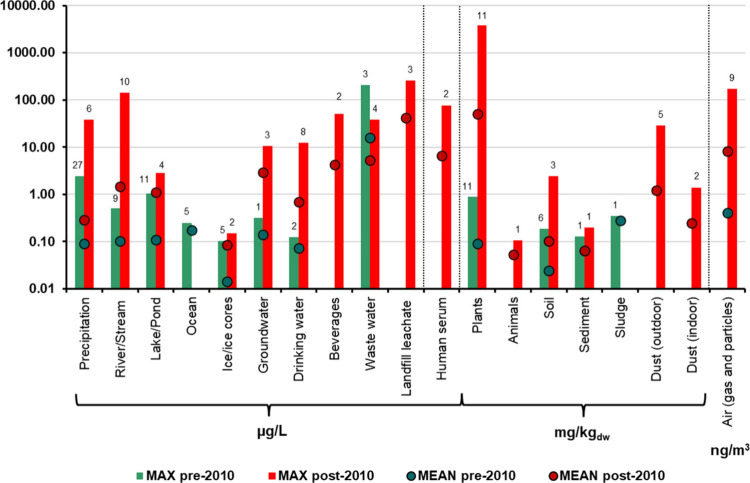
Trifluoroacetic acid (TFA) is a hydrophilic, non-degradable substance that has been increasing in concentrations within diverse environmental media, including rain, soils, human serum, plants, plant-based foods, and drinking water. Currently, TFA concentrations are orders of magnitude higher than those of other per- and polyfluoroalkyl substances (PFAS). This accumulation is due to many PFAS that have TFA as a transformation byproduct, including several fluorinated gases (F-gases), high-volume pesticides, pharmaceuticals and industrial chemicals, in addition to direct industrial release. Due to TFA’s extreme persistence and mobility, these concentrations are increasing irreversibly. What remains less clear is the thresholds where irreversible effects on local or global scales occur. There are indications from mammalian toxicity studies that TFA is toxic to reproduction and that it exhibits liver toxicity. Ecotoxicity data are scarce, with most data for aquatic systems; fewer data are available for terrestrial plants, where TFA bioaccumulates most readily. Collectively, these trends imply that TFA meets the criteria of a planetary boundary threat for novel entities because of increasing planetary-scale exposure, where potential, irreversible disruptive impacts on vital earth system processes could occur. The rational response to this is to instigate binding actions to reduce emissions of TFA and its many precursors.
Overview
The claims and statistics of this paper haven’t been checked yet.
Run the check — free, no account needed. It reads the open-access text and checks the sources it cites.
Integrity signals
Registry
Cites
Statistics
Figures
Verification
Claims the paper makes
The claims and statistics of this paper haven’t been checked yet.
Run the check — free, no account needed. It reads the open-access text and checks the sources it cites.
Self-check
Percentages, sums and reported differences re-computed from the paper’s own numbers.
The self-check needs the paper’s full text.
Citations
No citation lists for this paper
No citation lists for this paper yet — checked again daily.
References 105 · Cited by 283
Metadata
- Authors
- Arp, H. P. H., Gredelj, A., Glüge, J., Scheringer, M., & Cousins, I. T.
- Affiliations
- Norwegian Geotechnical Institute (NO)
- ETH Zurich (CH)
- Masaryk University (CZ)
- Stockholm University (SE)
- Corresponding author
- Arp, Hans Peter H.
- Venue
- Environmental Science & Technology
- Publisher
- American Chemical Society (ACS)
- Published
- 2024-06-19
- Volume
- 58
- Issue
- 45
- Pages
- 19925-19935
- ISSN
- 0013-936X (ISSN-L)
- PMC
- PMC11562725
- OpenAlex
- W4403922499
- Cited by
- 283
- References
- 105
- Citations by year
- 2026: 178 · 2025: 102 · 2024: 3
- FWCI
- 9.16
- Type
- journal article
- Language
- en
- Open access
- hybrid
- doi.org
- Locations
- Environmental Science & Technology (publishedVersion, cc-by)
- ChemRxiv (acceptedVersion, cc-by)
- PubMed Central (publishedVersion, cc-by)
- PubMed (publishedVersion)
- Funders
- European Commission (101036756)
- H2020 Environment (101036756)
- HORIZON EUROPE Food, Bioeconomy, Natural Resources, Agriculture and Environment (101112723)
- Topics
- Physical Sciences › Environmental Science › Environmental Chemistry › Per- and polyfluoroalkyl substances research
- Physical Sciences › Chemistry › Organic Chemistry › Fluorine in Organic Chemistry
- Physical Sciences › Environmental Science › Health, Toxicology and Mutagenesis › Toxic Organic Pollutants Impact
- Keywords
- trifluoroacetic acid, per- and polyfluoroalkyl substances, fluorinated gases, persistent mobile toxic substances, environmental accumulation, planetary boundaries, novel entities, reproductive toxicity, hepatotoxicity, plant bioaccumulation, ecotoxicity, emission reduction policy
- MeSH terms
- Animals, Environmental Monitoring, Environmental Pollutants, Humans, Trifluoroacetic Acid
About these checks
Registry, retraction, Cites and statistics results are computed, not judged, with one exception: a printed reference that no index lists is read once by a model before it counts as a citation error. Claims are extracted by a model and kept only when their quote appears verbatim in the text; each cited source is then checked, with a model’s help, for whether it says what the claim relies on. Those verdicts can be wrong — read the claim’s quote and the cited source before relying on one.
Statistics and arithmetic are recomputed, not judged.
Confidence bands are shown only for fields calibrated on our annotated test set. None is calibrated yet, so no band is shown.
What counts as a claim ›How we measure confidence ›How we check this ›
Are you an author, or do you see a problem with this page? Request a review
How to cite
Cite CoChat for the checks on this page, and the paper for its own findings.
- This page
- CoChat. (2026). Citation check: The global threat from the irreversible accumulation of trifluoroacetic acid (TFA). https://app.cochat.ai/papers/10.26434/chemrxiv-2024-0djqt
- The paper
- Arp, H. P. H., Gredelj, A., Glüge, J., Scheringer, M., & Cousins, I. T. (2024). The global threat from the irreversible accumulation of trifluoroacetic acid (TFA). Environmental Science & Technology. https://doi.org/10.26434/chemrxiv-2024-0djqt
