

PDB-CAT: A User-Friendly Tool to Classify and Analyze PDB Protein-Ligand Complexes
Open accessPreprint — published as 10.1002/pro.70379
The DOI matches its Crossref record; 1 of the 1 references it cites were found in a registry or an index.
Abstract
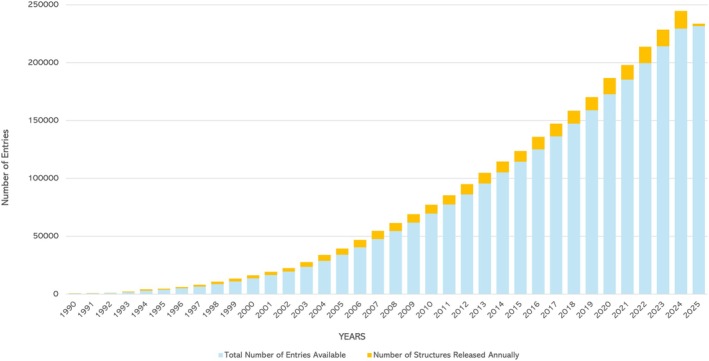
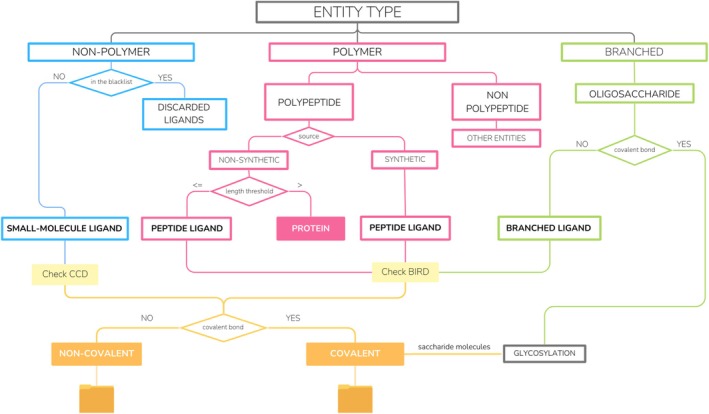
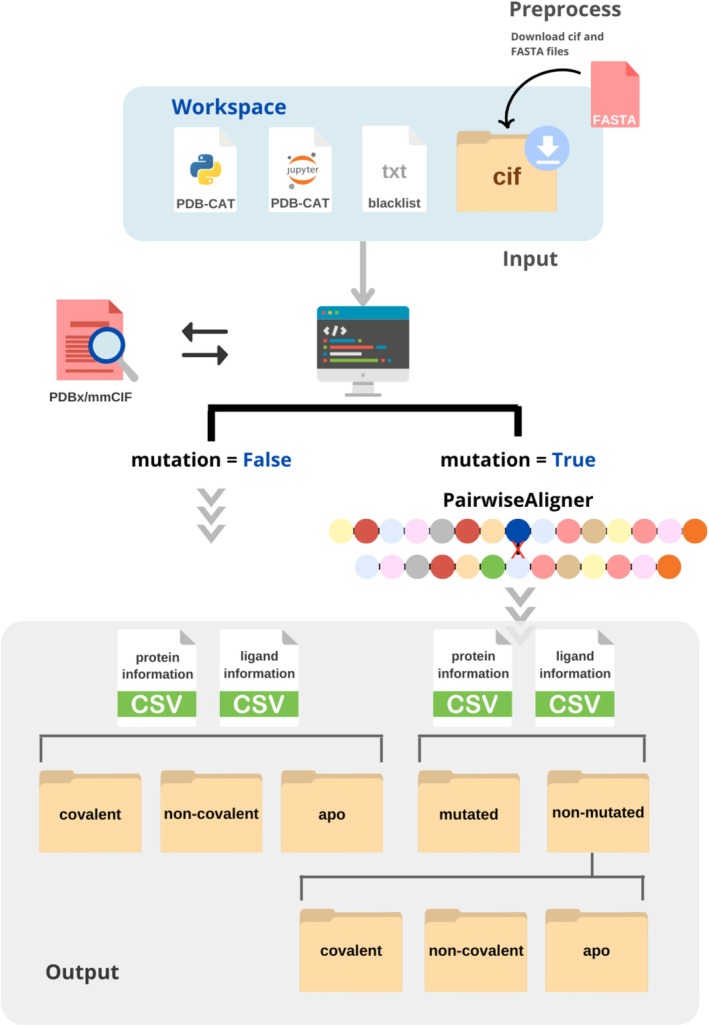
The Protein Data Bank contains more than 223,000 three dimensional biostructures and is growing at a rate of nearly 10% per year. The lack of a tool that facilitates the classification between apo and holo structures and differentiates between covalent and non-covalent ligand protein complexes, makes it difficult to manage a large number of structures. To address this issue, we present PDBCAT, a user-friendly tool that facilitates the categorization and extraction of key information from PDBx/mmCIF files. PDB-CAT is a program that classifies a group of protein structures based on their ligands into three categories: apo, covalently, and non-covalently bonded. Besides this classification, the program can verify if there are any mutations in the protein sequence by comparing it to a reference sequence. PDB-CAT is designed to be user-friendly, with its output clearly defining every entity present in each entry to facilitate decision-making. PDB-CAT is now available on GitHub (https://github.com/URV-cheminformatics/PDB-CAT).
Overview
The claims and statistics of this paper haven’t been checked yet.
Free: it reads the open-access text and checks the first 5 claims that cite a source we can check. Create a free account to check every claim.
Integrity signals
Registry
Cites
Statistics
Figures
Verification
Claims the paper makes
The claims and statistics of this paper haven’t been checked yet.
Free: it reads the open-access text and checks the first 5 claims that cite a source we can check. Create a free account to check every claim.
Self-check
Percentages, sums and reported differences re-computed from the paper’s own numbers.
The self-check needs the paper’s full text.
Citations
Cites
Highly accurate protein structure prediction with AlphaFold
Jumper, J., Evans, R., Pritzel, A., Green, T., Figurnov, M., Ronneberger, O., Tunyasuvunakool, K., Bates, R., Žídek, A., Potapenko, A., et al. (2021) · Nature · doi:10.1038/s41586-021-03819-2 · Cited by 43,764
Metadata
- Authors
- Llop-Peiró, A., Pujadas, G., Gimeno, A., & Garcia-Vallvé, S.
- Affiliations
- Universidad Rovira i Virgili
- Universitat Rovira i Virgili (ES)
- Corresponding author
- Gimeno, Aleix
- Venue
- Protein Science
- Publisher
- American Chemical Society (ACS)
- Published
- 2024-08-12
- Volume
- 34
- Issue
- 12
- Pages
- e70379-e70379
- ISSN
- 0961-8368 (ISSN-L)
- PMC
- PMC12612595
- OpenAlex
- W4416193905
- Cited by
- 1
- References
- 1
- Citations by year
- 2026: 1
- FWCI
- 0.52
- Type
- journal article
- Language
- en
- Open access
- hybrid
- doi.org
- Licence
- Locations
- Protein Science (publishedVersion, cc-by-nc-nd)
- ChemRxiv (acceptedVersion, cc-by-nc-nd)
- Europe PMC (PubMed Central) (publishedVersion, cc-by-nc-nd)
- PubMed (publishedVersion)
- Rovira & Virgili repository (submittedVersion, cc-by)
- Funders
- Universitat Rovira i Virgili (MCIN/AEI/10.13039/501100011033/)
- Agencia Estatal de Investigación (501100011033, 13039, .13039/501100011033, 501100011033/FEDER, AEI/10)
- NextGenerationEU (MCIN/AEI/10.13039/5011 00011033, 13039/501100011033, AEI/10.13039/501100011033, 10.13039/501100011033)
- Topics
- Life Sciences › Pharmacology, Toxicology and Pharmaceutics › Drug Discovery › Computational Drug Discovery Methods
- Life Sciences › Biochemistry, Genetics and Molecular Biology › Structural Biology › Enzyme Structure and Function
- Life Sciences › Biochemistry, Genetics and Molecular Biology › Molecular Biology › Protein Structure and Dynamics
- Keywords
- protein-ligand complex, Protein Data Bank, ligand identification, main protease
- MeSH terms
- SARS-CoV-2, Humans, Ligands, Protein Binding, Protein Conformation, Proteins, Software, Databases, Protein
About these checks
Registry, retraction, Cites and statistics results are computed, not judged, with one exception: a printed reference that no index lists is read once by a model before it counts as a citation error. Claims are extracted by a model and kept only when their quote appears verbatim in the text; each cited source is then checked, with a model’s help, for whether it says what the claim relies on. Those verdicts can be wrong — read the claim’s quote and the cited source before relying on one.
Statistics and arithmetic are recomputed, not judged.
Confidence bands are shown only for fields calibrated on our annotated test set. None is calibrated yet, so no band is shown.
What counts as a claim ›How we measure confidence ›How we check this ›
Are you an author, or do you see a problem with this page? Request a review
Data sources
Bibliographic data: Semantic Scholar, OpenAlex, Crossref.
Contains information from the Semantic Scholar Academic Graph Datasets, made available under the ODC Attribution License (ODC-BY 1.0).
Semantic Scholar’s data is described in: Kinney, R., et al. (2023). The Semantic Scholar Open Data Platform. arXiv:2301.10140.
