

Local Entropy in Proteins
Open accessPreprint — published as 10.1039/d5sc06411b · Paper page
The DOI matches its Crossref record; 1 of the 1 references it cites were found in a registry or an index.
Abstract
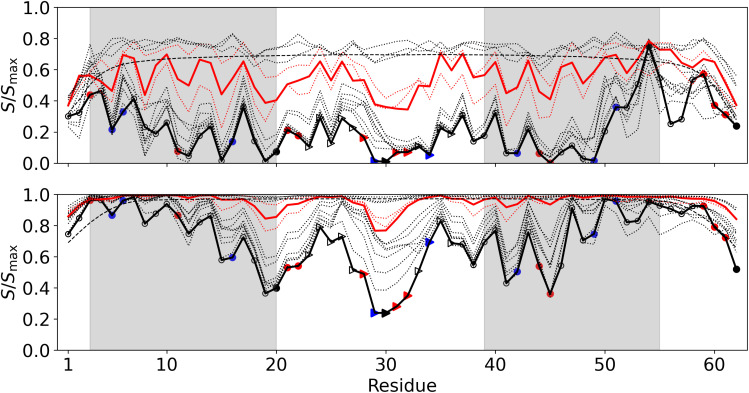
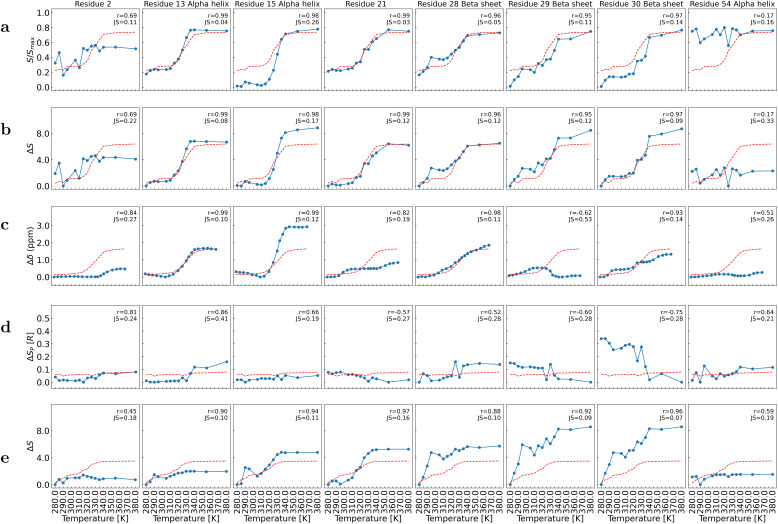
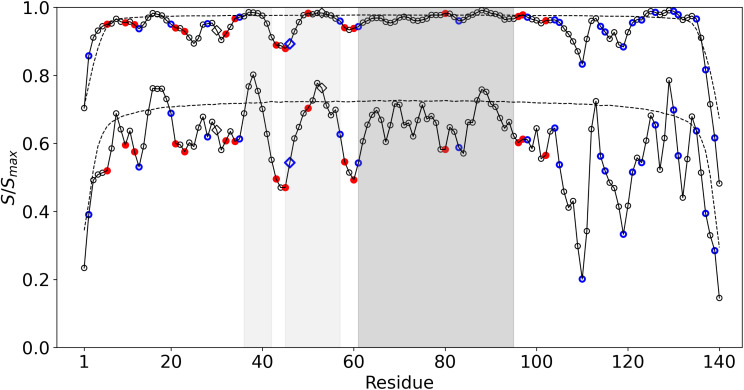
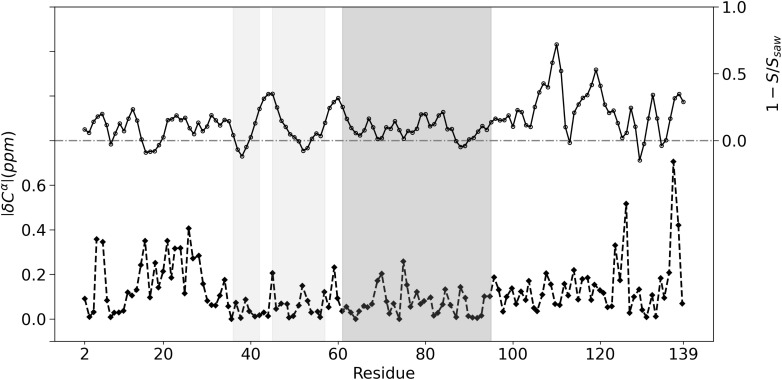
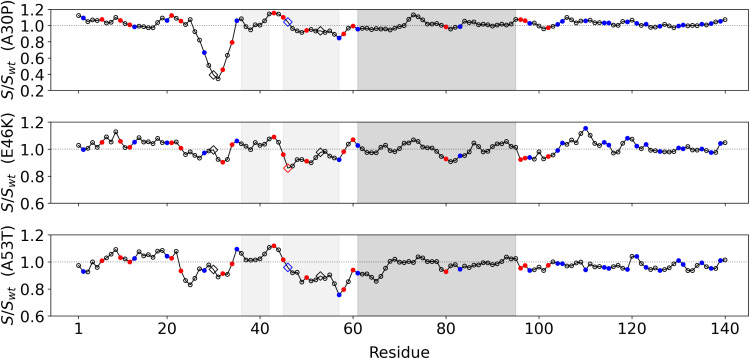
Proteins exist as dynamic conformational ensembles, and understanding how temperature and mutations reshape these ensembles remains challenging. We introduce a local entropy measure, assigning each residue a Shannon entropy S derived from a graph-based representation of its accessible substates, to continuously and quantitatively characterize conformational ensembles spanning folded, unfolded, and intrinsically disordered states. Applied to molecular dynamics simulations of the fast-folding gpW protein (280–380 K) and the intrinsically disordered protein alpha-synuclein (at 310 K), local entropy captures structural complexity beyond conventional secondary structure or motif analysis. For gpW, local entropy shows sharp changes near the melting temperature (T_m = 330 K), enabling interpretation of S(T) as a local denaturation curve. These local curves can be clustered into five categories when compared to the global unfolding transition, defined by the residue-averaged S(T). For alpha-synuclein, the local entropy profile is heterogeneous and resembles the local entropy behavior of gpW near T_m. The average values of S follow the trend: S_C-term < S_N-term < S_NAC where the averages are taken over the C-terminal, N-terminal, and NAC (non-amyloid-beta component) regions, respectively. In Parkinson’s disease-linked mutants (A30P, E46K, A53T), point mutations locally reduce S while increasing/decreasing it elsewhere along the sequence. Overall, local entropy reflects the number of accessible substates (as predicted by the Boltzmann formula) and correlates well with NMR data, including temperature dependent alpha carbon atom chemical shifts (for gpW) and disorder-related shift scores (for alpha-synuclein). These results highlight how temperature and subtle perturbations, as single-residue changes, can remodel conformational ensembles
Overview
The claims and statistics of this paper haven’t been checked yet.
Free: it reads the open-access text and checks the first 5 claims that cite a source we can check. Create a free account to check every claim.
Integrity signals
Registry
Cites
Statistics
Figures
Verification
Claims the paper makes
The claims and statistics of this paper haven’t been checked yet.
Free: it reads the open-access text and checks the first 5 claims that cite a source we can check. Create a free account to check every claim.
Self-check
Percentages, sums and reported differences re-computed from the paper’s own numbers.
The self-check needs the paper’s full text.
Citations
Cites
Highly accurate protein structure prediction with AlphaFold
Jumper, J., Evans, R., Pritzel, A., Green, T., Figurnov, M., Ronneberger, O., Tunyasuvunakool, K., Bates, R., Žídek, A., Potapenko, A., et al. (2021) · Nature · doi:10.1038/s41586-021-03819-2 · Cited by 43,764
Metadata
- Authors
- Senet, P., Guzzo, A., Delarue, P., Laforge, C., Maisuradze, G. G., Heydel, J.-M., Neiers, F., & Nicolaï, A.
- Affiliations
- Centre National de la Recherche Scientifique (FR)
- Inserm (FR)
- Cornell University (US)
- Université Bourgogne Europe
- Corresponding author
- Senet, Patrick
- Venue
- Chemical Science
- Publisher
- American Chemical Society (ACS)
- Published
- 2025-07-14
- Volume
- 17
- Issue
- 11
- Pages
- 5482-5497
- ISSN
- 2041-6520 (ISSN-L)
- PMC
- PMC12826060
- OpenAlex
- W7115588821
- Cited by
- 3
- References
- 1
- Citations by year
- 2026: 2 · 2025: 1
- FWCI
- 0.90
- Type
- journal article
- Language
- en
- Open access
- diamond
- doi.org
- Licence
- Locations
- Chemical Science (publishedVersion, cc-by-nc)
- ChemRxiv (acceptedVersion, cc-by-nc-nd)
- PubMed Central (publishedVersion, cc-by-nc)
- PubMed (publishedVersion)
- Funders
- European Commission (ANR-17-EURE-0002)
- Agence Nationale de la Recherche (ANR-17-EURE-, ANR-17-EURE-0002, ANR-17)
- Conseil régional de Bourgogne-Franche-Comté (ANR‐17‐EURE‐0002, 2021/2027, PO FEDER-FSE Bourgogne 2021/2027)
- Topics
- Life Sciences › Biochemistry, Genetics and Molecular Biology › Molecular Biology › Protein Structure and Dynamics
- Life Sciences › Biochemistry, Genetics and Molecular Biology › Molecular Biology › RNA and protein synthesis mechanisms
- Physical Sciences › Chemistry › Physical and Theoretical Chemistry › Advanced Physical and Chemical Molecular Interactions
- Keywords
- local entropy, protein conformational ensembles, protein unfolding, intrinsically disordered proteins, Shannon entropy, alpha-synuclein, accessible volume, packing entropy, Debye-Waller factor, hydrophobic effect, temperature effects, structural complexity, fibril formation
About these checks
Registry, retraction, Cites and statistics results are computed, not judged, with one exception: a printed reference that no index lists is read once by a model before it counts as a citation error. Claims are extracted by a model and kept only when their quote appears verbatim in the text; each cited source is then checked, with a model’s help, for whether it says what the claim relies on. Those verdicts can be wrong — read the claim’s quote and the cited source before relying on one.
Statistics and arithmetic are recomputed, not judged.
Confidence bands are shown only for fields calibrated on our annotated test set. None is calibrated yet, so no band is shown.
What counts as a claim ›How we measure confidence ›How we check this ›
Are you an author, or do you see a problem with this page? Request a review
How to cite
Cite CoChat for the checks on this page, and the paper for its own findings.
- This page
- CoChat. (2026). Citation check: Local Entropy in Proteins. https://app.cochat.ai/papers/10.26434/chemrxiv-2025-qcd4w
- The paper
- Senet, P., Guzzo, A., Delarue, P., Laforge, C., Maisuradze, G. G., Heydel, J.-M., Neiers, F., & Nicolaï, A. (2025). Local Entropy in Proteins. Chemical Science. https://doi.org/10.26434/chemrxiv-2025-qcd4w
Data sources
Bibliographic data: Semantic Scholar, OpenAlex, Crossref.
Contains information from the Semantic Scholar Academic Graph Datasets, made available under the ODC Attribution License (ODC-BY 1.0).
Semantic Scholar’s data is described in: Kinney, R., et al. (2023). The Semantic Scholar Open Data Platform. arXiv:2301.10140.
