

The DOI matches its Crossref record.
Engaging Novice Writers in Online Collaborative Review through Peer-Review Circles
Open accessAbstract
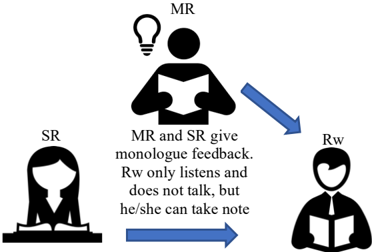
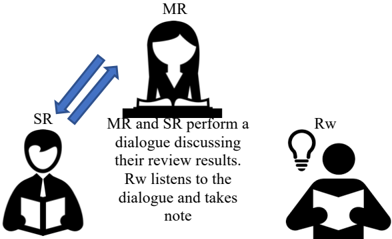
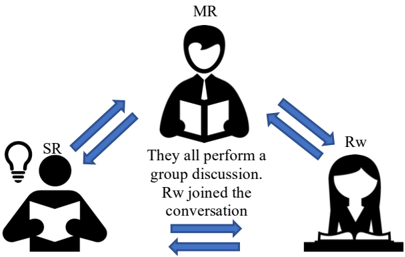
In response to the Covid-19 pandemic, this article presents online Peer-Review Circles (PRC) as an innovative and collaborative approach to academic writing, mainly proofreading and copy-editing processes. It aims to engage novice second language (L2) writers in online joint review and increase their understanding of pre-reviewing scholarly papers before submission. The authors had observed that a large number of doctoral students are still considered novice writers. Therefore, there was a need for a practical approach to improve their review skills and engage them in online PRC activities. Grounded in Monologue-Dialogue-Discussion (MDD) Circles (Manning & Jobbitt, 2018), this article extends its potential to be adopted and used beyond the classroom and mandatory ELT contexts. MDD requires three consecutive stages: 1) primary reviewer’s monologue, 2) primary and secondary reviewer’s dialogue, and 3) writer and the reviewers perform a group discussion. These activities will help the writers to look after the manuscripts simultaneously from a PRC perspective. We also developed peer review Feedback Questions (FQs) to guide the reviewers to perform meaningful discussions. The output of the PRCs will likely be an initial review or a pre-evaluation process to improve the manuscript quality, readability, and publishability.
Overview
The claims and statistics of this paper haven’t been checked yet.
Run the check — free, no account needed. It reads the open-access text and checks the sources it cites.
Integrity signals
Registry
Cites
Statistics
Figures
Verification
Claims the paper makes
The claims and statistics of this paper haven’t been checked yet.
Run the check — free, no account needed. It reads the open-access text and checks the sources it cites.
Claims other papers make about this one
Each is checked against this paper’s own text: does it say what the citing paper says it does?
In the citing paper
“Furthermore, factors such as limited experience (Yucel et al., 2014), inadequate subject knowledge (Kostopoulou and O’Dwyer, 2021), and constrained metacognitive abilities (Nur and Anas, 2022) have also been identified as contributing factors to this challenge.”
From Incorporating peer feedback in academic writing: a systematic review of benefits and challenges (2024) · cites this paper as Nur and Anas, 2022
Self-check
Percentages, sums and reported differences re-computed from the paper’s own numbers.
The self-check needs the paper’s full text.
Citations
Cites
No references could be resolved yet.
Research works printed but not linked: 18
- Ahmadian, M., Maftoon, P., & Birjandi, P. (2021). Collaborative Discussion Circles : A Path towards Critical Language Teacher Development. Journal of English Language Pedagogy and Practice, 13(26), 230-253.
- Anas, I. (2018). Teacher professional development in an online community of practice (OCoP): Teacher's engagement and participation in a facebook-mediated communication (FMC). Asian EFL Journal, 20(5).
- Arsyad, S., Nur, S., Nasihin, A., Syahrial, & Adnan, Z. (2021). Writing in a Foreign Language: The Rhetorical and Argument Styles in Research Article Drafts by Nonnative Speakers of English in Linguistics and Language Education. International Journal of Language Education, 5(3), 135-151.
- Breuch, L.-A. K. (2004). Virtual peer review: teaching and learning about writing in online environments. State University of New York Press.
- Bruffee, K. A. (1984). Collaborative Learning and the "Conversation of Mankind." College English, 46(7), 635-652.
- Bui, G., & Kong, A. (2019). Metacognitive instruction for peer review interaction in L2 writing. Journal of Writing Research, 11(2), 357-392. https://doi.org/10.17239/jowr-2019.11.02.05 · DOI
- Cook, M. (2019). What Makes an Excellent Journal Paper ? Science and Technology for the Built Environment, 25(2), 113. https://doi.org/10.1080/23744731.2019.1583942 · DOI
- Ferdiansyah, S., Ridho, M. A., Sembilan, F. D., Sembilan, F. D., & Zahro, S. F. (2020). Online literature circles during the COVID-19 pandemic : Engaging undergraduate students in Indonesia Indonesia. TESOL Journal, 11(e544). https://doi.org/10.1002/tesj.544 · DOI
- Kirschner, P. A., & Lai, K. (2007). Online communities of practice in education. Technology, Pedagogy and Education, 16(2), 127-131. https://doi.org/10.1080/14759390701406737 · DOI
- Magno, C. (2010). The role of metacognitive skills in developing critical thinking. Metacognition and Learning, 5, 137-156. https://doi.org/10.1007/s11409-010-9054-4 · DOI
- Manning, S. J., & Jobbitt, T. (2018). Engaged and Interactive Peer Review : Introducing Peer Review Circles. RELC Journal, 1-8. https://doi.org/10.1177/0033688218791832 · DOI
- Rajagopal, K., Hsiao, Y. P. (Amy), Vrieling-Teunterb, E., & Verjans, S. (2018). Thesis circles : Feedback in Personal Learning Networks. Abstract from 25th Annual Conference of the Association for Learning Technology. https://goo.gl/oRfVoJ
- Rajagopal, K., Vrieling-Teunterb, E., Hsiao, Y. P. (Amy), Van Seggelen-Damen, I., & Verjans, S. (2021). Guiding thesis circles in higher education: towards a typology. Professional Development in Education.
- Venegas, E. M. (2018). Strengthening the Reader Self-Efficacies of Reluctant and Struggling Readers Through Literature Circles Strengthening the Reader Self-Efficacies of Reluctant and Struggling Readers Through Literature Circles. Reading & Writing Quarterly, 1-17. https://doi.org/10.1080/10573569.2018.1483788 · DOI
- Vygotsky, L. . (1978). Mind in society: the development of higher psychological processes. Harvard University Press.
- Wee, B. Van, & Banister, D. (2015). How to Write a Literature Review Paper? Transport Reviews, 36(2), 278-288. https://doi.org/10.1080/01441647.2015.1065456 · DOI · Paper page
- Zamanian, M., & Heydari, P. (2012). Readability of Texts: State of the Art. Theory and Practice in Language Studies, 2(1), 1-5.
- Zhao, H., Sullivan, K. P. H., & Mellenius, I. (2014). Participation, interaction and social presence: An exploratory study of collaboration in online peer review groups. British Journal of Educational Technology, 45(5), 807-819. https://doi.org/10.1111/bjet.12094. · DOI
Cited by
Incorporating peer feedback in academic writing: a systematic review of benefits and challenges
Wei, Y., & Liu, D. (2024) · Frontiers in Psychology · doi:10.3389/fpsyg.2024.1506725 · Cited by 26
Metadata
- Authors
- Nur, S., Anas, I., & Rahayu, R.
- Affiliations
- State University of Makassar (ID)
- Politeknik Negeri Ujung Pandang (ID)
- Universitas Sawerigading Makassar (ID)
- Venue
- International Journal of Language Education
- Publisher
- Universitas Negeri Makassar
- Published
- 2022-03-31
- Volume
- 6
- Issue
- 1
- Pages
- 63
- ISSN
- 2548-8457 (ISSN-L)
- 2548-8465
- OpenAlex
- W4402958092
- Cited by
- 7
- References
- 0
- Citations by year
- 2026: 1 · 2024: 3 · 2023: 3
- FWCI
- 5.65
- Type
- journal article
- Language
- en
- Open access
- diamond
- dx.doi.org
- Licence
- Locations
- International Journal of Language Education (publishedVersion, cc-by)
- Topics
- Social Sciences › Arts and Humanities › Language and Linguistics › EFL/ESL Teaching and Learning
- Social Sciences › Library and Information Sciences › Academic Writing and Publishing
- Social Sciences › Linguistics and Language › Discourse Analysis in Language Studies
- Keywords
- novice writers, second language academic writing, doctoral students, online writing instruction, COVID-19 pandemic
About these checks
Registry, retraction, Cites and statistics results are computed, not judged, with one exception: a printed reference that no index lists is read once by a model before it counts as a citation error. Claims are extracted by a model and kept only when their quote appears verbatim in the text; each cited source is then checked, with a model’s help, for whether it says what the claim relies on. Those verdicts can be wrong — read the claim’s quote and the cited source before relying on one.
Statistics and arithmetic are recomputed, not judged.
Confidence bands are shown only for fields calibrated on our annotated test set. None is calibrated yet, so no band is shown.
What counts as a claim ›How we measure confidence ›How we check this ›
Are you an author, or do you see a problem with this page? Request a review
How to cite
Cite CoChat for the checks on this page, and the paper for its own findings.
- This page
- CoChat. (2026). Citation check: Engaging Novice Writers in Online Collaborative Review through Peer-Review Circles. https://app.cochat.ai/papers/10.26858/ijole.v6i1.26141
- The paper
- Nur, S., Anas, I., & Rahayu, R. (2022). Engaging Novice Writers in Online Collaborative Review through Peer-Review Circles. International Journal of Language Education. https://doi.org/10.26858/ijole.v6i1.26141
Data sources
Bibliographic data: Semantic Scholar, OpenAlex, Crossref.
Contains information from the Semantic Scholar Academic Graph Datasets, made available under the ODC Attribution License (ODC-BY 1.0).
Semantic Scholar’s data is described in: Kinney, R., et al. (2023). The Semantic Scholar Open Data Platform. arXiv:2301.10140.
