

The DOI matches its Crossref record; 18 of the 20 references it cites were found in a registry or an index; none of the 19 sources its claims cite is checked for support yet.
Beyond the search process: Exploring the affective stages in developing a research proposal
Open accessAbstract
This research aims to investigate the affective stages developed in the Information Search Process (ISP) model developed by Carol Kuhlthau. The purpose of this study was to understand how feelings relate to the six stages of conducting a research proposal. Feelings experienced by information seekers include optimism, clarity, confidence and satisfaction or uncertainty, confusion, frustration, and disappointment. This work specifies how feelings affect the various phases of the research process. A qualitative methodology was used for this study. Twenty Information Studies (IS) graduate students from the Social Science department at Kuwait University, who had taken the Research Methods course, were selected for the study using purposive sampling. Face-to-face interviews were conducted in order to collect feelings, perceptions, and views of the participants. Data collected were analysed using the narrative approach of the interviews. The results showed that the feelings of students changed during the different stages of Kuhlthau’s ISP model. The study indicates significant implications for research on information behaviour. It may help students and teachers to be aware of the affective role at different stages of their research proposal writing. It also assesses the possible contribution of intermediaries in helping students during the research writing process.
Overview
CoChat Summary
TL;DR
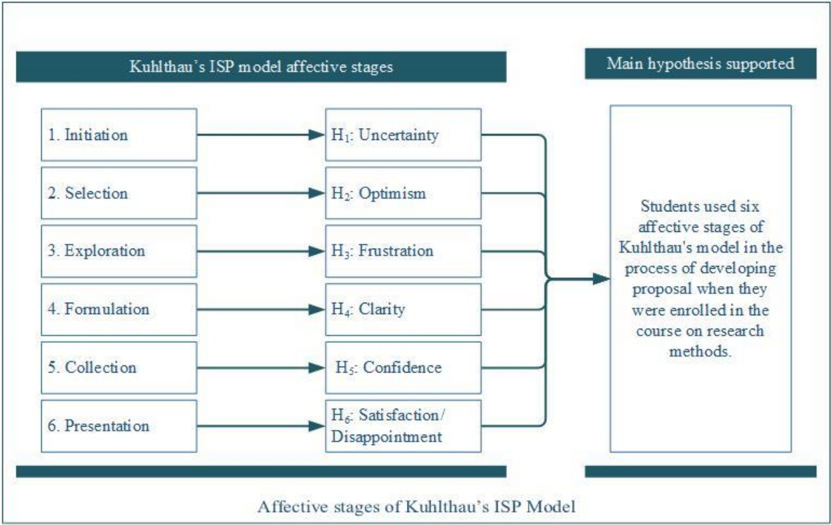
This qualitative interview study of 20 Information Studies graduate students at Kuwait University explored how feelings changed across Kuhlthau’s six Information Search Process stages while developing a research proposal. It reports that the affective stages largely matched Kuhlthau’s model, with H1 partially supported/negligible variation and H2–H6 supported.
Key findings
- Students’ feelings shifted by stage: initial mixed uncertainty/confusion and excitement; selection optimism; exploration anxiety/frustration; formulation clarity/confidence; collection relief/confidence; presentation satisfaction or disappointment. For example, 13/20 showed confusion and anxiety at the initial stage, 17/20 were excited, 19/20 expressed negative feelings such as frustration, anger, and anxiety during selection/exploration, all 20 reported clarity and relief at collection, and 17/20 showed positive feelings toward presentation while 2 were not satisfied.
- Topic selection was unstable for many: 11/20 changed topics once, 4/20 changed several times until accepted, 9/20 did not change, and 4/20 picked a topic related to another course.
- Search and variable difficulties were common: 17/20 could not locate what they wanted on the first attempt, 18/20 found it difficult to identify variables, and 19/20 felt frustrated, angry, or anxious because they found too many sources without confidence in their relevance.
- Hypothesis testing: H1 was partially supported with negligible variation; H2–H6 were supported, and the primary hypothesis that students used six affective stages of Kuhlthau’s model was supported.
Methods
- Qualitative study using open-ended, face-to-face interviews with 20 Information Studies graduate students from the Social Science department at Kuwait University who had taken the Research Methods course; purposive sampling was used, participants were from both genders, and interviews lasted about 20–30 minutes within a two-week period.
- Data were analysed qualitatively using concept coding and a narrative approach; concepts were organised around six developmental stages, and the analysis resolved six hypotheses.
Limitations
- The paper states that other methods might have enhanced results, that various disciplinary and institutional settings may add credibility, that a larger number of participants might bring richness and validity, and that further studies on this and similar behavioural models may strengthen theoretical dimensions.
- Evident from the text: the study is limited to one institution (Kuwait University, described as the only public university in Kuwait), relies on 20 self-report interviews, and does not mention inter-coder reliability or member checking, so findings may not generalise beyond this context.
Model-written summary. Check it against the paper before relying on it.
Integrity signals
Registry
Cites
Statistics
Figures
Verification
Claims the paper makes
0 Valid · 1 Not valid · 20 Not checked · 76 Own results and interpretations
A result the paper states — it cites no source for it, so there is none to check. The quote shows it is in the paper.
In the paper
“They had a good understanding of their selection of information sources for their topics.”
§ Beyond the search process: Exploring the affective stages in developing a research proposal > Confidence and Relief
plainn = 20- Asserted: passes — The authors put it forward as true.
- Checkable: passes — It can be checked against evidence.
- Load-bearing: unclear — It is unclear whether the paper’s conclusions depend on it.
- Based: passes — The paper gives a reason why it holds.
- Rests on an assumption not shown here.
A result the paper reports from its own data — it cites no other source for it, so there is none to check. The quote shows it is in the paper.
In the paper
“The results showed that the feelings of students changed during the different stages of Kuhlthau's ISP model.”
§ Beyond the search process: Exploring the affective stages in developing a research proposal > Abstract
plainstates an association- Asserted: passes — The authors put it forward as true.
- Checkable: passes — It can be checked against evidence.
- Load-bearing: passes — The paper’s conclusions depend on it.
- Based: passes — The paper gives a reason why it holds.
A result the paper reports from its own data — it cites no other source for it, so there is none to check. The quote shows it is in the paper.
In the paper
“and eight of them noted acute frustration as their suggested topics underwent frequent changes.”
§ Beyond the search process: Exploring the affective stages in developing a research proposal > Uncertainty/Confusion
plainn = 20- Asserted: passes — The authors put it forward as true.
- Checkable: passes — It can be checked against evidence.
- Load-bearing: unclear — It is unclear whether the paper’s conclusions depend on it.
- Based: passes — The paper gives a reason why it holds.
A result the paper reports from its own data — it cites no other source for it, so there is none to check. The quote shows it is in the paper.
In the paper
“All participants began by choosing a topic they were interested in.”
§ Beyond the search process: Exploring the affective stages in developing a research proposal > Uncertainty/Confusion
plainn = 20- Asserted: passes — The authors put it forward as true.
- Checkable: passes — It can be checked against evidence.
- Load-bearing: unclear — It is unclear whether the paper’s conclusions depend on it.
- Based: passes — The paper gives a reason why it holds.
A result the paper reports from its own data — it cites no other source for it, so there is none to check. The quote shows it is in the paper.
In the paper
“It was found that 17 of the 20 participants showed positive feelings toward the presentation of the research proposal.”
§ Beyond the search process: Exploring the affective stages in developing a research proposal > Satisfaction
plainn = 20- Asserted: passes — The authors put it forward as true.
- Checkable: passes — It can be checked against evidence.
- Load-bearing: unclear — It is unclear whether the paper’s conclusions depend on it.
- Based: passes — The paper gives a reason why it holds.
- Rests on an assumption not shown here.
37 more claims
Create a free account to see all 97 claims and to verify the 16 references still open.
- It may state two separate claims as one. 34
- Probably not a substantial claim. 28
Self-check
Percentages, sums and reported differences re-computed from the paper’s own numbers.
Each contradiction between two passages listed here was confirmed by an independent check.
Rated major: it would touch a result — a value a result rests on, reported and recomputed p-values on opposite sides of the significance level, two passages that conflict with no sign which is right, or a cited work retracted before this paper was published.
In the paper
§ Beyond the search process: Exploring the affective stages in developing a research proposal > Uncertainty/Confusion
“Eleven of them mentioned that they had to change the topic multiple times”
§ Beyond the search process: Exploring the affective stages in developing a research proposal > Selection Stage: Selecting the Research Proposal Topic
“It was found that 11 of the 20 participants changed their topics once; four of them admitted that they changed it several times until it got accepted.”
Rated minor: it would not touch a result — a value no result rests on, a p-value that stays on the same side of the significance level, or a conflict that is clerical, resolved elsewhere in the paper, or outside its own findings.
In the paper
§ Beyond the search process: Exploring the affective stages in developing a research proposal > Findings
“course requirement of 1330509 in Semester 2, 2018-19.”
§ Beyond the search process: Exploring the affective stages in developing a research proposal > Conclusion
“Course 1331509 entitled Research Methods in Information Studies.”
Rated minor: it would not touch a result — a value no result rests on, a p-value that stays on the same side of the significance level, or a conflict that is clerical, resolved elsewhere in the paper, or outside its own findings.
In the paper
§ Beyond the search process: Exploring the affective stages in developing a research proposal > Optimism
“Once all the participants chose topics and got them approved, all students felt as if they liked their topics”
§ Beyond the search process: Exploring the affective stages in developing a research proposal > Conclusion
“Only one of the participants said they did not like their topic, but since the instructor approved it they continued working on it.”
Citations
Cites
Inside the search process: Information seeking from the user's perspective
Kuhlthau, C. C. (1991) · Journal of the American Society for Information Science · doi:10.1002/(sici)1097-4571(199106)42:5<361::aid-asi6>3.0.co;2-# · Cited by 2,166
ON USER STUDIES AND INFORMATION NEEDS
WILSON, T. D. (1981) · Journal of Documentation · doi:10.1108/eb026702 · Cited by 1,565
Savolainen, R. (2007) · The Library Quarterly · doi:10.1086/517840 · Cited by 522
Emotions as motivators for information seeking: A conceptual analysis
Savolainen, R. (2014) · Library & Information Science Research · doi:10.1016/j.lisr.2013.10.004 · Cited by 194
Savolainen, R. (2015) · Journal of Documentation · doi:10.1108/jd-10-2013-0134 · Cited by 68
Wu, D., Dang, W., He, D., & Bi, R. (2016) · Journal of Librarianship and Information Science · doi:10.1177/0961000616654960 · Cited by 19
Affective Experiences of International and Home Students During the Information Search Process
Haley, A. N., & Clough, P. D. (2017) · New Review of Academic Librarianship · doi:10.1080/13614533.2017.1308387 · Cited by 13
The Role of Affect in the Information Seeking of Productive Scholars
Fitzgerald, S. R. (2018) · The Journal of Academic Librarianship · doi:10.1016/j.acalib.2018.01.001 · Cited by 13
Models of Information Seeking Behaviour: A Comparative Study
Kundu, D. K. (2017) · SSRN Electronic Journal · doi:10.2139/ssrn.4289303 · Cited by 12
Kim, S. (2015) · School Libraries Worldwide · doi:10.29173/slw6896 · Cited by 10
Research works printed but not linked: 4
- Burdick, T.A. (1996). Success and diversity in information seeking: Gender and the information search styles model. School Library Media Quarterly, 25(1), 19-26. Library and Information Research https://doi.org/10.29173/lirg818 _____________________________________________________________________________________________ _____________________________________________________________________________ Aladem & Rehman 27 · doi:10.29173/lirg818__________________________________________________________________________________________________________________________________________________________________________aladem&rehman27
- Dyckman, L. (2005). Fear of failure and fear of finishing: A case study on the emotional aspects of dissertation proposal research, with thoughts on library instruction and graduate student retention. ACRL Twelfth National Conference. Retrieved from https://www.ala.org/acrl/sites/ala.org.acrl/files/content/conferences/pdf/dyckman05.pdf
- Kobe, S. (2006). Adapting Kuhlthau's Information Search Process Model to a life information need: The search for a new job. (Unpublished dissertation). Emporia State University, United States. Retrieved from http://staceykobe.wdfiles.com/local-- files/demonstrate/LI_802.pdf
- Orlu, A., Ilo, H., & Tochukwu, N. (2017). Perceived emotions in the information seeking behaviour of Manchester Metropolitan University Students. Library Philosophy and Library and Information Research https://doi.org/10.29173/lirg818 _____________________________________________________________________________________________ _____________________________________________________________________________ Aladem & Rehman 29 Practice (e-journal), 1534. Retrieved from http://digitalcommons.unl.edu/libphilprac/1534. · doi:10.29173/lirg818__________________________________________________________________________________________________________________________________________________________________________aladem&rehman29practice(e-journal
Cited by
Information needs and information-seeking behavior of university students in Bandung Raya
Putri, D. N., Prijana, P., & Chigbundu, M. C. (2024) · Jurnal Kajian Informasi & Perpustakaan · doi:10.24198/jkip.v12i2.51367 · Cited by 5
Exploring Burmese Graduate Students’ Information Search Process Using Kuhlthau’s Model
Tsawm, H. M., Cantel, A. M. B., & Yap, J. M. (2025) · New Review of Academic Librarianship · doi:10.1080/13614533.2025.2491325 · Cited by 2
Muhammad Nurfadillah (2023) · Repository at Universitas Pendidikan Indonesia (Universitas Pendidikan Indonesia)
The Information Behavior of Fashion Students in the UK
Cummings, R. A. (2025) · City Research Online (City University London)
Mawela, M. L. (2025) · ResearchSpace (University of KwaZulu-Natal)
Metadata
- Authors
- Aladem, D., & Rehman, S.
- Affiliations
- Kuwait University (KW)
- ORCID
- Rehman, Sajjad
- Venue
- Library and Information Research
- Publisher
- University of Alberta Libraries
- Published
- 2022-12-19
- ISSN
- 0141-6561 (ISSN-L)
- 1756-1086
- OpenAlex
- W4313436950
- Semantic Scholar
- e142f06ebe0e0b7ea9512a10ea922475a3285bca
- Cited by
- 5
- References
- 20
- Citations by year
- 2025: 3 · 2024: 1 · 2023: 1
- FWCI
- 1.35
- Type
- journal article
- Language
- en
- Open access
- diamond
- doi.org
- Locations
- Library and Information Research (publishedVersion, cc-by)
- Topics
- Social Sciences › Library and Information Sciences › Library Science and Information Literacy
- Social Sciences › Education › Doctoral Education Challenges and Solutions
- Social Sciences › Library and Information Sciences › Information Science and Libraries
- Keywords
- information search process, research proposal writing, information behavior, information studies students, graduate students, research process, information intermediaries
About these checks
Registry, retraction, Cites and statistics results are computed, not judged, with one exception: a printed reference that no index lists is read once by a model before it counts as a citation error. Claims are extracted by a model and kept only when their quote appears verbatim in the text; each cited source is then checked, with a model’s help, for whether it says what the claim relies on. Those verdicts can be wrong — read the claim’s quote and the cited source before relying on one.
A language model drew the claims from the paper on 2026-11-18, under version 3 of the claim definition (model deepseek-v4.1-flash, prompt extract-v3).
A second model labelled each claim on 2026-11-18 (model jev-1.13-20260917, definition revision gold-guideline-v0.2).
Statistics and arithmetic are recomputed, not judged.
Confidence bands are shown only for fields calibrated on our annotated test set. None is calibrated yet, so no band is shown.
What counts as a claim ›How we measure confidence ›How we check this ›
Are you an author, or do you see a problem with this page? Request a review
How to cite
Cite CoChat for the checks on this page, and the paper for its own findings.
- This page
- CoChat. (2026). Citation check: Beyond the search process: Exploring the affective stages in developing a research proposal. https://app.cochat.ai/papers/10.29173/lirg818
- The paper
- Aladem, D., & Rehman, S. (2022). Beyond the search process: Exploring the affective stages in developing a research proposal. Library and Information Research. https://doi.org/10.29173/lirg818
Data sources
Bibliographic data: Semantic Scholar, OpenAlex, Crossref.
Contains information from the Semantic Scholar Academic Graph Datasets, made available under the ODC Attribution License (ODC-BY 1.0).
Semantic Scholar’s data is described in: Kinney, R., et al. (2023). The Semantic Scholar Open Data Platform. arXiv:2301.10140.
