

Calculation of Shear Studs in the Load Introduction Area of Concrete-Encased Steel Composite Columns: A Review of Current Design Approaches
Open accessThe DOI matches its Crossref record; none of the 19 sources its claims cite is checked for support yet.
Abstract
This paper reviews the calculation of shear studs in the load introduction area (LIA) of concrete-encased steel composite columns, focusing on their role in transferring shear forces between the concrete and the embedded steel section. Based on recent literature, especially the stiffness-based approach proposed by Grzeszykowski et al. (2023), the study highlights key factors influencing shear transfer, such as load distribution, material properties, and stud arrangement. Through a critical review of current design practices and assumptions in international codes, the paper identifies limitations in traditional strength-based methods, particularly at service load levels. In contrast, the stiffness-based method (StiffM) considers partial interaction and connector stiffness, offering a more realistic evaluation than the conventional strength-based method (StrM). Case studies are briefly discussed to demonstrate the practical implications of adopting a stiffness-based design perspective, which may improve structural efficiency and safety.
Overview
CoChat Summary
TL;DR
This paper is a review and design-note on shear studs in the load introduction area of concrete-encased steel composite columns, arguing that conventional strength-based sizing can miss service-level and partial-interaction behavior. It proposes and illustrates a stiffness-based method (StiffM/SBA) as a more realistic alternative for short LIAs, slender columns, and serviceability design.
Key findings
- The paper states that strength-based methods in EN 1994-1-1 and AISC 360-16 can underpredict interface shear demand by over 30% under moderate or low-to-moderate loads, especially in slender columns and short LIAs.
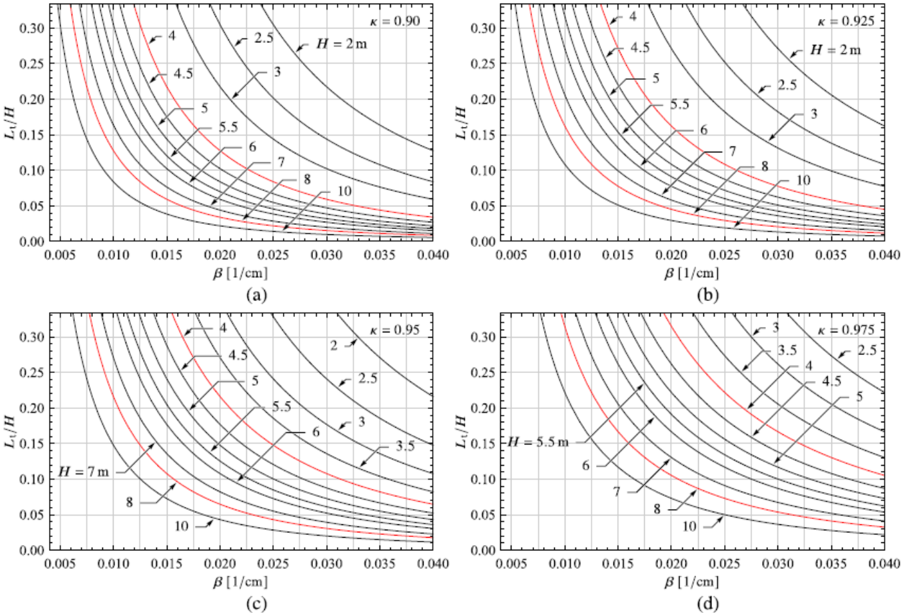
- In the HEA280 case study, the reported results were: StrM required 40 studs for a → c with transfer efficiency 0.891 and 14 studs for c → a with efficiency 0.730; StiffM-d gave 68 studs, efficiency 0.952, and LnB/H = 0.08 for a → c; StiffM-f gave 86 studs, efficiency 0.966, and LnB/H = 0.06 for a → c, and 68 studs, efficiency 0.952, and LnB/H = 0.03 for c → a.
- The paper reports that the stiffness-based allocation approach can reduce estimation errors to less than 5% under moderate load ratios.
- The authors conclude that the stiffness-based method is especially suitable for serviceability-level loading, short LIAs, and slender columns, because it explicitly controls connector stiffness and slip rather than assuming full plastic mobilization.
Methods
- The paper is a review plus analytical comparison: it synthesizes prior literature, contrasts code-based strength design with a stiffness-based approach, and discusses experimental studies from the literature.
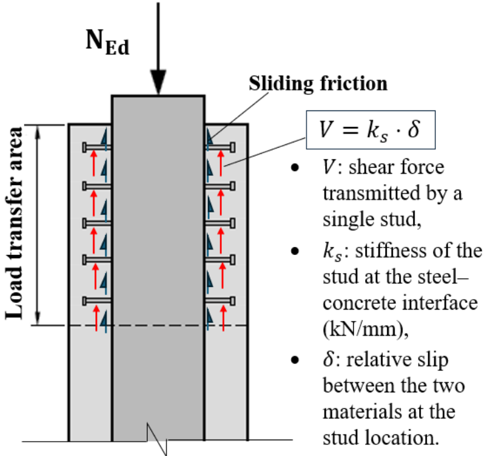
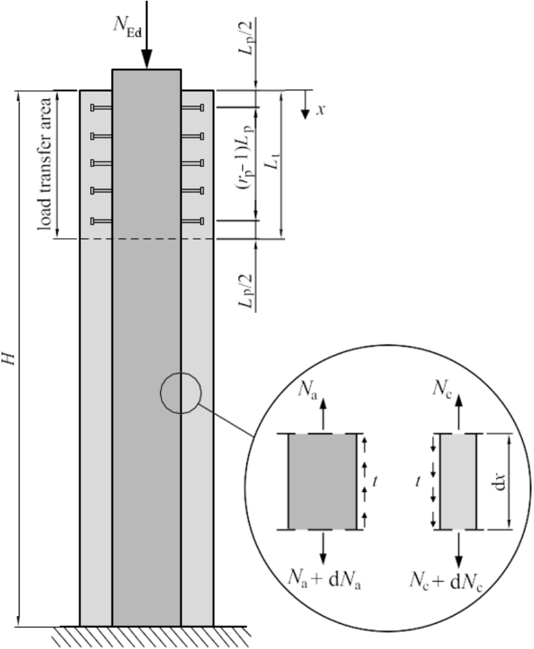
- It develops a theoretical force-transfer model for headed studs using a linear elastic shear-slip relationship, then derives connector demand from design shear force, stud stiffness, and allowable slip.
- It includes a single illustrative case study of a concrete-encased HEA280 column with reported material/geometric properties and compares StrM versus StiffM using reported connector counts, efficiencies, and natural bond lengths.
Limitations
- The paper states that the proposed stiffness-based method is limited to centrally embedded H-shaped steel sections encased in concrete, with centered axial loading and vertical headed studs; it does not account for eccentricity or torsion.
- The text states that the current framework excludes bending moments, lateral shear, and combined axial-flexural-shear interactions; this is an explicit limitation noted by the authors.
- Evident from the text: the paper does not report new experiments of its own and instead relies on a literature review, theoretical derivation, and brief case studies.
Model-written summary. Check it against the paper before relying on it.
Integrity signals
Registry
Cites
Statistics
Figures
Verification
Claims the paper makes
0 Valid · 1 Not valid · 13 Not checked · 25 Own results and interpretations
None of the sources cited for this claim could be matched to a paper, so there is nothing to check it against.
In the paper
“Despite their importance, the current design practice for shear studs in LIAs is largely governed by strength-based methods (StrM), such as those recommended in EN 1994-1-1 and AISC 360-16.”
What the sources say
- Not matchedcites EN 1994-1-1
This doesn’t read as a citation we can look up.
- Not matchedcites AISC 360-16
This doesn’t read as a citation we can look up.
plain- Asserted: passes — The authors put it forward as true.
- Checkable: passes — It can be checked against evidence.
- Load-bearing: passes — The paper’s conclusions depend on it.
- Based: passes — The paper gives a reason why it holds.
- Not matched
None of the sources cited for this claim could be matched to a paper, so there is nothing to check it against.
In the paper
“While these standards provide practical design formulas, they primarily rely on the ultimate shear resistance of individual studs and do not explicitly account for interface stiffness, load level dependency, or the gradual development of shear forces along the transfer length.”
What the sources say
- Not matchedcites EN 1994-1-1
This doesn’t read as a citation we can look up.
- Not matchedcites AISC 360-16
This doesn’t read as a citation we can look up.
plain- Asserted: passes — The authors put it forward as true.
- Checkable: passes — It can be checked against evidence.
- Load-bearing: passes — The paper’s conclusions depend on it.
- Based: passes — The paper gives a reason why it holds.
- Not matched
A conclusion the paper draws from its own results — it cites no other source for it, so there is none to check. The quote shows it is in the paper.
In the paper
“Therefore, this method is particularly suitable for Serviceability Limit State (SLS) design, where the primary objective is to control deformations and interface slip within acceptable limits, ensuring effective composite action without causing plastic deformation or structural damage.”
plainstates an association- Asserted: passes — The authors put it forward as true.
- Checkable: passes — It can be checked against evidence.
- Load-bearing: unclear — It is unclear whether the paper’s conclusions depend on it.
- Based: passes — The paper gives a reason why it holds.
None of the sources cited for this claim could be matched to a paper, so there is nothing to check it against.
In the paper
“While these standards provide practical design formulas, they primarily rely on the ultimate shear resistance of individual studs and do not explicitly account for interface stiffness, load level dependency, or the gradual development of shear forces along the transfer length.”
What the sources say
- Not matchedcites EN 1994-1-1
This doesn’t read as a citation we can look up.
- Not matchedcites AISC 360-16
This doesn’t read as a citation we can look up.
plain- Asserted: passes — The authors put it forward as true.
- Checkable: passes — It can be checked against evidence.
- Load-bearing: passes — The paper’s conclusions depend on it.
- Based: passes — The paper gives a reason why it holds.
- Not matched
8 more claims
Create a free account to see all 39 claims and every source verdict.
- It may state two separate claims as one. 22
- Probably not a substantial claim. 6
- The quote only partly states this claim. 1
Citations
Cites
The publisher hasn’t deposited this paper’s reference list.
Research works printed but not linked: 7
- Grzeszykowski, B.; Węcławik, M. ; Kozłowski, M. (2023). Load introduction to composite columns revisited. Journal of Constructional Steel Research, 207, 107877. https://doi.org/10.1016/j.jcsr.2023.107877 · doi:10.1016/j.jcsr.2023.107877
- Xue, J.; Xu, L.; Chen, Z. (2008). Push-out tests and finite element analysis on shear connector behavior in composite beams. Journal of Constructional Steel Research, 64(12), 1359 -1368. https://doi.org/10.1016/j.jcsr.2008.06.005 · doi:10.1016/j.jcsr.2008.06.005
- Xiang, Y.; Liu, R. (eds.) (2024). Experimental investigation of headed studs in high-strength concrete. Forthcoming.
- Shin, Y.S. (2007). Behavior of shear studs in high strength concrete. Engineering Structures, 29(9), 2296 -2305. https://doi.org/10.1016/j.engstruct.2006.11.021 · doi:10.1016/j.engstruct.2006.11.021
- Xue, J.; Zhang, Q. (2022). Calibrated model for shear contribution of concrete in composite columns. Journal of Building Structures, 43(4), 125 -134.
- Abambres, M.; He, J. (2024). Artificial intelligence-based prediction of shear stud resistance using ANN models. Journal of Structural Engineering (ASCE), 150(2), 04023188. https://doi.org/10.1061/(ASCE)ST.1943-541X.0003407 · doi:10.1061/(asce)st.1943-541x.0003407
- Lam, D.; Ellobody, E. (2001). Finite element modelling of composite columns with shear connectors. Steel and Composite Structures, 1(3), 239 -259. https://doi.org/10.12989/scs.2001.1.3.239 - European Committee for Standardization. (2004). Eurocode 4: Design of composite steel and concrete structures -Part 1-1: General rules and rules for buildings (EN 1994-1-1). Brussels, Belgium: CEN. · doi:10.12989/scs.2001.1.3.239
Metadata
- Authors
- Hang, M. T., & Vung, N. H.
- Affiliations
- Vietnam Aviation Academy (VN)
- Venue
- Inżynieria Mineralna
- Publisher
- Polish Mineral Engineering Society
- Published
- 2025-10-10
- Volume
- 1
- Issue
- 2
- ISSN
- 1640-4920 (ISSN-L)
- OpenAlex
- W4415092083
- Cited by
- 0
- References
- 0
- FWCI
- 0.00
- Type
- journal article
- Language
- en
- Open access
- diamond
- doi.org
- Locations
- Inżynieria Mineralna (publishedVersion, cc-by)
- Topics
- Physical Sciences › Engineering › Civil and Structural Engineering › Structural Load-Bearing Analysis
- Physical Sciences › Engineering › Building and Construction › Structural Behavior of Reinforced Concrete
- Physical Sciences › Engineering › Civil and Structural Engineering › Structural Engineering and Materials Analysis
- Keywords
- shear studs, shear transfer, strength-based design, partial interaction, connector stiffness, load distribution, design code comparison
About these checks
Registry, retraction, Cites and statistics results are computed, not judged, with one exception: a printed reference that no index lists is read once by a model before it counts as a citation error. Claims are extracted by a model and kept only when their quote appears verbatim in the text; each cited source is then checked, with a model’s help, for whether it says what the claim relies on. Those verdicts can be wrong — read the claim’s quote and the cited source before relying on one.
A language model drew the claims from the paper on 2026-10-11, under version 3 of the claim definition (model deepseek-v4.1-flash, prompt extract-v3).
A second model labelled each claim on 2026-10-11 (model jev-1.13-20260917, definition revision gold-guideline-v0.2).
Statistics and arithmetic are recomputed, not judged.
Confidence bands are shown only for fields calibrated on our annotated test set. None is calibrated yet, so no band is shown.
What counts as a claim ›How we measure confidence ›How we check this ›
Are you an author, or do you see a problem with this page? Request a review
How to cite
Cite CoChat for the checks on this page, and the paper for its own findings.
- This page
- CoChat. (2026). Citation check: Calculation of Shear Studs in the Load Introduction Area of Concrete-Encased Steel Composite Columns: A Review of Current Design Approaches. https://app.cochat.ai/papers/10.29227/im-2025-02-42
- The paper
- Hang, M. T., & Vung, N. H. (2025). Calculation of Shear Studs in the Load Introduction Area of Concrete-Encased Steel Composite Columns: A Review of Current Design Approaches. Inżynieria Mineralna. https://doi.org/10.29227/im-2025-02-42
Data sources
Bibliographic data: Semantic Scholar, OpenAlex, Crossref.
Contains information from the Semantic Scholar Academic Graph Datasets, made available under the ODC Attribution License (ODC-BY 1.0).
Semantic Scholar’s data is described in: Kinney, R., et al. (2023). The Semantic Scholar Open Data Platform. arXiv:2301.10140.
