

ChannelsDB 2.0: A Comprehensive Database of Protein Tunnels and Pores in AlphaFold Era
Open accessPreprint — published as 10.1093/nar/gkad1012
The DOI matches its Crossref record; 1 of the 1 references it cites were found in a registry or an index.
Abstract
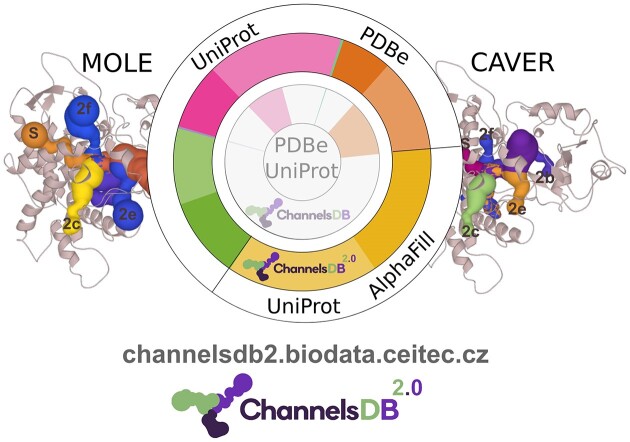
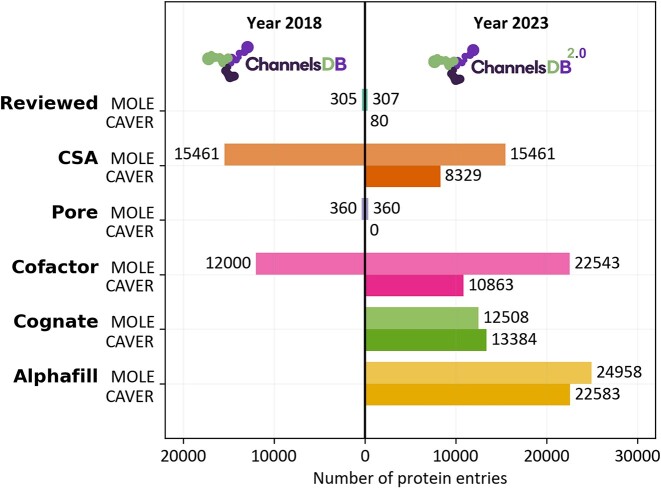
ChannelsDB 2.0 is an updated database providing structural information about the position, geometry and physicochemical properties of protein channels - tunnels and pores - within deposited biomacromolecular structures from PDB and AlphaFoldDB databases. The newly deposited information originated from several sources. Firstly, we included data calculated using a popular CAVER tool to complement the data obtained using original MOLE tool for detection and analysis of protein tunnels and pores. Secondly, we added tunnels starting from cofactors within the AlphaFill database to enlarge the scope of the database to protein models based on Uniprot. This has enlarged available channel annotations ~4.6 times as of 1st September 2023. The database stores information about geometrical features, e.g., length and radius, and physico-chemical properties based on channel-lining amino acids. The stored data are interlinked with the available UniProt mutation annotation data. ChannelsDB 2.0 provides an excellent resource for deep analysis of the role of biomacromolecular tunnels and pores. The database is available free of charge: https://channelsdb2.biodata.ceitec.cz.
Overview
The claims and statistics of this paper haven’t been checked yet.
Free: it reads the open-access text and checks the first 5 claims that cite a source we can check. Create a free account to check every claim.
Integrity signals
Registry
Cites
Statistics
Figures
Verification
Claims the paper makes
The claims and statistics of this paper haven’t been checked yet.
Free: it reads the open-access text and checks the first 5 claims that cite a source we can check. Create a free account to check every claim.
Self-check
Percentages, sums and reported differences re-computed from the paper’s own numbers.
The self-check needs the paper’s full text.
Citations
Cites
Highly accurate protein structure prediction with AlphaFold
Jumper, J., Evans, R., Pritzel, A., Green, T., Figurnov, M., Ronneberger, O., Tunyasuvunakool, K., Bates, R., Žídek, A., Potapenko, A., et al. (2021) · Nature · doi:10.1038/s41586-021-03819-2 · Cited by 43,764
Metadata
- Authors
- Špačková, A., Vávra, O., Raček, T., Bazgier, V., Sehnal, D., Damborský, J., Svobodová, R., Bednář, D., & Berka, K.
- Affiliations
- Palacký University Olomouc (CZ)
- Masaryk University (CZ)
- Corresponding author
- Bednář, David
- Berka, Karel
- Venue
- Nucleic Acids Research
- Publisher
- Center for Open Science
- Published
- 2023-10-02
- Volume
- 52
- Issue
- D1
- Pages
- D413-D418
- ISSN
- 0305-1048 (ISSN-L)
- PMC
- PMC10767935
- OpenAlex
- W4388622554
- Cited by
- 17
- References
- 1
- Citations by year
- 2026: 2 · 2025: 8 · 2024: 7
- FWCI
- 1.51
- Type
- journal article
- Language
- en
- Open access
- gold
- doi.org
- Locations
- Nucleic Acids Research (publishedVersion, cc-by)
- PubMed Central (publishedVersion, cc-by)
- PubMed (publishedVersion)
- Veřejné služby Informačního systému (Masarykiana Brunensis Universitas) (submittedVersion, cc-by)
- OSF Preprints (OSF Preprints) (submittedVersion, cc-by)
- Funders
- European Bioinformatics Institute
- European Commission (LX22NPO5102, LM2023055, LM2023069, 90254)
- Ministerstvo Školství, Mládeže a Tělovýchovy (LM2023069, 90254), LX22NPO5102, ID: 90254, LM2023055)
- Central European Institute of Technology
- Masarykova Univerzita (LX22NPO5102)
- RECETOX Přírodovědecké Fakulty Masarykovy Univerzity (LM2023069)
- NextGenerationEU
- Topics
- Life Sciences › Biochemistry, Genetics and Molecular Biology › Molecular Biology › Protein Structure and Dynamics
- Life Sciences › Biochemistry, Genetics and Molecular Biology › Structural Biology › Enzyme Structure and Function
- Life Sciences › Pharmacology, Toxicology and Pharmaceutics › Drug Discovery › Computational Drug Discovery Methods
- Keywords
- protein channels, protein tunnels, protein pores, protein structure database, AlphaFold, CAVER, moles, cofactors, channel geometry, physicochemical properties, protein models
- MeSH terms
- Amino Acids, Protein Conformation, Proteins, Software, Databases, Protein
About these checks
Registry, retraction, Cites and statistics results are computed, not judged, with one exception: a printed reference that no index lists is read once by a model before it counts as a citation error. Claims are extracted by a model and kept only when their quote appears verbatim in the text; each cited source is then checked, with a model’s help, for whether it says what the claim relies on. Those verdicts can be wrong — read the claim’s quote and the cited source before relying on one.
Statistics and arithmetic are recomputed, not judged.
Confidence bands are shown only for fields calibrated on our annotated test set. None is calibrated yet, so no band is shown.
What counts as a claim ›How we measure confidence ›How we check this ›
Are you an author, or do you see a problem with this page? Request a review
How to cite
Cite CoChat for the checks on this page, and the paper for its own findings.
- This page
- CoChat. (2026). Citation check: ChannelsDB 2.0: A Comprehensive Database of Protein Tunnels and Pores in AlphaFold Era. https://app.cochat.ai/papers/10.31219/osf.io/37ezt
- The paper
- Špačková, A., Vávra, O., Raček, T., Bazgier, V., Sehnal, D., Damborský, J., Svobodová, R., Bednář, D., & Berka, K. (2023). ChannelsDB 2.0: A Comprehensive Database of Protein Tunnels and Pores in AlphaFold Era. Nucleic Acids Research. https://doi.org/10.31219/osf.io/37ezt
Data sources
Bibliographic data: Semantic Scholar, OpenAlex, Crossref.
Contains information from the Semantic Scholar Academic Graph Datasets, made available under the ODC Attribution License (ODC-BY 1.0).
Semantic Scholar’s data is described in: Kinney, R., et al. (2023). The Semantic Scholar Open Data Platform. arXiv:2301.10140.
