

Unfollowing hyperpartisan social media influencers durably reduces out-party animosity
Open accessThe DOI matches its Crossref record; 11 of the 11 references it cites were found in a registry or an index.
Abstract
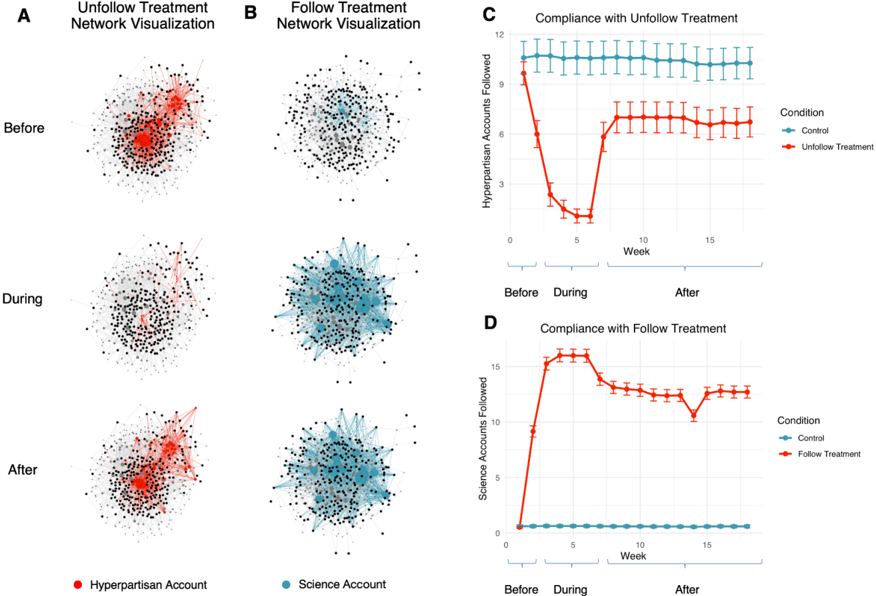
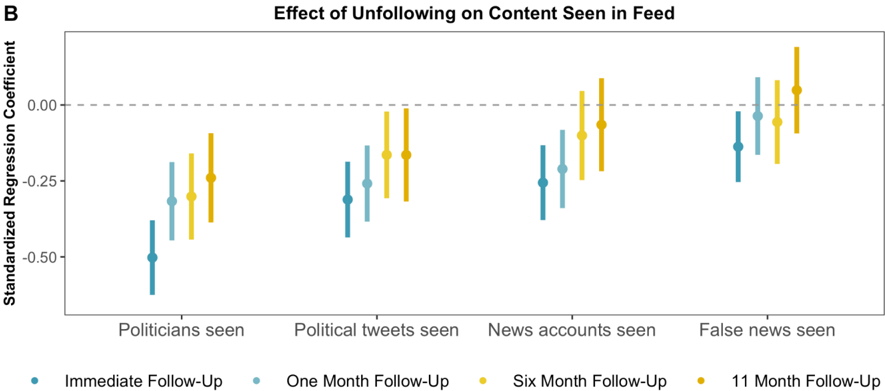
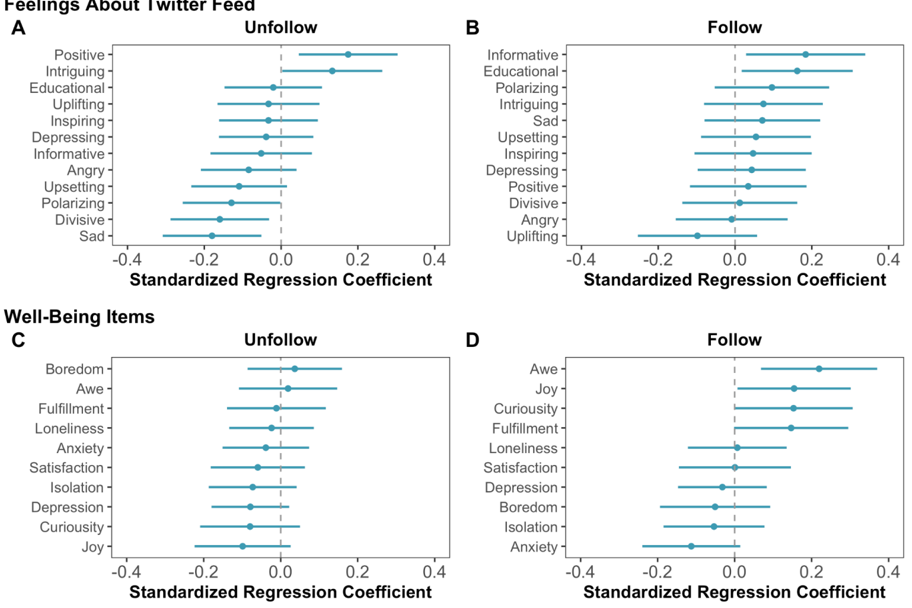
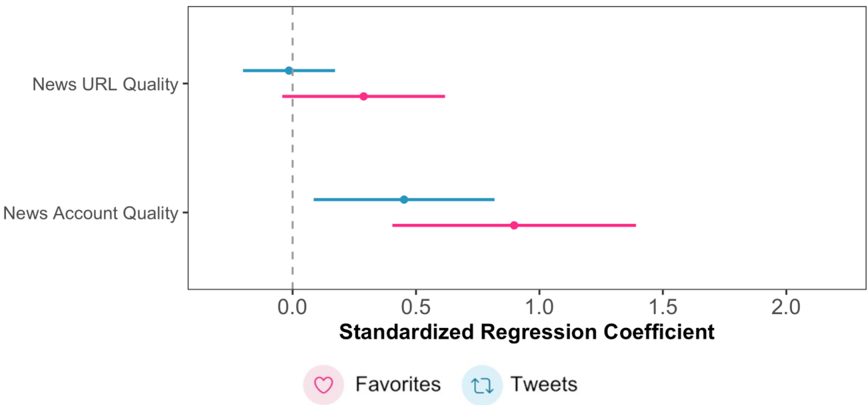
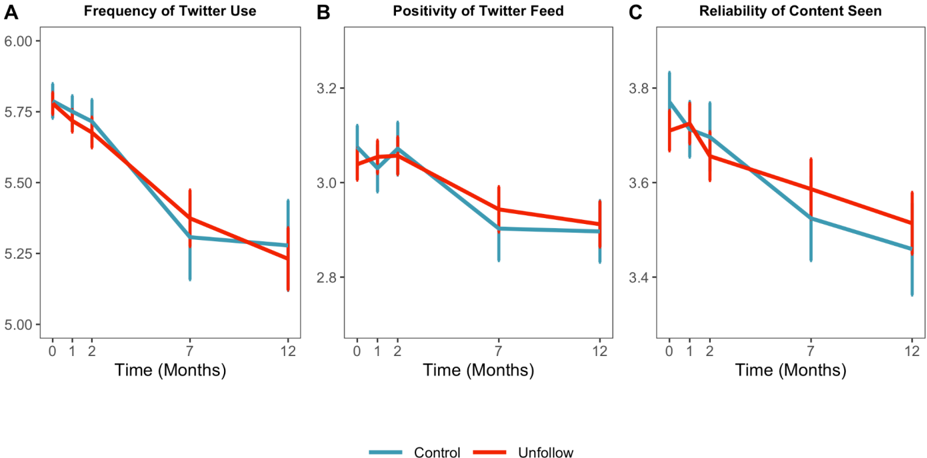
There is considerable debate over whether and how social media contributes to polarization. Research suggests that a small number of hyperpartisan “influencers,” or highly followed accounts, produce the vast majority of misinformation and toxic content. Yet, little is known about the long-term causal effects of exposure to these influencers. In a correlational study (n1 = 1,447) and two digital field experiments (n2 = 494, n3 = 1,133), we examined whether (un)following hyperpartisan social media influencers contributes to polarization and misinformation sharing. We found that incentivizing Twitter/X users to unfollow hyperpartisan social media influencers improved their recent feelings toward the out-party by 23.5% compared to the control group, with effects persisting for at least six months. Unfollowing also led participants to engage with more accurate news accounts, increased satisfaction with their Twitter/X feeds, and reduced the amount of political content they reported seeing a full year later—without reducing engagement. By contrast, incentivizing users to follow accounts that tweeted about science improved well-being. Additionally, we found that, after Elon’s Musk purchased Twitter/X and made several platform changes, participants used Twitter/X less frequently, viewed their feeds as less reliable, and posted lower quality news. Our results demonstrate the long-term, causal impact of repeated exposure to hyper-partisan influencers on attitudes and behavior. They also illustrate that the behavior and experience of Twitter/X users changed substantially after Elon Musk’s purchase of the platform, revealing the potential impact of social media design changes. Our work has implications for interventions that can be made by platforms or by individuals seeking to curate their social media experience. Unlike other social media reduction interventions, unfollowing is a targeted approach: like a scalpel, it surgically removes a few harmful parts of one’s feed, allowing the beneficial aspects to remain.
Overview
The claims and statistics of this paper haven’t been checked yet.
Free: it reads the open-access text and checks the first 5 claims that cite a source we can check. Create a free account to check every claim.
Integrity signals
Registry
Cites
Statistics
Figures
Verification
Claims the paper makes
The claims and statistics of this paper haven’t been checked yet.
Free: it reads the open-access text and checks the first 5 claims that cite a source we can check. Create a free account to check every claim.
Self-check
Percentages, sums and reported differences re-computed from the paper’s own numbers.
The self-check needs the paper’s full text.
Citations
Cites
The publisher hasn’t deposited this paper’s reference list.
Research works printed but not linked: 23
- E. Kubin, C. von Sikorski, The role of (social) media in political polarization: a systematic review. Annals of the International Communication Association 45, 188-206 (2021).
- E. Harris, S. Rathje, C. Robertson, J. J. Van Bavel, The SPIR Model of Social Media and Polarization: Exploring the Role of Selection, Platform Design, Incentives, and Real-World Context. International Journal of Communication (In Press).
- L. Boxell, M. Gentzkow, J. M. Shapiro, Greater Internet use is not associated with faster growth in political polarization among US demographic groups. Proceedings of the National Academy of Sciences 114, 10612-10617 (2017).
- H. Allcott, L. Braghieri, S. Eichmeyer, M. Gentzkow, The welfare effects of social media. American Economic Review 110, 629-76 (2020).
- H. Allcott, et al., The effects of Facebook and Instagram on the 2020 election: A deactivation experiment. Proc. Natl. Acad. Sci. U.S.A. 121, e2321584121 (2024).
- C. R. Sunstein, # Republic: Divided democracy in the age of social media (Princeton University Press, 2018).
- M. Cinelli, G. D. F. Morales, A. Galeazzi, W. Quattrociocchi, M. Starnini, The echo chamber effect on social media. Proceedings of the National Academy of Sciences 118 (2021).
- C. Bail, Breaking the Social Media Prism (Princeton University Press, 2021).
- S. B. Hobolt, K. Lawall, J. Tilley, The polarizing effect of partisan echo chambers. American Political Science Review 1-16 (2023).
- P. Törnberg, How digital media drive affective polarization through partisan sorting. Proc. Natl. Acad. Sci. U.S.A. 119, e2207159119 (2022).
- C. A. Bail, et al., Exposure to opposing views on social media can increase political polarization. Proceedings of the National Academy of Sciences 115, 9216-9221 (2018).
- W. J. Brady, A. P. Gantman, J. J. Van Bavel, Attentional capture helps explain why moral and emotional content go viral. Journal of Experimental Psychology: General 149, 746 (2020).
- D. Antypas, A. Preece, J. Camacho-Collados, Negativity spreads faster: A large-scale multilingual twitter analysis on the role of sentiment in political communication. Online Social Networks and Media 33, 100242 (2023).
- D. Kumar, J. Hancock, K. Thomas, Z. Durumeric, Understanding the Behaviors of Toxic Accounts on Reddit in Proceedings of the ACM Web Conference 2023, (ACM, 2023), pp. 2797-2807.
- G. Pennycook, D. G. Rand, Fighting misinformation on social media using crowdsourced judgments of news source quality. Proceedings of the National Academy of Sciences 116, 2521-2526 (2019).
- S. Rathje, S. van der Linden, "Shifting online incentive structures to reduce polarization and the spread of misinformation" in Research Handbook on Nudges and Society, (Edward Elgar Publishing, 2023), pp. 91-108.
- M. Mosleh, D. G. Rand, Measuring exposure to misinformation from political elites on Twitter. nature communications 13, 7144 (2022).
- J. L. Peugh, D. Strotman, M. McGrady, J. Rausch, S. Kashikar-Zuck, Beyond intent to treat (ITT): A complier average causal effect (CACE) estimation primer. Journal of school psychology 60, 7-24 (2017).
- C. Barrie, Did the Musk takeover boost contentious actors on Twitter? Harvard Kennedy School Misinformation Review 4, 1-19 (2023).
- C. K. Lai, et al., A comparative investigation of 17 interventions to reduce implicit racial preferences. Journal of Experimental Psychology: General 143, 1765-1785 (2014).
- E. L. Paluck, R. Porat, C. S. Clark, D. P. Green, Prejudice reduction: Progress and challenges. Annual Review of Psychology 72 (2020).
- D. Broockman, J. Kalla, Consuming cross-cutting media causes learning and moderates attitudes: A field experiment with Fox News viewers. Journal of Politics (2024).
- C. J. Ferguson, Do social media experiments prove a link with mental health: A methodological and meta-analytic review. Psychology of Popular Media (2024).
Cited by
Why depolarization is hard: Evaluating attempts to decrease partisan animosity in America
Holliday, D. E., Lelkes, Y., & Westwood, S. J. (2025) · Proceedings of the National Academy of Sciences · doi:10.1073/pnas.2508827122 · Cited by 47
The Reinforcement Effect of Social Media Likes in Depression
Mirea, D.-M., Chen, S., Ding, J., Palacio-Soto, K., Mildner, J. N., Kelley, S. W., Gillan, C. M., Nook, E. C., & Niv, Y. (2026) · JAMA Psychiatry · doi:10.1001/jamapsychiatry.2026.1430 · Cited by 1
Lundstedt, F., & Lindgren, S. (2026) · Journal of Computational Social Science · doi:10.1007/s42001-026-00488-x · Cited by 1
Metadata
- Authors
- Rathje, S., Pretus, C., He, J. K., Harjani, T., Roozenbeek, J., Gray, K., Linden, S. V. D., & Van Bavel, J. J.
- Affiliations
- New York University (US)
- Universitat Autònoma de Barcelona (ES)
- University of Cambridge (GB)
- King's College London (GB)
- University of North Carolina at Chapel Hill (US)
- ORCID
- Publisher
- Center for Open Science
- Published
- 2025-08-23
- OpenAlex
- W4413470066
- Cited by
- 3
- References
- 0
- Citations by year
- 2026: 2 · 2025: 1
- Type
- posted content
- Language
- en
- Open access
- green
- doi.org
- Funders
- National Science Foundation (2404649, 2334148)
- Sage Foundation
- Templeton World Charity Foundation (TWCF-2023-31570)
- Stanford Bio-X
- Topics
- Social Sciences › Sociology and Political Science › Misinformation and Its Impacts
- Social Sciences › Communication › Social Media and Politics
- Social Sciences › Sociology and Political Science › Media Influence and Politics
- Keywords
- political polarization, misinformation sharing, Twitter, science communication
About these checks
Registry, retraction, Cites and statistics results are computed, not judged, with one exception: a printed reference that no index lists is read once by a model before it counts as a citation error. Claims are extracted by a model and kept only when their quote appears verbatim in the text; each cited source is then checked, with a model’s help, for whether it says what the claim relies on. Those verdicts can be wrong — read the claim’s quote and the cited source before relying on one.
Statistics and arithmetic are recomputed, not judged.
Confidence bands are shown only for fields calibrated on our annotated test set. None is calibrated yet, so no band is shown.
What counts as a claim ›How we measure confidence ›How we check this ›
Are you an author, or do you see a problem with this page? Request a review
How to cite
Cite CoChat for the checks on this page, and the paper for its own findings.
- This page
- CoChat. (2026). Citation check: Unfollowing hyperpartisan social media influencers durably reduces out-party animosity. https://app.cochat.ai/papers/10.31234/osf.io/acbwg_v2
- The paper
- Rathje, S., Pretus, C., He, J. K., Harjani, T., Roozenbeek, J., Gray, K., Linden, S. V. D., & Van Bavel, J. J. (2025). Unfollowing hyperpartisan social media influencers durably reduces out-party animosity. https://doi.org/10.31234/osf.io/acbwg_v2
Data sources
Bibliographic data: Semantic Scholar, OpenAlex, Crossref.
Contains information from the Semantic Scholar Academic Graph Datasets, made available under the ODC Attribution License (ODC-BY 1.0).
Semantic Scholar’s data is described in: Kinney, R., et al. (2023). The Semantic Scholar Open Data Platform. arXiv:2301.10140.
