

The DOI matches its Crossref record; 18 of the 19 references it cites were found in a registry or an index, and 1 are not checked yet; 3 of the 10 sources its claims cite were checked for support.
Indie at Scale: How Large Language Models Make Community-Centered Game Development Economically Viable
Open accessAbstract
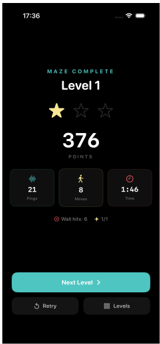
Large language models (LLMs) are now widely used in software engineering, yet most evidence of their practical effect comes from corporate productivity studies or synthetic benchmarks. This paper offers a complementary view from the solo indie developer's perspective: a reflective case study of two complete, shipped iOS games developed in continuous pair-programming with an LLM-based coding assistant. Both games are aimed at communities that mainstream consumer software has long ignored. The Listening Maze is a spatial-audio echolocation maze for blind and low-vision players. Trace Memory Game is a memory-recall game built around brief-flash visual encoding and freehand redraw, positioned for daily cognitive engagement. We describe the development methodology, the four-step human-LLM loop used throughout, the resulting codebases, and what the experience implies for socially oriented software development by very small teams. We argue that LLM-assisted development reduces the cost of serving small, underserved audiences enough that a solo developer or a small academic team can now defend such products economically.
Verified 2026-10-10 · 1 reference not checked yet
Overview
CoChat Summary
TL;DR
This reflective case study describes two shipped iOS games built by a solo developer in continuous pair-programming with an LLM assistant, arguing that LLM-assisted development can make community-centered games economically viable. It presents *The Listening Maze* for blind/low-vision players and *Trace Memory Game* for memory recall, framed by a “crossover thesis” that target-community mechanics should be core and broadly appealing.
Key findings
- The paper reports two complete, App-Store-submission-state iOS games developed over roughly six months with no external dependencies and no outsourced asset work: *The Listening Maze* (spatial-audio echolocation maze with HRTF-rendered echoes, VoiceOver compatibility, and toggleable haptics for blind/low-vision players) and *Trace Memory Game* (sub-second shape flash and freehand redraw for cognitive engagement).
- It argues LLM-assisted development lowers the cost of serving small underserved audiences enough for a solo developer or small academic team to defend such products economically, citing prior productivity results of roughly 56% on isolated coding tasks (Peng et al., 2023) and a 26% increase in completed tasks across nearly 5,000 developers (Cui et al., 2026).
- The “crossover thesis” holds that the disability or condition motivating a game should shape the core mechanic, not be a sidecar feature, so the mechanic is interesting to players outside the target community and the mainstream audience underwrites the niche.
- Contextual numbers: roughly one million US adults live with blindness; more than 55 million people globally live with dementia, projected to nearly triple by mid-century (Livingston et al., 2024); App Store rank-to-demand follows a Pareto curve with the top-ranked paid app generating roughly 150 times the downloads of the app at rank 200 (Garg & Telang, 2013).
Methods
- Reflective case study by a single author of two complete iOS games developed in continuous pair-programming with an LLM-based coding assistant over roughly six months.
- Development used a four-step human-LLM loop, a persistent project-memory artefact, and explicit audit cycles; both games were built with no external dependencies and no outsourced asset work.
- Analysis is qualitative: description of the methodology, resulting codebases, and implications for socially oriented software development by very small teams; no quantitative user or economic evaluation is reported in the provided text.
Limitations
- The paper states LLM-assisted development is not a panacea: meta-analyses show human-AI combinations sometimes underperform either party alone (Vaccaro et al., 2024), and benchmarks show current agents are far from resolving real bugs in real repositories at human rates (Jimenez et al., 2024).
- Evident from the text: the study is a single-author reflective case study of only two games, with no user studies, sales data, or controlled comparison reported in the provided text, so economic viability and player outcomes are argued rather than empirically tested.
- Evident from the text: the economic argument relies on cited productivity studies rather than cost or revenue data from the two games themselves.
Model-written summary. Check it against the paper before relying on it.
Integrity signals
Registry
Cites
Statistics
Figures




Verification
Claims the paper makes
3 Valid · 2 Not valid · 6 Not checked · 7 Own results and interpretations
Every source the paper cites for this claim was checked and supports it.
In the paper
“Controlled experiments measure productivity gains of roughly 56% on isolated coding tasks (Peng et al., 2023)”
What the sources say
- Supportedcites Peng et al., 2023 source
The Results report a 55.8% reduction in task completion time for the Copilot group relative to the control group. The Study Design describes a controlled experiment using a standardized programming task, matching the claim’s reference to isolated coding tasks. (LLM, conf=0.93)
plainstates a cause- Asserted: passes — The authors put it forward as true.
- Checkable: passes — It can be checked against evidence.
- Load-bearing: passes — The paper’s conclusions depend on it.
- Based: passes — The paper gives a reason why it holds.
- Supported
A result the paper states — it cites no source for it, so there is none to check. The quote shows it is in the paper.
In the paper
“We report on two complete, App-Store-archived iOS games developed by a single author in continuous pair-programming collaboration with an LLM-based coding assistant over roughly six months.”
plain- Asserted: passes — The authors put it forward as true.
- Checkable: passes — It can be checked against evidence.
- Load-bearing: passes — The paper’s conclusions depend on it.
- Based: passes — The paper gives a reason why it holds.
In the paper
“The App Store exhibits a steep power-law revenue distribution: empirical work by Garg and Telang (2013) shows that the rank-to-demand relationship in the iTunes App Store follows a Pareto curve, with the top-ranked paid app generating roughly 150 times the downloads of the app at rank 200.”
What the sources say
- Not checked — no full text of the sourcecites Garg and Telang (2013) source
boostedstates an association- Asserted: passes — The authors put it forward as true.
- Checkable: passes — It can be checked against evidence.
- Load-bearing: passes — The paper’s conclusions depend on it.
- Based: passes — The paper gives a reason why it holds.
A conclusion the paper draws from its own results — it cites no other source for it, so there is none to check. The quote shows it is in the paper.
In the paper
“What does seem to be happening is that the break-even point for a solo developer attempting a polished commercial product is shifting in a direction it had not shifted before.”
hedgedstates an association- Asserted: passes — The authors put it forward as true.
- Checkable: passes — It can be checked against evidence.
- Load-bearing: passes — The paper’s conclusions depend on it.
- Based: passes — The paper gives a reason why it holds.
- Rests on an assumption not shown here.
A conclusion the paper draws from its own results — it cites no other source for it, so there is none to check. The quote shows it is in the paper.
In the paper
“development reduces the cost of serving small, underserved audiences enough that a solo developer or a small academic team can now defend such products economically.”
plainstates a cause- Asserted: passes — The authors put it forward as true.
- Checkable: passes — It can be checked against evidence.
- Load-bearing: passes — The paper’s conclusions depend on it.
- Based: passes — The paper gives a reason why it holds.
- Rests on 4 assumptions not shown here.
1 more claim
Create a free account to see all 18 claims and every source verdict.
- Probably not a substantial claim. 9
- It may state two separate claims as one. 4
Self-check
Percentages, sums and reported differences re-computed from the paper’s own numbers.
Each contradiction between two passages listed here was confirmed by an independent check.
Rated major: it would touch a result — a value a result rests on, reported and recomputed p-values on opposite sides of the significance level, two passages that conflict with no sign which is right, or a cited work retracted before this paper was published.
In the paper
“two complete, shipped iOS games”
“Both are now in App-Store-submission state”
Citations
Cites
The publisher hasn’t deposited this paper’s reference list.
Metadata
- Authors
- Qarkaxhija, J.
- Corresponding author
- Qarkaxhija, Jusuf
- ORCID
- Qarkaxhija, Jusuf
- Venue
- International Journal of Advanced Computer Science and Applications
- Publisher
- Center for Open Science
- Published
- 2026-05-22
- Volume
- 17
- Issue
- 8
- ISSN
- 2156-5570 (ISSN-L)
- OpenAlex
- W7162082828
- Cited by
- 0
- References
- 0
- FWCI
- 0.00
- Type
- journal article
- Language
- en
- Open access
- diamond
- doi.org
- Locations
- International Journal of Advanced Computer Science and Applications (publishedVersion, cc-by)
- International Journal of Advanced Computer Science and Applications (submittedVersion, cc-by)
- SocArXiv (OSF Preprints) (submittedVersion, cc-by)
- Topics
- Physical Sciences › Computer Science › Information Systems › Software Engineering Techniques and Practices
- Physical Sciences › Computer Science › Information Systems › Software Engineering Research
- Physical Sciences › Computer Science › Artificial Intelligence › Artificial Intelligence Applications
- Keywords
- large language models, LLM-assisted software development, indie game development, small teams, pair programming, economic feasibility, accessibility, blind and visually impaired users, spatial audio, memory games, cognitive engagement, underserved audiences
About these checks
Registry, retraction, Cites and statistics results are computed, not judged, with one exception: a printed reference that no index lists is read once by a model before it counts as a citation error. Claims are extracted by a model and kept only when their quote appears verbatim in the text; each cited source is then checked, with a model’s help, for whether it says what the claim relies on. Those verdicts can be wrong — read the claim’s quote and the cited source before relying on one.
A language model drew the claims from the paper on 2026-10-10, under version 3 of the claim definition (model deepseek-v4.1-flash, prompt extract-v3).
A second model labelled each claim on 2026-10-10 (model jev-1.13-20260917, definition revision gold-guideline-v0.2).
Cited sources are checked with a language model’s help (gpt-6-sol).
Statistics and arithmetic are recomputed, not judged.
Confidence bands are shown only for fields calibrated on our annotated test set. None is calibrated yet, so no band is shown.
What counts as a claim ›How we measure confidence ›How we check this ›
Are you an author, or do you see a problem with this page? Request a review
How to cite
Cite CoChat for the checks on this page, and the paper for its own findings.
- This page
- CoChat. (2026). Citation check: Indie at Scale: How Large Language Models Make Community-Centered Game Development Economically Viable. https://app.cochat.ai/papers/10.31235/osf.io/m75hn_v1
- The paper
- Qarkaxhija, J. (2026). Indie at Scale: How Large Language Models Make Community-Centered Game Development Economically Viable. International Journal of Advanced Computer Science and Applications. https://doi.org/10.31235/osf.io/m75hn_v1
Data sources
Bibliographic data: Semantic Scholar, OpenAlex, Crossref.
Contains information from the Semantic Scholar Academic Graph Datasets, made available under the ODC Attribution License (ODC-BY 1.0).
Semantic Scholar’s data is described in: Kinney, R., et al. (2023). The Semantic Scholar Open Data Platform. arXiv:2301.10140.
