

Effects of NutriDense and Waxy Corn Hybrids on the Rumen Fermentation, Digestibility and Lactational Performance of Dairy Cows
Open accessThe DOI matches its Crossref record; 29 of the 29 references it cites were found in a registry or an index.
Abstract
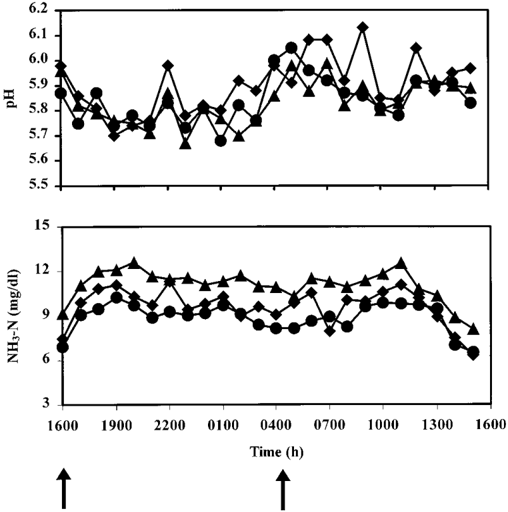
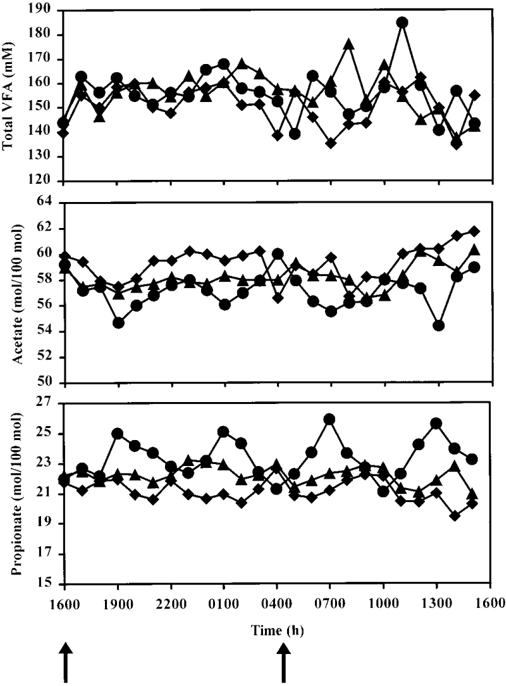
The objectives of this study were to determine the effects of NutriDense and waxy corn hybrids as silage and grain sources on milk yield, milk composition, digestibility of dietary components, and rumen characteristics. Six multiparous (intact) and six primiparous (ruminally cannulated) Holstein cows were assigned at 72 to 90 d of lactation to a 3 x 6 Latin rectangle design experiment to treatment of: 1) control diet, 2) NutriDense corn diet, and 3) waxy corn diet. Diets consisted of 10.9% alfalfa silage, 32.8% corn silage, 27.9% cracked corn grain, and 28.4% other ingredients (DM basis). Milk, FCM, and milk fat and protein yields were higher for cows fed the waxy diet than those fed the control diet. Milk protein percentage tended to be higher for cows fed the control and waxy diets than those fed the NutriDense diet. Dry matter intake tended to be higher for cows fed the waxy diet than the NutriDense diet. Apparent DM, OM, CP, ADF, NDF, and gross energy digestibilities were similar among dietary treatments, while apparent starch digestibility was higher for the waxy corn than for the NutriDense corn. Rumen NH3-N concentration was higher for cows fed the NutriDense diet than for those fed the control and waxy diets. The proportion of ruminal propionate was higher for the waxy diet than the control diet. NutriDense and waxy corn hybrids can be effective substitutes for conventional yellow dent corn hybrids in lactating dairy cow rations.
Overview
The claims and statistics of this paper haven’t been checked yet.
Free: it reads the open-access text and checks the first 5 claims that cite a source we can check. Create a free account to check every claim.
Integrity signals
Registry
Cites
Statistics
Figures
Verification
Claims the paper makes
The claims and statistics of this paper haven’t been checked yet.
Free: it reads the open-access text and checks the first 5 claims that cite a source we can check. Create a free account to check every claim.
Self-check
Percentages, sums and reported differences re-computed from the paper’s own numbers.
The self-check needs the paper’s full text.
Citations
Cites
Van Soest, P. J., Robertson, J. B., & Lewis, B. A. (1991) · Journal of Dairy Science · doi:10.3168/jds.s0022-0302(91)78551-2 · Cited by 28,658 · cited 2×
“Silage samples were analyzed for DM (lyophilized), CP (Leco FP-2000, Leco Corporation, St. Joseph, MI), ADF (Robertson and Van Soest, 1981), NDF ( Van Soest et al., 1991 ), ash (500°C for 5 h), aciddetergent lignin (Robertson and Van Soest, 1981), and starch (Dado and Beek, 1998).”
MethodEstimación lineal de los requerimientos nutricionales del NRC para ganado de leche.
Elizondo-Salazar, J. A. (2014) · Agronomía Mesoamericana · doi:10.15517/am.v13i1.13244 · Cited by 6,497
Phenol-hypochlorite reaction for determination of ammonia
Weatherburn, M. W. (1967) · Analytical Chemistry · doi:10.1021/ac60252a045 · Cited by 4,099 · cited 12×
“Ruminal pH and concentrations of NH3-N and VFA are shown in Table 5.”
MethodInfluentialVolatile Fatty Acid Analyses of Blood and Rumen Fluid by Gas Chromatography
Erwin, E. S., Marco, G. J., & Emery, E. M. (1961) · Journal of Dairy Science · doi:10.3168/jds.s0022-0302(61)89956-6 · Cited by 1,903 · cited 2×
“Ten milliliters of rumen fluid was acidified with 2 ml of 25% (wt/ vol) meta-phosphoric acid and stored at -20°C for later analysis of VFA by gas chromatography (Erwin et al., 1961), and NH3-N (Weatherburn, 1967).”
MethodEffect of ammonia concentration on rumen microbial protein production in vitro
Satter, L. D., & Slyter, L. L. (1974) · British Journal of Nutrition · doi:10.1079/bjn19740073 · Cited by 1,797
AN IMPROVED PROCEDURE FOR THE DETERMINATION OF CHROMIC OXIDE IN FEED AND FECES
FENTON, T. W., & FENTON, M. (1979) · Canadian Journal of Animal Science · doi:10.4141/cjas79-081 · Cited by 1,068
Experimental Design and Analysis
(2006) · Resampling Methods · doi:10.1007/0-8176-4444-x_5 · Cited by 624
McCarthy, R. D., Klusmeyer, T. H., Vicini, J. L., Clark, J. H., & Nelson, D. R. (1989) · Journal of Dairy Science · doi:10.3168/jds.s0022-0302(89)79324-3 · Cited by 317 · cited 1×
“Feeding dairy cows increasing dietary contents of ruminally available starch negatively impacts NDF and ADF digestibilities (McCarthy et al., 1989).”
BackgroundHerrera-Saldana, R., Gomez-Alarcon, R., Torabi, M., & Huber, J. T. (1990) · Journal of Dairy Science · doi:10.3168/jds.s0022-0302(90)78657-2 · Cited by 265 · cited 1×
“Feeding dairy cows ruminally available starch from barley compared with milo lowered ruminal pH and acetate-to-propionate ratio (Herrera-Saldana et al., 1990).”
BackgroundSouthgate, D. A. T. (1976) · Fiber in Human Nutrition · doi:10.1007/978-1-4684-2241-2_3 · Cited by 240
Influence of Varying Protein and Starch Degradabilities on Performance of Lactating Cows
Herrera-Saldana, R., & Huber, J. T. (1989) · Journal of Dairy Science · doi:10.3168/jds.s0022-0302(89)79257-2 · Cited by 198
Aldrich, J. M., Muller, L. D., Varga, G. A., & Griel, L. C. (1993) · Journal of Dairy Science · doi:10.3168/jds.s0022-0302(93)77438-x · Cited by 185 · cited 1×
“Aldrich et al. (1993) reported that ruminal pH and NH3-N concentration were higher when cows were fed ruminally available protein diets.”
BackgroundEffect of starch on the digestion of cellulose in vitro and in vivo by rumen microorganisms.
El-Shazly, K. A., Dehority, B. A., & Johnson, R. R. (1961) · Journal of Animal Science · Cited by 183
Microbial Growth and Flow as Influenced by Dietary Manipulations
Sniffen, C. J., & Robinson, P. H. (1987) · Journal of Dairy Science · doi:10.3168/jds.s0022-0302(87)80027-9 · Cited by 178 · cited 2×
“Diets with increased amount of ruminally available starch increased microbial protein synthesis (Sniffen and Robinson, 1987) and thereby increase amino acid flow to the duodenum of dairy cows (Poore et al.”
BackgroundPoore, M. H., Moore, J. A., Eck, T. P., & Theurer, C. B. (1993) · Journal of Dairy Science · doi:10.3168/jds.s0022-0302(93)77561-x · Cited by 120 · cited 7×
“This resulted in higher milk yield and protein percentage (Poore et al., 1993b).”
BackgroundInfluentialLykos, T., Varga, G. A., & Casper, D. P. (1997) · Journal of Dairy Science · doi:10.3168/jds.s0022-0302(97)76310-0 · Cited by 113 · cited 3×
“Lykos et al. (1997) fed dairy cows varying levels of ruminally available total NSC and reported that ruminal pH and NH3-N concentration were linearly decreased as ruminally available NSC increased in the diet.”
BackgroundWeiss, W. P., & Wyatt, D. J. (2000) · Journal of Dairy Science · doi:10.3168/jds.s0022-0302(00)74886-7 · Cited by 109 · cited 2×
“Feeding lactating dairy cows high oil corn silage had no effect on DMI, yields of milk, fat, and protein, and milk fat percentage; however, FCM yield was increased and milk protein percentage was decreased with high oil corn silage compared with conventional corn silage (Weiss and Wyatt, 2000).”
BackgroundExperimental Design and Analysis
Mellenbergh, G. J., Arce, C., Brown, S. R., & Melamed, L. E. (1992) · Journal of Marketing Research · doi:10.2307/3172504 · Cited by 102
Effect of Steam Flaking of Corn and Sorghum Grains on Performance of Lactating Cows
Chen, K. H., Huber, J. T., Theurer, C. B., Swingle, R. S., Simas, J. M. C., Chan, S. C., Wu, Z., & Sullivan, J. L. (1994) · Journal of Dairy Science · doi:10.3168/jds.s0022-0302(94)77039-9 · Cited by 95 · cited 2×
“Increasing ruminally available starch in the diet of lactating dairy cows by steam flaking of corn or sorghum increased milk yield, FCM yield, protein percentage, Journal of Dairy Science Vol. 84, No. 7, 2001 and yields of protein and fat (Chen et al., 1994).”
BackgroundNutritional benefits of speciality corn grain hybrids in dairy diets
Dado, R. G. (1999) · Journal of Animal Science · doi:10.2527/1999.77suppl_2197x · Cited by 74 · cited 1×
“Many new corn hybrids, including high oil and waxy corn hybrids, have recently become the subject of renewed interest due to improvements in agronomic performance and our understanding of digestion and nutrient requirements (Dado, 1999).”
BackgroundEffect of Processing High Moisture Ear Corn on Ruminal Fermentation and Milk Yield
Ekinci, C., & Broderick, G. A. (1997) · Journal of Dairy Science · doi:10.3168/jds.s0022-0302(97)76305-7 · Cited by 67 · cited 1×
“Ruminal NH3-N concentrations were significantly lower in dairy cows fed ground high moisture corn (more digestible) versus those fed whole high moisture corn (less digestible) (Ekinci and Broderick, 1997).”
BackgroundRuminal VFA Production with Steers Fed Whole or Ground Corn Grain
Sharp, W. M., Johnson, R. R., & Owens, F. N. (1982) · Journal of Animal Science · doi:10.2527/jas1982.5561505x · Cited by 64
Poore, M. H., Moore, J. A., Swingle, R. S., Eck, T. P., & Brown, W. H. (1993) · Journal of Dairy Science · doi:10.3168/jds.s0022-0302(93)77560-8 · Cited by 56 · cited 6×
“This resulted in higher milk yield and protein percentage (Poore et al., 1993b).”
BackgroundInfluentialIn vitro Digestibility of Hydroxypropyl Maize, Waxy Maize and High Amylose Maize Starches
Mohd. Azemi, B. M. N., & Wootton, M. (1984) · Starch - Stärke · doi:10.1002/star.19840360805 · Cited by 38 · cited 1×
“Because of the high digestibility of amylopectin in the rumen (Mohd and Wootton, 1984), it is believed that waxy corn may be more beneficial than conventional yellow dent corn for ruminants.”
BackgroundAvailability of amino acids in high-oil corn
Parsons, C. M., Zhang, Y., & Araba, M. (1998) · Poultry Science · doi:10.1093/ps/77.7.1016 · Cited by 38 · cited 1×
“High oil corn has a larger germ in the kernel than conventional yellow dent corn, and the protein content of the germ is normally higher than the rest of the kernel (Parsons et al., 1998).”
BackgroundHigh Oil Corn as Silage or Grain for Dairy Cows During an Entire Lactation
LaCount, D. W., Drackley, J. K., Cicela, T. M., & Clark, J. H. (1995) · Journal of Dairy Science · doi:10.3168/jds.s0022-0302(95)76800-x · Cited by 26 · cited 2×
“Dietary inclusion of high oil corn silage decreased the percentage of protein in milk only during the early lactation period when compared with the dietary inclusion of conventional corn silage (LaCount et al., 1995).”
BackgroundKeery, C. M., & Amos, H. E. (1993) · Journal of Dairy Science · doi:10.3168/jds.s0022-0302(93)77370-1 · Cited by 25 · cited 1×
“If enough nutrients are not supplied to the high producing cows to support their milk yield, body reserves will be mobilized to support milk yield. Keery and Amos (1993) fed”
BackgroundEvaluation of High Oil Corn and Corn Silage for Lactating Cows
Atwell, D. G., Jaster, E. H., Moore, K. J., & Fernando, R. L. (1988) · Journal of Dairy Science · doi:10.3168/jds.s0022-0302(88)79862-8 · Cited by 24 · cited 5×
“Higher concentrations of CP and EE were also reported for high oil corn grain than conventional corn grain by Atwell et al. (1988).”
BackgroundResultInfluentialIn vitro ruminal starch digestibility in opaque-2 and regular corn hybrids
Dado, R. G., & Beek, S. D. (1998) · Animal Feed Science and Technology · doi:10.1016/s0377-8401(98)00128-x · Cited by 7 · cited 1×
“, 1991), ash (500°C for 5 h), aciddetergent lignin (Robertson and Van Soest, 1981), and starch (Dado and Beek, 1998).”
Background
Research works printed but not linked: 4
- 1. Akay, V., J. A. Jackson, and K. A. Dawson. 1999. Ruminal fiber fermentation of value added corn silage. J. Dairy Sci. 82(Suppl. 1):88. (Abstr.)
- 3. Allen, M. S., M. Oba, and B. R. Choi. 1997. Nutritionist's perspective on selecting corn silage hybrids. Pages 9-24 in Proc. 16th Ken- tucky Ruminant Nutrition Workshop. Bardstown, KY. Univ. Ken- tucky, Lexington. Journal of Dairy Science Vol. 84, No. 7, 2001
- 20. Moreira, V. R., J. Jimmink, L. D. Satter, J. L. Vicini, and G. F. Hartnell. 2000. Effect of corn silage containing high oil, waxy, multileaf, or bm3 corn genetics on feed intake, milk yield, and milk composition of dairy cows. J. Dairy Sci. 83(Suppl. 1):110. (Abstr.)
- 27. Schroeder, J. W., Y. S. Moon, J. A. Ford, Jr., W. L. Keller, and C. S. Park. 1996. Waxy corn as a replacement for dent corn fed in diets of lactating Holstein dairy cows. J. Dairy Sci. 79(Suppl. 1):139. (Abstr.)
Cited by
Ferraretto, L. F., Crump, P. M., & Shaver, R. D. (2013) · Journal of Dairy Science · doi:10.3168/jds.2012-5932 · Cited by 278
“…the meta-analysis Article n1 Cereal type2 Grain MPS3 Forage NDF4 Sites of starch digestion5 Agle et al. (2010a) 6 CRN — * — Agle et al. (2010b) 6 CRN — * — Akay and Jackson (2001) 6 CRN — * — Avila et al. (2000) 4 CRN — * * Bal et al. (2000a) 24/24 CRN — * — Bal et al. (2000b) 24 CRN — * —…”
Nutritive value of maize silage in relation to dairy cow performance and milk quality
Khan, N. A., Yu, P., Ali, M., Cone, J. W., & Hendriks, W. H. (2015) · Journal of the Science of Food and Agriculture · doi:10.1002/jsfa.6703 · Cited by 251
Seymour, W. M., Campbell, D. R., & Johnson, Z. B. (2004) · Animal Feed Science and Technology · doi:10.1016/j.anifeedsci.2004.10.001 · Cited by 170
Barrière, Y., Guillet, C., Goffner, D., & Pichon, M. (2003) · Animal Research · doi:10.1051/animres:2003018 · Cited by 147
“Akay and Jackson [5] compared normal, “NutriDense” and waxy maize hybrids given to cows as silage and grain.”
BackgroundFerraretto, L. F., & Shaver, R. D. (2015) · Journal of Dairy Science · doi:10.3168/jds.2014-9045 · Cited by 105
Metadata
- Authors
- Akay, V., & Jackson, J. A.
- Affiliations
- University of Kentucky (US)
- ORCID
- Jackson, J.A.
- Venue
- Journal of Dairy Science
- Publisher
- American Dairy Science Association
- Published
- 2001-07
- Volume
- 84
- Issue
- 7
- Pages
- 1698-1706
- ISSN
- 0022-0302 (ISSN-L)
- OpenAlex
- W2088172812
- Semantic Scholar
- df907ad23223326ffdf679a2fddc7c2b091bf56e
- Cited by
- 35
- References
- 29
- Citations by year
- 2025: 2 · 2022: 2 · 2021: 1 · 2020: 1 · 2019: 2 · 2016: 2 · 2015: 2 · 2014: 2 · 2012: 3
- FWCI
- 5.41
- Type
- journal article
- Language
- en
- Open access
- hybrid
- doi.org
- Licence
- cc-by
- www.elsevier.com/tdm/userlicense/1.0/ (tdm)
- www.elsevier.com/open-access/userlicense/1.0/ (vor, 6406 d)
- Locations
- Journal of Dairy Science (publishedVersion, cc-by)
- PubMed (publishedVersion)
- Topics
- Life Sciences › Agricultural and Biological Sciences › Animal Science and Zoology › Ruminant Nutrition and Digestive Physiology
- Life Sciences › Agricultural and Biological Sciences › Agronomy and Crop Science › Crop Yield and Soil Fertility
- Life Sciences › Agricultural and Biological Sciences › Animal Science and Zoology › Animal Nutrition and Physiology
- Keywords
- dairy cattle, lactation performance, milk yield, milk composition, rumen fermentation, starch digestibility, rumen ammonia, propionate, dry matter intake, corn silage, Holstein cows
- MeSH terms
- Ammonia, Animals, Animal Feed, Animal Nutritional Physiological Phenomena, Catheterization, Cattle, Zea mays, Diet, Digestion, Female, Fermentation, Lactation, Milk, Milk Proteins, Nitrogen, Rumen, Silage, Time Factors
About these checks
Registry, retraction, Cites and statistics results are computed, not judged, with one exception: a printed reference that no index lists is read once by a model before it counts as a citation error. Claims are extracted by a model and kept only when their quote appears verbatim in the text; each cited source is then checked, with a model’s help, for whether it says what the claim relies on. Those verdicts can be wrong — read the claim’s quote and the cited source before relying on one.
Statistics and arithmetic are recomputed, not judged.
Confidence bands are shown only for fields calibrated on our annotated test set. None is calibrated yet, so no band is shown.
What counts as a claim ›How we measure confidence ›How we check this ›
Are you an author, or do you see a problem with this page? Request a review
Data sources
Bibliographic data: Semantic Scholar, OpenAlex, Crossref.
Contains information from the Semantic Scholar Academic Graph Datasets, made available under the ODC Attribution License (ODC-BY 1.0).
Semantic Scholar’s data is described in: Kinney, R., et al. (2023). The Semantic Scholar Open Data Platform. arXiv:2301.10140.
