

The DOI matches its Crossref record; 9 of the 9 references it cites were found in a registry or an index.
SARS among Critical Care Nurses, Toronto
Open accessAbstract
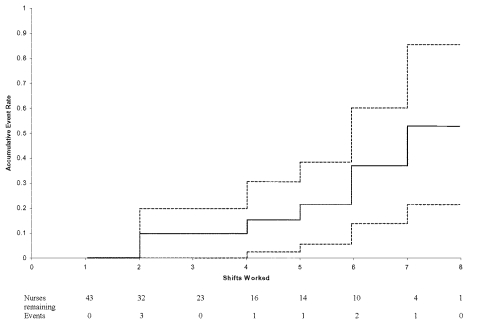
To determine factors that predispose or protect healthcare workers from severe acute respiratory syndrome (SARS), we conducted a retrospective cohort study among 43 nurses who worked in two Toronto critical care units with SARS patients. Eight of 32 nurses who entered a SARS patient's room were infected. The probability of SARS infection was 6% per shift worked. Assisting during intubation, suctioning before intubation, and manipulating the oxygen mask were high-risk activities. Consistently wearing a mask (either surgical or particulate respirator type N95) while caring for a SARS patient was protective for the nurses, and consistent use of the N95 mask was more protective than not wearing a mask. Risk was reduced by consistent use of a surgical mask, but not significantly. Risk was lower with consistent use of a N95 mask than with consistent use of a surgical mask. We conclude that activities related to intubation increase SARS risk and use of a mask (particularly a N95 mask) is protective.
Overview
The claims and statistics of this paper haven’t been checked yet.
Run the check — free, no account needed. It reads the open-access text and checks the sources it cites.
Integrity signals
Registry
Cites
Statistics
Figures
Verification
Claims the paper makes
The claims and statistics of this paper haven’t been checked yet.
Run the check — free, no account needed. It reads the open-access text and checks the sources it cites.
Claims other papers make about this one
Each is checked against this paper’s own text: does it say what the citing paper says it does?
The source backs part of the claim, not all of it — or backs it for a different population, condition or comparison.
In the citing paper
“One study evaluated the health risk of nurses using respiratory protection during the severe acute respiratory syndrome (SARS) epidemic in Canada (12) and showed that N95 respirators were more protective than the SMs.”
From A Quantitative Assessment of the Total Inward Leakage of NaCl Aerosol Representing Submicron-Size Bioaerosol Through N95 Filtering Facepiece Respirators and Surgical Masks (2014) · cites this paper as [12]
Experimental — accuracy not yet measuredThe cited source says what the claim attributes to it.
In the citing paper
“The inverse relationship between filter efficiency and TIL provides a better explanation for the higher levels of respiratory protection offered by the N95 FFRs than the SMs reported previously. (12,14,15)”
Self-check
Percentages, sums and reported differences re-computed from the paper’s own numbers.
The self-check needs the paper’s full text.
Citations
Cites
Identification of a novel coronavirus in patients with severe acute respiratory syndrome
Drosten, C., Günther, S., Preiser, W., van der Werf, S., Brodt, H.-R., Becker, S., Rabenau, H., Panning, M., Kolesnikova, L., Fouchier, R. A. M., et al. (2003) · New England Journal of Medicine · doi:10.1056/nejmoa030747 · Cited by 4,574
A Novel Coronavirus Associated with Severe Acute Respiratory Syndrome
Tg, K., Erdman, D. D., Cs, G., Zaki, Peret, T. C. T., Emery, S. L., Tong, S., Urbani, C., Comer, J. A., Lim, W., et al. (2003) · New England Journal of Medicine · doi:10.1056/nejmoa030781 · Cited by 4,353
Clinical Features and Short-term Outcomes of 144 Patients With SARS in the Greater Toronto Area
Booth, C. M. (2003) · JAMA · doi:10.1001/jama.289.21.joc30885 · Cited by 1,405
Identification of Severe Acute Respiratory Syndrome in Canada
Poutanen, S. M., Low, D. E., Henry, B., Finkelstein, S., Rose, D. E., Green, K., Tellier, R., Draker, R., Adachi, D., Ayers, M., et al. (2003) · New England Journal of Medicine · doi:10.1056/nejmoa030634 · Cited by 1,133
Self-citationDonnelly, C. A., Ghani, A. C., Leung, G. M., Hedley, A. J., Fraser, C., Riley, S., Abu-Raddad, L. J., Ho, L.-M., Thach, T.-Q., Chau, P., et al. (2003) · The Lancet · doi:10.1016/s0140-6736(03)13410-1 · Cited by 940 · cited 1×
“The case-fatality rate has been estimated at 13% for patients <60 years and 43% for those >60 years (5).”
BackgroundSeto, W., Tsang, D., Yung, R., Ching, T., Ng, T., Ho, M., Ho, L., & Peiris, J. (2003) · The Lancet · doi:10.1016/s0140-6736(03)13168-6 · Cited by 863
Varia, M., Wilson, S., Sarwal, S., McGeer, A., Gournis, E., Galanis, E., & Henry, B. (2003) · PubMed Central · Cited by 373
Self-citationIllness in Intensive Care Staff after Brief Exposure to Severe Acute Respiratory Syndrome
Scales, D. C., Green, K., Chan, A. K., Poutanen, S. M., Foster, D., Nowak, K., Raboud, J., Saskin, R., Lapinsky, S. E., & Stewart, T. E. (2003) · Emerging infectious diseases · doi:10.3201/eid0910.030525 · Cited by 162
Self-citation
Cited by
Sorted by citations
Chu, D. K., Akl, E. A., Duda, S., Solo, K., Yaacoub, S., Schünemann, H. J., Chu, D. K., Akl, E. A., El-harakeh, A., Bognanni, A., et al. (2020) · The Lancet · doi:10.1016/s0140-6736(20)31142-9 · Cited by 3,843
Self-citationSiegel, J. D., Rhinehart, E., Jackson, M. M., & Chiarello, L. A. (2007) · American Journal of Infection Control · doi:10.1016/j.ajic.2007.10.007 · Cited by 3,506
Tran, K. T., Cimon, K., Severn, M., Pessoa-Silva, C. L., & Conly, J. M. (2012) · PLoS ONE · doi:10.1371/journal.pone.0035797 · Cited by 1,809
Consensus guidelines for managing the airway in patients with COVID ‐19
Cook, T. M., El‐Boghdadly, K., McGuire, B. E., McNarry, A. F., Patel, A., & Higgs, A. (2020) · Anaesthesia · doi:10.1111/anae.15054 · Cited by 893
Verbeek, J. H. A. M., Rajamaki, B., Ijaz, S., Sauni, R., Toomey, E. C., Blackwood, B., Tikka, C., Ruotsalainen, J. H., & Balci, F. S. K. (2020) · Cochrane Database of Systematic Reviews · doi:10.1002/14651858.cd011621.pub4 · Cited by 723
Metadata
- Authors
- Loeb, M., McGeer, A., Henry, B., Ofner, M., Rose, D., Hlywka, T., Levie, J., McQueen, J., Smith, S., Moss, L., Smith, A., Green, K., & Walter, S. D.
- Affiliations
- McMaster University (CA)
- Mount Sinai Hospital (CA)
- Toronto Public Health (CA)
- Health Canada (CA)
- Scarborough Grace Hospital, Ontario, Canada
- McMaster University, Hamilton, Ontario, Canada
- Corresponding author
- Loeb, Mark
- ORCID
- Venue
- Emerging Infectious Diseases
- Published
- 2004-02
- Volume
- 10
- Issue
- 2
- Pages
- 251-255
- ISSN
- 1080-6040 (ISSN-L)
- 1080-6059
- PMC
- PMC3322898
- OpenAlex
- W1973418860
- Cited by
- 345
- References
- 9
- Citations by year
- 2026: 4 · 2025: 1 · 2024: 3 · 2023: 8 · 2022: 34 · 2021: 51 · 2020: 95 · 2019: 7 · 2018: 3 · 2017: 4 · 2016: 7 · 2015: 4 · 2014: 2 · 2013: 7 · 2012: 13
- FWCI
- 14.68
- Type
- journal article
- Language
- en
- Open access
- diamond
- doi.org
- Licence
- cc-by
- Locations
- Emerging infectious diseases (publishedVersion, cc-by)
- Europe PMC (PubMed Central) (publishedVersion)
- PubMed Central (publishedVersion, cc-by)
- PubMed (publishedVersion)
- DOAJ (DOAJ: Directory of Open Access Journals) (submittedVersion)
- Funders
- McMaster University
- Ontario Ministry of Health and Long-Term Care
- Canadian Institutes of Health Research
- Topics
- Health Sciences › Medicine › Pulmonary and Respiratory Medicine › Infection Control and Ventilation
- Health Sciences › Medicine › Infectious Diseases › Infection Control in Healthcare
- Health Sciences › Medicine › Infectious Diseases › SARS-CoV-2 and COVID-19 Research
- Keywords
- SARS, intensive care unit nurses, occupational infection risk, healthcare worker infection, N95 respirators, surgical masks, personal protective equipment, intubation, aerosol-generating procedures, infection control
- MeSH terms
- Critical Care, Disease Outbreaks, Female, Humans, Male, Masks, Nurses, Occupational Diseases, Ontario, Retrospective Studies, Risk Factors, Cohort Studies, Occupational Exposure, Infectious Disease Transmission, Patient-to-Professional, Severe Acute Respiratory Syndrome
About these checks
Registry, retraction, Cites and statistics results are computed, not judged, with one exception: a printed reference that no index lists is read once by a model before it counts as a citation error. Claims are extracted by a model and kept only when their quote appears verbatim in the text; each cited source is then checked, with a model’s help, for whether it says what the claim relies on. Those verdicts can be wrong — read the claim’s quote and the cited source before relying on one.
Statistics and arithmetic are recomputed, not judged.
Confidence bands are shown only for fields calibrated on our annotated test set. None is calibrated yet, so no band is shown.
What counts as a claim ›How we measure confidence ›How we check this ›
Are you an author, or do you see a problem with this page? Request a review
