

Iquitos Virus in Traveler Returning to the United States from Ecuador
Open accessThe DOI matches its Crossref record; 10 of the 11 references it cites were found in a registry or an index; none of the 16 sources its claims cite is checked for support yet.
Abstract
We describe the case of a returned traveler to the United States from Ecuador who had an acute febrile illness, initially diagnosed as Oropouche fever. This illness was later confirmed to be a rare infection with Iquitos virus, a related bunyavirus that shares 2 of 3 genome segments with Oropouche virus.
Overview
CoChat Summary
TL;DR
A 38-year-old man returning to the United States from Ecuador had an acute febrile illness initially detected as Oropouche virus or a related bunyavirus by RT-PCR and later confirmed as Iquitos virus by sequencing. The case documents a rare travel-associated Iquitos virus infection and supports increased bunyavirus monitoring in Ecuador.
Key findings
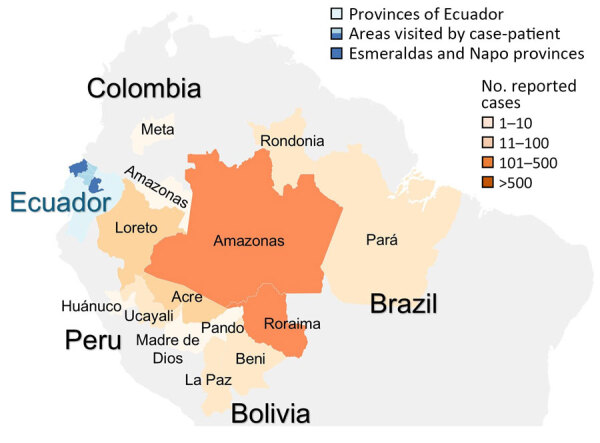
- In a 38-year-old traveler returning from a 10-day Ecuador itinerary (Quito, Esmeraldas Province, Napo Province), illness began 2 days after return with fever reaching 102°F, chills, sweats, headache, and pain with eye movement; fever resolved after 2 days, and headache and fatigue resolved over 10 days.
- Initial testing was negative for Zika, chikungunya, and dengue viruses and for *Leptospira* and *Plasmodium* species; serum and whole blood tested positive by real-time RT-PCR targeting the small genome segment of Oropouche virus and related bunyaviruses, confirmed by a second RT-PCR targeting a different portion of the small segment.
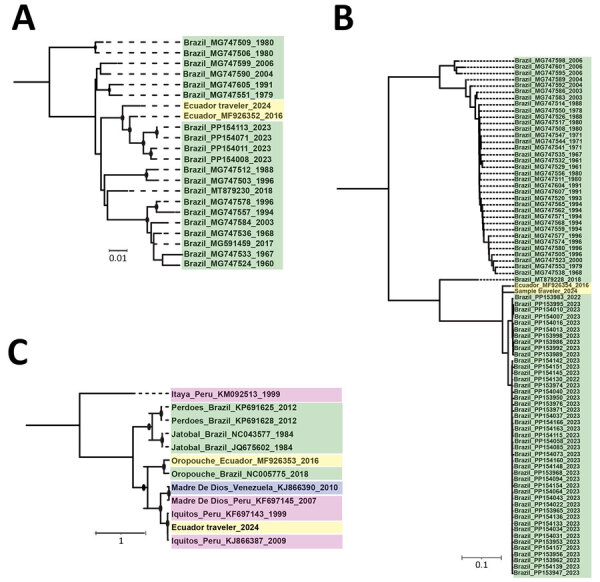
- Partial sequences were generated for the small (83%), medium (27%), and large (37%) segments; the small and large segments were most closely related to an Oropouche virus sample from Ecuador in 2016, while the medium segment was most closely related to Iquitos virus from Peru, confirming Iquitos virus.
- The authors note that Oropouche virus infection does not appear to protect against future Iquitos virus infection and that meningitis and relapsing disease have been reported in Oropouche virus infection.
Methods
- Case report of a returned traveler, with clinical data from an emergency department visit, an Emory TravelWell Center visit, GeoSentinel reporting, and follow-up.
- EDTA whole blood and serum were processed with an RNA extraction and storage protocol and tested by laboratory-developed assays for Zika, chikungunya, dengue, *Leptospira*, and *Plasmodium*, plus real-time RT-PCR for Oropouche virus and related bunyaviruses, with confirmatory RT-PCR.
- Partial genome sequencing and maximum-likelihood phylogenetic analysis were performed for the small, medium, and large segments; sequences were deposited under GenBank accession nos. PQ325301–4.
Limitations
- The paper does not state formal limitations. Evident: this is a single case report, so it cannot establish incidence, risk factors, or generalizability.
- Evident: only partial genome sequences were obtained (small 83%, medium 27%, large 37%), limiting phylogenetic resolution.
- Stated: bunyavirus detection in Ecuador may be limited by limited diagnostics, poor healthcare access, sociopolitical instability, or a combination, leading to underdetection or underreporting.
Model-written summary. Check it against the paper before relying on it.
Integrity signals
Registry
Cites
Statistics
Figures
Verification
Claims the paper makes
0 Valid · 0 Not valid · 12 Not checked · 15 Own results and interpretations
A result the paper reports from its own data — it cites no other source for it, so there is none to check. The quote shows it is in the paper.
In the paper
“This illness was later confirmed to be a rare infection with Iquitos virus, a related bunyavirus that shares 2 of 3 genome segments with Oropouche virus.”
- Also stated in: § Abstract · plain
“However, further characterization by next-generation sequencing identified this virus as IQTV, a related bunyavirus that also circulates in the Amazon Basin and may have contributed to reassortment events that led to current OROV genetic diversity in South America (10).”
§ Iquitos Virus in Traveler Returning to the United States from Ecuador > Abstract
plainstates a causeSingle case- Asserted: passes — The authors put it forward as true.
- Checkable: passes — It can be checked against evidence.
- Load-bearing: passes — The paper’s conclusions depend on it.
- Based: passes — The paper gives a reason why it holds.
- Also stated in: § Abstract · plain
In the paper
“Eluates from serum and whole blood tested positive in a laboratory-developed real-time reverse transcription PCR (RT-PCR) that targets the small genome segment of OROV and related bunyaviruses (Appendix Figure, panel A) (4).”
§ Iquitos Virus in Traveler Returning to the United States from Ecuador > Abstract
What the sources say
- Not checked yetcites [4] Rojas A, Stittleburg V, Cardozo F, Bopp N, Cantero C, López S, et al. Real-time RT-PCR for the detection and quantitation of Oropouche virus. Diagn Microbiol Infect Dis. 2020; 96: 114894. 10.1016/j.diagmicrobio.2019.114894 31727377 PMC6906250 source
plainSingle case- Asserted: passes — The authors put it forward as true.
- Checkable: passes — It can be checked against evidence.
- Load-bearing: passes — The paper’s conclusions depend on it.
- Based: passes — The paper gives a reason why it holds.
A result the paper reports from its own data — it cites no other source for it, so there is none to check. The quote shows it is in the paper.
In the paper
“However, phylogenetic analysis of the medium segment confirmed that it was most closely related to IQTV, the only other available sequences of which were from Peru (Figure 2, panel C).”
§ Iquitos Virus in Traveler Returning to the United States from Ecuador > Abstract
plainstates an associationSingle case- Asserted: passes — The authors put it forward as true.
- Checkable: passes — It can be checked against evidence.
- Load-bearing: passes — The paper’s conclusions depend on it.
- Based: passes — The paper gives a reason why it holds.
A result the paper reports from its own data — it cites no other source for it, so there is none to check. The quote shows it is in the paper.
In the paper
“We successfully generated partial sequences for the coding regions of the small (83%), medium (27%), and large (37%) segments (GenBank accession nos. PQ325301–4) (Appendix).”
§ Iquitos Virus in Traveler Returning to the United States from Ecuador > Abstract
plainSingle case- Asserted: passes — The authors put it forward as true.
- Checkable: passes — It can be checked against evidence.
- Load-bearing: passes — The paper’s conclusions depend on it.
- Based: passes — The paper gives a reason why it holds.
A result the paper reports from its own data — it cites no other source for it, so there is none to check. The quote shows it is in the paper.
In the paper
“We describe the case of a returned traveler to the United States from Ecuador who had an acute febrile illness, initially diagnosed as Oropouche fever.”
§ Iquitos Virus in Traveler Returning to the United States from Ecuador > Abstract
plainSingle case- Asserted: passes — The authors put it forward as true.
- Checkable: passes — It can be checked against evidence.
- Load-bearing: unclear — It is unclear whether the paper’s conclusions depend on it.
- Based: passes — The paper gives a reason why it holds.
6 more claims
Create a free account to see all 27 claims and to verify the 16 references still open.
- It may state two separate claims as one. 14
- Probably not a substantial claim. 8
Citations
Cites
Sakkas, H., Bozidis, P., Franks, A., & Papadopoulou, C. (2018) · Viruses · doi:10.3390/v10040175 · Cited by 249
Human outbreaks of a novel reassortant Oropouche virus in the Brazilian Amazon region
Naveca, F. G., Almeida, T. A. P. D., Souza, V., Nascimento, V., Silva, D., Nascimento, F., Mejía, M., Oliveira, Y. S. D., Rocha, L., Xavier, N., et al. (2024) · Nature Medicine · doi:10.1038/s41591-024-03300-3 · Cited by 167
Iquitos virus: a novel reassortant Orthobunyavirus associated with human illness in Peru.
Aguilar, P. V., Barrett, A. D., Saeed, M. F., Watts, D. M., Russell, K., Guevara, C., Ampuero, J. S., Suarez, L., Cespedes, M., Montgomery, J. M., et al. (2011) · PLoS Neglected Tropical Diseases · doi:10.1371/journal.pntd.0001315 · Cited by 130
Rapid detection of human pathogenic orthobunyaviruses.
Weidmann, M., Rudaz, V., Nunes, M. R. T., Vasconcelos, P. F. C., & Hufert, F. T. (2003) · Journal of Clinical Microbiology · doi:10.1128/jcm.41.7.3299-3305.2003 · Cited by 61
Real-time RT-PCR for the detection and quantitation of Oropouche virus.
Rojas, A., Stittleburg, V., Cardozo, F., Bopp, N., Cantero, C., López, S., Bernal, C., Mendoza, L., Aguilar, P., Pinsky, B. A., et al. (2020) · Diagnostic Microbiology and Infectious Disease · doi:10.1016/j.diagmicrobio.2019.114894 · Cited by 36
Self-citationBrown, A. B., Miller, C., Hamer, D. H., Kozarsky, P., Libman, M., Huits, R., Rizwan, A., Emetulu, H., Waggoner, J., Chen, L. H., et al. (2023) · MMWR. Surveillance Summaries · doi:10.15585/mmwr.ss7207a1 · Cited by 32
Self-citationIsolation of Oropouche virus from febrile patient, Ecuador.
Wise, E. L., Pullan, S. T., Márquez, S., Paz, V., Mosquera, J. D., Zapata, S., Jackson, S. K., Fejer, G., Trueba, G., & Logue, C. H. (2018) · Emerging Infectious Diseases · doi:10.3201/eid2405.171569 · Cited by 32
Multiplex nucleic acid amplification test for diagnosis of dengue fever, malaria, and leptospirosis.
Waggoner, J. J., Abeynayake, J., Balassiano, I., Lefterova, M., Sahoo, M. K., Liu, Y., Vital-Brazil, J. M., Gresh, L., Balmaseda, A., Harris, E., et al. (2014) · Journal of Clinical Microbiology · doi:10.1128/jcm.00341-14 · Cited by 25
Self-citationSimple and Economical Extraction of Viral RNA and Storage at Ambient Temperature
Hernandez, S., Cardozo, F., Myers, D. R., Rojas, A., & Waggoner, J. J. (2022) · Microbiology Spectrum · doi:10.1128/spectrum.00859-22 · Cited by 19
Self-citationPower Law for Estimating Underdetection of Foodborne Disease Outbreaks, United States
Ford, L., Self, J. L., Wong, K. K., Hoekstra, R. M., Tauxe, R. V., Rose, E. B., & Bruce, B. B. (2023) · Emerging infectious diseases · doi:10.3201/eid3002.230342 · Cited by 8
Cited by
Fischer, C., Frühauf, A., Inchauste, L., Cassiano, M. H. A., Ramírez, H. A., Barthélémy, K., Machicado, L. B., Bozza, F. A., Brites, C. R., Cabada, M. M., et al. (2025) · The Lancet Infectious Diseases · doi:10.1016/s1473-3099(25)00110-0 · Cited by 53
Ding, Y., Li, J., Wang, X., Malagò, S., Duarte‐Neto, A. N., Ding, X., Fang, Q., Deiana, M., Castilletti, C., Guo, H., et al. (2025) · Virologica Sinica · doi:10.1016/j.virs.2025.09.009 · Cited by 5
Oropouche Virus: Implications for Transfusion Services
Focosi, D., Colavita, F., Meschi, S., Lalle, E., Franchini, M., & Maggi, F. (2025) · Reviews in Medical Virology · doi:10.1002/rmv.70031 · Cited by 3
Genomic evidence of active circulation of Orthobunyavirus in Ecuador
Romero-Álvarez, D., Navarro, J. C., Gutiérrez-Pallo, D., Echeverría‐Garcés, G., Lara-Cazorla, C., Fuertes-Flores, B., García-Díaz, G., Wallau, G. L., Coloma, J., & Carrazco-Montalvo, A. (2025) · International Journal of Infectious Diseases · doi:10.1016/j.ijid.2025.108000 · Cited by 2
Rock, M. L., Huskey, J. B., Hernandez, S., Shinde, D. P., Oguin, T. H., Ping, S., Lewis, A., Waggoner, J. J., Moody, M. A., Sempowski, G. D., et al. (2025) · Journal of Virological Methods · doi:10.1016/j.jviromet.2025.115292 · Cited by 1
Self-citation
Metadata
- Authors
- Baer, K., Arora, I., Kimbro, J., Haider, A., Mott, M., Marshall, K., Wu, H. M., Fairley, J., Piantadosi, A., Myers, D. R., & Waggoner, J. J.
- Affiliations
- Georgia Institute of Technology (US)
- Corresponding author
- Waggoner, Jesse J.
- Venue
- Emerging Infectious Diseases
- Published
- 2024-11
- Volume
- 30
- Issue
- 11
- Pages
- 2447-2451
- ISSN
- 1080-6040 (ISSN-L)
- 1080-6059
- PMC
- PMC11521160
- OpenAlex
- W4403557294
- Cited by
- 10
- References
- 10
- Citations by year
- 2026: 4 · 2025: 6
- FWCI
- 2.54
- Type
- journal article
- Language
- en
- Open access
- diamond
- doi.org
- Licence
- cc-by
- Locations
- Emerging infectious diseases (publishedVersion, cc-by)
- PubMed Central (publishedVersion, cc-by)
- PubMed (publishedVersion)
- DOAJ (DOAJ: Directory of Open Access Journals) (submittedVersion)
- Funders
- Emory University
- Georgia Research Alliance
- International Society of Travel Medicine
- National Institutes of Health
- Centers for Disease Control and Prevention
- National Institute of Allergy and Infectious Diseases (U01AI151788)
- Topics
- Health Sciences › Medicine › Infectious Diseases › Viral Infections and Vectors
- Health Sciences › Medicine › Public Health, Environmental and Occupational Health › Mosquito-borne diseases and control
- Health Sciences › Medicine › Epidemiology › Virology and Viral Diseases
- Keywords
- Oropouche virus, Bunyaviridae, acute febrile illness, returning travelers, imported infections, viral diagnosis
- MeSH terms
- Adult, Bunyaviridae Infections, Ecuador, Humans, Male, Phylogeny, Travel, United States, Orthobunyavirus
About these checks
Registry, retraction, Cites and statistics results are computed, not judged, with one exception: a printed reference that no index lists is read once by a model before it counts as a citation error. Claims are extracted by a model and kept only when their quote appears verbatim in the text; each cited source is then checked, with a model’s help, for whether it says what the claim relies on. Those verdicts can be wrong — read the claim’s quote and the cited source before relying on one.
A language model drew the claims from the paper on 2026-11-23, under version 3 of the claim definition (model deepseek-v4.1-flash, prompt extract-v3).
A second model labelled each claim on 2026-11-23 (model jev-1.13-20260917, definition revision gold-guideline-v0.2).
Statistics and arithmetic are recomputed, not judged.
Confidence bands are shown only for fields calibrated on our annotated test set. None is calibrated yet, so no band is shown.
What counts as a claim ›How we measure confidence ›How we check this ›
Are you an author, or do you see a problem with this page? Request a review
Data sources
Bibliographic data: Semantic Scholar, OpenAlex, Crossref.
Contains information from the Semantic Scholar Academic Graph Datasets, made available under the ODC Attribution License (ODC-BY 1.0).
Semantic Scholar’s data is described in: Kinney, R., et al. (2023). The Semantic Scholar Open Data Platform. arXiv:2301.10140.
