

The DOI matches its Crossref record; 4 of the 4 references it cites were found in a registry or an index; none of the 17 sources its claims cite is checked for support yet.
A Statistical Investigation of the Synoptic Problem
Open accessAbstract
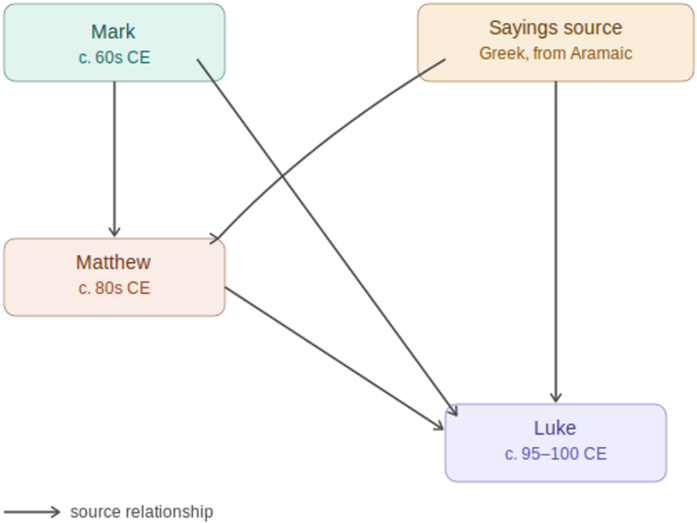
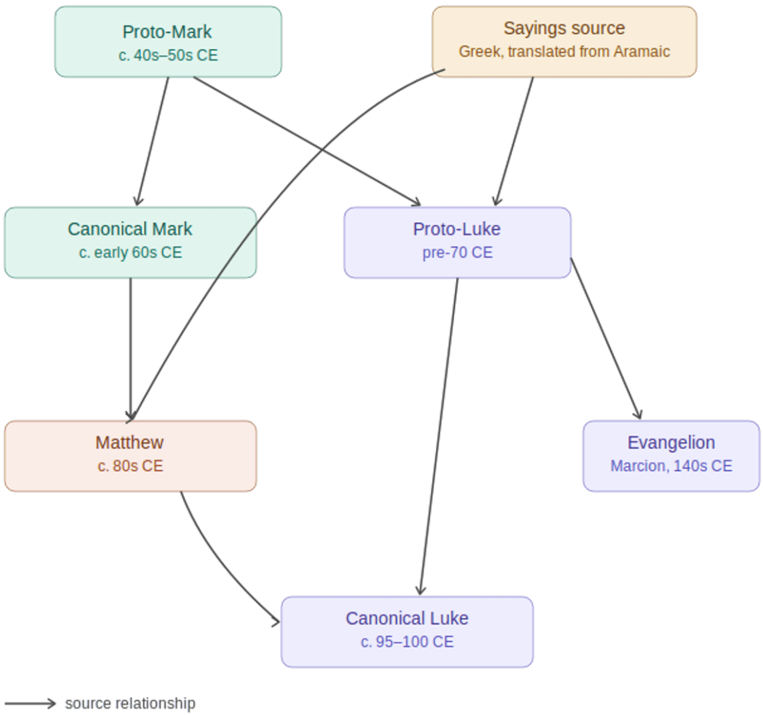
This study presents a statistical investigation of the literary relationships among the three synoptic gospels — Matthew, Mark, and Luke — using vocabulary frequency data drawn from the Hoffmann, Hieke, and Bauer Synoptic Concordance. Word occurrence counts across nineteen synoptic categories are modeled using a Poisson distribution, and pairwise relationships between categories are tested using maximum likelihood estimation and the likelihood ratio test, with a correction for the overdispersion characteristic of word-frequency data. The analysis identifies statistically significant vocabulary affinities between specific synoptic categories, yielding evidence for Markan priority, for Luke's use of Matthew, and for a sayings source underlying the double tradition. The results are most consistent with the Three Source Hypothesis: Mark composed first; Matthew drew on Mark and a sayings source; Luke drew on Mark, the sayings source, and Matthew. The same framework accommodates, without establishing, more speculative refinements — a proto-Mark and a proto-Luke — that are developed on literary grounds in the discussion and reserved for fuller treatment elsewhere. An extended example from Luke 14:1–6 illustrates how an alliterative Aramaic saying, preserved in Greek translation, illustrates Luke's use of all three sources.
Overview
CoChat Summary
Written by AI from the paper’s full text.
TL;DR
Using 807 vocabulary items across 19 HHB synoptic categories, the paper fits Poisson models with likelihood-ratio tests and an overdispersion correction to test directional vocabulary prediction among Matthew, Mark, and Luke. It reports statistically significant support for Markan priority, Luke’s use of Matthew, and a sayings source, concluding the Three Source Hypothesis best fits the data.
Key findings
- Markan priority: distinctively Markan vocabulary predicts Mark/Matthew shared material; the anchor relationship 121 → 221 remains significant at the order of 10⁻⁸ after correction and clears even the most conservative dispersion factor tested, while the reverse 211 → 221 does not appear.
- Luke’s use of Matthew and the minor agreements: 211 → 212 has corrected p = 8.0 × 10⁻⁴ and 210 → 212 has corrected p = 8.0 × 10⁻⁵, indicating distinctively Matthean vocabulary predicts passages where Matthew and Luke agree against Mark.
- Sayings source: both 201 → 202 and 102 → 202 predict the double tradition with near-equal weights (β = .1576 and β = .1484), which the paper reads as the symmetry of a shared source; 122 → 002 is reported as exploratory with corrected p = 2.0 × 10⁻⁶.
- Overall: 17 relationships survive the paper’s filters; all 17 clear FDR at φ = 1.8, eight clear Bonferroni, and six form a “robust core” at φ = 2.5 spanning Markan priority, the Markan origin of triple-tradition agreements, the sayings source, and the minor agreements as Matthean.
Methods
- Data: the Hoffmann, Hieke, and Bauer Synoptic Concordance, restricted to 807 fully tabulated vocabulary items across 19 synoptic categories, with each cell recording absolute occurrence counts.
- Model: Poisson count models with maximum likelihood estimation and likelihood ratio tests; each ordered pair asks whether a predictor category improves prediction of a test category beyond the corpus-wide baseline, with 171 possible pairwise comparisons and a 66-comparison hypothesis-testing family.
- Corrections: overdispersion estimated at φ ≈ 1.8 (1.88 for 222, 1.76 for 122, 1.80 for 002), applied by dividing each likelihood ratio statistic by φ; multiple-comparison control uses Bonferroni threshold .05/66 ≈ 7.6 × 10⁻⁴ and Benjamini-Hochberg FDR at q = 0.05, with robustness checks at φ = 2.17 and φ = 2.5.
Limitations
- Stated: the study does not establish a proto-Mark or proto-Luke; the proto-Luke discussion is speculative, the Marcion question cannot be adjudicated, and the statistical evidence cannot adjudicate proto-Mark.
- Stated: 122 → 002 lies outside the hypothesis-testing family and is reported as exploratory; direct Mark → Luke relationships clear only the FDR threshold, not Bonferroni, and some reported weights are not individually significant.
- Stated/evident: the analysis depends on HHB concordance category assignments, excludes rarer items with incomplete data, excludes 200 → 202 on methodological grounds because the concordance distributes Matthean doublets across categories, and applies conservative overdispersion and multiple-comparison corrections; the paper also discloses AI assistance for copyediting, drafting, condensing, and consultation on overdispersion.
Model-written summary. Check it against the paper before relying on it.
Integrity signals
Registry
Cites
Statistics
Figures
Verification
Claims the paper makes
84 Own interpretation · 41 Own result · 17 Own method · 9 Not checked yet · 5 No basis given · 2 Sources not found · 1 No full text of the sources
A result the paper reports from its own data — it cites no other source for it, so there is none to check. The quote shows it is in the paper.
In the paper
“The results establish with a high degree of mathematical con dence that the vocabulary pro les of certain synoptic categories are more closely related to speci c individual categories than to the synoptic corpus as a whole.”
§ A Statistical Investigation of the Synoptic Problem > 6. Discussion
boostedstates an association- Asserted: passes — The authors put it forward as true.
- Checkable: passes — It can be checked against evidence.
- Load-bearing: passes — The paper’s conclusions depend on it.
- Based: passes — The paper gives a reason why it holds.
A result the paper reports from its own data — it cites no other source for it, so there is none to check. The quote shows it is in the paper.
In the paper
“The analysis identi es statistically signi cant vocabulary af nities between speci c synoptic categories”
§ A Statistical Investigation of the Synoptic Problem > Abstract
plainstates an association- Asserted: passes — The authors put it forward as true.
- Checkable: passes — It can be checked against evidence.
- Load-bearing: passes — The paper’s conclusions depend on it.
- Based: passes — The paper gives a reason why it holds.
A result the paper reports from its own data — it cites no other source for it, so there is none to check. The quote shows it is in the paper.
In the paper
“Distinctively Markan vocabulary predicts the material Mark shares with Matthew”
§ A Statistical Investigation of the Synoptic Problem > 6. Discussion
plainstates an association- Asserted: passes — The authors put it forward as true.
- Checkable: passes — It can be checked against evidence.
- Load-bearing: passes — The paper’s conclusions depend on it.
- Based: passes — The paper gives a reason why it holds.
A result the paper reports from its own data — it cites no other source for it, so there is none to check. The quote shows it is in the paper.
In the paper
“122 → 002 (corrected p = 2.0 × 10 -6 ) Vocabulary shared between Mark and Luke in the triple tradition predicts vocabulary appearing in Luke's Sondergut”
§ A Statistical Investigation of the Synoptic Problem > 5. Results
plainstates an association- Asserted: passes — The authors put it forward as true.
- Checkable: passes — It can be checked against evidence.
- Load-bearing: unclear — It is unclear whether the paper’s conclusions depend on it.
- Based: passes — The paper gives a reason why it holds.
A result the paper reports from its own data — it cites no other source for it, so there is none to check. The quote shows it is in the paper.
In the paper
“The reciprocal relationship does not hold: special-Luke material does not predict the Mark/Luke agreement categories.”
§ A Statistical Investigation of the Synoptic Problem > 5. Results
plain- Asserted: passes — The authors put it forward as true.
- Checkable: passes — It can be checked against evidence.
- Load-bearing: passes — The paper’s conclusions depend on it.
- Based: passes — The paper gives a reason why it holds.
- It may state two separate claims as one. 79
- The quote only partly states this claim. 2
- Probably not a substantial claim. 39
Create a free account to see these claims.
Create a free account to see these assumptions.
57 more claims
Create a free account to see all 159 claims and to verify the 13 references still open.
Citations
Cites
Goodacre, M. (2001) · SBL Press eBooks · doi:10.15699/9781589836327-010 · Cited by 44
The Synoptic Problem: A Way Through the Maze
Goodacre, M. (2001) · doi:10.5040/9780567691187 · Cited by 44
The Great Expansion: Proto-Mark and the Gentile Enlargement of Canonical MarkPreprint
Gentile, D. (2026) · Qeios · doi:10.32388/awerm6 · Cited by 5
Self-citationA Statistical Investigation of the Synoptic ProblemPreprint
Gentile, D. (2026) · Qeios · doi:10.32388/ribdz7 · Cited by 2
Self-citation
Research works printed but not linked: 7
- Kloppenborg, J. S. (1987). The formation of Q: Trajectories in Ancient Wisdom Collections. Philadelphia: Fortress Press.
- Farmer, W. R. (1976). The Synoptic Problem: A Critical Analysis 2nd ed. Macon: Mercer University Press.
- Gundry, R. H. (1992). Matthean Foreign Bodies in Agreements of Luke with Matthew Against Mark: Evidence that Luke used Matthew. In F. van Segbroeck (Ed.), The Four Gospels (Vol. 2, pp. 1466-95). Leuven: University Press.
- Greene, W. H. (2000). Econometric Analysis. 4th ed. Upper Saddle River: Prentice Hall.
- Oakes, M. P. (1998). Statistics for Corpus Linguistics. Edinburgh: University Press.
- BeDuhn, J. (2013). The First New Testament: Marcion's Scriptural Canon. Salem: Polebridge Press.
- Tyson, J. B. (2006). Marcion and Luke-Acts: A defining Struggle. Columbia: University of South Carolina Press.
Cited by
Pauline Soteriology in the Gospel of MarkPreprint
Gentile, D. (2026) · Qeios · doi:10.32388/kshmav.2 · Cited by 2
Self-citationThe Great Expansion: Proto-Mark and the Pro-Gentile Enlargement of Canonical MarkPreprint
Gentile, D. (2026) · Qeios · doi:10.32388/awerm6.2
Self-citationPauline Soteriology in the Gospel of MarkPreprint
Gentile, D. (2026) · Qeios · doi:10.32388/kshmav.3
Self-citation
Metadata
- Authors
- Gentile, D.
- Corresponding author
- Gentile, David
- ORCID
- Gentile, David
- Venue
- Qeios
- Publisher
- Qeios Ltd
- Published
- 2026-07-09
- ISSN
- 2632-3834 (ISSN-L)
- OpenAlex
- W7167820081
- Cited by
- 3
- References
- 1
- Citations by year
- 2026: 3
- Type
- posted content
- Language
- en
- Open access
- diamond
- doi.org
- Locations
- Qeios (submittedVersion, cc-by)
- Topics
- Social Sciences › Arts and Humanities › Religious studies › Biblical Studies and Interpretation
- Social Sciences › Arts and Humanities › Literature and Literary Theory › Digital Humanities and Scholarship
- Social Sciences › Arts and Humanities › Language and Linguistics › Classical Studies and Philology
- Keywords
- Synoptic problem, Synoptic Gospels, Markan priority, word frequency, word occurrences, Poisson distribution, overdispersion, Mark, Gospel of Luke
About these checks
Registry, retraction, Cites and statistics results are computed, not judged, with one exception: a printed reference that no index lists is read once by a model before it counts as a citation error. Claims are extracted by a model and kept only when their quote appears verbatim in the text; each cited source is then checked, with a model’s help, for whether it says what the claim relies on. Those verdicts can be wrong — read the claim’s quote and the cited source before relying on one.
A language model drew the claims from the paper on 2026-11-11, under version 3 of the claim definition (model deepseek-v4.1-flash, prompt extract-v3).
A second model labelled each claim on 2026-11-11 (model jev-1.13-20260917, definition revision gold-guideline-v0.2).
Statistics and arithmetic are recomputed, not judged.
Confidence bands are shown only for fields calibrated on our annotated test set. None is calibrated yet, so no band is shown.
What counts as a claim ›How we measure confidence ›How we check this ›
Are you an author, or do you see a problem with this page? Request a review
How to cite
Cite CoChat for the checks on this page, and the paper for its own findings.
- This page
- CoChat. (2026). Citation check: A Statistical Investigation of the Synoptic Problem. https://app.cochat.ai/papers/10.32388/ribdz7.3
- The paper
- Gentile, D. (2026). A Statistical Investigation of the Synoptic Problem. Qeios. https://doi.org/10.32388/ribdz7.3
