

The DOI matches its Crossref record.
Exploring the Structure of AI-Induced Language Change in Scientific English
Open accessAbstract
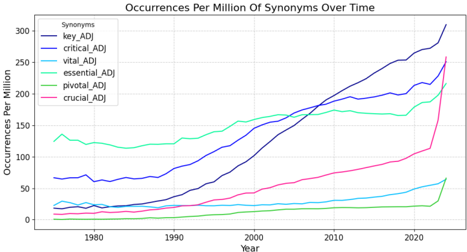
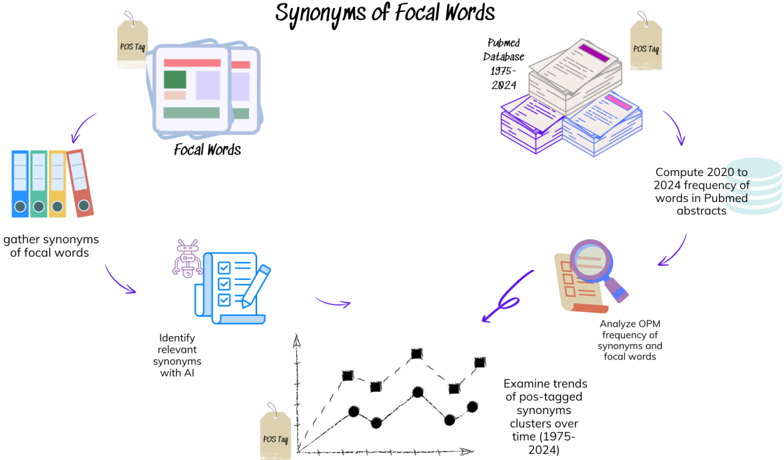
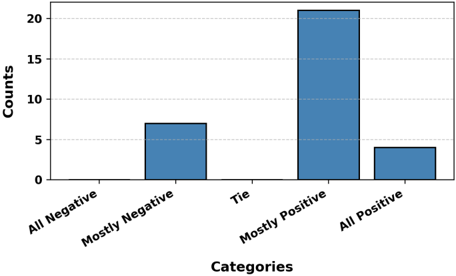
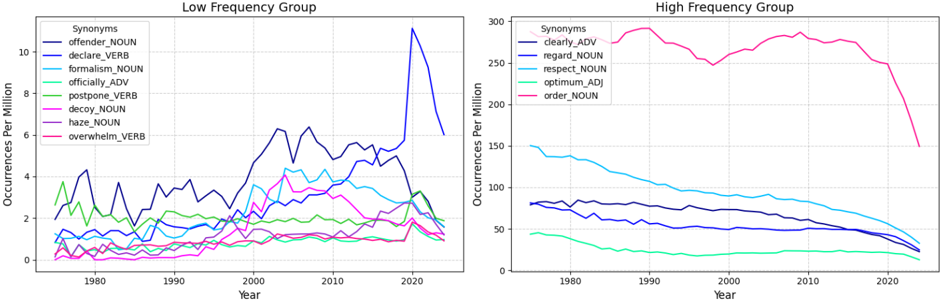
Scientific English has undergone rapid and unprecedented changes in recent years, with words such as "delve," "intricate," and "crucial" showing significant spikes in frequency since around 2022. These changes are widely attributed to the growing influence of Large Language Models like ChatGPT in the discourse surrounding bias and misalignment. However, apart from changes in frequency, the exact structure of these linguistic shifts has remained unclear. The present study addresses this and investigates whether these changes involve the replacement of synonyms by suddenly 'spiking words,' for example, "crucial" replacing "essential" and "key," or whether they reflect broader semantic and pragmatic qualifications. To further investigate structural changes, we include part of speech tagging in our analysis to quantify linguistic shifts over grammatical categories and differentiate between word forms, like "potential" as a noun vs. as an adjective. We systematically analyze synonym groups for widely discussed 'spiking words' based on frequency trends in scientific abstracts from PubMed. We find that entire semantic clusters often shift together, with most or all words in a group increasing in usage. This pattern suggests that changes induced by Large Language Models are primarily semantic and pragmatic rather than purely lexical. Notably, the adjective "important" shows a significant decline, which prompted us to systematically analyze decreasing lexical items. Our analysis of collapsing words reveals a more complex picture, which is consistent with organic language change and contrasts with the patterns of the abrupt spikes. These insights into the structure of language change contribute to our understanding of how language technology continues to shape human language.
Overview
The claims and statistics of this paper haven’t been checked yet.
Run the check — free, no account needed. It reads the open-access text and checks the sources it cites.
Integrity signals
Registry
Cites
Statistics
Figures
Verification
Claims the paper makes
The claims and statistics of this paper haven’t been checked yet.
Run the check — free, no account needed. It reads the open-access text and checks the sources it cites.
Claims other papers make about this one
Each is checked against this paper’s own text: does it say what the citing paper says it does?
In the citing paper
“It has been reported that the usage of certain terms, such as the words ‘declare’ and ‘clearly,’ decreased after the introduction of ChatGPT [24].”
From Delving Into PubMed Records: How AI-Influenced Vocabulary has Transformed Medical Writing since ChatGPT (2025) · cites this paper as [24]
Self-check
Percentages, sums and reported differences re-computed from the paper’s own numbers.
The self-check needs the paper’s full text.
Citations
Cites
No references could be resolved yet.
Research works printed but not linked: 28
- Aitchison, J. 2005. Language change. In Cobley, P., ed., The Routledge Companion to Semiotics and Linguistics. London: Routledge. chapter 7. [Alemohammad et al. 2023] Alemohammad, S.; Casco- Rodriguez, J.; Luzi, L.; Humayun, A. I.; Babaei, H.; LeJeune, D.; Siahkoohi, A.; and Baraniuk, R. G. 2023. Self-consuming generative models go mad. arXiv preprint arXiv:2307.01850. · arXiv
- Altman, D. G., and Bland, J. M. 1995. Statistics notes: Absence of evidence is not evidence of absence. Bmj 311(7003):485.
- Baron, N. S. 2010. Always on: Language in an online and mobile world. Oxford University Press.
- Briesch, M.; Soba- nia, D.; and Rothlauf, F. 2023. Large language models suf- fer from their own output: An analysis of the self-consuming training loop. arXiv preprint arXiv:2311.16822. · arXiv
- Bybee, J. L. 2006. From usage to grammar: The mind's response to repetition. Language 82(4):711- 733.
- Crystal, D. 2008. Txtng: The gr8 db8. OUP Oxford.
- Degaetano-Ortlieb and Teich 2018] Degaetano-Ortlieb, S., and Teich, E. 2018. Using relative entropy for detection and analysis of periods of diachronic linguistic change. In Proceedings of the second joint SIGHUM workshop on com- putational linguistics for cultural heritage, social sciences, humanities and literature, 22-33.
- Geng, M.; Chen, C.; Wu, Y.; Chen, D.; Wan, Y.; and Zhou, P. 2024. The impact of large lan- guage models in academia: from writing to speaking. arXiv preprint arXiv:2409.13686. · arXiv
- Gray, A. 2024. Chatgpt" contamination": es- timating the prevalence of llms in the scholarly literature. arXiv preprint arXiv:2403.16887. · arXiv
- Haslwanter, T. 2016. An introduction to statistics with python. With applications in the life sciences. Switzerland: Springer International Publishing.
- Hataya, R.; Bao, H.; and Arai, H. 2023. Will large-scale generative models corrupt fu- ture datasets? In Proceedings of the IEEE/CVF International Conference on Computer Vision, 20555-20565.
- Hopper, P. J., and Thompson, S. A. 1984. The discourse basis for lexical categories in universal grammar. Language 60(4):703-752.
- Juzek, T. S., and Ward, Z. B. 2025. Why does chatgpt" delve" so much? exploring the sources of lexical overrepresentation in large language models. In Proceedings of the 31st International Conference on Com- putational Linguistics (COLING 2025).
- Kobak, D.; Márquez, R. G.; Horvát, E.- Á.; and Lause, J. 2024. Delving into chatgpt usage in aca- demic writing through excess vocabulary. arXiv preprint arXiv:2406.07016. · arXiv
- Krielke, M.-P. 2024. Cross-linguistic depen- dency length minimization in scientific language: Syntactic complexity reduction in english and german in the late mod- ern period. Languages in Contrast 24(1):133-163.
- Labov, W. 1973. Sociolinguistic patterns. Uni- versity of Pennsylvania press.
- Liang et al. 2024a] Liang, W.; Izzo, Z.; Zhang, Y.; Lepp, H.; Cao, H.; Zhao, X.; Chen, L.; Ye, H.; Liu, S.; Huang, Z.; et al. 2024a. Monitoring ai-modified content at scale: A case study on the impact of chatgpt on ai conference peer reviews. arXiv preprint arXiv:2403.07183. · arXiv
- Liang et al. 2024b] Liang, W.; Zhang, Y.; Wu, Z.; Lepp, H.; Ji, W.; Zhao, X.; Cao, H.; Liu, S.; He, S.; Huang, Z.; et al. 2024b. Mapping the increasing use of llms in scientific pa- pers. arXiv preprint arXiv:2404.01268. · arXiv
- Liu, J., and Bu, Y. 2024. Towards the relationship between aigc in manuscript writing and author profiles: evidence from preprints in llms. arXiv preprint arXiv:2404.15799. · arXiv
- Mahajan, S. 2023. Artificial intelligence and its impacts on the society. Contemporary Social Sci- ences 32(4):135-151.
- Matsui, K. 2024. Delving into pubmed records: Some terms in medical writing have drastically changed after the arrival of chatgpt. medRxiv 2024-05.
- Menzel, K. 2022. Medical discourse in late modern english: Insights from a multidisciplinary corpus of scientific journal articles. In Corpus pragmatic studies on the history of medical discourse. John Benjamins. 79-104.
- Milroy, J., and Milroy, L. 1985. Linguistic change, social network and speaker innovation1. Journal of linguistics 21(2):339-384.
- Montani, I.; Honnibal, M.; Boyd, A.; Landeghem, S. V.; and Peters, H. 2023. explosion/spacy: v3.7.2: Fixes for apis and requirements. Version v3.7.2, Zen- odo. [National Library of Medicine 2024] National Li- brary of Medicine. 2024. PubMed Database. https://pubmed.ncbi.nlm.nih.gov/. Accessed: 2024-12-06.
- Pachegowda, C. 2023. The global im- pact of ai-artificial intelligence: Recent advances and future directions, a review. arXiv preprint arXiv:2401.12223. · arXiv
- Thomason, S. G., and Kauf- man, T. 2023. Language contact, creolization, and genetic linguistics. Univ of California Press.
- Yakura et al. 2024] Yakura, H.; Lopez-Lopez, E.; Brinkmann, L.; Serna, I.; Gupta, P.; and Rahwan, I. 2024. Empirical evidence of large language model's influence on human spoken communication. arXiv preprint arXiv:2409.01754. · arXiv
- Zhang, X.; Xiong, W.; Chen, L.; Zhou, T.; Huang, H.; and Zhang, T. 2024. From lists to emojis: How format bias affects model alignment. arXiv preprint arXiv:2409.11704. · arXiv
Cited by
Sorted by citations
Matsui, K. (2025) · Perspectives on Medical Education · doi:10.5334/pme.1929 · Cited by 6
“It has been reported that the usage of certain terms, such as the words ‘declare’ and ‘clearly,’ decreased after the introduction of ChatGPT [24].”
Metadata
- Authors
- Galpin, R., Anderson, B., & Juzek, T. S.
- Affiliations
- Florida State University (US)
- Venue
- The International FLAIRS Conference Proceedings
- Published
- 2025-05-14
- Volume
- 38
- ISSN
- 2334-0754 (ISSN-L)
- 2334-0762
- OpenAlex
- W4410397935
- Cited by
- 3
- References
- 0
- Citations by year
- 2026: 3
- FWCI
- 69.84
- Type
- conference paper
- Language
- en
- Open access
- diamond
- doi.org
- Licence
- Locations
- Proceedings of the ... International Florida Artificial Intelligence Research Society Conference (publishedVersion, cc-by-nc)
- arXiv (Cornell University) (submittedVersion)
- DOAJ (DOAJ: Directory of Open Access Journals) (submittedVersion, cc-by-sa)
- arXiv (Cornell University)
- Topics
- Social Sciences › Arts and Humanities › Language and Linguistics › Linguistics, Language Diversity, and Identity
- Social Sciences › Arts and Humanities › Language and Linguistics › linguistics and terminology studies
- Physical Sciences › Computer Science › Artificial Intelligence › Natural Language Processing Techniques
- Keywords
- scientific English, large language models, ChatGPT, synonym replacement, semantic clusters, part-of-speech tagging, PubMed abstracts
About these checks
Registry, retraction, Cites and statistics results are computed, not judged, with one exception: a printed reference that no index lists is read once by a model before it counts as a citation error. Claims are extracted by a model and kept only when their quote appears verbatim in the text; each cited source is then checked, with a model’s help, for whether it says what the claim relies on. Those verdicts can be wrong — read the claim’s quote and the cited source before relying on one.
Statistics and arithmetic are recomputed, not judged.
Confidence bands are shown only for fields calibrated on our annotated test set. None is calibrated yet, so no band is shown.
What counts as a claim ›How we measure confidence ›How we check this ›
Are you an author, or do you see a problem with this page? Request a review
