

Multi-Stage Voltage Control Optimization Strategy for Distribution Networks Considering Active-Reactive Co-Regulation of Electric Vehicles
Open accessThe DOI matches its Crossref record; 31 of the 31 references it cites were found in a registry or an index; none of the 25 sources its claims cite is checked for support yet.
Abstract
The high proportion of uncertain distributed power sources and the access to large-scale random electric vehicle (EV) charging resources further aggravate the voltage fluctuation of the distribution network, and the existing research has not deeply explored the EV active-reactive synergistic regulating characteristics, and failed to realize the multi-timescale synergistic control with other regulating means, For this reason, this paper proposes a multilevel linkage coordinated optimization strategy to reduce the voltage deviation of the distribution network. Firstly, a capacitor bank reactive power compensation voltage control model and a distributed photovoltaic (PV) active-reactive power regulation model are established. Additionally, an external characteristic model of EV active-reactive power regulation is developed considering the four-quadrant operational characteristics of the EV charger. A multi-objective optimization model of the distribution network is then constructed considering the time-series coupling constraints of multiple types of voltage regulators. A multi-timescale control strategy is proposed by considering the impact of voltage regulators on active-reactive EV energy consumption and PV energy consumption. Then, a four-stage voltage control optimization strategy is proposed for various types of voltage regulators with multiple time scales. The multi-objective optimization is solved with the improved Drosophila algorithm to realize the power fluctuation control of the distribution network and the multi-stage voltage control optimization. Simulation results validate that the proposed voltage control optimization strategy achieves the coordinated control of decentralized voltage control resources in the distribution network. It effectively reduces the voltage deviation of the distribution network while ensuring the energy demand of EV users and enhancing the stability and economic efficiency of the distribution network.
Overview
CoChat Summary
TL;DR
This paper proposes a four-level/multi-stage voltage control optimization strategy for distribution networks that coordinates capacitor banks, distributed PV active-reactive regulation, EV charger active-reactive co-regulation, and network reconfiguration, solved with an improved fruit fly/Drosophila algorithm. In a modified IEEE 33-node case, the four-level strategy reduced network loss from 250.13 kW to 91.53 kW (63.4%) and voltage deviation from 0.065 to 0.024 p.u.
Key findings
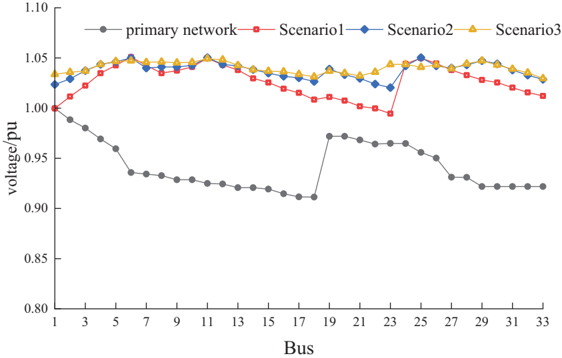
- The four-level linkage strategy reduced network loss to 91.53 kW, compared with 250.13 kW without optimization, 143.29 kW in Scenario 1, and 97.55 kW in Scenario 2; voltage deviation fell to 0.024 p.u., compared with 0.065, 0.045, and 0.037 p.u., respectively.
- At node 15, voltage fluctuation was reduced from ±5% in Scenario 1 to within ±1% in Scenario 3; at line-end node 18, Scenario 3 kept voltage stable above 0.98 p.u. with a very small fluctuation range.
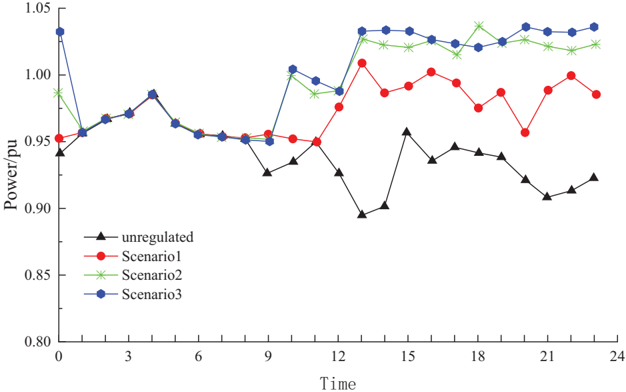
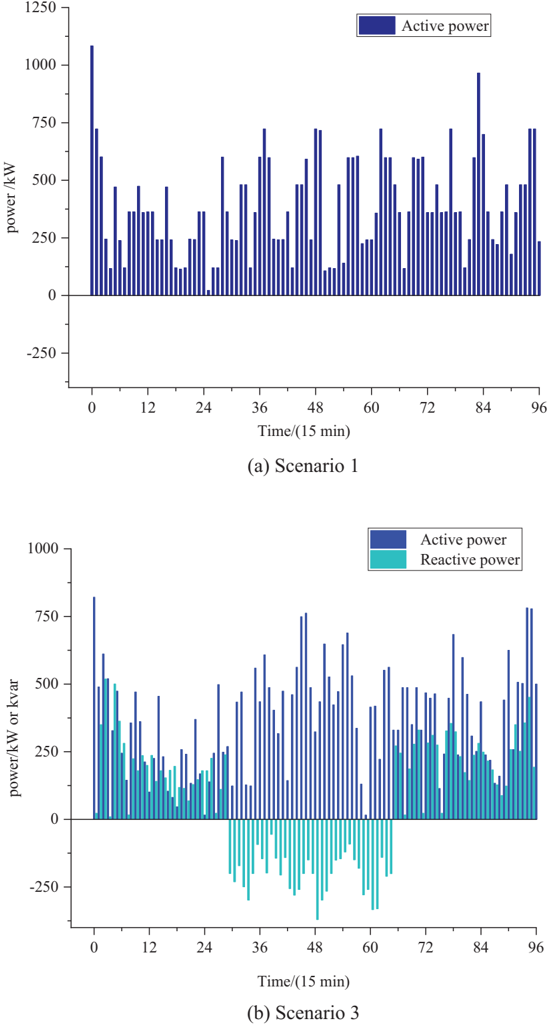
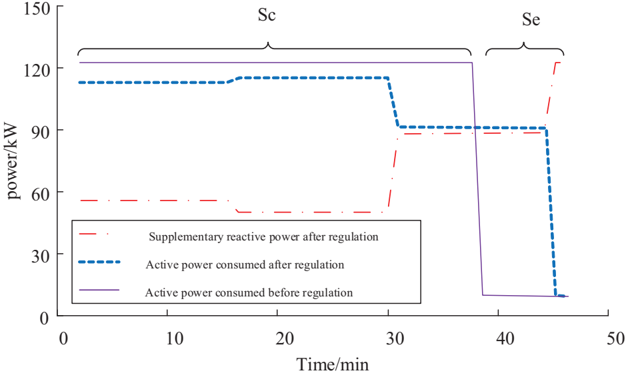
- EV active-reactive co-regulation with other voltage control resources alleviated power peak pressure before 1:00 and after 17:30 and reduced node voltage deviation; during the idle period, EV active power could be flexibly adjusted without affecting the owner’s charging demand.
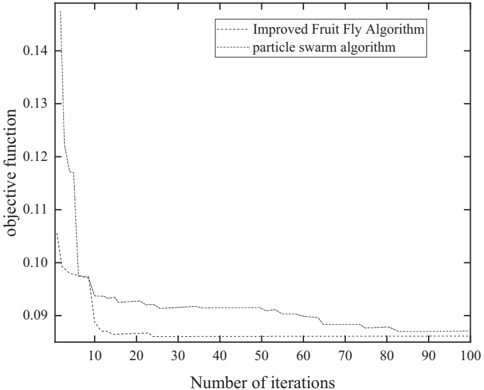
- The improved fruit fly optimization algorithm achieved better convergence speed and convergence accuracy than the particle swarm optimization algorithm in the multi-level voltage coordination optimization problem.
Methods
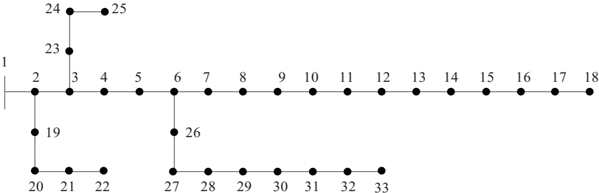
- Simulation used a modified IEEE 33-node distribution system: 33 nodes and 32 branch circuits with five operable contact lines; distributed PV of 1200 kW at nodes 12 and 29, total maximum active output 960 kW, adjustable power factor range −0.9 to 0.9; total load 5920 kW and 2320 kvar; EV charging stations at nodes 11 and 19 with 10 sets of 120 kW chargers, maximum power factor 0.95, and EV battery capacity 100 kWh; shunt capacitor compensation at nodes 6, 13, and 25 with 10 sets each and 500 kvar compensation capacity.
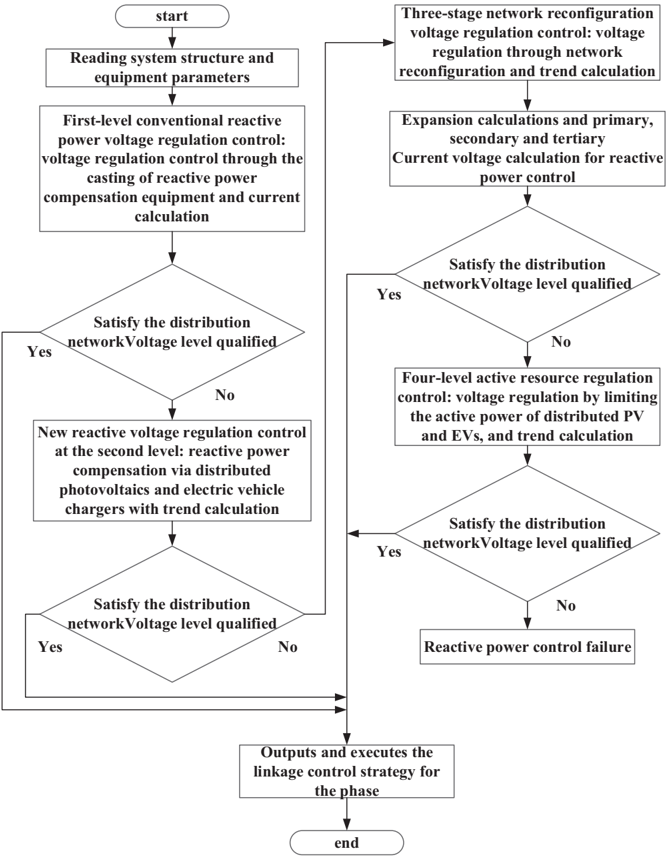
- The paper constructs a multi-objective optimization model minimizing voltage deviation and active power loss, with constraints for EV operation, power flow, distributed PV, network reconfiguration, and reactive power compensation. It proposes a four-level control sequence: capacitor bank switching, PV/EV reactive power regulation, network reconfiguration, and active power limiting of PVs and EVs.
- Three scenarios were evaluated: Scenario 1, shunt capacitors alone; Scenario 2, integrated first-, second-, and third-level linkage coordination; Scenario 3, four-level linkage coordination. The multi-objective optimization was solved with an improved fruit fly/Drosophila algorithm, with full-day simulation and comparison against particle swarm optimization.
Limitations
- The paper states that future work is needed on how to tap the user’s psychological affordability and how to optimize incentive value for users to participate in flexible grid regulation, including incentives such as financial rewards, electricity bill discounts, and access to premium services.
- Evident from the text: validation is simulation-only on a modified IEEE 33-node system; no field deployment or real-world utility data are reported.
- Evident from the text: EV user behavior and uncertainty are represented through SOC and charging-time constraints, but the paper does not report sensitivity analysis for user uncertainty or incentive response.
Model-written summary. Check it against the paper before relying on it.
Integrity signals
Registry
Cites
Statistics
Figures
Verification
Claims the paper makes
0 Valid · 0 Not valid · 11 Not checked · 50 Own results and interpretations
A result the paper reports from its own data — it cites no other source for it, so there is none to check. The quote shows it is in the paper.
In the paper
“The voltage fluctuation control performance in Scenario 3 is much better compared to the use of shunt capacitor casting and switching alone in Scenario 1, as well as the integrated one-, two-, and three-level linkage coordinated optimization in Scenario 2.”
§ Multi-Stage Voltage Control Optimization Strategy for Distribution Networks Considering Active-Reactive Co-Regulation of Electric Vehicles > 5 Case Study Analysis
plainstates an association- Asserted: passes — The authors put it forward as true.
- Checkable: passes — It can be checked against evidence.
- Load-bearing: passes — The paper’s conclusions depend on it.
- Based: passes — The paper gives a reason why it holds.
A result the paper reports from its own data — it cites no other source for it, so there is none to check. The quote shows it is in the paper.
In the paper
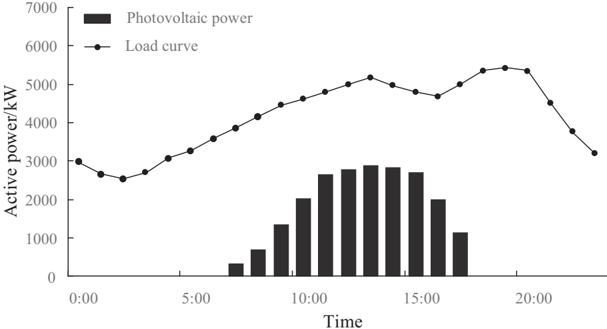
“As shown in Fig. 8, the PV output gradually increases from early morning to late afternoon and then weakens after peaking in the late afternoon.”
§ Multi-Stage Voltage Control Optimization Strategy for Distribution Networks Considering Active-Reactive Co-Regulation of Electric Vehicles > 5 Case Study Analysis
plainstates a cause- Asserted: passes — The authors put it forward as true.
- Checkable: passes — It can be checked against evidence.
- Load-bearing: unclear — It is unclear whether the paper’s conclusions depend on it.
- Based: passes — The paper gives a reason why it holds.
A result the paper reports from its own data — it cites no other source for it, so there is none to check. The quote shows it is in the paper.
In the paper
“the voltage deviation is scaled down to 0.037 p.u.”
§ Multi-Stage Voltage Control Optimization Strategy for Distribution Networks Considering Active-Reactive Co-Regulation of Electric Vehicles > 5 Case Study Analysis
plainstates a cause- Asserted: passes — The authors put it forward as true.
- Checkable: passes — It can be checked against evidence.
- Load-bearing: unclear — It is unclear whether the paper’s conclusions depend on it.
- Based: passes — The paper gives a reason why it holds.
A result the paper reports from its own data — it cites no other source for it, so there is none to check. The quote shows it is in the paper.
In the paper
“an improvement in voltage deviation to 0.045 p.u.”
§ Multi-Stage Voltage Control Optimization Strategy for Distribution Networks Considering Active-Reactive Co-Regulation of Electric Vehicles > 5 Case Study Analysis
plainstates a cause- Asserted: passes — The authors put it forward as true.
- Checkable: passes — It can be checked against evidence.
- Load-bearing: unclear — It is unclear whether the paper’s conclusions depend on it.
- Based: passes — The paper gives a reason why it holds.
A result the paper reports from its own data — it cites no other source for it, so there is none to check. The quote shows it is in the paper.
In the paper
“The two highly overlap in the 10:00 to 15:00 time period,”
§ Multi-Stage Voltage Control Optimization Strategy for Distribution Networks Considering Active-Reactive Co-Regulation of Electric Vehicles > 5 Case Study Analysis
plainstates an associationSingle case- Asserted: passes — The authors put it forward as true.
- Checkable: passes — It can be checked against evidence.
- Load-bearing: unclear — It is unclear whether the paper’s conclusions depend on it.
- Based: passes — The paper gives a reason why it holds.
22 more claims
Create a free account to see all 61 claims and to verify the 25 references still open.
- It may state two separate claims as one. 31
- Probably not a substantial claim. 4
Self-check
Percentages, sums and reported differences re-computed from the paper’s own numbers.
Each contradiction between two passages listed here was confirmed by an independent check.
Rated minor: it would not touch a result — a value no result rests on, a p-value that stays on the same side of the significance level, or a conflict that is clerical, resolved elsewhere in the paper, or outside its own findings.
In the paper
§ Multi-Stage Voltage Control Optimization Strategy for Distribution Networks Considering Active-Reactive Co-Regulation of Electric Vehicles > 5 Case Study Analysis
“five operable contact lines (switches numbered 6-21(34), 8-15(35), 13-23(36), and 18-33(37))”
§ Multi-Stage Voltage Control Optimization Strategy for Distribution Networks Considering Active-Reactive Co-Regulation of Electric Vehicles > 5 Case Study Analysis
“6-21(34), 8-15(35), 13-23(36), and 18-33(37)”
Rated minor: it would not touch a result — a value no result rests on, a p-value that stays on the same side of the significance level, or a conflict that is clerical, resolved elsewhere in the paper, or outside its own findings.
In the paper
§ Multi-Stage Voltage Control Optimization Strategy for Distribution Networks Considering Active-Reactive Co-Regulation of Electric Vehicles > 5 Case Study Analysis
“the network losses are significantly reduced from 250.13 kWh in the nooptimization state to a minimum of 91.53 kWh”
§ Multi-Stage Voltage Control Optimization Strategy for Distribution Networks Considering Active-Reactive Co-Regulation of Electric Vehicles > 5 Case Study Analysis
“the system net loss is as high as 250.13 kW”
Citations
Cites
Integration of Vehicle-to-Grid in the Western Danish Power System
Pillai, J. R., & Bak-Jensen, B. (2010) · IEEE Transactions on Sustainable Energy · doi:10.1109/tste.2010.2072938 · Cited by 388
Tavakoli, A., Saha, S., Arif, M. T., Haque, M. E., Mendis, N., & Oo, A. M. T. (2020) · IET Energy Systems Integration · doi:10.1049/iet-esi.2019.0047 · Cited by 326 · cited 1×
“This problem further exacerbates the voltage fluctuation in the distribution network, and poses a serious challenge to the operational safety and voltage stability of the distribution network [1].”
EV/PHEV Bidirectional Charger Assessment for V2G Reactive Power Operation
Kisacikoglu, M. C., Ozpineci, B., & Tolbert, L. M. (2013) · IEEE Transactions on Power Electronics · doi:10.1109/tpel.2013.2251007 · Cited by 291
Bagheri Tolabi, H., Ali, M. H., & Rizwan, M. (2015) · IEEE Transactions on Sustainable Energy · doi:10.1109/tste.2014.2364230 · Cited by 278
Robust Coordinated Optimization of Active and Reactive Power in Active Distribution Systems
Gao, H., Liu, J., & Wang, L. (2018) · IEEE Transactions on Smart Grid · doi:10.1109/tsg.2017.2657782 · Cited by 197
Ding, T., Yang, Q., Yang, Y., Li, C., Bie, Z., & Blaabjerg, F. (2018) · IEEE Transactions on Smart Grid · doi:10.1109/tsg.2017.2677481 · Cited by 164
Nafisi, H., Agah, S. M. M., Abyaneh, H. A., & Abedi, M. (2015) · IEEE Transactions on Smart Grid · doi:10.1109/tsg.2015.2480999 · Cited by 131
An Adaptive Distributionally Robust Model for Three-Phase Distribution Network Reconfiguration
Zheng, W., Huang, W., Hill, D. J., & Hou, Y. (2020) · IEEE Transactions on Smart Grid · doi:10.1109/tsg.2020.3030299 · Cited by 126
Coordinated Electric Vehicle Active and Reactive Power Control for Active Distribution Networks
Wang, Y., Qiu, D., Štrbac, G., & Gao, Z. (2022) · IEEE Transactions on Industrial Informatics · doi:10.1109/tii.2022.3169975 · Cited by 125
Wandhare, R. G., & Agarwal, V. (2014) · IEEE Transactions on Smart Grid · doi:10.1109/tsg.2014.2298532 · Cited by 91
Cited by
Still being checked.
Metadata
- Authors
- Zeng, F., Han, H., Miao, H., Pan, Y., Yuan, X., & Lyu, S.
- Affiliations
- State Grid Jiangsu Electric Power (China) (CN)
- Corresponding author
- Lyu, Shukang
- Venue
- Energy Engineering
- Publisher
- Tech Science Press
- Published
- 2025
- Volume
- 122
- Issue
- 1
- Pages
- 221-242
- ISSN
- 0199-8595 (ISSN-L)
- 1546-0118
- OpenAlex
- W4405860050
- Cited by
- 7
- References
- 31
- Citations by year
- 2026: 4 · 2025: 3
- FWCI
- 1.18
- Type
- journal article
- Language
- en
- Open access
- diamond
- doi.org
- Licence
- cc-by
- Locations
- Energy Engineering (publishedVersion, cc-by)
- Topics
- Physical Sciences › Engineering › Electrical and Electronic Engineering › Optimal Power Flow Distribution
- Physical Sciences › Engineering › Electrical and Electronic Engineering › Electric Vehicles and Infrastructure
- Physical Sciences › Engineering › Electrical and Electronic Engineering › Smart Grid Energy Management
- Keywords
- distribution network voltage control, electric vehicle charging, multi-timescale control, distributed photovoltaic generation, voltage deviation, multi-objective optimization, voltage fluctuation
About these checks
Registry, retraction, Cites and statistics results are computed, not judged, with one exception: a printed reference that no index lists is read once by a model before it counts as a citation error. Claims are extracted by a model and kept only when their quote appears verbatim in the text; each cited source is then checked, with a model’s help, for whether it says what the claim relies on. Those verdicts can be wrong — read the claim’s quote and the cited source before relying on one.
A language model drew the claims from the paper on 2026-11-26, under version 3 of the claim definition (model deepseek-v4.1-flash, prompt extract-v3).
A second model labelled each claim on 2026-11-26 (model jev-1.13-20260917, definition revision gold-guideline-v0.2).
Statistics and arithmetic are recomputed, not judged.
Confidence bands are shown only for fields calibrated on our annotated test set. None is calibrated yet, so no band is shown.
What counts as a claim ›How we measure confidence ›How we check this ›
Are you an author, or do you see a problem with this page? Request a review
How to cite
Cite CoChat for the checks on this page, and the paper for its own findings.
- This page
- CoChat. (2026). Citation check: Multi-Stage Voltage Control Optimization Strategy for Distribution Networks Considering Active-Reactive Co-Regulation of Electric Vehicles. https://app.cochat.ai/papers/10.32604/ee.2024.056380
- The paper
- Zeng, F., Han, H., Miao, H., Pan, Y., Yuan, X., & Lyu, S. (2025). Multi-Stage Voltage Control Optimization Strategy for Distribution Networks Considering Active-Reactive Co-Regulation of Electric Vehicles. Energy Engineering. https://doi.org/10.32604/ee.2024.056380
Data sources
Bibliographic data: Semantic Scholar, OpenAlex, Crossref.
Contains information from the Semantic Scholar Academic Graph Datasets, made available under the ODC Attribution License (ODC-BY 1.0).
Semantic Scholar’s data is described in: Kinney, R., et al. (2023). The Semantic Scholar Open Data Platform. arXiv:2301.10140.
