

Cyclone Sub-Micron Particulate Separator
Open accessThe DOI matches its Crossref record; 12 of the 12 references it cites were found in a registry or an index; 2 of the 9 sources its claims cite were checked for support.
Abstract
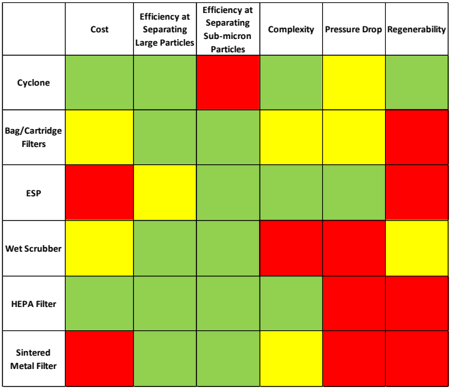
A hygienic environment for deep space exploration vehicles is vital to the health and functionality of crew members and the hardware. Previous missions have shown the pervasive problem of fine particulate including obscuring optical systems, scratching surfaces, and potential long-term health impacts. The current International Space Station (ISS) Environmental Control and Life Support (ECLS) system architecture employs traditional High-Efficiency Particulate Air (HEPA) filters to combat sub-micron particles, but these require frequent cleaning and ultimate replacement as particles embed within the filters and are unable to be removed. As missions return to planetary bodies, particulate becomes an even larger challenge as frequent migration of crew members to and from the vehicle will cause sub-micron lunar regolith particles to permeate throughout the pressurized cabin. Mainstream Engineering has been developing a cyclone-based system for sub-micron particulate capture that integrates with the central HVAC system. In this work, we present our computational fluid dynamics (CFD) model development, rapid prototyping process, and validated system design to achieve an in-place regenerable system with high-efficiency sub-micron particle collection and a comparable pressure drop to HEPA filters. The results of this work can aid in the reduction of consumable filtration devices and provide a longer service life than the filters that are currently in use on deep space exploration vehicles.
Overview
CoChat Summary
TL;DR
Mainstream Engineering developed and validated a cyclone-based sub-micron particulate separator using CYCLOP optimization, CFD, rapid prototyping, and experimental testing, targeting reduced HEPA loading in spacecraft ECLS. The cyclones achieved sub-micron d50 cut-offs—0.4 µm for the small cyclone and 0.6 µm for the larger cyclone in the conclusions—with pressure drops below 660 Pa and below 125 Pa, respectively, and showed gravity-agnostic operation.
Key findings
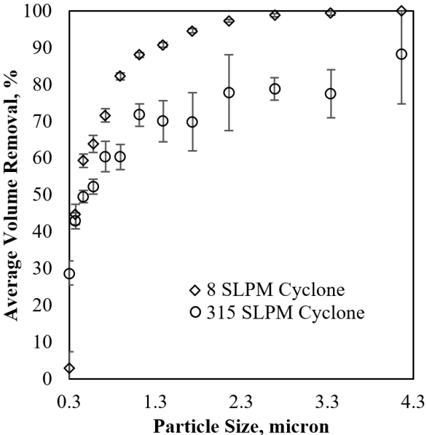
- CYCLOP designed cyclone A1 for 8 SLPM with a target pressure drop of 3.3 kPa, selecting it from approximately 10 billion iterations; CYCLOP predicted 250 Pa pressure drop and a d50 of 0.2 µm. Cyclone B1 was designed for 315 SLPM with a target pressure drop of 125 Pa, selected from approximately 40 billion iterations; CYCLOP predicted 125 Pa and a d50 of 0.4 µm.
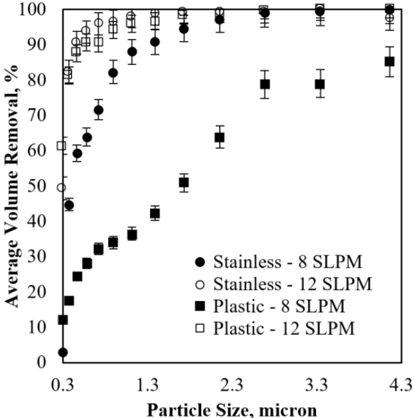
- In A1 open/closed-bottom tests, the open bottom with no filter removed the highest percentage of particles; adding a bottom filter or closing the bottom only slightly reduced efficacy, with 86.8% versus 91.5% removal, while pressure drop increased by up to 30% when the bottom was closed.
- Surface roughness affected pressure drop more than capture: at 0.4 µm roughness, particles were captured at 85% efficiency with 325 Pa pressure drop; at 60 µm roughness, capture was 83% with 262 Pa pressure drop.
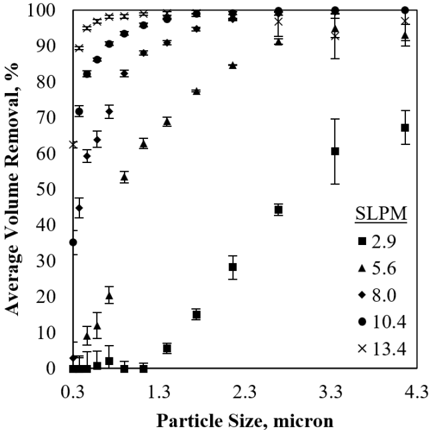
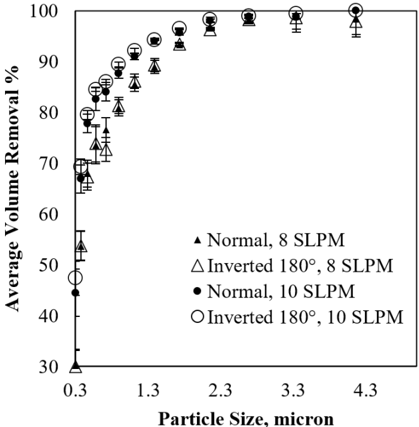
- A2 at its 8 SLPM design flow had roughly 660 Pa pressure drop, matching CFD within 10%; at 15 SLPM pressure drop rose to 6.6 kPa. A1 operated normally, upside down, and in random orientation all averaged 85% removal, and A2 in 110 °C steam achieved 80% collection efficiency versus 85% in dry air.
Methods
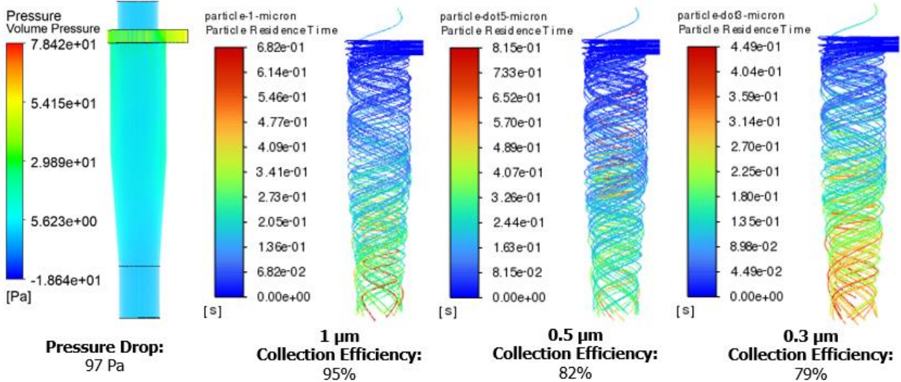
- CYCLOP used a filtered Monte-Carlo optimization approach to tune cyclone geometry parameters simultaneously, then designs were converted to 3D and simulated in ANSYS Fluent using the Reynolds stress model, k-ω-SST with curvature correction and production limiter, and a discrete phase model for particle trajectories from 0.3 to 10 µm with one-way coupling and up to 500,000 steps per element.
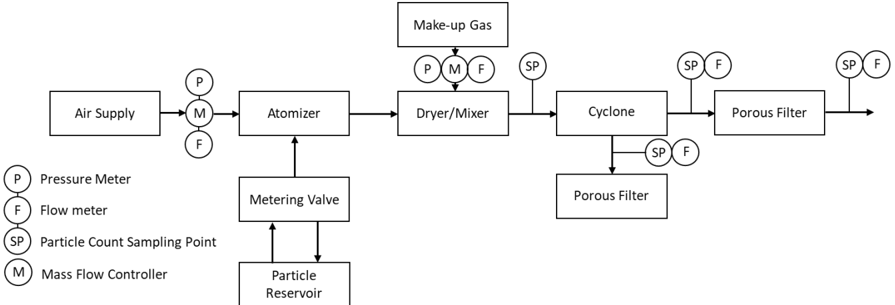
- Experimental testing used a test stand with HEPA-filtered air, mass flow controllers, a venturi aerosolizer feeding carbon solids or Arizona test dust, a dryer, static mixer, deionizer, and an optical particle sizer with nominal 0.3–10 µm range; cyclones A1/A2 were 8 SLPM designs with 2.5×10⁻⁴ m³ space claim, and B1 was a 315 SLPM design with 1.1×10⁻² m³ space claim.
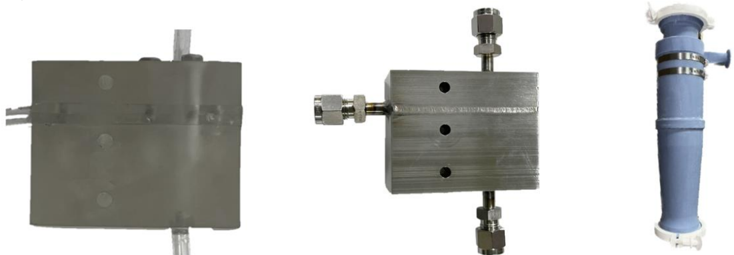
- Cyclones were fabricated by stereolithography with 50 µm layer height and 60 µm average surface roughness, while A2 was machined from SS316 with 0.4 µm average roughness; tests covered open/closed bottom operation, surface roughness, flow rates from 2.9 to 13.4 SLPM, orientation, and 110 °C steam, with triplicate data collection where noted.
Limitations
- The paper states that additional work is needed to validate long-term performance, pressure drop, regenerability, chamber removal capabilities, and durability; testing of higher loadings, longer periods, and collection cup efficiencies is ongoing. Electrostatic adhesion was not modeled, and future work will include long-term modeling with electrostatics.
- The paper states that CFD models tended to underpredict experimentally measured pressure drop, possibly due to incompressible and surface roughness assumptions, and that closed-bottom CFD did not fully represent agglomeration and surface interactions that increase collection over time.
- Evident from the text: experimental runs were short—e.g., 2 hours for open/closed tests and 1 hour for steam—so long-duration fouling and regeneration were not demonstrated; the OPS nominal range of 0.3–10 µm means particles below 0.3 µm were not measured; and modeling the collection cup as an outlet may overpredict collection efficiency.
Model-written summary. Check it against the paper before relying on it.
Integrity signals
Registry
Cites
Statistics
Figures
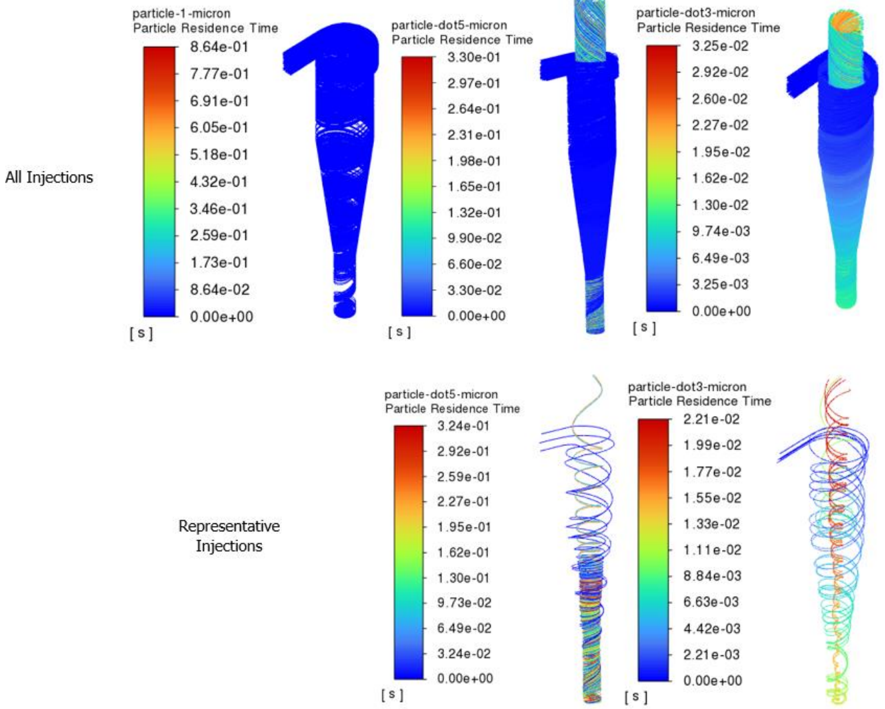
Verification
Claims the paper makes
2 Valid · 1 Not valid · 7 Not checked · 77 Own results and interpretations
The cited sources support only part of this claim — read each source’s verdict below.
In the paper
“However, there is a body of work that has investigated the separation of submicron particles and is capable of separation down to even sub-microns by leveraging unique surface property functionality and higher pressure drops. 8”
What the sources say
- Partly supportedcites [8] 8. Peukert, W.; Wadenpohl, C., "Industrial Separation ff Fine Particles with Difficult Dust Properties," Powder technology 2001, 118 (1-2), 136-148. sourceExperimental — accuracy not yet measured
The Abstract and sections 2 and 5.1 describe separating submicron or smaller particles using electrostatic forces and surface filters. But Table 2 describes high pressure drop in surface filters as a difficulty associated with fine particles, not as a mechanism deliberately used to achieve separation. The claim’s explanation of how separation is achieved is therefore only partly supported. (LLM, conf=0.86)
plainstates a cause- Asserted: passes — The authors put it forward as true.
- Checkable: passes — It can be checked against evidence.
- Load-bearing: unclear — It is unclear whether the paper’s conclusions depend on it.
- Based: passes — The paper gives a reason why it holds.
- Partly supported
A result the paper states — it cites no source for it, so there is none to check. The quote shows it is in the paper.
In the paper
“With this layer height, the average surface roughness of all fluid-encasing regions is 60 μm.”
plainstates a cause- Asserted: passes — The authors put it forward as true.
- Checkable: passes — It can be checked against evidence.
- Load-bearing: passes — The paper’s conclusions depend on it.
- Based: passes — The paper gives a reason why it holds.
A result the paper reports from its own data — it cites no other source for it, so there is none to check. The quote shows it is in the paper.
In the paper
“However, putting a filter on the bottom and closing the bottom only had minor reductions in efficacy with 86.8% compared to 91.5%.”
plainstates a cause- Asserted: passes — The authors put it forward as true.
- Checkable: passes — It can be checked against evidence.
- Load-bearing: passes — The paper’s conclusions depend on it.
- Based: passes — The paper gives a reason why it holds.
A result the paper reports from its own data — it cites no other source for it, so there is none to check. The quote shows it is in the paper.
In the paper
“Further, it was observed that as surface roughness increases, the pressure drop across the cyclone decreases with negligible change in particle capture efficiency.”
plainstates a cause- Asserted: passes — The authors put it forward as true.
- Checkable: passes — It can be checked against evidence.
- Load-bearing: passes — The paper’s conclusions depend on it.
- Based: passes — The paper gives a reason why it holds.
A result the paper reports from its own data — it cites no other source for it, so there is none to check. The quote shows it is in the paper.
In the paper
“The one caveat is that as flow increases, so too does the pressure drop across the cyclone.”
plainstates a cause- Asserted: passes — The authors put it forward as true.
- Checkable: passes — It can be checked against evidence.
- Load-bearing: unclear — It is unclear whether the paper’s conclusions depend on it.
- Based: passes — The paper gives a reason why it holds.
34 more claims
Create a free account to see all 87 claims and every source verdict.
- It may state two separate claims as one. 35
- Probably not a substantial claim. 21
Self-check
Percentages, sums and reported differences re-computed from the paper’s own numbers.
Each contradiction between two passages listed here was confirmed by an independent check.
Rated major: it would touch a result — a value a result rests on, reported and recomputed p-values on opposite sides of the significance level, two passages that conflict with no sign which is right, or a cited work retracted before this paper was published.
In the paper
§ C. CFD Modeling of Bench-Scale Geometries · p. 3
“To model the swirling turbulent flow in a cyclone separator, the Reynolds stress model (RSM) was used instead of the k-epsilon (k-ϵ) and k-omega (k-ω) models”
§ C. CFD Modeling of Bench-Scale Geometries · p. 3
“The k-ω-SST physics was used for the model simulation to best capture the flow field while minimizing computational resources.”
Rated minor: it would not touch a result — a value no result rests on, a p-value that stays on the same side of the significance level, or a conflict that is clerical, resolved elsewhere in the paper, or outside its own findings.
In the paper
§ J. Impact of Gravity and Orientation · p. 10
“The results showed that the collection efficiency of the tested particles were less than 5% of the standard model when the gravitational force was oriented opposite to the standard Earth gravity cyclone.”
§ J. Impact of Gravity and Orientation · p. 10
“Therefore, simulations identify that the direction of gravitational force insignificantly impacts the performance of cyclones in terms of collection efficiency.”
Citations
Cites
The publisher hasn’t deposited this paper’s reference list.
Research works printed but not linked: 3
- [3]3. Perry, J. L.; Coston, J. E. "Analysis of Particulate and Fiber Debris Samples Returned from the International Space Station," 44th International Conference on Environmental Systems : 2014.
- [4]4. Agui, J.; Vijayakumar, R.; Perry, J. "Particulate Filtration Design Considerations for Crewed Spacecraft Life Support Systems," 46th International Conference on Environmental Systems : 2016.
- [6]6. Adamson, D. J.; Westinghouse, S., "Insitu Cleanable Alternative HEPA Filter Media," Waste Management 2002, 2 , 24-28.
Metadata
- Authors
- Haggerty, M., Emmons, M., Wagner, A., & Cutbirth, M.
- Affiliations
- Mainstream Engineering Corporation (United States) (US)
- Venue
- 52nd International Conference on Environmental Systems
- Published
- 2023-07-16
- OpenAlex
- W7160272101
- Semantic Scholar
- 2282e26e913abb381bca0a67c2e4ac2ad506dd24
- Cited by
- 0
- References
- 0
- FWCI
- 0.00
- Type
- conference paper
- Language
- en
- Open access
- bronze
- doi.org
- Locations
- International Conference on Environmental Systems (ICES) (publishedVersion)
- ThinkTech (Texas Tech University) (submittedVersion)
- Funders
- National Aeronautics and Space Administration
- Topics
- Physical Sciences › Engineering › Computational Mechanics › Cyclone Separators and Fluid Dynamics
- Physical Sciences › Engineering › Electrical and Electronic Engineering › Aerosol Filtration and Electrostatic Precipitation
- Physical Sciences › Chemical Engineering › Fluid Flow and Transfer Processes › Particle Dynamics in Fluid Flows
- Keywords
- cyclone separator, cabin air filtration, pressure drop, rapid prototyping, computational fluid dynamics
About these checks
Registry, retraction, Cites and statistics results are computed, not judged, with one exception: a printed reference that no index lists is read once by a model before it counts as a citation error. Claims are extracted by a model and kept only when their quote appears verbatim in the text; each cited source is then checked, with a model’s help, for whether it says what the claim relies on. Those verdicts can be wrong — read the claim’s quote and the cited source before relying on one.
The claim verdicts this report counts are experimental: their accuracy is not yet measured.
A language model drew the claims from the paper on 2026-10-10, under version 3 of the claim definition (model deepseek-v4.1-flash, prompt extract-v3).
A second model labelled each claim on 2026-10-10 (model jev-1.13-20260917, definition revision gold-guideline-v0.2).
Cited sources are checked with a language model’s help (gpt-6-sol).
Statistics and arithmetic are recomputed, not judged.
Confidence bands are shown only for fields calibrated on our annotated test set. None is calibrated yet, so no band is shown.
What counts as a claim ›How we measure confidence ›How we check this ›
Are you an author, or do you see a problem with this page? Request a review
Data sources
Bibliographic data: Semantic Scholar, OpenAlex, Crossref.
Contains information from the Semantic Scholar Academic Graph Datasets, made available under the ODC Attribution License (ODC-BY 1.0).
Semantic Scholar’s data is described in: Kinney, R., et al. (2023). The Semantic Scholar Open Data Platform. arXiv:2301.10140.
