

The Geopolitical Energy Transition Between Russia and the EU (2014–2024): An Analysis of Germany’s Role in Reshaping Energy Security After the Ukraine Crisis
Open accessThe DOI matches its Crossref record; 5 of the 5 references it cites were found in a registry or an index; 2 of the 39 sources its claims cite were checked for support.
Abstract
This study examines the transformation of energy relations between Russia and the European Union (EU) from 2014 to 2024, with a specific focus on Germany’s pivotal role in redefining European energy security in the aftermath of the Ukraine crisis. While extensive literature has addressed EU–Russia energy ties, the mechanisms through which geopolitical shocks reshape energy policies – particularly the interplay between securitisation, diversification, and strategic leadership – remain insufficiently theorised. This article addresses this gap by posing the following research question: How did geopolitical developments, especially the 2022 Ukraine invasion, transform energy cooperation and confrontation between Russia and the EU, and what role did Germany play in this transition? This study employs a qualitative methodology based on directed content analysis. The dataset comprises 147 documents, including official EU communications from the European Commission, Council, and Parliament, German government policy papers, Russian energy strategy documents, reports published by the International Energy Agency, and corporate disclosures from Gazprom and Uniper. The material was analysed through theory-driven coding based on the securitisation framework, operationalised across three analytical dimensions: geopolitical (competition over resources and transit routes); security (threat perception and vulnerability); and diversification (alternatives suppliers and infrastructure development). The findings reveal that Russia’s 2022 invasion of Ukraine constituted a critical juncture, fundamentally disrupting the path-dependent model of cooperation exemplified by the Nord Stream 1 and 2 pipeline projects. In response, the EU activated three interconnected approaches – geopolitical, security-oriented, and diversification-focused – while Germany transitioned from serving as a primary economic bridge to Moscow to becoming the central driver of Europe’s decoupling from Russian energy. This shift was operationalised through the REPowerEU plan, resulting in a reduction of Russian gas imports from 55% to under 5% for Germany, accelerated LNG infrastructure development, and an expedited renewable energy transition. The study makes a theoretical contribution by demonstrating that securitisation theory, when disaggregated into geopolitical, security, and diversification mechanisms, provides a robust analytical framework for understanding how external shocks restructure energy dependencies. Empirically, it offers the first comprehensive analysis of Germany’s dual role – as both an enabler of interdependence and as a leader of decoupling – within a unified analytical framework. These findings have broader implications for understanding energy transitions in other geopolitical contexts.
Overview
CoChat Summary
TL;DR
The paper argues that the 2022 Ukraine invasion was a critical juncture that turned EU–Russia energy interdependence into confrontation, with Germany shifting from bridge-builder to leader of European decoupling. Using a tripartite energy-security framework—geopolitical, security-oriented, and diversification—it traces how securitisation drove diversification and reshaped geopolitical competition from 2014 to 2024.
Key findings
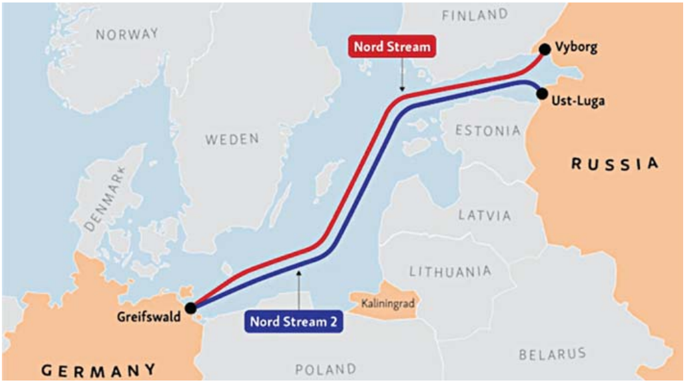
- Pre-2022 Germany sourced approximately 55% of its gas via Gazprom pipelines, particularly Nord Stream 1; after the 2022 invasion, Russian gas imports fell to less than 5%, and Germany’s LNG imports reached 35 billion cubic metres in 2023 compared with nearly zero in 2021. EU-wide Russian gas imports declined from 45% to 15% by 2023, offset by Norway (34%) and the United States (20%) as at March 2024.
- Germany’s post-2022 restructuring left it importing 98% of petroleum products, 95% of natural gas, and 100% of solid fuels by 2024; gas supplies came 40%–50% from Norway, 20%–30% from the Netherlands, and over 30% from US and Qatari LNG. German wholesale gas prices tripled in the second half of 2022, inflation exceeded 10% in October 2022, and the government allocated approximately €200 billion to stabilise energy prices.
- The paper identifies three causal mechanisms: securitisation reframed Russian gas as a strategic threat; tangible alternatives such as LNG terminals and new contracts with the United States, Qatar, and Norway made diversification operational; and EU-level coordination through REPowerEU amplified national efforts. Germany exercised leadership across all three mechanisms.
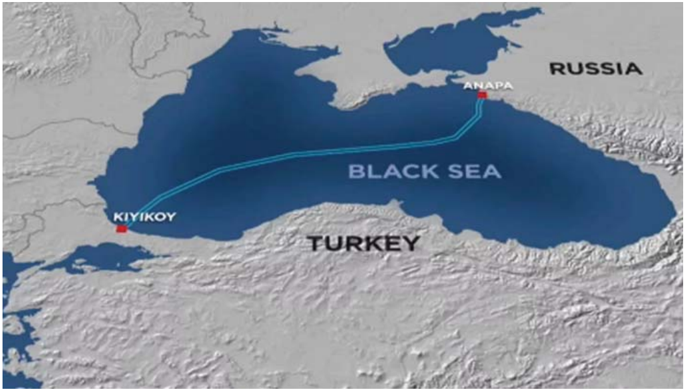
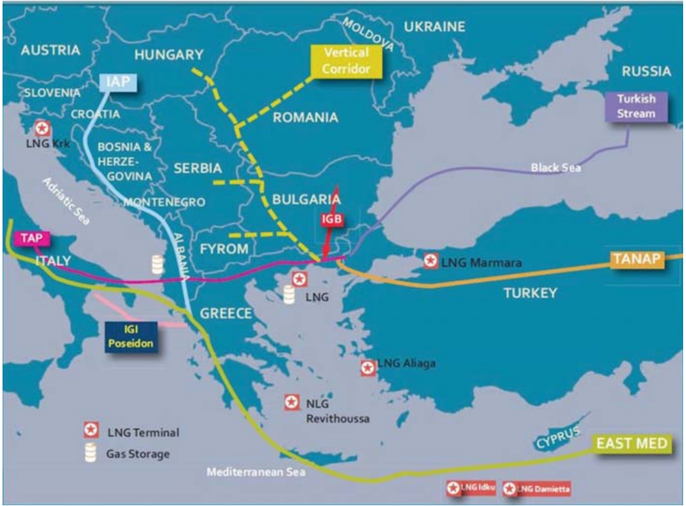
- Russia pivoted toward TurkStream and Asian markets: TurkStream exports reached 16.7 billion cubic metres in 2023; Azerbaijani gas through the Southern Gas Corridor reached 11.7 billion cubic metres in 2024, a 44% increase over 2021, with a target of 20 billion cubic metres by 2027; the January 2025 halt of Ukraine transit, which had delivered 15 billion cubic metres annually, is estimated to have reduced Russia’s annual revenue by €5 billion.
Methods
- Qualitative directed content analysis of 147 documents, including official EU communications from the European Commission, Council, and Parliament; German government policy papers; Russian energy strategy documents; International Energy Agency reports; and corporate disclosures from Gazprom and Uniper, covering 2014–2024.
- Purposive sampling based on direct relevance to energy issues and Russia–EU relations; theory-driven coding structured around three analytical dimensions—geopolitical, security-oriented, and diversification—with source triangulation and a five-stage research process.
Limitations
- The paper states that its primary limitation is restricted access to internal Russian governmental documents, which necessitated reliance on primarily English-language sources.
- Evident from the text: the qualitative, purposive, document-based design cannot establish causal effects quantitatively, and the findings are interpretive and context-specific to EU–Russia relations and Germany’s role.
- Evident from the text: several key figures rely on news agencies and secondary sources (e.g., Reuters, Tass, Bloomberg), which may limit independent verification.
Model-written summary. Check it against the paper before relying on it.
Integrity signals
Registry
Cites
Statistics
Figures
Verification
Claims the paper makes
1 Valid · 21 Not valid · 28 Not checked · 133 Own results and interpretations
The cited sources that could be checked couldn’t confirm or dispute this claim.
In the paper
“Moreover, the interaction between the three identifi ed dimensions (geopolitical competition, securitisation, and diversifi cation) is rarely analysed within an integrated analytical framework.”
§ The Geopolitical Energy Transition Between Russia and the EU (2014-2024): An Analysis of Germany's Role in Reshaping Energy Security After the Ukraine Crisis > Studies on Energy and Economic Relations
What the sources say
- Could not verifycites Sampedro et al., 2024 matched to “Energy system analysis of cutting off Russian gas supply to the European Union” (2024) sourceExperimental — accuracy not yet measured
Our copy of Sampedro et al. (2024) contains no discussion of 'securitisation' or of an integrated framework combining geopolitical competition, securitisation and diversification; searches on those terms and on 'rarely analysed / research gap / integrated framework' returned only the paper's own literature summary. The Introduction (Sec. 1) and Table 1 characterise the gap differently — that existing modelling studies of the Russia–Ukraine conflict are mostly short-term and focus on economic effects, gas consumption profiles, energy mix or emissions, while this study adds subregional, multisector GCAM analysis of a full cut-off. That is a methodological/horizon gap, not the claim's tri-dimensional one, so our copy neither supports nor contradicts the cited sentence. (LLM, conf=0.72)
- Not matchedcites Westphal, 2023
An author–year citation the paper’s reference list doesn’t settle. We don’t search these by name.
- Not matchedcites Goldthau, Sitter, 2023
An author–year citation the paper’s reference list doesn’t settle. We don’t search these by name.
plain- Asserted: passes — The authors put it forward as true.
- Checkable: passes — It can be checked against evidence.
- Load-bearing: passes — The paper’s conclusions depend on it.
- Based: passes — The paper gives a reason why it holds.
- Could not verify
The cited sources support only part of this claim — read each source’s verdict below.
In the paper
“However, this body of literature predominantly adopts a descriptive approach to documenting policy shifts, offering limited theoretical elaboration on how external shocks -such as military confl ict -catalyse structural transformations in energy relationships.”
§ The Geopolitical Energy Transition Between Russia and the EU (2014-2024): An Analysis of Germany's Role in Reshaping Energy Security After the Ukraine Crisis > Studies on Energy and Economic Relations
What the sources say
- Partly supportedcites Sampedro et al., 2024 matched to “Energy system analysis of cutting off Russian gas supply to the European Union” (2024) sourceExperimental — accuracy not yet measured
Split into 2 atoms — 1 confirmed, 0 partially supported, 0 disputed, 0 misattributed, 1 unverifiable. Expand the claim to see per-atom verdicts.
- Not matchedcites Westphal, 2023
An author–year citation the paper’s reference list doesn’t settle. We don’t search these by name.
- Not matchedcites Goldthau, Sitter, 2023
An author–year citation the paper’s reference list doesn’t settle. We don’t search these by name.
plain- Asserted: passes — The authors put it forward as true.
- Checkable: passes — It can be checked against evidence.
- Load-bearing: passes — The paper’s conclusions depend on it.
- Based: passes — The paper gives a reason why it holds.
- Partly supported
In the paper
“To cushion the impact, the German government allocated approximately €200 billion to stabilise energy prices and provide targeted support to households and industries (Roedl, 2025, p. 3).”
§ The Geopolitical Energy Transition Between Russia and the EU (2014-2024): An Analysis of Germany's Role in Reshaping Energy Security After the Ukraine Crisis > Energy Geopolitics: An Analysis of Russia-Germany Political-Economic Relations With a Focus on Energy Resources
What the sources say
- Not matchedcites Roedl, 2025, p. 3
An author–year citation the paper’s reference list doesn’t settle. We don’t search these by name.
plainstates a cause- Asserted: passes — The authors put it forward as true.
- Checkable: passes — It can be checked against evidence.
- Load-bearing: unclear — It is unclear whether the paper’s conclusions depend on it.
- Based: passes — The paper gives a reason why it holds.
- Not matched
None of the sources cited for this claim have been checked yet.
In the paper
“A 2014 survey by the Deutsches Institut für Wirtschaftsforschung indicated that most Germans supported Angela Merkel's sanction policies, despite losses incurred by German industries (Siddi, 2018, pp. 15-18).”
§ The Geopolitical Energy Transition Between Russia and the EU (2014-2024): An Analysis of Germany's Role in Reshaping Energy Security After the Ukraine Crisis > Energy Geopolitics: An Analysis of Russia-Germany Political-Economic Relations With a Focus on Energy Resources
What the sources say
- Not checked yetcites Siddi, 2018, pp. 15-18 matched to “A Contested Hegemon? Germany’s Leadership in EU Relations with Russia” (2020) source
Checked before — its earlier verdict is held back until a new check runs.
hedged- Asserted: passes — The authors put it forward as true.
- Checkable: passes — It can be checked against evidence.
- Load-bearing: unclear — It is unclear whether the paper’s conclusions depend on it.
- Based: passes — The paper gives a reason why it holds.
- Not checked yet
A conclusion the paper draws from its own results — it cites no other source for it, so there is none to check. The quote shows it is in the paper.
In the paper
“Nevertheless, the implementation of diversifi cation policies remained sluggish due to entrenched economic interests and extensive German-Russian commercial ties.”
§ The Geopolitical Energy Transition Between Russia and the EU (2014-2024): An Analysis of Germany's Role in Reshaping Energy Security After the Ukraine Crisis > Energy Geopolitics in EU-Russian Interactions
plainstates a cause- Asserted: passes — The authors put it forward as true.
- Checkable: passes — It can be checked against evidence.
- Load-bearing: passes — The paper’s conclusions depend on it.
- Based: unclear — It is unclear why the paper says it holds.
61 more claims
Create a free account to see all 183 claims and to verify the 4 references still open.
- Probably not a substantial claim. 58
- It may state two separate claims as one. 81
- The quote only partly states this claim. 1
Self-check
Percentages, sums and reported differences re-computed from the paper’s own numbers.
Each contradiction between two passages listed here was confirmed by an independent check.
Rated minor: it would not touch a result — a value no result rests on, a p-value that stays on the same side of the significance level, or a conflict that is clerical, resolved elsewhere in the paper, or outside its own findings.
In the paper
§ The Geopolitical Energy Transition Between Russia and the EU (2014-2024): An Analysis of Germany's Role in Reshaping Energy Security After the Ukraine Crisis > Introduction
“the European Energy Policy Reset, which aims to eliminate dependence on Russian energy by 2027.”
§ The Geopolitical Energy Transition Between Russia and the EU (2014-2024): An Analysis of Germany's Role in Reshaping Energy Security After the Ukraine Crisis > The Diversifi cation Approach: Reducing Dependency
“Introduced in March 2022, the Energy Policy Reset aims to eliminate reliance on Russian fossil fuels by 2030.”
Rated minor: it would not touch a result — a value no result rests on, a p-value that stays on the same side of the significance level, or a conflict that is clerical, resolved elsewhere in the paper, or outside its own findings.
In the paper
§ The Geopolitical Energy Transition Between Russia and the EU (2014-2024): An Analysis of Germany's Role in Reshaping Energy Security After the Ukraine Crisis > Energy Geopolitics: An Analysis of Russia-Germany Political-Economic Relations With a Focus on Energy Resources
“The suspension of Nord Stream 2, even before construction was complete, marked the defi nitive collapse of the Ostpolitik paradigm”
§ The Geopolitical Energy Transition Between Russia and the EU (2014-2024): An Analysis of Germany's Role in Reshaping Energy Security After the Ukraine Crisis > Energy Geopolitics: An Analysis of Russia-Germany Political-Economic Relations With a Focus on Energy Resources
“The Nord Stream 2 project, launched in 2017 with the objective of doubling the pipeline's capacity to 110 billion cubic metres, was technically completed in September 2021”
Citations
Cites
The EU energy security relations with Russia until the Ukraine war
Tichý, L., & Dubský, Z. (2024) · Energy Strategy Reviews · doi:10.1016/j.esr.2024.101313 · Cited by 53
Energy system analysis of cutting off Russian gas supply to the European Union
Sampedro, J., Van de Ven, D.-J., Horowitz, R., Rodés-Bachs, C., Frilingou, N., Nikas, A., Binsted, M., Iyer, G., & Yarlagadda, B. (2024) · Energy Strategy Reviews · doi:10.1016/j.esr.2024.101450 · Cited by 27
A Contested Hegemon? Germany’s Leadership in EU Relations with Russia
Siddi, M. (2020) · German Politics · doi:10.1080/09644008.2018.1551485 · Cited by 26
امنیت انرژی و فرضیة جداسازی: شواهدی از جنگ روسیه و اوکراین
راسخی, س., & قنبرتبار, س. (2024) · DOAJ (DOAJ: Directory of Open Access Journals) · doi:10.22059/jcountst.2023.367548.1073 · Cited by 1
Impact of Russian Disinformation in Germany
Eastern Partnership at the Centre for Liberal Modernity, & Kikalishvili, K. (2024) · GEOpolitics · doi:10.62343/geopolitics.2024.5.2
Research works printed but not linked: 6
- Ashrafi Hasheminejad, M. and Maleki, A. (2024) "Assessing the role of energy in the Ukraine war and the emerging new global order within the framework of interdependence theories", International Studies Journal. Vol. 20(4). DOI: 10.22034/ISJ.2024.423503.2092. · doi:10.22034/isj.2024.423503.2092
- IEA (2022) The role of Russia in global energy markets. Paris: IEA Publications. IEA (2025a) Energy policy review Germany 2025. Available at: https://www. iea.org/reports/germany-2025 (Access 21.02.2026).
- IEA (2025a) Energy policy review Germany 2025. Available at: https://www.iea.org/reports/germany-2025 (Access 21.02.2026).
- IEA. (2025b) Global energy review 2025. Available at: https://www.iea.org/ reports/global-energy-review-2025 (Access 21.02.2026).
- Rezapour, D. (2025) "The pattern of relations between the Islamic Republic of Iran and Armenia in the South Caucasus region", Central Asia and The Caucasus Journal. Vol. 31(130), pp. 169-171. DOI: 10.22034/ ca.2025.729396. · doi:10.22034/ca.2025.729396
- Umbach, F. (2023) "Geopolitics of energy in the post-Ukraine war era: Germany's vulnerabilities and strategic shift", Energy Strategy Reviews. Vol. 50, 101067. DOI: 10.1016/j.esr.2023.101067. · doi:10.1016/j.esr.2023.101067
Cited by
Russia–Ukraine War, the Weaponisation of Energy, and Türkiye’s Ambition to Become an Energy Hub
Aktaş, M. (2026) · Erzincan Üniversitesi Fen Bilimleri Enstitüsü Dergisi · doi:10.18185/erzifbed.1986803
Metadata
- Authors
- Rezapour, D.
- Affiliations
- University of Guilan (IR)
- Corresponding author
- Rezapour, Daniyal
- ORCID
- Rezapour, Daniyal
- Venue
- Studia Europejskie-Studies in European Affairs
- Publisher
- University of Warsaw
- Published
- 2026-03-25
- Volume
- 30
- Issue
- 1/2026
- Pages
- 91
- ISSN
- 1428-149X (ISSN-L)
- 2719-3780
- OpenAlex
- W7163816540
- Cited by
- 1
- References
- 4
- Citations by year
- 2026: 1
- FWCI
- 3.22
- Type
- journal article
- Language
- en
- Open access
- diamond
- doi.org
- Locations
- Studia Europejskie / Centrum Europejskie Uniwersytetu Warszawskiego (publishedVersion, cc-by-nc)
- Topics
- Physical Sciences › Energy › General Energy › Global Energy Security and Policy
- Social Sciences › Political Science and International Relations › European Politics and Security
- Social Sciences › Political Science and International Relations › European and Russian Geopolitical Military Strategies
- Keywords
- energy security, securitization theory, energy diversification, German energy policy, REPowerEU, Nord Stream pipeline, LNG infrastructure, Russian gas imports, energy transition, geopolitical shocks, Gazprom
About these checks
Registry, retraction, Cites and statistics results are computed, not judged, with one exception: a printed reference that no index lists is read once by a model before it counts as a citation error. Claims are extracted by a model and kept only when their quote appears verbatim in the text; each cited source is then checked, with a model’s help, for whether it says what the claim relies on. Those verdicts can be wrong — read the claim’s quote and the cited source before relying on one.
The claim verdicts this report counts are experimental: their accuracy is not yet measured.
A language model drew the claims from the paper on 2026-11-16, under version 3 of the claim definition (model deepseek-v4.1-flash, prompt extract-v3).
A second model labelled each claim on 2026-11-16 (model jev-1.13-20260917, definition revision gold-guideline-v0.2).
Cited sources are checked with a language model’s help (qwen3.8-omni-flash).
Statistics and arithmetic are recomputed, not judged.
Confidence bands are shown only for fields calibrated on our annotated test set. None is calibrated yet, so no band is shown.
What counts as a claim ›How we measure confidence ›How we check this ›
Are you an author, or do you see a problem with this page? Request a review
How to cite
Cite CoChat for the checks on this page, and the paper for its own findings.
- This page
- CoChat. (2026). Citation check: The Geopolitical Energy Transition Between Russia and the EU (2014–2024): An Analysis of Germany’s Role in Reshaping Energy Security After the Ukraine Crisis. https://app.cochat.ai/papers/10.33067/se.1.2026.6
- The paper
- Rezapour, D. (2026). The Geopolitical Energy Transition Between Russia and the EU (2014–2024): An Analysis of Germany’s Role in Reshaping Energy Security After the Ukraine Crisis. Studia Europejskie-Studies in European Affairs. https://doi.org/10.33067/se.1.2026.6
Data sources
Bibliographic data: Semantic Scholar, OpenAlex, Crossref.
Contains information from the Semantic Scholar Academic Graph Datasets, made available under the ODC Attribution License (ODC-BY 1.0).
Semantic Scholar’s data is described in: Kinney, R., et al. (2023). The Semantic Scholar Open Data Platform. arXiv:2301.10140.
