

The DOI matches its Crossref record.
Caftaric acid: an overview on its structure, daily consumption, bioavailability and pharmacological effects
Abstract
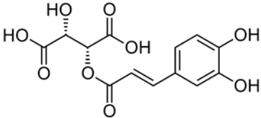
Caftaric acid is simply known as phenolic derivative and it is present in high concentrations in grape seeds and juice. The chemical structure of caftaric acid is C13H12O9, with molar mass of the acid equal to 312.230 g/mol. Caftaric acid is formed united of caffeic acid and tartaric acid. This paper reviews caftaric acid structure, daily consumption, bioavailability and pharmacological effects. The caftaric acid quickly passes to the stomach and duodenum and increases the absorption of the acid in the intestinal Caco-2 cells. The antioxidant effect of grape stem was related to its caftaric acid constituent. The grape juice has anti-inflammatory effect and this anti-inflammatory effect is correlated with the main constituent of this juice which is caftaric acid. Caftaric acid has antimutagenic effect in an animal model suggesting that caftaric acid participates in chemopreventive effect of the Yamabudo juice. The "liver detoxifying" effect is observed and correlated with oral supplementation with aqueous decoctions of Cichorium spinosum and Cichorium intybus in Greece where caftaric acid is the major constituent of these two aqueous decoctions. The caftaric acid possesses a double effect through decreasing high blood glucose and high blood pressure so this acid can be used in the treatment of diabetes and hypertension. The caftaric acid increases granulocyte/macrophage-colony forming cells from femurs of female animals' models by 70%. In conclusion, caftaric acid is presented about 5 mg/100 cm3 grape juice. The acid is quickly passes into the stomach and duodenum. The trans-caftaric acid represents 85% of the total phenolic content in the Concord grape juice with a total concentration of 444 μmol/L. The caftaric acid has many pharmacological effects such as antioxidant, anti-inflammatory, antimutagenic and anticarcinogenic, hepatoprotective, anti-diabetic and anti-hypertensive, anti-obesity and anti-metabolic syndrome and neuroprotective effects.
Overview
The claims and statistics of this paper haven’t been checked yet.
Run the check — free, no account needed. It reads the open-access text and checks the sources it cites.
Integrity signals
Registry
Cites
Statistics
Figures
Verification
Claims the paper makes
The claims and statistics of this paper haven’t been checked yet.
Run the check — free, no account needed. It reads the open-access text and checks the sources it cites.
Claims other papers make about this one
Each is checked against this paper’s own text: does it say what the citing paper says it does?
In the citing paper
“Trans-caffeic acid shows promise in antioxidant, anti-inflammatory, antimutagenic, anticarcinogenic, hepatoprotective, antidiabetic, antihypertensive, anti-obesity, and metabolic syndrome, as well as neuroprotective effects [65].”
Self-check
Percentages, sums and reported differences re-computed from the paper’s own numbers.
The self-check needs the paper’s full text.
Citations
Cites
No references could be resolved yet.
Research works printed but not linked: 51
- Lee, C.Y.; Jaworski, A. Phenolic Compounds in White Grapes Grown in New York. Am J Enol Vitic. 1987, 38, 277- 281.
- Andrew, W.; Gavin, S.; David, J. Chapter 13: Non-flavonoid Phenolics. In: Understanding Wine Chemistry. Adelaide: Wiley Books. 2016; pp. 112-113, https://doi.org/10.1002/9781118730720.ch13. · DOI
- Ivanova, N.N.; Khomich, L.M.; Perova, I.B.; Eller, K.I. Grape juice nutritional profile. Vopr Pitan. 2018, 87, 95-105, http://doi.org/10.24411/0042-8833-2018-10046. · DOI
- Olivati, C.; de Oliveira Nishiyama, Y.P.; de Souza, R.T.; Janzantti, N.S.; Mauro, M.A.; Gomes, E.; Hermosín-Gutiérrez, I.; da Silva, R.; Lago-Vanzela, E.S. Effect of the pre-treatment and the drying process on the phenolic composition of raisins produced with a seedless Brazilian grape cultivar. Food Res Int. 2019, 116, 190-199, https://doi.org/10.1016/j.foodres.2018.08.012. · DOI
- Oniszczuk, T.; Oniszczuk, A.; Gondek, E.; Guz, L.; Puk, K.; Kocira, A.; Kusz, A.; Kasprzak, K.; Wójtowicz, A. Active polyphenolic compounds, nutrient contents and antioxidant capacity of extruded fish feed containing purple coneflower (Echinacea purpurea (L.) Moench.). Saudi J Biol Sci. 2019, 26, 24-30, https://doi.org/10.1016/j.sjbs.2016.11.013. · DOI
- Shi, P.; Yang, C.; Su, Y.; Huang, L.; Lin, X.; Yao, H. Simultaneous Determination of Five Phenolic Acids and Four Flavonoid Glycosides in Rat Plasma Using HPLC-MS/MS and Its Application to a Pharmacokinetic Study after a Single Intravenous Administration of Kudiezi Injection. Molecules 2018, 24, https://doi.org/10.3390/molecules24010064. · DOI
- Stagos, D.; Balabanos, D.; Savva, S.; Skaperda, Z.; Priftis, A.; Kerasioti, E.; Mikropoulou, E.V.; Vougogiannopoulou, K.; Mitakou, S.; Halabalaki, M.; Kouretas, D. Extracts from the Mediterranean Food Plants Carthamus lanatus, Cichorium intybus, and Cichorium spinosum Enhanced GSH Levels and Increased Nrf2 Expression in Human Endothelial Cells. Oxid Med Cell Longev. 2018, 2018, https://doi.org/10.1155/2018/6594101. · DOI
- Senica, M.; Mlinsek, G.; Veberic, R.; Mikulic-Petkovsek, M. Which Plant Part of Purple Coneflower (Echinacea purpurea (L.) Moench) Should be Used for Tea and Which for Tincture? J Med Food. 2019, 22, 102-108, https://doi.org/10.1089/jmf.2018.0026. · DOI
- Priftis, A.; Goutzourelas, N.; Halabalaki, M.; Ntasi, G.; Stagos, D.; Amoutzias, G.D.; Skaltsounis, L.A.; Kouretas, D. Effect of polyphenols from coffee and grape on gene expression in myoblasts. Mech Ageing Dev. 2018, 172, 115-122, https://doi.org/10.1016/j.mad.2017.11.015. · DOI
- Vanzo, A; Cecotti, R; Vrhovsek, U; Torres, AM; Mattivi, F; Passamonti, S. The fate of trans -caftaric acid administered into the rat stomach. J Agric Food Chem. 2007, 55, 1604-11, https://doi.org/10.1021/jf0626819. · DOI
- Chukwuma, C.I.; Matsabisa, M.G.; Ibrahim, M.A.; Erukainure, O.L.; Chabalala, M.H.; Islam, M.S. Medicinal plants with concomitant anti-diabetic and anti-hypertensive effects as potential sources of dual acting therapies against diabetes and hypertension: A review. J Ethnopharmacol. 2019, 235, 329-360, https://doi.org/10.1016/j.jep.2019.02.024. · DOI
- Yasir, M.; Sultana, B.; Anwar, F. LC-ESI-MS/MS based characterization of phenolic components in fruits of two species of Solanaceae. J Food Sci Technol. 2018, 55, 2370-2376, https://doi.org/10.1007/s13197-017-2702-9. · DOI
- Tartaglione, L.; Gambuti, A.; De Cicco, P.; Ercolano, G.; Ianaro, A.; Taglialatela-Scafati, O.; Moio, L.; Forino, M. NMR- based phytochemical analysis of Vitis vinifera cv Falanghina leaves. Characterization of a previously undescribed biflavonoid with antiproliferative activity. Fitoterapia 2018, 125, 13-17, https://doi.org/10.1016/j.fitote.2017.12.009. · DOI
- Griesser, M.; Martinez, S.C.; Eitle, M.W.; Warth, B.; Andre, C.M.; Schuhmacher, R.; Forneck, A. The ripening disorder berry shrivel affects anthocyanin biosynthesis and sugar metabolism in Zweigelt grape berries. Planta 2018, 247, 471-481, https://doi.org/10.1007/s00425-017-2795-4. · DOI
- Sartor, S.; Burin, V.M.; Panceri, C.P.; Dos Passos, R.R.; Caliari, V.; Bordignon-Luiz, M.T. Rosé Sparkling Wines: Influence of Winemaking Practices on the Phytochemical Polyphenol During Aging on Lees and Commercial Storage. J Food Sci. 2018, 83, 2790-2801, https://doi.org/10.1111/1750- 3841.14379. · DOI
- Kamiya, T.; Tanimoto, Y.; Fujii, N.; Negishi, T.; Suzuki, T.; Hatano, T.; Arimoto-Kobayashi, S. 2,6-Dimethoxy-1,4- benzoquinone, isolation and identification of anti-carcinogenic, anti-mutagenic and anti-inflammatory component from the juice of Vitis coignetiae. Food Chem Toxicol. 2018, 122, 172-180, https://doi.org/10.1016/j.fct.2018.10.028. · DOI
- Nadeem, M.; Zeb, A. Impact of maturity on phenolic composition and antioxidant activity of medicinally important leaves of Ficus carica L. Physiol Mol Biol Plants. 2018, 24, 881- 887, https://doi.org/10.1007/s12298-018-0550-3. · DOI
- Ferreira-Lima, N.; Vallverdú-Queralt, A.; Meudec, E.; Mazauric, J.P.; Sommerer, N.; Bordignon-Luiz, M.T.; Cheynier, V.; Le Guernevé, C. Synthesis, identification, and structure elucidation of adducts formed by reactions of hydroxycinnamic acids with glutathione or cysteinylglycine. J Nat Prod. 2016, 79, 2211-22, https://doi.org/10.1021/acs.jnatprod.6b00279. · DOI
- Avidzba, A.M.; Kubyshkin, AV.; Guguchkina, T.I.; Markosov, V.A.; Katsev, A.M.; Naumova, N.V.; Shramko, Y.I.; Zaytsev, G.P.; Chernousova, I.V.; Ogay, Y.A.; Fomochkina, I.I. The antioxidant activity of the products of processing of red grape of Cabernet Sauvignon, Merlot, Saperavi. Vopr Pitan. 2016, 85, 99-109.
- Stalmach, A.; Edwards, C.A.; Wightman, J.D.; Crozier, A. Identification of (poly)phenolic compounds in concord grape juice and their metabolites in human plasma and urine after juice consumption. J Agric Food Chem. 2011, 59, 9512-22, https://doi.org/10.1021/jf2015039. · DOI
- Roland, A.; Vialaret, J.; Razungles, A.; Rigou, P.; Schneider, R. Evolution of S-cysteinylated and S-glutathionylated thiol precursors during oxidation of Melon B. and Sauvignon blanc musts. J Agric Food Chem. 2010, 58, 4406-13, https://doi.org/10.1021/jf904164t. · DOI
- Brieudes, V.; Angelis, A.; Vougogiannopoulou, K.; Pratsinis, H.; Kletsas, D.; Mitakou, S.; Halabalaki, M.; Skaltsounis, LA. Phytochemical Analysis and Antioxidant Potential of the Phytonutrient-Rich Decoction of Cichorium spinosum and C. intybus. Planta Med. 2016, 82, 1070-8, https://doi.org/10.1055/s-0042-107472. · DOI
- Lee, H.J.; Cha, K.H.; Kim, C.Y.; Nho, C.W.; Pan, C.H. Bioavailability of hydroxycinnamic acids from Crepidiastrum denticulatum using simulated digestion and Caco -2 intestinal cells. J Agric Food Chem. 2014, 62, 5290-5, https://doi.org/10.1021/jf500319h. · DOI
- Williamson, G.; Carughi, A. Polyphenol content and health benefits of raisins. Nutr Res. 2010, 30, 511-9, https://doi.org/10.1016/j.nutres.2010.07.005. · DOI
- Malejane, D.N.; Tinyani, P.; Soundy, P.; Sultanbawa, Y.; Sivakumar, D. Deficit irrigation improves phenolic content and antioxidant activity in leafy lettuce varieties. Food Sci Nutr. 2017, 6, 334-341, https://doi.org/10.1002/fsn3.559. · DOI
- Queiroz, M.; Oppolzer, D.; Gouvinhas, I.; Silva, A.M.; Barros, A.; Domínguez-Perles, R. New grape stems' isolated phenolic compounds modulate reactive oxygen species, glutathione, and lipid peroxidation in vitro: Combined formulations with vitamins C and E. Fitoterapia 2017, 120, 146- 157, https://doi.org/10.1016/j.fitote.2017.06.010. · DOI
- Kim, H.D.; Hong, K.B.; Noh, D.O.; Suh, H.J. Sleep-inducing effect of lettuce (Lactuca sativa) varieties on pentobarbital- induced sleep. Food Sci Biotechnol. 2017, 26, 807-814, https://doi.org/10.1007/s10068-017-0107-1. · DOI
- Li, Y.; Li, L.; Cui, Y.; Zhang, S.; Sun, B. Separation and purification of polyphenols from red wine extracts using high speed counter current chromatography. J Chromatogr B Analyt Technol Biomed Life Sci. 2017, 1054, 105-113, https://doi.org/10.1016/j.jchromb.2017.03.006. · DOI
- Padilha, C.V.; Miskinis, G.A.; de Souza, M.E.; Pereira, G.E.; de Oliveira, D.; Bordignon-Luiz, M.T.; Lima, M.D. Rapid determination of flavonoids and phenolic acids in grape juices and wines by RP-HPLC/DAD: Method validation and characterization of commercial products of the new Brazilian varieties of grape. Food Chem. 2017, 228, 106-115, https://doi.org/10.1016/j.foodchem.2017.01.137. · DOI
- Petropoulos, S.A.; Levizou, E.; Ntatsi, G.; Fernandes, Â.; Petrotos, K.; Akoumianakis, K.; Barros, L.; Ferreira, I.C.F.R. Salinity effect on nutritional value, chemical composition and bioactive compounds content of Cichorium spinosum L. Food Chem. 2017, 214, 129-136, https://doi.org/10.1016/j.foodchem.2016.07.080. · DOI
- Tanyeli, A.; Ekinci, A.F.N.; Eraslan, E.; Güler, M.C.; Nacar, T. Anti-oxidant and anti-inflamatuar effectiveness of caftaric acid on gastric ulcer induced by indomethacin in rats. Gen Physiol Biophys. 2019, 38, https://doi.org/10.4149/gpb_2018035x. · DOI
- Arimoto-Kobayashi, S.; Zhang, X.; Yuhara, Y.; Kamiya, T.; Negishi, T.; Okamoto, G. Chemopreventive effects of the juice of Vitis coignetiae Pulliat on two-stage mouse skin carcinogenesis. Nutr Cancer 2013, 65, 440-50, https://doi.org/10.1080/01635581.2013.767916. · DOI
- Yasir, M.; Sultana, B.; Nigam, P.S.; Owusu-Apenten, R. Antioxidant and genoprotective activity of selected cucurbitaceae seed extracts and LC-ESIMS/MS identification of phenolic components. Food Chem. 2016, 199, 307-13, https://doi.org/10.1016/j.foodchem.2015.11.138. · DOI · Paper page
- Zhang, X.; Ishida, R.; Yuhara, Y.; Kamiya, T.; Hatano, T.; Okamoto, G.; Arimoto-Kobayashi, S. Anti-genotoxic activity of Vitis coignetiae Pulliat towards heterocyclic amines and isolation and identification of caftaric acid as an antimutagenic component from the juice. Mutat Res. 2011, 723, 182-9, https://doi.org/10.1016/j.mrgentox.2011.05.001. · DOI
- Corona, G.; Vauzour, D.; Hercelin, J.; Williams, C.M.; Spencer, J.P. Phenolic acid intake, delivered via moderate champagne wine consumption, improves spatial working memory via the modulation of hippocampal and cortical protein expression/activation. Antioxid Redox Signal. 2013, 19, 1676-89, https://doi.org/10.1089/ars.2012.5142. · DOI
- Liu, Q.; Wang, Y.; Xiao, C.; Wu, W.; Liu, X. Metabolism of chicoric acid by rat liver microsomes and bioactivity comparisons of chicoric acid and its metabolites. Food Funct. 2015, 6, 1928-35, https://doi.org/10.1039/C5FO00073D. · DOI
- Koriem, K.M.; Soliman, R.E. Chlorogenic and caftaric acids in liver toxicity and oxidative stress induced by methamphetamine. J Toxicol. 2014, 2014, https://doi.org/10.1155/2014/583494. · DOI
- Vanzo, A.; Cecotti, R.; Vrhovsek, U.; Torres, A.M.; Mattivi, F.; Passamonti, S. The fate of trans-caftaric acid administered into the rat stomach. J Agric Food Chem. 2007, 55, 1604-11, https://doi.org/10.1021/jf0626819. · DOI
- Landrault, N.; Poucheret, P.; Azay, J.; Krosniak, M.; Gasc, F.; Jenin, C.; Cros, G.; Teissedre, P.L. Effect of a polyphenols - enriched chardonnay white wine in diabetic rats. J Agric Food Chem. 2003, 51, 311-8, https://doi.org/10.1021/jf020219s . · DOI
- Falchi, M.; Bertelli, A.; Lo Scalzo, R.; Morassut, M.; Morelli, R.; Das, S.; Cui, J.; Das, D.K. Comparison of cardioprotective abilities between the flesh and skin of grapes. J Agric Food Chem. 2006, 54, 6613-22, https://doi.org/10.1021/jf061048k. · DOI
- Casanova, L.M.; Gu , W.; Costa, S.S.; Jeppesen, P.B. Phenolic Substances from Ocimum Species Enhance Glucose- Stimulated Insulin Secretion and Modulate the Expression of Key Insulin Regulatory Genes in Mice Pancreatic Islets. J Nat Prod. 2017, 80, 3267-3275, https://doi.org/10.1021/acs.jnatprod.7b00699. · DOI
- Ramasahayam, S.; Baraka, H.N.; Abdel Bar, F.M.; Abuasal, B.S.; Widrlechner, M.P.; Sayed, K.A.; Meyer, S.A. Effects of chemically characterized fractions from aerial parts of Echinacea purpurea and E. angustifolia on myelopoiesis in rats. Planta Med. 2011, 77, 1883-9, https://doi.org/10.1055/s-0031-1279990. · DOI
- Koriem, K.M.M.; Arbid, M.S. Role of caftaric acid in lead- associated nephrotoxicity in rats via antidiuretic, antioxidant and anti-apoptotic activities. J Complement Integr Med. 2017, 15, https://doi.org/10.1515/jcim-2017-0024. · DOI
- Ferreira-Lima, N.; Vallverdú-Queralt, A.; Meudec, E.; Pinasseau, L.; Verbaere, A.; Bordignon-Luiz, M.T.; Le Guernevé, C.; Cheynier, V.; Sommerer, N. Quantification of hydroxycinnamic derivatives in wines by UHPLC-MRM-MS. Anal Bioanal Chem. 2018, 410, 3483-3490, https://doi.org/10.1007/s00216-017-0759-y. · DOI
- Constantino, L.F.; Nascimento, L.B.; Casanova, L.M.; Moreira, N.D.; Menezes, E.A.; Esteves, R.L.; Costa, S.S.; Tavares, E.S. Responses of Crepis japonica induced by supplemental blue light and UV-A radiation. Photochem Photobiol Sci. 2017, 16, 238-245, https://doi.org/10.1039/C6PP00343E. · DOI
- Calabriso, N.; Scoditti, E.; Massaro, M.; Pellegrino, M.; Storelli, C.; Ingrosso, I.; Giovinazzo, G.; Carluccio, M.A. Multiple anti-inflammatory and anti-atherosclerotic properties of red wine polyphenolic extracts: differential role of hydroxycinnamic acids, flavonols and stilbenes on endothelial inflammatory gene expression. Eur J Nutr. 2016, 55, 477-489, https://doi.org/10.1007/s00394-015-0865-6. · DOI
- Ali, K.; Iqbal, M.; Fortes, A.M.; Pais, M.S.; Korthout, H.A.; Verpoorte, R.; Choi, Y.H. Red wines attenuate TNFα production in human histiocytic lymphoma cell line: an NMR spectroscopy and chemometrics based study. Food Chem. 2013, 141, 3124-30, https://doi.org/10.1016/j.foodchem.2013.06.001. · DOI
- Bel-Rhlid, R.; Pagé-Zoerkler, N.; Fumeaux, R.; Ho-Dac, T.; Chuat, J.Y.; Sauvageat, J.L.; Raab, T. Hydrolysis of chicoric and caftaric acids with esterases and Lactobacillus johnsonii in Vitro and in a gastrointestinal model. J Agric Food Chem. 2012, 60, 9236-41, https://doi.org/10.1021/jf301317h. · DOI
- Ramanauskiene, K.; Raudonis, R.; Majiene, D. Rosmarinic acid and Melissa officinalis extracts differently affect glioblastoma cells. Oxid Med Cell Longev. 2016, 2016, https://doi.org/10.1155/2016/1564257. · DOI
- Singleton, V.L.; Zaya, J.; Trousdale, E.K. Caftaric and coutaric acids in fruit of Vitis. Phytochemistry 1986, 25, 2127- 2133, https://doi.org/10.1016/0031-9422(86)80078-4. · DOI
- Singleton, V.L.; Salgues, M.; Zaya, J.; Trousdale, E. Caftaric acid disappearance and conversion to products of enzymic Oxidationin Grape Must and Wine. Am J Enol Vitic. 1985, 36, 50-56.
Cited by
Hadi, N., Drioiche, A., Bouchra, E. M., Baammi, S., Abdelaziz Shahat, A., Tagnaout, I., Radi, M., Remok, F., Bouzoubaa, A., & Zair, T. (2024) · Pharmaceuticals · doi:10.3390/ph17070862 · Cited by 30
Metadata
- Venue
- Biointerface Research in Applied Chemistry
- Publisher
- AMG Transcend Association
- Published
- 2020-03-29
- Volume
- 10
- Issue
- 3
- Pages
- 5616-5623
- ISSN
- 2069-5837
- Cited by
- 29
- References
- 0
- Language
- en
About these checks
Registry, retraction, Cites and statistics results are computed, not judged, with one exception: a printed reference that no index lists is read once by a model before it counts as a citation error. Claims are extracted by a model and kept only when their quote appears verbatim in the text; each cited source is then checked, with a model’s help, for whether it says what the claim relies on. Those verdicts can be wrong — read the claim’s quote and the cited source before relying on one.
Statistics and arithmetic are recomputed, not judged.
Confidence bands are shown only for fields calibrated on our annotated test set. None is calibrated yet, so no band is shown.
What counts as a claim ›How we measure confidence ›How we check this ›
Are you an author, or do you see a problem with this page? Request a review
How to cite
Cite CoChat for the checks on this page, and the paper for its own findings.
- This page
- CoChat. (2026). Citation check: Caftaric acid: an overview on its structure, daily consumption, bioavailability and pharmacological effects. https://app.cochat.ai/papers/10.33263/briac103.616623
- The paper
- Caftaric acid: an overview on its structure, daily consumption, bioavailability and pharmacological effects. (2020). Biointerface Research in Applied Chemistry. https://doi.org/10.33263/briac103.616623
