

The DOI matches its Crossref record; 12 of the 12 references it cites were found in a registry or an index; none of the 22 sources its claims cite is checked for support yet.
Effects of Early Surgical Exploration in Suspected Barotraumatic Perilymph Fistulas
Open accessAbstract
OBJECTIVES: Treatment of traumatic perilymph fistula (PLF) remains controversial between surgical repair and conservative therapy. The aim of this study is to analyze the outcomes of early surgical exploration in suspected barotraumatic PLF. METHODS: Nine patients (10 cases) who developed sudden sensorineural hearing loss and dizziness following barotrauma and underwent surgical exploration with the clinical impression of PLF were enrolled. Types of antecedent trauma, operative findings, control of dizziness after surgery, postoperative hearing outcomes, and relations to the time interval between traumatic event and surgery were assessed retrospectively. RESULTS: All patients had sudden or progressive hearing loss and dizziness following trauma. Types of barotrauma were classified by the origin of the trauma: 4 external (car accident, slap injury) and 6 internal traumas (lifting, nasal blowing, straining). Surgical exploration was performed whenever PLF was suspected with the time interval of 2 to 47 days after the trauma. The possible evidence of PLF was found during surgery in 9 cases: a fibrous web around the oval window (n=3), fluid collection in the round window (RW; n=6) and bulging of the RW pseudomembrane (n=1). In every patient, vestibular symptoms disappeared immediately after surgery. The hearing was improved with a mean gain of 27.0±14.9 dB. When the surgical exploration was performed as early as less than 10 days after the trauma, serviceable hearing (≤40 dB) was obtained in 4 out of 7 cases (57.1%). CONCLUSION: Sudden or progressive sensorineural hearing loss accompanied by dizziness following barotrauma should prompt consideration of PLF. Early surgical exploration is recommended to improve hearing and vestibular symptoms.
Overview
AI snapshot
Written from the paper’s full text.
TL;DR
In nine patients (10 ears) with suspected barotraumatic perilymph fistula, early surgical exploration was followed by immediate resolution of dizziness in all patients and a mean hearing gain of 27.0 ± 14.9 dB. The authors recommend early surgical exploration for sudden or progressive sensorineural hearing loss with dizziness after barotrauma.
Key findings
- All 9 patients (10 cases) had sudden or progressive hearing loss and dizziness after barotrauma; vestibular symptoms disappeared immediately after surgery in every patient.
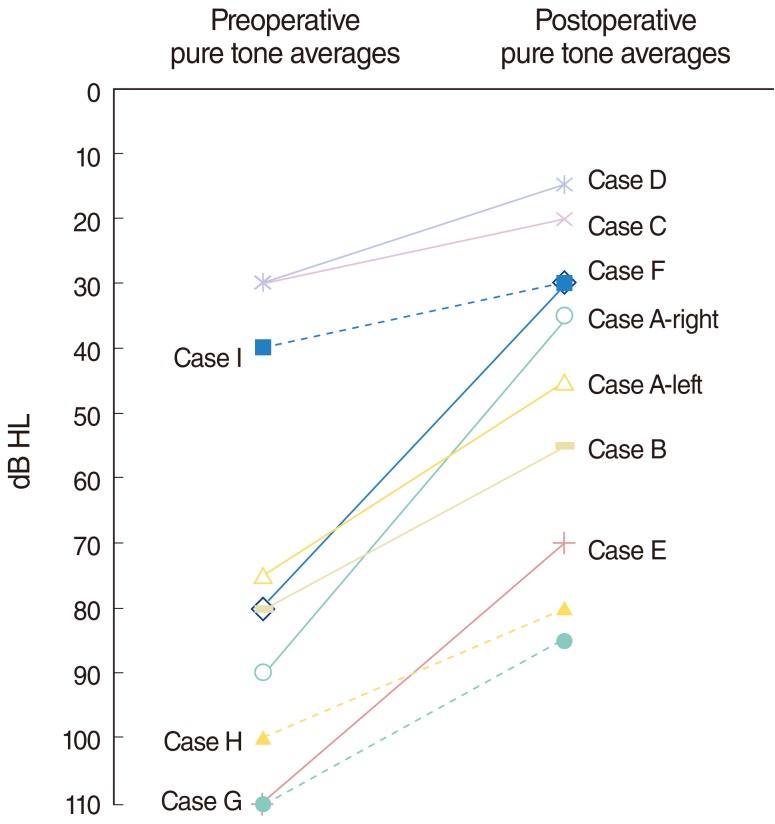
- Mean hearing gain was 27.0 ± 14.9 dB (range, 10–55 dB), and serviceable hearing (≤40 dB) was achieved in 5 of 10 cases (50%).
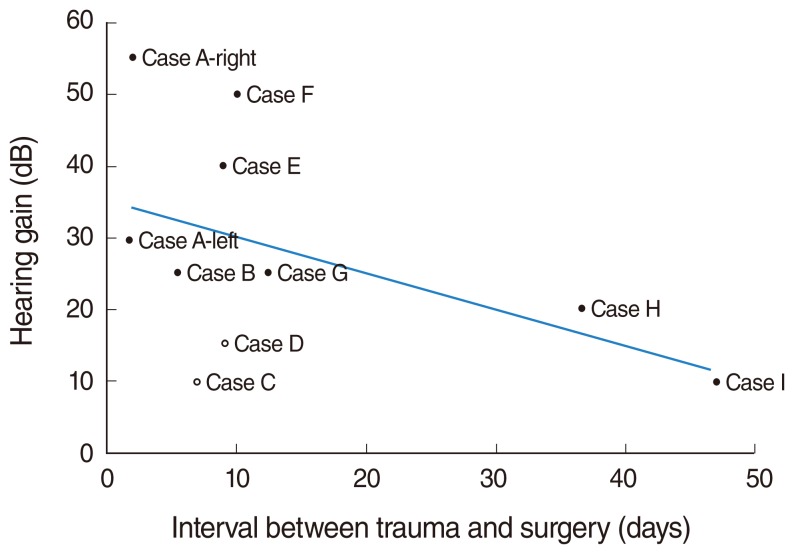
- When surgery was performed <10 days after trauma, serviceable hearing was obtained in 4 of 7 cases (57.1%), compared with 1 of 3 cases (33.3%) after 10 days.
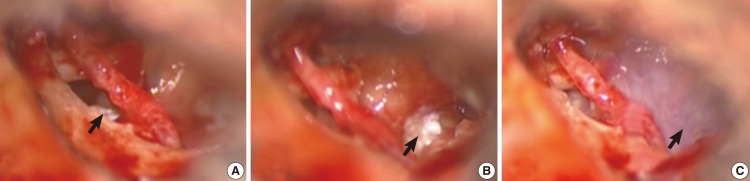
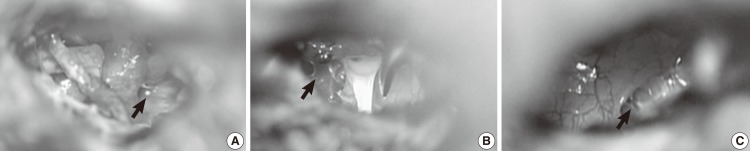
- Intraoperative possible evidence of perilymph fistula was found in 9 cases: fibrous web around the oval window (n=3), fluid collection in the round window (n=6), and bulging of the round window pseudomembrane (n=1).
Methods
- Retrospective review of medical records of 9 patients who underwent exploratory tympanotomy from January 2005 through December 2010 with clinical impression of barotraumatic perilymph fistula.
- Types of antecedent trauma, operative findings, postoperative dizziness, hearing outcomes, and time interval between trauma and surgery were assessed; pure tone averages at 0.5, 1, 2, and 4 kHz were compared at 2 months after surgery.
- Surgical exploration exposed the oval and round windows; both windows were covered with soft tissue and fibrin glue whether or not a suspected fistula site was found.
Limitations
- The paper states that conclusions about optimal timing for improved hearing outcomes could not be determined because of the limited number of cases.
- The paper states that, because of the limited number of cases and lack of a control group, the effects of conservative management could not be exactly ruled out.
- Evident from the text: this is a small, single-center retrospective case series without a definite diagnostic test for perilymph fistula, and surgery was performed within two days of first visit at the authors’ center despite trauma-to-surgery intervals of 2 to 47 days.
Model-written summary. Check it against the paper before relying on it.
Integrity signals
Registry
Cites
Statistics
Figures
Verification
Claims the paper makes
20 Own result · 14 Own interpretation · 7 No full text of the sources · 3 Not checked yet · 2 Sources not found · 2 Own method
A result the paper reports from its own data — it cites no other source for it, so there is none to check. The quote shows it is in the paper.
In the paper
“All patients had sudden or progressive hearing loss and dizziness following trauma.”
- Also stated in: § Symptoms and signs · p. 3 · plain
“All patients had sudden or progressive hearing loss and dizziness.”
plainn = 9- Asserted: passes — The authors put it forward as true.
- Checkable: passes — It can be checked against evidence.
- Load-bearing: passes — The paper’s conclusions depend on it.
- Based: passes — The paper gives a reason why it holds.
- Also stated in: § Symptoms and signs · p. 3 · plain
A result the paper reports from its own data — it cites no other source for it, so there is none to check. The quote shows it is in the paper.
In the paper
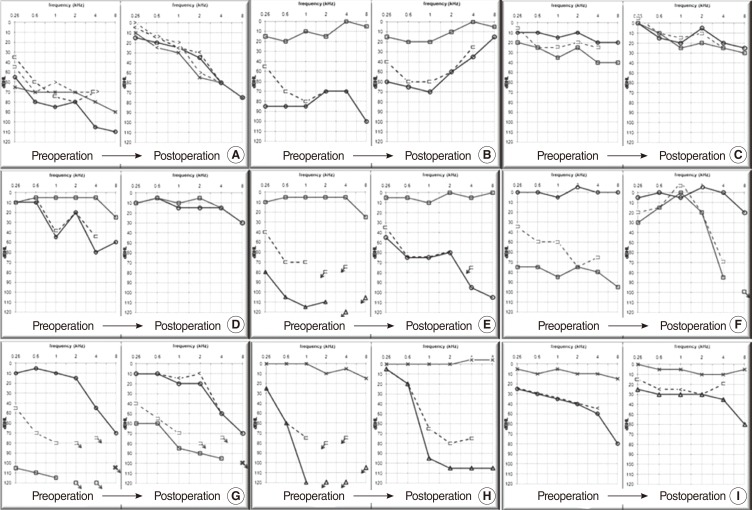
“Serviceable hearing (pure tone averages in 4 frequencies ≤ 40 dB) was achieved in 5 out of 10 cases (50%) (Fig. 2A, C, D, F, I).”
plainn = 10- Asserted: passes — The authors put it forward as true.
- Checkable: passes — It can be checked against evidence.
- Load-bearing: passes — The paper’s conclusions depend on it.
- Based: passes — The paper gives a reason why it holds.
A result the paper reports from its own data — it cites no other source for it, so there is none to check. The quote shows it is in the paper.
In the paper
“The possible evidence of PLF was found during surgery in 9 cases: a fibrous web around the oval window (n = 3), fluid collection in the round window (RW; n = 6) and bulging of the RW pseudomembrane (n = 1).”
hedgedn = 9- Asserted: passes — The authors put it forward as true.
- Checkable: passes — It can be checked against evidence.
- Load-bearing: unclear — It is unclear whether the paper’s conclusions depend on it.
- Based: passes — The paper gives a reason why it holds.
A result the paper reports from its own data — it cites no other source for it, so there is none to check. The quote shows it is in the paper.
In the paper
“The hearing was improved with a mean gain of 27.0 ± 14.9 dB.”
- Also stated in: § Surgical outcomes and related factors · p. 4 · plain
“The mean hearing gain was 27.0 ± 14.9 dB (range, 10 to 55 dB) in pure tone averages and 27.4 ± 32.6% (range, 0 to 92%) in speech discrimination score at 2 months after the operation.”
plainstates a causen = 10- Asserted: passes — The authors put it forward as true.
- Checkable: passes — It can be checked against evidence.
- Load-bearing: passes — The paper’s conclusions depend on it.
- Based: passes — The paper gives a reason why it holds.
- Also stated in: § Surgical outcomes and related factors · p. 4 · plain
A result the paper reports from its own data — it cites no other source for it, so there is none to check. The quote shows it is in the paper.
In the paper
“Regarding the hearing outcomes, every patient has improv ed significantly their hearing ( > 10 dB).”
plainstates a causen = 10- Asserted: passes — The authors put it forward as true.
- Checkable: passes — It can be checked against evidence.
- Load-bearing: passes — The paper’s conclusions depend on it.
- Based: passes — The paper gives a reason why it holds.
A result the paper reports from its own data — it cites no other source for it, so there is none to check. The quote shows it is in the paper.
In the paper
“In our series, the audiometric configuration showed descending types (8 cases).”
plainn = 8- Asserted: passes — The authors put it forward as true.
- Checkable: passes — It can be checked against evidence.
- Load-bearing: passes — The paper’s conclusions depend on it.
- Based: passes — The paper gives a reason why it holds.
A result the paper reports from its own data — it cites no other source for it, so there is none to check. The quote shows it is in the paper.
In the paper
“There were no complications related to the surgical repair of the PLFs such as conductive hearing loss, worsening of the hearing loss, perforation of the tympanic membrane, infection and/or facial nerve injury .”
plain- Asserted: passes — The authors put it forward as true.
- Checkable: passes — It can be checked against evidence.
- Load-bearing: passes — The paper’s conclusions depend on it.
- Based: passes — The paper gives a reason why it holds.
A result the paper reports from its own data — it cites no other source for it, so there is none to check. The quote shows it is in the paper.
In the paper
“There was no direct evidence of fistula such as definite fistula hole in the RW or OW.”
plain- Asserted: passes — The authors put it forward as true.
- Checkable: passes — It can be checked against evidence.
- Load-bearing: passes — The paper’s conclusions depend on it.
- Based: passes — The paper gives a reason why it holds.
A result the paper reports from its own data — it cites no other source for it, so there is none to check. The quote shows it is in the paper.
In the paper
“Air bone gap, especially in low frequency (250, 500, and 1,000 Hz), was found in 5 cases (Fig. 2A, B, E-G).”
plainn = 5- Asserted: passes — The authors put it forward as true.
- Checkable: passes — It can be checked against evidence.
- Load-bearing: unclear — It is unclear whether the paper’s conclusions depend on it.
- Based: passes — The paper gives a reason why it holds.
A result the paper states — it cites no source for it, so there is none to check. The quote shows it is in the paper.
In the paper
“In addition, the hearing recovery was better at low frequencies.”
plain- Asserted: passes — The authors put it forward as true.
- Checkable: passes — It can be checked against evidence.
- Load-bearing: unclear — It is unclear whether the paper’s conclusions depend on it.
- Based: passes — The paper gives a reason why it holds.
- Probably not a substantial claim. 12
- It may state two separate claims as one. 13
A result the paper reports from its own data — it cites no other source for it, so there is none to check. The quote shows it is in the paper.
In the paper
“Surgical exploration was performed whenever PLF was suspected with the time interval of 2 to 47 days after the trauma.”
plain- Asserted: passes — The authors put it forward as true.
- Checkable: passes — It can be checked against evidence.
- Load-bearing: passes — The paper’s conclusions depend on it.
- Based: passes — The paper gives a reason why it holds.
Probably not a substantial claim.
A result the paper reports from its own data — it cites no other source for it, so there is none to check. The quote shows it is in the paper.
In the paper
“The possible evidence of PLF was found during surgery in 9 cases: a fibrous web around the oval window (n = 3), fluid collection in the round window (RW; n = 6) and bulging of the RW pseudomembrane (n = 1).”
plainSingle case- Asserted: passes — The authors put it forward as true.
- Checkable: passes — It can be checked against evidence.
- Load-bearing: fails — The paper’s conclusions may not depend on it.
- Based: passes — The paper gives a reason why it holds.
Probably not a substantial claim. The paper’s conclusions may not depend on it.
A result the paper states — it cites no source for it, so there is none to check. The quote shows it is in the paper.
In the paper
“For the limited number of cases, there was a tendency that the OW fistula might be more vulnerable to external trauma and RW fistula to internal trauma.”
hedgedstates a possible cause- Asserted: passes — The authors put it forward as true.
- Checkable: passes — It can be checked against evidence.
- Load-bearing: unclear — It is unclear whether the paper’s conclusions depend on it.
- Based: passes — The paper gives a reason why it holds.
It may state two separate claims as one.
A conclusion the paper draws from its own results — it cites no other source for it, so there is none to check. The quote shows it is in the paper.
In the paper
“It is because the external trauma causes hypermobility of ossicles to subluxate stapes against the OW.”
plainstates a cause- Asserted: passes — The authors put it forward as true.
- Checkable: passes — It can be checked against evidence.
- Load-bearing: fails — The paper’s conclusions may not depend on it.
- Based: fails — The paper may give no reason why it holds.
Probably not a substantial claim. The paper’s conclusions may not depend on it. The paper may give no reason why it holds.
A conclusion the paper draws from its own results — it cites no other source for it, so there is none to check. The quote shows it is in the paper.
In the paper
“Early surgical exploration is recommended to improve hearing and vestibular symptoms.”
- Also stated in: § DISCUSSION · p. 7 · plain
“Early surgical exploration is recommended to improve hearing outcomes and control dizziness.”
plainstates a causen = 9- Asserted: passes — The authors put it forward as true.
- Checkable: passes — It can be checked against evidence.
- Load-bearing: passes — The paper’s conclusions depend on it.
- Based: passes — The paper gives a reason why it holds.
It may state two separate claims as one.
- Rests on an assumption: The patients clinically suspected of barotraumatic PLF actually had a perilymph fistula.
- Rests on an assumption: The observed postoperative improvements in hearing and dizziness are due to surgical repair rather than natural recovery or conservative management.
- Also stated in: § DISCUSSION · p. 7 · plain
A conclusion the paper draws from its own results — it cites no other source for it, so there is none to check. The quote shows it is in the paper.
In the paper
“The authors think that once the RW or OW is torn, it would be difficult to heal spontaneously , because they are mov ing and the patients tends to blow their nose to relieve their plug ging sensation.”
hedgedstates a cause- Asserted: passes — The authors put it forward as true.
- Checkable: passes — It can be checked against evidence.
- Load-bearing: passes — The paper’s conclusions depend on it.
- Based: fails — The paper may give no reason why it holds.
Probably not a substantial claim. The paper may give no reason why it holds. It may state two separate claims as one.
A conclusion the paper draws from its own results — it cites no other source for it, so there is none to check. The quote shows it is in the paper.
In the paper
“Although fibrous web around the RW can be regarded as non-specific finding, it is unusual finding in normal middle ear and fibrosis can be made by long standing inflammation.”
plainstates a cause- Asserted: passes — The authors put it forward as true.
- Checkable: passes — It can be checked against evidence.
- Load-bearing: passes — The paper’s conclusions depend on it.
- Based: passes — The paper gives a reason why it holds.
It may state two separate claims as one.
A conclusion the paper draws from its own results — it cites no other source for it, so there is none to check. The quote shows it is in the paper.
In the paper
“Fluid collection and pseudomambrane bulging can be regarded as evident findings of RW fistula.”
plainstates an association- Asserted: passes — The authors put it forward as true.
- Checkable: passes — It can be checked against evidence.
- Load-bearing: passes — The paper’s conclusions depend on it.
- Based: passes — The paper gives a reason why it holds.
It may state two separate claims as one.
In the paper
“Goto et al. (5) suggested that urgent tympanotomy is not required because the surgical closure of a PLF had disappointing results with regard to hearing recovery; in addition, the restoration of disequilibrium was suggested to be the major purpose of the surgical procedure.”
What the sources say
- Not checked — no full text of the sourcecites [5] Goto, 2001, Auris Nasus Larynx source
hedgedstates a cause- Asserted: passes — The authors put it forward as true.
- Checkable: passes — It can be checked against evidence.
- Load-bearing: fails — The paper’s conclusions may not depend on it.
- Based: passes — The paper gives a reason why it holds.
Probably not a substantial claim. The paper’s conclusions may not depend on it. It may state two separate claims as one.
A conclusion the paper draws from its own results — it cites no other source for it, so there is none to check. The quote shows it is in the paper.
In the paper
“Progression of hearing loss over time after trauma is common and it may imply that there is continuous leak of perilymph from the fistulous site.”
hedgedstates a possible cause- Asserted: passes — The authors put it forward as true.
- Checkable: passes — It can be checked against evidence.
- Load-bearing: passes — The paper’s conclusions depend on it.
- Based: fails — The paper may give no reason why it holds.
Probably not a substantial claim. The paper may give no reason why it holds. It may state two separate claims as one.
A conclusion the paper draws from its own results — it cites no other source for it, so there is none to check. The quote shows it is in the paper.
In the paper
“The dizziness might be caused by transient otolithic dysfunction or perilymph perturbation.”
hedgedstates a possible cause- Asserted: passes — The authors put it forward as true.
- Checkable: passes — It can be checked against evidence.
- Load-bearing: unclear — It is unclear whether the paper’s conclusions depend on it.
- Based: passes — The paper gives a reason why it holds.
It may state two separate claims as one.
A claim is checked only against the cited paper’s full text, never its abstract, and none is available for its sources.
In the paper
“This is consistent with previous studies that reported the vestibular outcomes to be better than the hearing results and the improvement rate for dizziness was more than 80% (7-9).”
What the sources say
plain- Asserted: passes — The authors put it forward as true.
- Checkable: passes — It can be checked against evidence.
- Load-bearing: unclear — It is unclear whether the paper’s conclusions depend on it.
- Based: passes — The paper gives a reason why it holds.
It may state two separate claims as one.
A claim is checked only against the cited paper’s full text, never its abstract, and none is available for its sources.
In the paper
“Black et al. (8) and Goto et al. (5) reported that the patients showed improved hearing in only 17% and 9%, respectively.”
What the sources say
- Not checked — no full text of the sourcecites [8] Black, 1992, Am J Otol
- Not checked — no full text of the sourcecites [5] Goto, 2001, Auris Nasus Larynx source
plain- Asserted: passes — The authors put it forward as true.
- Checkable: passes — It can be checked against evidence.
- Load-bearing: passes — The paper’s conclusions depend on it.
- Based: passes — The paper gives a reason why it holds.
It may state two separate claims as one.
In the paper
“Hearing was improved in one case out of the nine that underwent surgical repair five days after trauma.”
What the sources say
- Not matchedcites [2] Glasscock, 1992, Am J Otol
Couldn’t be matched to a paper in Crossref, so it can’t be checked.
plainSingle case- Asserted: passes — The authors put it forward as true.
- Checkable: passes — It can be checked against evidence.
- Load-bearing: fails — The paper’s conclusions may not depend on it.
- Based: passes — The paper gives a reason why it holds.
Probably not a substantial claim. The paper’s conclusions may not depend on it.
- Not matched
In the paper
“On the other hand, Seltzer and McCabe (9) reported that improved hearing was possible after many years of symptoms in some patients that underwent PLF repair, and therefore early exploration was suggested to be important.”
What the sources say
- Not checked — no full text of the sourcecites [9] Seltzer, 1986, Laryngoscope source
hedgedstates a possible cause- Asserted: passes — The authors put it forward as true.
- Checkable: passes — It can be checked against evidence.
- Load-bearing: passes — The paper’s conclusions depend on it.
- Based: passes — The paper gives a reason why it holds.
Probably not a substantial claim. It may state two separate claims as one.
A conclusion the paper draws from its own results — it cites no other source for it, so there is none to check. The quote shows it is in the paper.
In the paper
“Without repair, it would progress to deaf.”
hedgedstates a cause- Asserted: passes — The authors put it forward as true.
- Checkable: passes — It can be checked against evidence.
- Load-bearing: passes — The paper’s conclusions depend on it.
- Based: fails — The paper may give no reason why it holds.
Probably not a substantial claim. The paper may give no reason why it holds.
None of the sources cited for this claim have been checked yet.
In the paper
“Treatment of traumatic PLF remains controversial.”
What the sources say
plain- Asserted: passes — The authors put it forward as true.
- Checkable: passes — It can be checked against evidence.
- Load-bearing: passes — The paper’s conclusions depend on it.
- Based: passes — The paper gives a reason why it holds.
Probably not a substantial claim.
In the paper
“They reported that dizziness could be improved by surgical repair, but hearing improvement was not common.”
What the sources say
- Not matchedcites [2] Glasscock, 1992, Am J Otol
Couldn’t be matched to a paper in Crossref, so it can’t be checked.
hedgedstates a possible causen = 9- Asserted: passes — The authors put it forward as true.
- Checkable: passes — It can be checked against evidence.
- Load-bearing: fails — The paper’s conclusions may not depend on it.
- Based: passes — The paper gives a reason why it holds.
Probably not a substantial claim. The paper’s conclusions may not depend on it. It may state two separate claims as one.
- Not matched
A conclusion the paper draws from its own results — it cites no other source for it, so there is none to check. The quote shows it is in the paper.
In the paper
“Fistula repair to prevent further leakage would prevent further damage of hearing and would increase the chance of functional recovery.”
hedgedstates a cause- Asserted: passes — The authors put it forward as true.
- Checkable: passes — It can be checked against evidence.
- Load-bearing: passes — The paper’s conclusions depend on it.
- Based: fails — The paper may give no reason why it holds.
Probably not a substantial claim. The paper may give no reason why it holds. It may state two separate claims as one.
The paper relies on this without support.
The patients clinically suspected of barotraumatic PLF actually had a perilymph fistula.
“The medical records of nine patients that underwent exploratory tympanotomy from January 2005 through December 2010, with the clinical impression of a barotraumatic PLF, were reviewed.”
The paper relies on this without support.
The observed postoperative improvements in hearing and dizziness are due to surgical repair rather than natural recovery or conservative management.
“In our series, because of limited number of cases and lacking a control group we could not exactly rule out the effects of conservative management.”
The paper relies on this without support.
Surgical exploration under local anesthesia has low morbidity and usually takes less than an hour.
“In addition, surgical exploration under local anesthesia has low morbidity and usually takes less than an hour.”
The paper relies on this without support.
Severe traumatic head injury causing temporal bone fracture and pneumolabyrinth usually causes permanent deafness and total vestibular loss immediately after head trauma.
“Severe traumatic head injury to cause the temporal bone fracture and pneu molabyrinth were not included. Because these type of injury usually cause permanent deafness and total vestibular loss immediately after head trauma.”
The paper relies on this without support.
The diagnosis of traumatic PLF is mostly based on clinical findings, including history, physical examination and audiogram.
“The diagnosis of traumatic PLF is mostly based on the clinical findings, including the history , physical examination and audiogram.”
Self-check
Percentages, sums and reported differences re-computed from the paper’s own numbers.
Each contradiction between two passages listed here was confirmed by an independent check.
Rated minor: it would not touch a result — a value no result rests on, a p-value that stays on the same side of the significance level, or a conflict that is clerical, resolved elsewhere in the paper, or outside its own findings.
In the paper
§ Effects of Early Surgical Exploration in Suspected Barotraumatic Perilymph Fistulas · p. 1
“When the surgical exploration was performed as early as less than 10 days after the trauma, serviceable hearing ( ≤ 40 dB) was obtained in 4 out of 7 cases (57.1%).”
§ Types of antecedent trauma · p. 3
“| F | M/12 | 10 | + | Slap (cheek) | H/L, vertigo | F ibrous web around OW, stapes | L) 80 30 (50 dB) |”
Rated minor: it would not touch a result — a value no result rests on, a p-value that stays on the same side of the significance level, or a conflict that is clerical, resolved elsewhere in the paper, or outside its own findings.
In the paper
§ Surgical outcomes and related factors · p. 5
“Two patients (case C and D, empty circle) showed serviceable hearing before the operation.”
§ Symptoms and signs · p. 3
“Six patients had severe to profound sensorineural hearing loss and 3 patients show ed serviceable hearing before the operation (Fig. 2).”
Rated minor: it would not touch a result — a value no result rests on, a p-value that stays on the same side of the significance level, or a conflict that is clerical, resolved elsewhere in the paper, or outside its own findings.
In the paper
§ Surgical outcomes and related factors · p. 4
“Regarding the hearing outcomes, every patient has improv ed significantly their hearing ( > 10 dB).”
§ Types of antecedent trauma · p. 3
“| C | F/40 | 7 | - | Nose blowing | H/L, vertigo | F luid collection around RW | L) 30 20 (10 dB) |”
Rated minor: it would not touch a result — a value no result rests on, a p-value that stays on the same side of the significance level, or a conflict that is clerical, resolved elsewhere in the paper, or outside its own findings.
In the paper
§ Effects of Early Surgical Exploration in Suspected Barotraumatic Perilymph Fistulas · p. 1
“fluid collection in the round window (RW; n = 6) and bulging of the RW pseudomembrane (n = 1)”
§ Intraoperative findings · p. 3
“In 6 cases with a suspected RW fistula, fluid or pus collections were found in 5 cases (Fig. 3A), and the RW pseudomembrane was bulging in 1 case.”
Rated minor: it would not touch a result — a value no result rests on, a p-value that stays on the same side of the significance level, or a conflict that is clerical, resolved elsewhere in the paper, or outside its own findings.
In the paper
§ Symptoms and signs · p. 3
“Air bone gap, especially in low frequency (250, 500, and 1,000 Hz), was found in 5 cases (Fig. 2A, B, E-G).”
§ DISCUSSION · p. 6
“In seven cases, an air -bone gap at low frequencies (250, 500, and 1,000 Hz) was found.”
Citations
Cites
Cummings Otolaryngology: Head and Neck Surgery
Flint, E. B. P. W., Haughey, B. H., Lund, V. J., Niparko, J. K., Robbins, K. T., Thomas, J. R., & Lesperance, M. M. (2004) · Cited by 1,439
Cummings otolaryngology--head & neck surgery
illustrator, T. P. (2012) · Cited by 323
Perilymph fistula: The iowa experience
Seltzer, S., & Mccabe, B. F. (1986) · The Laryngoscope · doi:10.1288/00005537-198601000-00007 · Cited by 160
Reversible Peripheral Vestibulopathy: The Treatment of Superior Canal Dehiscence
Hillman, T. A., Kertesz, T. R., Hadley, K., et al. (2006) · Otolaryngology · doi:10.1016/j.otohns.2005.10.033 · Cited by 70
Is there Consensus in Perilymph Fistula Management?
Hughes, G. B., Sismanis, A., & House, J. W. (1990) · Otolaryngology–Head and Neck Surgery · doi:10.1177/019459989010200203 · Cited by 51
Perilymph fistula — 45 case analysis
Goto, F., Ogawa, K., Kunihiro, T., Kurashima, K., Kobayashi, H., & Kanzaki, J. (2001) · Auris Nasus Larynx · doi:10.1016/s0385-8146(00)00089-4 · Cited by 49
(1992) · PubMed · Cited by 43
(1992) · PubMed · Cited by 38
Perilymphatic fistula: Surgical experience in the united states
House, J. W., Morris, M. S., Kramer, S. J., Shasky, G. L., Coggan, B. B., & Putter, J. S. (1991) · Otolaryngology–Head and Neck Surgery · doi:10.1177/019459989110500108 · Cited by 34
Perilymph Fistula: Concept, Diagnosis and Management
Nomura, Y. (1994) · Acta Oto-Laryngologica · doi:10.3109/00016489409127559 · Cited by 22
Research works printed but not linked: 3
- Glasscock, 1992, Am J Otol, 13, 333
- Black, 1992, Am J Otol, 13, 254
- Simmons, 1982, Adv Otorhinolaryngol, 28, 68
Cited by
Sorted by citations
Perilymphatic Fistula: A Review of Classification, Etiology, Diagnosis, and Treatment
Sarna, B., Abouzari, M., Merna, C., et al. (2020) · Frontiers in Neurology · doi:10.3389/fneur.2020.01046 · Cited by 76
In-vitro perforation of the round window membrane via direct 3-D printed microneedles
Aksit, A., Arteaga, D. N., Arriaga, M., Wang, X., Watanabe, H., Kasza, K. E., Lalwani, A. K., & Kysar, J. W. (2018) · Biomedical Microdevices · doi:10.1007/s10544-018-0287-3 · Cited by 73
Perilymphatic fistulas: can we predict the diagnosis?
Alzahrani, M. A., Fadous, R., Dufour, J., et al. (2014) · European Archives of Oto-Rhino-Laryngology · doi:10.1007/s00405-014-3007-5 · Cited by 25
Eagles, K., Fralich, L., & Stevenson, J. H. (2013) · Clinics in Sports Medicine · doi:10.1016/j.csm.2012.12.011 · Cited by 21
Surgical Outcomes on Hearing and Vestibular Symptoms in Barotraumatic Perilymphatic Fistula
Ahn, J., Son, S., Choi, J. E., et al. (2019) · Otology & Neurotology · doi:10.1097/mao.0000000000002160 · Cited by 17
Self-citationDiagnostic criteria of barotraumatic perilymph fistula based on clinical manifestations
Choi, J. E., Moon, I. J., Kim, H., et al. (2016) · Acta Oto-Laryngologica · doi:10.1080/00016489.2016.1213419 · Cited by 17
Self-citationThomas, J. P., Drewermann, S., Völter, C., et al. (2018) · European Archives of Oto-Rhino-Laryngology · doi:10.1007/s00405-018-5023-3 · Cited by 13
Pneumolabyrinth and Recurrent Paroxysmal Positional Vertigo After Traumatic Stapes Fracture
Comacchio, F., Guidetti, G., Guidetti, R., et al. (2018) · Annals of Otology Rhinology & Laryngology · doi:10.1177/0003489418819553 · Cited by 13
Mallen, J. R., & Roberts, D. S. (2019) · The Laryngoscope · doi:10.1002/lary.27874 · Cited by 13
Komori, M., Yamamoto, Y., Yaguchi, Y., et al. (2016) · Acta Oto-Laryngologica · doi:10.3109/00016489.2016.1165861 · Cited by 13
Comacchio, F., & Mion, M. (2018) · The Journal of International Advanced Otology · doi:10.5152/iao.2018.4336 · Cited by 11
Stapes hypermobility as a possible cause of hyperacusis
Silverstein, H., Smith, J. D., & Kellermeyer, B. M. (2018) · American Journal of Otolaryngology · doi:10.1016/j.amjoto.2018.10.018 · Cited by 10
Validation of Persian Version of Hyperacusis Questionnaire
Kashani, M. M., Dehabadi, P. K., Karamali, F., & Akbari, H. (2022) · Noise and Health · doi:10.4103/nah.nah_16_22 · Cited by 10
Autologous intratympanic blood patch for presumed perilymphatic fistulas
Foster, P. K. (2016) · The Journal of Laryngology & Otology · doi:10.1017/s0022215116009580 · Cited by 9
Kim, J. S., Son, S., Kim, M. B., et al. (2021) · Clinical and Experimental Otorhinolaryngology · doi:10.21053/ceo.2020.01942 · Cited by 7
Self-citationAudiologic Outcomes After Oval and Round Window Reinforcement Surgery
Conway, R. M., Tu, N. C.-Y., Pinther, S., et al. (2021) · Otology & Neurotology · doi:10.1097/mao.0000000000003115 · Cited by 4
Diving-related otological injuries: Initial assessment and management
Nofz, L., Porrett, J. K., Yii, N., et al. (2020) · Australian Journal of General Practice · doi:10.31128/ajgp-01-20-5191 · Cited by 3
DIAGNOSTICS OF NON-INFLAMMATORY PERILYMPHATIC FISTULAS OF LABYRINTHINE WINDOWS
Kozarenko, M. A. (2018) · Science and Innovations in Medicine · doi:10.35693/2500-1388-2018-0-1-55-58 · Cited by 2
Medical and surgical management of otic barotrauma
Wu, M. J., & Kozin, E. D. (2023) · Elsevier eBooks · doi:10.1016/b978-0-323-87482-3.00010-7 · Cited by 1
A Case of Perilymphatic Fistula Misdiagnosed as Benign Paroxysmal Positional Vertigo
Kim, T. H., Chang, S. O., & Kim, M. B. (2016) · Korean Journal of Otorhinolaryngology - Head and Neck Surgery · doi:10.3342/kjorl-hns.2016.59.4.327 · Cited by 1
Two Cases of Recurred Vertigo Following Perilymphatic Oval Window Fistula Repair
Kim, H. J., & Chung, W. (2020) · Korean Journal of Otorhinolaryngology - Head and Neck Surgery · doi:10.3342/kjorl-hns.2020.00206 · Cited by 1
Self-citationPark, M., Kim, H. J., & Chung, W. (2021) · Korean Journal of Otorhinolaryngology - Head and Neck Surgery · doi:10.3342/kjorl-hns.2020.00668 · Cited by 1
Self-citationPereira, S., Miranda, D., & Vilá, S. B. (2014) · Dialnet (Universidad de la Rioja)
Smit, A. L., & Speleman, L. (2019) · Bohn Stafleu van Loghum eBooks · doi:10.1007/978-90-368-1870-4_27
Оцінка ефективності лікування пацієнтів із перилімфатичними фістулами різного генезу
Sherbul-Trokhymenko, O. V., Srebniak, I. A., Борисенко, О. М., et al. (2021) · Шпитальна хірургія Журнал імені Л Я Ковальчука · doi:10.11603/2414-4533.2021.1.12027
돌발성 난청과 비전형적인 양성돌발체위현훈의 소견을 보이는 외림프누공 환자 2예
Joo, L. J., Ryu, G., Moon, I. J., et al. (2015)
Self-citationSneeze-induced pneumolabyrinth 15 years after stapedotomy
Cheang, Y. F. A., & Yeo, S. B. (2021) · BMJ Case Reports · doi:10.1136/bcr-2021-243575
Srebniak, I. A., Sherbul-Trokhymenko, O. V., & Pedachenko, A. E. (2021) · OTORHINOLARYNGOLOGY · doi:10.37219/2528-8253-2021-4-23
A Case of Paroxysmal Positional Vertigo Several Months After Perilymph Fistula Repair
Kim, Y. N., Lee, J. G., Lee, J. Y., et al. (2022) · Korean Journal of Otorhinolaryngology - Head and Neck Surgery · doi:10.3342/kjorl-hns.2022.00682
Therapeutic management of barotraumatic perilymphatic fistula: a narrative review
Canzi, P., Ottoboni, I., Stellato, A. C., et al. (2024) · Otorhinolaryngology · doi:10.23736/s2724-6302.23.02516-1
Barotrauma inducido por vuelo en otorrinolaringología: Una revisión de la literatura
Kevin Alarcón, P., E., M. I. Z., Ibeas, C., et al. (2023) · Revista de otorrinolaringología y cirugía de cabeza y cuello · doi:10.4067/s0718-48162023000400415
Audio-Vestibular Evaluation of Pediatric Pseudo-Conductive Hearing Loss: Third Window Syndromes
Ertuğrul, G., Comert, A., & Yağcıoğlu, A. A. (2024) · Audiology Research · doi:10.3390/audiolres14050066
Srebniak, I. A., & Sherbul-Trokhymenko, O. V. (2025) · Clinical and Preventive Medicine · doi:10.31612/2616-4868.1.2025.05
Metadata
- Authors
- Park, G. Y., Byun, H., Moon, I. J., Hong, S. H., Cho, Y.-S., & Chung, W.-H.
- Affiliations
- Samsung Medical Center (KR)
- Corresponding author
- Chung, Won-Ho
- Venue
- Clinical and Experimental Otorhinolaryngology
- Published
- 2012
- Volume
- 5
- Issue
- 2
- Pages
- 74
- ISSN
- 1976-8710 (ISSN-L)
- 2005-0720
- PMC
- PMC3380116
- OpenAlex
- W1964998496
- Semantic Scholar
- 320ea29e146b25deb84d78b95c45d946f31916f8
- Cited by
- 33
- References
- 12
- Citations by year
- 2025: 1 · 2024: 2 · 2023: 2 · 2022: 2 · 2021: 6 · 2020: 3 · 2019: 3 · 2018: 6 · 2016: 4 · 2015: 1 · 2014: 2 · 2013: 1
- FWCI
- 0.56
- Type
- journal article
- Language
- en
- Open access
- gold
- doi.org
- Licence
- Locations
- Clinical and Experimental Otorhinolaryngology (publishedVersion, cc-by-nc)
- PubMed (publishedVersion)
- Europe PMC (PubMed Central) (submittedVersion, cc-by-nc)
- PubMed Central (submittedVersion, cc-by-nc)
- DOAJ (DOAJ: Directory of Open Access Journals) (submittedVersion)
- Topics
- Life Sciences › Neuroscience › Neurology › Vestibular and auditory disorders
- Health Sciences › Medicine › Otorhinolaryngology › Ear Surgery and Otitis Media
- Health Sciences › Medicine › Clinical Neurology › Neurosurgical Procedures and Complications
- Keywords
- perilymphatic fistula, barotrauma, early surgical exploration, sudden sensorineural hearing loss, dizziness, round window, oval window, hearing outcomes, timing of surgery, vestibular symptoms
About these checks
Registry, retraction, Cites and statistics results are computed, not judged, with one exception: a printed reference that no index lists is read once by a model before it counts as a citation error. Claims are extracted by a model and kept only when their quote appears verbatim in the text; each cited source is then checked, with a model’s help, for whether it says what the claim relies on. Those verdicts can be wrong — read the claim’s quote and the cited source before relying on one.
A language model drew the claims from the paper on 2026-10-22, under version 3 of the claim definition (model deepseek-v4.1-flash, prompt extract-v3).
A second model labelled each claim on 2026-10-22 (model jev-1.13-20260917, definition revision gold-guideline-v0.2).
Statistics and arithmetic are recomputed, not judged.
Confidence bands are shown only for fields calibrated on our annotated test set. None is calibrated yet, so no band is shown.
What counts as a claim ›How we measure confidence ›How we check this ›
Are you an author, or do you see a problem with this page? Request a review
