

Testosterone therapy in boys with constitutional delay of growth and puberty: a PubMed-based systematic review and exploratory meta-analysis
Open accessThe DOI matches its Crossref record; 31 of the 31 references it cites were found in a registry or an index; none of the 117 sources its claims cite is checked for support yet.
Abstract
Constitutional delay of growth and puberty (CDGP), the most common cause of delayed puberty in boys, accounts for the majority of pediatric endocrinology referrals. Although traditionally viewed as a variant of normal development, affected adolescents frequently experience short stature relative to their peers, delayed secondary sexual characteristics, and clinically meaningful psychosocial distress. Short-course low-dose testosterone has been used for more than 5 decades to accelerate pubertal progression and linear growth; however, the evidence base is heterogeneous and has not been synthesized in a PubMed-indexed review anchored in original testosterone studies. To systematically review PubMed-indexed studies from the last 40 years evaluating testosterone therapy in boys with CDGP or closely related self-limited delayed puberty and perform an exploratory meta-analysis of outcomes for which directly extractable comparative data are available. PubMed was searched from January 1, 1986, to March 10, 2026, for relevant original studies, systematic reviews, and meta-analyses. Eligible reports enrolled boys with CDGP or self-limiting delayed puberty treated with testosterone and reported growth, pubertal progression, bone age, predicted or near-adult height, or safety outcomes. Randomized studies were appraised by the Cochrane revised tool for risk of bias in randomized trials, while nonrandomized studies were appraised using the Risk of Bias in Non-randomized Studies – of Interventions. Random-effects mean differences (MDs) for height velocity were calculated when comparative means and dispersions were extractable. Twenty original studies involving 1,329 boys met the qualitative inclusion criteria, together with 2 supporting evidence syntheses. Across formulations (intramuscular testosterone enanthate or cypionate, depot ester mixtures, oral testosterone undecanoate, and transdermal gel), the literature consistently showed greater short-term height velocity and more rapid pubertal progression in treated boys without a clinically meaningful adverse effect on near-adult height when conservative regimens were used. Only 2 controlled studies (46 boys) directly provided pooled height velocity data. Random-effects pooling showed a statistically significant increase in short-term height velocity with testosterone versus placebo or no treatment (MD, 2.40 cm/yr; 95% confidence interval, 1.49–3.32; I²=0%). Narrative evidence from long-term studies does not support the detrimental effects of brief low-dose testosterone administration on near-adult or adult height. Testosterone therapy in boys with CDGP was associated with faster short-term growth and pubertal maturation, and long-term data did not show a detrimental effect on near-adult height when conservative time-limited regimens were used. The quantitative evidence base is small and methodologically heterogeneous, and modern multicenter randomized trials incorporating validated patient-reported outcomes and long-term follow-ups are necessary.
Overview
CoChat Summary
TL;DR
In boys with constitutional delay of growth and puberty (CDGP), testosterone therapy was associated with faster short-term height velocity and pubertal progression, without a clinically meaningful reduction in near-adult height when conservative low-dose, time-limited regimens were used. The pooled meta-analytic estimate came from only 2 controlled studies (46 boys), so it is exploratory and hypothesis-generating.
Key findings
- Twenty original PubMed-indexed studies involving 1,329 boys met qualitative inclusion criteria, plus 2 supporting evidence syntheses.
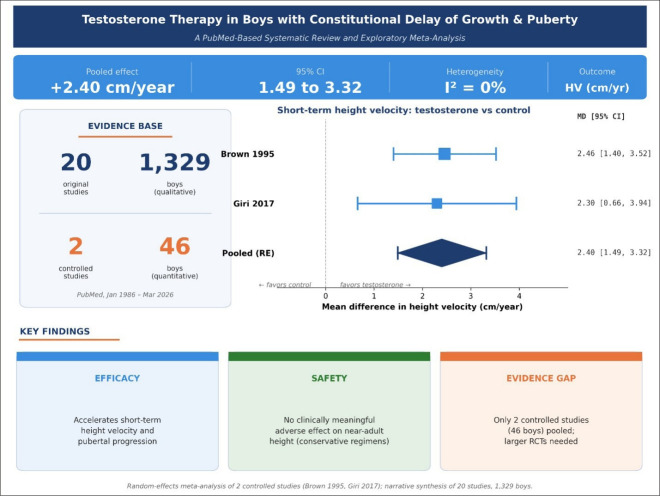
- Random-effects pooling of 2 controlled studies (combined n=46 boys) showed a statistically significant increase in short-term height velocity with testosterone versus placebo or no treatment: MD 2.40 cm/yr (95% CI, 1.49–3.32; I²=0%).
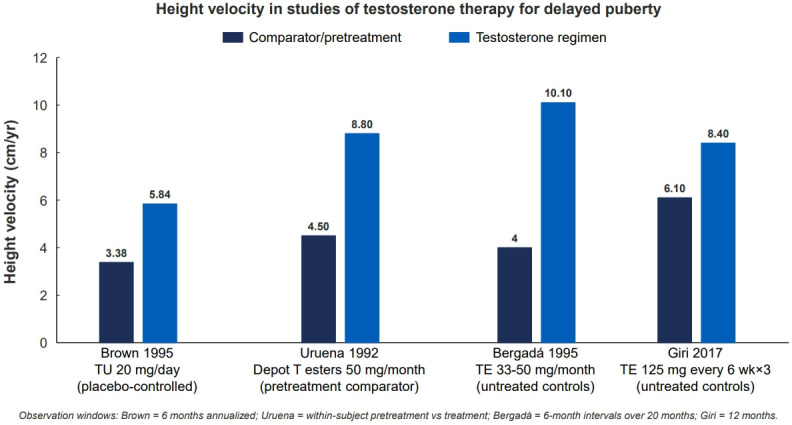
- Narrative findings: all 20 studies reporting height velocity showed an increase with treatment; intrasubject increments ranged from approximately 2 to 6 cm/yr and intergroup differences from 1.4 to 6.1 cm/yr. Controlled/comparative studies reporting Tanner stage showed at least one stage of advancement over 3–6 months of treatment.
- Five long-term studies showed brief, low-dose testosterone did not produce a clinically meaningful reduction in near-adult or adult height relative to untreated comparators or target height, except the Martin et al. 200 mg/mo arm, which compromised definitive height. Adverse events were uncommon and included transient acne, minor injection-site discomfort, gynecomastia in a small minority (particularly at higher doses), and transient suppression of testicular volume gain.
Methods
- PubMed was searched from January 1, 1986, to March 10, 2026. Eligible reports enrolled boys/adolescent males with CDGP or closely related self-limited delayed puberty treated with a testosterone-based regimen and reported clinically relevant endpoints such as height velocity, pubertal progression, bone age, predicted/near-adult height, endocrine response, or safety.
- Randomized studies were appraised with the Cochrane revised risk-of-bias tool; nonrandomized studies with ROBINS-I. Random-effects mean differences (MDs) with 95% CIs were calculated for height velocity when comparative means and dispersions were extractable; SD was derived as SEM × √n when needed; heterogeneity was quantified with I². Publication bias testing was not performed because only 2 studies were pooled; other outcomes were synthesized narratively.
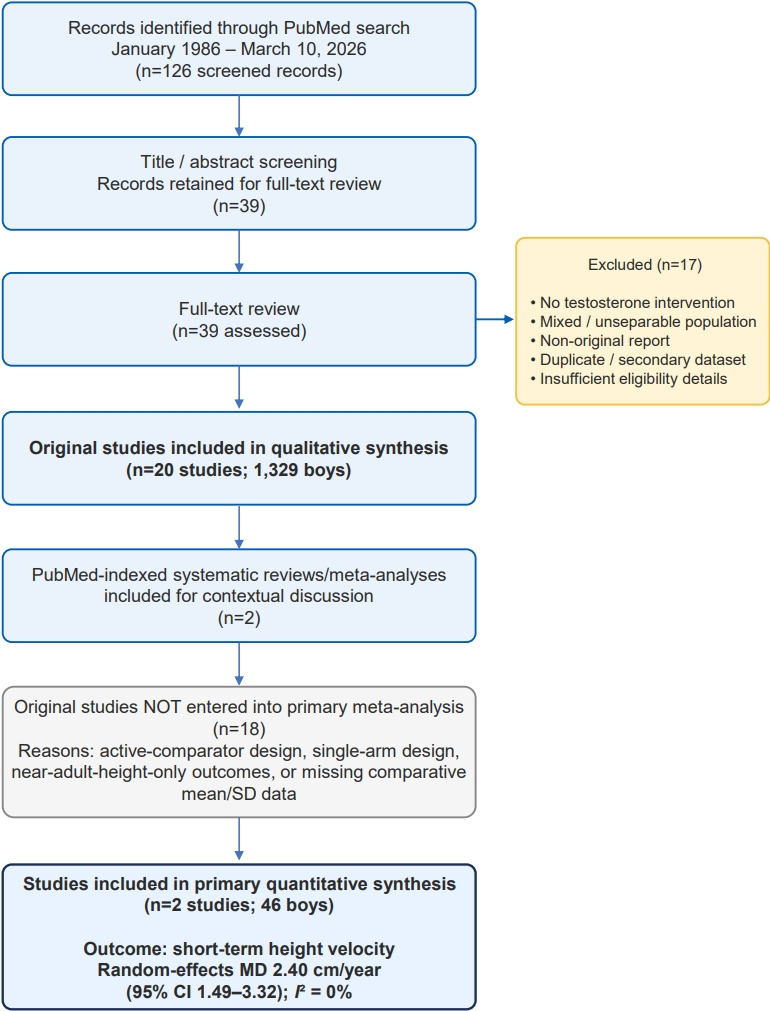
- From 126 records identified, 39 underwent full-text review, 17 were excluded, and 20 original studies (1,329 boys) were included qualitatively. Only 2 controlled studies (46 boys) provided directly extractable comparative data for the primary meta-analysis.
Limitations
- Stated in the paper: the review was PubMed-based; older full texts were not always numerically extractable; the primary meta-analysis was restricted to 2 controlled studies comprising 46 boys; Brown et al. enrolled prepubertal boys with constitutional growth delay rather than older boys with classic adolescent CDGP, so the pooled effect should be considered exploratory; and some recent retrospective cohorts may contain overlapping center-specific populations.
- Evident from the text: only 2 of 20 studies were suitable for pooling because of active comparator designs, single-arm designs, near-adult-height-only reporting, or missing comparative mean/SD data; heterogeneity in age, baseline pubertal stage, formulation, dose, injection interval, and treatment duration prevented meaningful subgroup analyses; no included study used a validated standardized psychometric instrument; and publication bias could not be assessed.
Model-written summary. Check it against the paper before relying on it.
Integrity signals
Registry
Cites
Statistics
Figures
Verification
Claims the paper makes
0 Valid · 0 Not valid · 44 Not checked · 33 Own results and interpretations
None of the sources cited for this claim have been checked yet.
In the paper
“Oral testosterone undecanoate (20–40 mg/day): within the standard range [9,10,12,14]”
§ Testosterone therapy in boys with constitutional delay of growth and puberty: a PubMed-based systematic review and exploratory meta-analysis > Results > 2. Characteristics of testosterone regimens across included studies (Table 1)
What the sources say
- Not checked yetcites [9] Gregory JW Greene SA Thompson J Scrimgeour CM Rennie MJ Effects of oral testosterone undecanoate on growth, body composition, strength and energy expenditure of adolescent boys Clin Endocrinol (Oxf) 1992 37 207 13 1424202 source
- Not checked yetcites [10] Butler GE Sellar RE Walker RF Hendry M Kelnar CJ Wu FC Oral testosterone undecanoate in the management of delayed puberty in boys: pharmacokinetics and effects on sexual maturation and growth J Clin Endocrinol Metab 1992 75 37 44 1619029 source
- Not checked yetcites [12] Albanese A Kewley GD Long A Pearl KN Robins DG Stanhope R Oral treatment for constitutional delay of growth and puberty in boys: a randomised trial of an anabolic steroid or testosterone undecanoate Arch Dis Child 1994 71 315 7 7979523 PMC1030008 source
- Not checked yetcites [14] Brown DC Butler GE Kelnar CJ Wu FC A double-blind, placebo-controlled study of the effects of low-dose testosterone undecanoate on the growth of small-for-age, prepubertal boys Arch Dis Child 1995 73 131 5 7574856 PMC1511206 source
plain- Asserted: passes — The authors put it forward as true.
- Checkable: passes — It can be checked against evidence.
- Load-bearing: unclear — It is unclear whether the paper’s conclusions depend on it.
- Based: passes — The paper gives a reason why it holds.
A result the paper reports from its own data — it cites no other source for it, so there is none to check. The quote shows it is in the paper.
In the paper
“The most common age band was 13.5–14.5 years, consistent with the current clinical practice of offering short-course testosterone in boys whose testicular volume remains below 4 mL at 14 years of age.”
§ Testosterone therapy in boys with constitutional delay of growth and puberty: a PubMed-based systematic review and exploratory meta-analysis > Results > 2. Characteristics of testosterone regimens across included studies (Table 1)
plain- Asserted: passes — The authors put it forward as true.
- Checkable: passes — It can be checked against evidence.
- Load-bearing: unclear — It is unclear whether the paper’s conclusions depend on it.
- Based: passes — The paper gives a reason why it holds.
A result the paper reports from its own data — it cites no other source for it, so there is none to check. The quote shows it is in the paper.
In the paper
“Eighteen of the 20 original studies could not be included in the primary meta-analysis because of active comparator designs, single-arm designs, near-adult height-only outcome reporting, or missing comparative mean/SD data.”
§ Testosterone therapy in boys with constitutional delay of growth and puberty: a PubMed-based systematic review and exploratory meta-analysis > Results > 1. Study selection and PRISMA flow
plain- Asserted: passes — The authors put it forward as true.
- Checkable: passes — It can be checked against evidence.
- Load-bearing: passes — The paper’s conclusions depend on it.
- Based: passes — The paper gives a reason why it holds.
A result the paper reports from its own data — it cites no other source for it, so there is none to check. The quote shows it is in the paper.
In the paper
“Two controlled studies (46 boys) provided directly extractable comparative data on short-term height velocity (Fig. 1).”
- Also stated in: § Abstract · plain
“Only 2 controlled studies (46 boys) directly provided pooled height velocity data.”
§ Testosterone therapy in boys with constitutional delay of growth and puberty: a PubMed-based systematic review and exploratory meta-analysis > Results > 1. Study selection and PRISMA flow
plain- Asserted: passes — The authors put it forward as true.
- Checkable: passes — It can be checked against evidence.
- Load-bearing: passes — The paper’s conclusions depend on it.
- Based: passes — The paper gives a reason why it holds.
- Also stated in: § Abstract · plain
A result the paper states — it cites no source for it, so there is none to check. The quote shows it is in the paper.
In the paper
“Most of the included studies had moderate methodological limitations.”
§ Testosterone therapy in boys with constitutional delay of growth and puberty: a PubMed-based systematic review and exploratory meta-analysis > Discussion > 10. Risk of bias
plain- Asserted: passes — The authors put it forward as true.
- Checkable: passes — It can be checked against evidence.
- Load-bearing: passes — The paper’s conclusions depend on it.
- Based: passes — The paper gives a reason why it holds.
20 more claims
Create a free account to see all 77 claims and to verify the 117 references still open.
- Probably not a substantial claim. 11
- It may state two separate claims as one. 45
Self-check
Percentages, sums and reported differences re-computed from the paper’s own numbers.
Each contradiction between two passages listed here was confirmed by an independent check.
Rated minor: it would not touch a result — a value no result rests on, a p-value that stays on the same side of the significance level, or a conflict that is clerical, resolved elsewhere in the paper, or outside its own findings.
In the paper
§ Testosterone therapy in boys with constitutional delay of growth and puberty: a PubMed-based systematic review and exploratory meta-analysis > Results > 2. Characteristics of testosterone regimens across included studies (Table 1)
“Across the 20 included studies, the mean or median age at initiation was 10.5–16.2 years”
§ Testosterone therapy in boys with constitutional delay of growth and puberty: a PubMed-based systematic review and exploratory meta-analysis > Discussion > 1. Heterogeneity of evidence base
“age at initiation (10.8–16.2 years)”
Rated minor: it would not touch a result — a value no result rests on, a p-value that stays on the same side of the significance level, or a conflict that is clerical, resolved elsewhere in the paper, or outside its own findings.
In the paper
§ Testosterone therapy in boys with constitutional delay of growth and puberty: a PubMed-based systematic review and exploratory meta-analysis > Results > 7. Endocrine and body-composition outcomes
“IGF-1 levels increased during treatment according to Soliman et al. [5]”
§ Testosterone therapy in boys with constitutional delay of growth and puberty: a PubMed-based systematic review and exploratory meta-analysis > Discussion > 4. Mechanistic considerations for growth and skeletal maturation
“The rise in IGF-1 levels reported by Soliman et al. [13]”
Rated minor: it would not touch a result — a value no result rests on, a p-value that stays on the same side of the significance level, or a conflict that is clerical, resolved elsewhere in the paper, or outside its own findings.
In the paper
§ Testosterone therapy in boys with constitutional delay of growth and puberty: a PubMed-based systematic review and exploratory meta-analysis > Results > 3. Height velocity: narrative findings
“All 20 studies that reported height velocity as an outcome showed an increase during or after testosterone treatment”
§ Testosterone therapy in boys with constitutional delay of growth and puberty: a PubMed-based systematic review and exploratory meta-analysis > Results > 1. Study selection and PRISMA flow
“Eighteen of the 20 original studies could not be included in the primary meta-analysis because of active comparator designs, single-arm designs, near-adult height-only outcome reporting, or missing comparative mean/SD data.”
Rated minor: it would not touch a result — a value no result rests on, a p-value that stays on the same side of the significance level, or a conflict that is clerical, resolved elsewhere in the paper, or outside its own findings.
In the paper
§ Testosterone therapy in boys with constitutional delay of growth and puberty: a PubMed-based systematic review and exploratory meta-analysis > Results > 8. Patient-reported and psychosocial outcomes
“Only 1 study [13] reported a formal patient-satisfaction assessment”
§ Testosterone therapy in boys with constitutional delay of growth and puberty: a PubMed-based systematic review and exploratory meta-analysis > Discussion > 8. Psychosocial and quality-of-life outcomes
“Only Soliman et al. [5] reported a formal patient-satisfaction measure”
Citations
Cites
Delayed Puberty: Analysis of a Large Case Series from an Academic Center
Sedlmeyer, I. L. (2002) · Journal of Clinical Endocrinology & Metabolism · doi:10.1210/jc.87.4.1613 · Cited by 372
Harrington, J., & Palmert, M. R. (2012) · The Journal of Clinical Endocrinology & Metabolism · doi:10.1210/jc.2012-1598 · Cited by 228
Final height in boys with untreated constitutional delay in growth and puberty.
Crowne, E. C., Shalet, S. M., Wallace, W. H., Eminson, D. M., & Price, D. A. (1990) · Archives of Disease in Childhood · doi:10.1136/adc.65.10.1109 · Cited by 173 · cited 1×
“4,5) These findings have motivated interest in treatments that can induce a pubertal growth spurt without com promising the patient's nearadult height.”
Adult Consequences of Self-Limited Delayed Puberty
Zhu, J., & Chan, Y.-M. (2017) · PEDIATRICS · doi:10.1542/peds.2016-3177 · Cited by 152
Rohayem, J., Hauffa, B. P., Zacharin, M., Kliesch, S., Zitzmann, M., & the “German Adolescent Hypogonadotropic Hypogonadism Study Group” (2017) · Clinical Endocrinology · doi:10.1111/cen.13164 · Cited by 148
Testosterone Treatment in Adolescent Boys with Constitutional Delay in Growth and Development
Richman, R. A., & Kirsch, L. R. (1988) · New England Journal of Medicine · doi:10.1056/nejm198812153192402 · Cited by 108
MANAGEMENT OF ENDOCRINE DISEASE: Reversible hypogonadotropic hypogonadism
Dwyer, A. A., Raivio, T., & Pitteloud, N. (2016) · European Journal of Endocrinology · doi:10.1530/eje-15-1033 · Cited by 69
Testosterone treatment in adolescent boys with constitutional delay of growth and development
Soliman, A. T., Abdul Khadir, M. M., & Asfour, M. (1995) · Metabolism · doi:10.1016/0026-0495(95)90098-5 · Cited by 59 · cited 4×
“IGF1 levels increased during treatment according to Soliman et al., 5) while fatfree mass increased according to Gregory et al., 9) consistent with the known anabolic and growth hormone (GH) axisstimulating effects of testoste rone.”
InfluentialSelf-citationButler, G. E., Sellar, R., Walker, R. F., Hendry, M., Kelnar, C. J. H., & Wu, F. C. W. (1992) · The Journal of Clinical Endocrinology & Metabolism · doi:10.1210/jcem.75.1.1619029 · Cited by 58 · cited 2×
“Across different formulations—IM testosterone enanthate, 7) oral testosterone undecanoate, 10) and depot esters 11) —height velocity and pubertal progression consistently increased, reinforcing the pooled estimate of mean difference 2.40 cm/yr.”
InfluentialConstitutional Delay of Growth and Puberty: From Presentation to Final Height
Poyrazoglu, Ş., Günöz, H., Darendeliler, F., Saka, Ν., Bundak, R., & Baş, F. (2005) · Journal of Pediatric Endocrinology and Metabolism · doi:10.1515/jpem.2005.18.2.171 · Cited by 48 · cited 5×
“Poyrazoğlu 26) 2005 Retrospective natural history/adult-height follow-up study Testosterone exposure did not influence adult height within the cohort.”
Influential
Cited by
Boltaboeva, M., Haydarov, A. A., & Каримовна, Р. Л. (2026) · Korean Journal of Pediatrics · doi:10.3345/cep.2026.02159 · Cited by 1
Rey, R. A., & Grinspon, R. P. (2026) · Expert Opinion on Pharmacotherapy · doi:10.1080/14656566.2026.2741490
Soliman, A. T., Alyafei, F., Alaaraj, N., Hamed, N., Ahmed, S., Siddiq, K. A., Qusad, M., & AlKhalaf, M. (2026) · Korean Journal of Pediatrics · doi:10.3345/cep.2026.02285
Self-citation
Metadata
- Authors
- Soliman, A. T., Alyafei, F., Alaaraj, N., Hamed, N., Ahmed, S., Siddiq, K. A., Qusad, M., & AlKhalaf, M.
- Affiliations
- Hamad Medical Corporation (QA)
- Division of Endocrinology, Department of Pediatrics, Hamad Medical Corporation, Doha, Qatar
- Corresponding author
- Soliman, Ashraf T.
- ORCID
- Venue
- Clinical and Experimental Pediatrics
- Publisher
- Korean Pediatric Society
- Published
- 2026-07-15
- Volume
- 69
- Issue
- 7
- Pages
- 531-541
- ISSN
- 1738-1061 (ISSN-L)
- 2713-4148
- PMC
- PMC13337309
- OpenAlex
- W7165181784
- Semantic Scholar
- a6c5b07776c2bbe0e506b9d3dbd82a54f23e54cb
- Cited by
- 3
- References
- 30
- Citations by year
- 2026: 3
- FWCI
- 2.01
- Type
- journal article
- Language
- en
- Open access
- diamond
- doi.org
- Licence
- cc-by-nc
- creativecommons.org/licenses/by-nc/4.0/ (tdm)
- Locations
- Korean Journal of Pediatrics (publishedVersion, cc-by-nc)
- PubMed Central (publishedVersion, cc-by-nc)
- PubMed (publishedVersion)
- DOAJ (DOAJ: Directory of Open Access Journals) (submittedVersion)
- Topics
- Health Sciences › Medicine › Reproductive Medicine › Hypothalamic control of reproductive hormones
- Health Sciences › Medicine › Endocrinology, Diabetes and Metabolism › Hormonal and reproductive studies
- Health Sciences › Medicine › Endocrinology, Diabetes and Metabolism › Growth Hormone and Insulin-like Growth Factors
- Keywords
- testosterone replacement therapy, constitutional delay of growth and puberty, delayed puberty, boys, pubertal progression, height velocity, near-adult height, short stature, testosterone enanthate, testosterone cypionate, testosterone undecanoate, transdermal testosterone gel, bone age, adverse effects, psychosocial distress, risk of bias assessment, pediatric endocrinology referral
About these checks
Registry, retraction, Cites and statistics results are computed, not judged, with one exception: a printed reference that no index lists is read once by a model before it counts as a citation error. Claims are extracted by a model and kept only when their quote appears verbatim in the text; each cited source is then checked, with a model’s help, for whether it says what the claim relies on. Those verdicts can be wrong — read the claim’s quote and the cited source before relying on one.
A language model drew the claims from the paper on 2026-11-28, under version 3 of the claim definition (model deepseek-v4.1-flash, prompt extract-v3).
A second model labelled each claim on 2026-11-28 (model jev-1.13-20260917, definition revision gold-guideline-v0.2).
Statistics and arithmetic are recomputed, not judged.
Confidence bands are shown only for fields calibrated on our annotated test set. None is calibrated yet, so no band is shown.
What counts as a claim ›How we measure confidence ›How we check this ›
Are you an author, or do you see a problem with this page? Request a review
Data sources
Bibliographic data: Semantic Scholar, OpenAlex, Crossref.
Contains information from the Semantic Scholar Academic Graph Datasets, made available under the ODC Attribution License (ODC-BY 1.0).
Semantic Scholar’s data is described in: Kinney, R., et al. (2023). The Semantic Scholar Open Data Platform. arXiv:2301.10140.
