

The DOI matches its Crossref record; 198 of the 199 references it cites were found in a registry or an index.
Engineering Strategies in Microorganisms for the Enhanced Production of Squalene: Advances, Challenges and Opportunities
Open accessAbstract
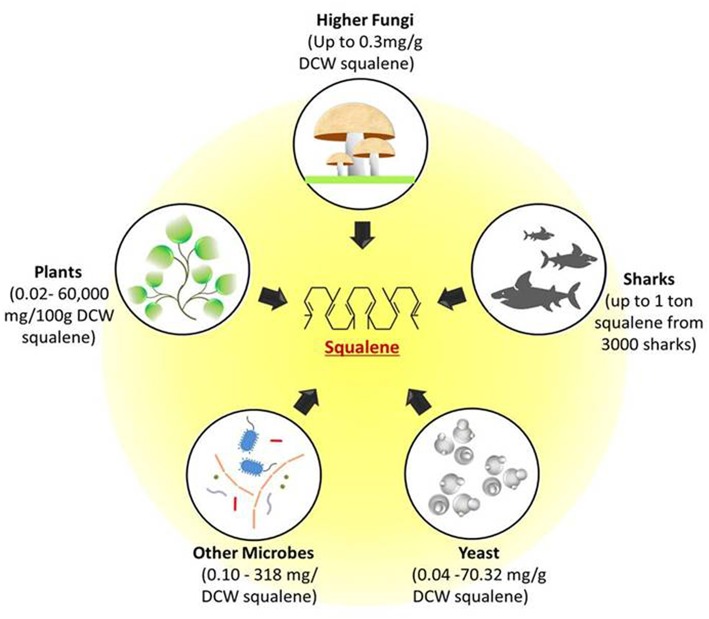
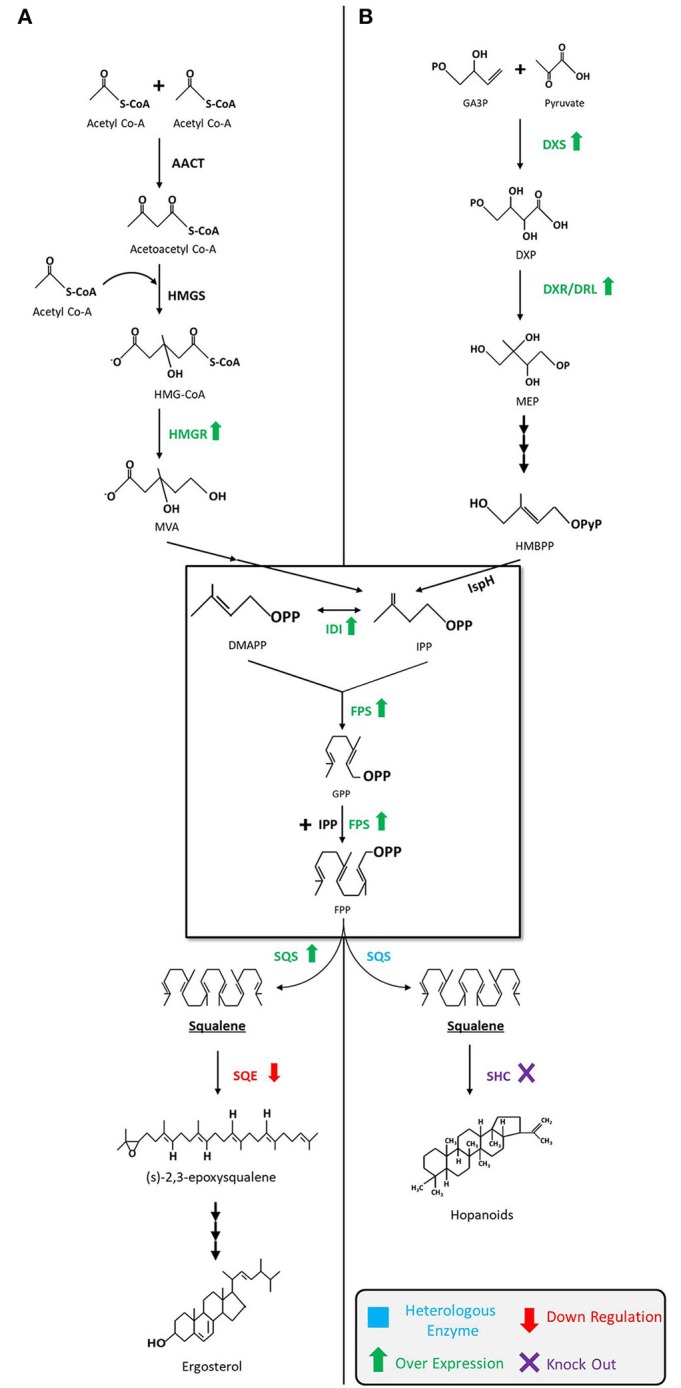
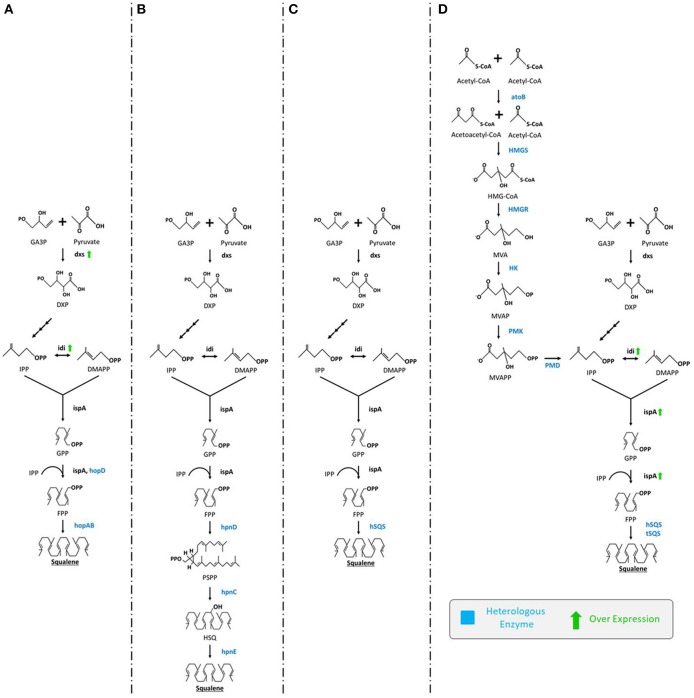
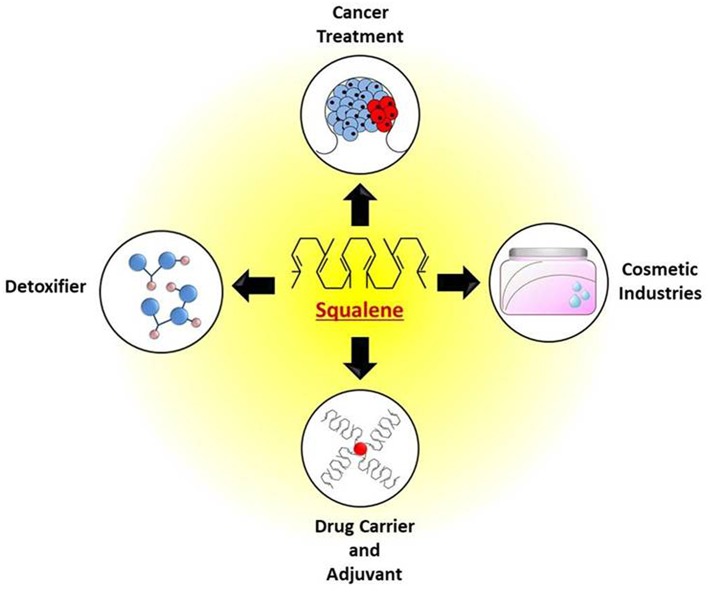
The triterpene squalene is a natural compound that has demonstrated an extraordinary diversity of uses in pharmaceutical, nutraceutical, and personal care industries. Emboldened by this range of uses, novel applications that can gain profit from the benefits of squalene as an additive or supplement are expanding, resulting in its increasing demand. Ever since its discovery, the primary source has been the deep-sea shark liver, although recent declines in their populations and justified animal conservation and protection regulations have encouraged researchers to identify a novel route for squalene biosynthesis. This renewed scientific interest has profited from immense developments in synthetic biology, which now allows fine-tuning of a wider range of plants, fungi, and microorganisms for improved squalene production. There are numerous naturally squalene producing species and strains; although they generally do not make commercially viable yields as primary shark liver sources can deliver. The recent advances made toward improving squalene output from natural and engineered species have inspired this review. Accordingly, it will cover in-depth knowledge offered by the studies of the natural sources, and various engineering-based strategies that have been used to drive the improvements in the pathways toward large-scale production. The wide uses of squalene are also discussed, including the notable developments in anti-cancer applications and in augmenting influenza vaccines for greater efficacy.
Overview
The claims and statistics of this paper haven’t been checked yet.
Run the check — free, no account needed. It reads the open-access text and checks the sources it cites.
Integrity signals
Registry
Cites
Statistics
Figures
Verification
Claims the paper makes
The claims and statistics of this paper haven’t been checked yet.
Run the check — free, no account needed. It reads the open-access text and checks the sources it cites.
Claims other papers make about this one
Each is checked against this paper’s own text: does it say what the citing paper says it does?
The cited source says what the claim attributes to it.
In the citing paper
“Alternatively, improving squalene production through up-regulation of genes that lead to its synthesis or down-regulation of genes for its degradation is possible [60].”
From Key Targets for Improving Algal Biofuel Production (2021) · cites this paper as [60]
Self-check
Percentages, sums and reported differences re-computed from the paper’s own numbers.
The self-check needs the paper’s full text.
Citations
Cites
Ras in Cancer and Developmental Diseases
Fernández‐Medarde, A., & Santos, E. (2011) · Genes & Cancer · doi:10.1177/1947601911411084 · Cited by 1,001 · cited 2×
“during their activation and anchorage to the cell membrane (Fernández-Medarde and Santos, 2011).”
BackgroundManufacturing Molecules Through Metabolic Engineering
Keasling, J. D. (2010) · Science · doi:10.1126/science.1193990 · Cited by 829 · cited 1×
“A wide range of chemicals and bioactive molecules have been identified in the organisms that are produced as an intermediate product in the pathways (Sanchez and Demain, 2008; Keasling, 2010; Chubukov et al., 2016; Panchasara et al., 2018).”
BackgroundDulvy, N. K., Baum, J. K., Clarke, S., Compagno, L. J. V., Cortés, E., Domingo, A., Fordham, S. V., Fowler, S., Francis, M. P., Gibson, C., et al. (2008) · Aquatic Conservation Marine and Freshwater Ecosystems · doi:10.1002/aqc.975 · Cited by 812
Botryococcus braunii : A Renewable Source of Hydrocarbons and Other Chemicals
Banerjee, A., Sharma, R., Yusuf Chisti, B., & Banerjee, U. C. (2002) · Critical Reviews in Biotechnology · doi:10.1080/07388550290789513 · Cited by 714 · cited 1×
“, 2010) and Botryococcus braunii (Banerjee et al., 2002; Uchida et al., 2015) can accumulate considerable amount of squalene.”
BackgroundVaccine Adjuvants: from 1920 to 2015 and Beyond
Pasquale, A. D., Preiss, S., Silva, F. T. D., & Garçon, N. (2015) · Vaccines · doi:10.3390/vaccines3020320 · Cited by 653 · cited 2×
“, 2015), adjuvant for vaccines and drug carrier (Del Giudice et al., 2006; Pasquale et al., 2015), and detoxifier (Kim and Karadeniz, 2012; Ivanova et al.”
BackgroundOlive-oil consumption and health: the possible role of antioxidants
Owen, R. W., Giacosa, A., Hull, W. E., Haubner, R., Würtele, G., Spiegelhalder, B., & Bartsch, H. (2000) · The Lancet Oncology · doi:10.1016/s1470-2045(00)00015-2 · Cited by 616
Nicolaides, N. (1974) · Science · doi:10.1126/science.186.4158.19 · Cited by 609 · cited 1×
“(Nicolaides, 1974).”
Owen, R. W., Mier, W., Giacosa, A., Hull, W. E., Spiegelhalder, B., & Bartsch, H. (2000) · Food and Chemical Toxicology · doi:10.1016/s0278-6915(00)00061-2 · Cited by 577
Maguire, L., O'Sullivan, S. M., Galvin, K., O'Connor, T. P., & O’Brien, N. M. (2004) · International Journal of Food Sciences and Nutrition · doi:10.1080/09637480410001725175 · Cited by 576 · cited 1×
“, 2002), soybean (3–22 mg/100 g) (Gutfinger and Letan, 1974; Frega et al., 1992; Maguire et al., 2004; Naziri et al., 2011b; Pokkanta et al., 2019), sunflower seed (0–19mg/100 g) (Tuberoso et al.”
Fang, J., Fang, C.-L., Liu, C.-H., & Su, Y.-H. (2008) · European Journal of Pharmaceutics and Biopharmaceutics · doi:10.1016/j.ejpb.2008.05.008 · Cited by 518 · cited 1×
“An in vivo study on the delivery of psoralen, an anti-psoriatic medicine, suggests that entrapment of the drug inside a nanostructured lipid carrier based on squalene and precirol facilitates better skin permeability and controlled release of the drug (Fang et al., 2008).”
Background
Research works printed but not linked: 6
- Bhattacharjee, 2003, Extraction of squalene from yeast by supercritical carbon dioxide, World J. Microbiol. Biotechnol., 19, 605, 10.1023/A:1025146132281 · DOI
- Panchasara, 2018, Biosynthetic pathway for production of renewable biofuels, 63
- Popa, 2014, Squalene - natural resources and applications, Farmacia, 62, 840
- Pora, 2014, Method for the Preparation and Extraction of Squalene From Microalgae.
- Tsujiwaki, 1995, Manufacture of squalene with Candida famata, Jpn. Kokai Tokkyo Koho JP, 7, 272
- Uragami, 1986, Bacterial production of squalene, Jpn. Kokai Tokkyo Koho JP, 61, 212
Cited by
Sorted by citations
Kim, J.-E., Jang, I.-S., Son, S., Ko, Y., Cho, B., Kim, S. C., & Lee, J. Y. (2019) · Metabolic Engineering · doi:10.1016/j.ymben.2019.08.013 · Cited by 190
Pfeifer, K., Ergal, İ., Koller, M., Basen, M., Schuster, B., & Rittmann, S. K. ‐. R. (2020) · Biotechnology Advances · doi:10.1016/j.biotechadv.2020.107668 · Cited by 154
Zhu, Z.-T., Du, M.-M., Gao, B., Tao, X., Zhao, M., Ren, Y., Wang, F., & Wei, D. (2021) · Metabolic Engineering · doi:10.1016/j.ymben.2021.10.011 · Cited by 153
From sequence to function through structure: Deep learning for protein design
(2022) · doi:10.1016/j.csbj.2022.11.014 · Cited by 124
“Proteins can serve as factories increasingly engineered to manufacture other products, such as the triterpene squalene [117].”
BackgroundSqualene monooxygenase: a journey to the heart of cholesterol synthesis
Chua, N. K., Coates, H. W., & Brown, A. J. (2020) · Progress in Lipid Research · doi:10.1016/j.plipres.2020.101033 · Cited by 112
Metadata
- Authors
- Gohil, N., Bhattacharjee, G., Khambhati, K., Braddick, D., & Singh, V.
- Affiliations
- Indian Institute of Advanced Research (IN)
- Genopole (France) (FR)
- Corresponding author
- Singh, Vijai
- Venue
- Frontiers in Bioengineering and Biotechnology
- Publisher
- Frontiers Media SA
- Published
- 2019-03-22
- Volume
- 7
- Pages
- 114-114
- ISSN
- 2296-4185 (ISSN-L)
- PMC
- PMC6439483
- OpenAlex
- W2924306915
- Cited by
- 121
- References
- 199
- Citations by year
- 2026: 15 · 2025: 15 · 2024: 20 · 2023: 21 · 2022: 19 · 2021: 15 · 2020: 14 · 2019: 2
- FWCI
- 1.10
- Type
- journal article
- Language
- en
- Update notices
- corrigendum (2019-05-28)
- Open access
- gold
- doi.org
- Licence
- Locations
- Frontiers in Bioengineering and Biotechnology (publishedVersion, cc-by)
- PubMed Central (publishedVersion, cc-by)
- Europe PMC (PubMed Central) (publishedVersion, cc-by)
- PubMed (publishedVersion)
- DOAJ (DOAJ: Directory of Open Access Journals) (submittedVersion, cc-by-sa)
- Topics
- Life Sciences › Biochemistry, Genetics and Molecular Biology › Molecular Biology › Plant biochemistry and biosynthesis
- Life Sciences › Biochemistry, Genetics and Molecular Biology › Molecular Biology › Microbial Metabolic Engineering and Bioproduction
- Life Sciences › Immunology and Microbiology › Applied Microbiology and Biotechnology › Microbial Natural Products and Biosynthesis
- Keywords
- squalene, triterpenoids, synthetic biology, influenza vaccine adjuvants, nutraceuticals, pharmaceutical applications, industrial biotechnology
About these checks
Registry, retraction, Cites and statistics results are computed, not judged, with one exception: a printed reference that no index lists is read once by a model before it counts as a citation error. Claims are extracted by a model and kept only when their quote appears verbatim in the text; each cited source is then checked, with a model’s help, for whether it says what the claim relies on. Those verdicts can be wrong — read the claim’s quote and the cited source before relying on one.
Statistics and arithmetic are recomputed, not judged.
Confidence bands are shown only for fields calibrated on our annotated test set. None is calibrated yet, so no band is shown.
What counts as a claim ›How we measure confidence ›How we check this ›
Are you an author, or do you see a problem with this page? Request a review
