

The DOI matches its Crossref record; 227 of the 228 references it cites were found in a registry or an index.
Pre-clinical Models of Metastasis in Pancreatic Cancer
Open accessAbstract
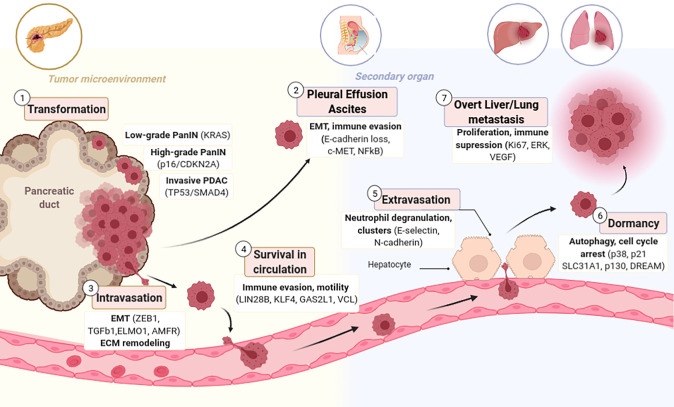
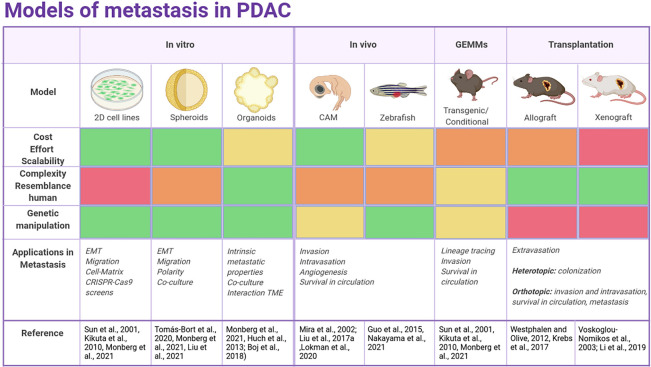
Pancreatic ductal adenocarcinoma (PDAC) is a hostile solid malignancy coupled with an extremely high mortality rate. Metastatic disease is already found in most patients at the time of diagnosis, resulting in a 5-year survival rate below 5%. Improved comprehension of the mechanisms leading to metastasis is pivotal for the development of new targeted therapies. A key field to be improved are modeling strategies applied in assessing cancer progression, since traditional platforms fail in recapitulating the complexity of PDAC. Consequently, there is a compelling demand for new preclinical models that mirror tumor progression incorporating the pressure of the immune system, tumor microenvironment, as well as molecular aspects of PDAC. We suggest the incorporation of 3D organoids derived from genetically engineered mouse models or patients as promising new tools capable to transform PDAC pre-clinical modeling and access new frontiers in personalized medicine.
Overview
The claims and statistics of this paper haven’t been checked yet.
Run the check — free, no account needed. It reads the open-access text and checks the sources it cites.
Integrity signals
Registry
Cites
Statistics
Figures
Verification
Claims the paper makes
The claims and statistics of this paper haven’t been checked yet.
Run the check — free, no account needed. It reads the open-access text and checks the sources it cites.
Claims other papers make about this one
Each is checked against this paper’s own text: does it say what the citing paper says it does?
The source backs part of the claim, not all of it — or backs it for a different population, condition or comparison.
In the citing paper
“PDAC cells acquire pro‐metastatic traits that enable them to disseminate and spread before primary tumour formation”
From Pyrvinium Pamoate Alone and With Gemcitabine Exhibits Anti‐Pancreatic Cancer Activity in 2D and 3D Cell Culture Models (2024) · cites this paper as [40]
Experimental — accuracy not yet measuredThe source backs part of the claim, not all of it — or backs it for a different population, condition or comparison.
In the citing paper
“resulting in PDAC patients presenting with liver (76%–80%), peritoneum (48%) or lung (45%) metastasis at diagnosis [39, 40]”
From Pyrvinium Pamoate Alone and With Gemcitabine Exhibits Anti‐Pancreatic Cancer Activity in 2D and 3D Cell Culture Models (2024) · cites this paper as [40]
Experimental — accuracy not yet measured
Self-check
Percentages, sums and reported differences re-computed from the paper’s own numbers.
The self-check needs the paper’s full text.
Citations
Cites
FOLFIRINOX versus Gemcitabine for Metastatic Pancreatic Cancer
Conroy, T., Desseigne, F., Ychou, M., Bouché, O., Guimbaud, R., Bécouarn, Y., Adenis, A., Raoul, J.-L., Gourgou-Bourgade, S., de la Fouchardière, C., et al. (2011) · New England Journal of Medicine · doi:10.1056/nejmoa1011923 · Cited by 7,810
Spencer, P. M., Cameron, J. L., & Lin, L. (2000) · Cited by 7,202
The new frontier of genome engineering with CRISPR-Cas9
Doudna, J. A., & Charpentier, E. (2014) · Science · doi:10.1126/science.1258096 · Cited by 7,062
Epithelial–mesenchymal transitions in tumour progression
Thiery, J. P. (2002) · Nature reviews. Cancer · doi:10.1038/nrc822 · Cited by 6,767
Burris, H. A., Moore, M. J., Andersen, J., Green, M. R., Rothenberg, M. L., Modiano, M., Cripps, M. C., Portenoy, R. K., Storniolo, A. M., Tarassoff, P. G., et al. (1997) · Journal of Clinical Oncology · doi:10.1200/jco.1997.15.6.2403 · Cited by 5,895
Targeting Hypoxia-Inducible Factors for the Treatment of Anemia in Chronic Kidney Disease Patients
Locatelli, F., Fishbane, S. N., Block, G. A., & Macdougall, I. C. (2017) · American Journal of Nephrology · doi:10.1159/000455166 · Cited by 4,836
The pathogenesis of cancer metastasis: the ‘seed and soil’ hypothesis revisited
Fidler, I. J. (2003) · Nature Reviews Cancer · doi:10.1038/nrc1098 · Cited by 4,686
Moore, M. J., Goldstein, D., Hamm, J., Figer, A., Hecht, J. R., Gallinger, S., Au, H. J., Murawa, P., Walde, D., Wolff, R. A., et al. (2007) · Journal of Clinical Oncology · doi:10.1200/jco.2006.07.9525 · Cited by 3,848
Genomic analyses identify molecular subtypes of pancreatic cancer
Bailey, P., Chang, D. K., Nones, K., Johns, A. L., Patch, A.-M., Gingras, M.-C., Miller, D. K., Christ, A. N., Bruxner, T. J. C., Quinn, M. C., et al. (2016) · Nature · doi:10.1038/nature16965 · Cited by 3,621
Self-citationEmerging Biological Principles of Metastasis
Lambert, A. W., Pattabiraman, D. R., & Weinberg, R. A. (2017) · Cell · doi:10.1016/j.cell.2016.11.037 · Cited by 3,191
Research works printed but not linked: 1
- 2021, PancREatic Cancer OrganoiDs rEsearch Network | PRECODE Project | H2020 | CORDIS | European Commission.
Cited by
Sorted by citations
Lencioni, G., Gregori, A., Toledo, B., Rebelo, R., Immordino, B., Amrutkar, M., Xavier, C. P. R., Kocijancic, A., Pandey, D. P., Perán, M., et al. (2024) · Seminars in Cancer Biology · doi:10.1016/j.semcancer.2024.09.002 · Cited by 32
Zhu, J., Zhang, K., Chen, Y., Ge, X., Wu, J., Xu, P., & Yao, J. J. (2024) · Journal of Translational Medicine · doi:10.1186/s12967-024-05307-3 · Cited by 30
MiR-223-3p in Cancer Development and Cancer Drug Resistance: Same Coin, Different Faces
Barbagallo, D., Ponti, D., Bassani, B., Bruno, A., Pulze, L., Akkihal, S. A., George-William, J. N., Gundamaraju, R., & Campomenosi, P. (2024) · International Journal of Molecular Sciences · doi:10.3390/ijms25158191 · Cited by 32
Markowski, A., Jaromin, A., Migdał, P., Olczak, E., Zygmunt, A., Zaremba-Czogalla, M., Pawlik, K., & Gubernator, J. (2022) · International Journal of Molecular Sciences · doi:10.3390/ijms23105536 · Cited by 29
Markowski, A., Zaremba-Czogalla, M., Jaromin, A., Olczak, E., Zygmunt, A., Etezadi, H., Boyd, B. J., & Gubernator, J. (2023) · Pharmaceutics · doi:10.3390/pharmaceutics15010179 · Cited by 27
Metadata
- Authors
- Miquel, M., Zhang, S., & Pilarsky, C.
- Affiliations
- Friedrich-Alexander-Universität Erlangen-Nürnberg (DE)
- Corresponding author
- Pilarsky, Christian
- Venue
- Frontiers in Cell and Developmental Biology
- Publisher
- Frontiers Media SA
- Published
- 2021-10-27
- Volume
- 9
- Pages
- 748631-748631
- ISSN
- 2296-634X (ISSN-L)
- PMC
- PMC8578999
- OpenAlex
- W3210638807
- Cited by
- 53
- References
- 228
- Citations by year
- 2026: 10 · 2025: 13 · 2024: 16 · 2023: 7 · 2022: 7
- FWCI
- 0.91
- Type
- journal article
- Language
- en
- Open access
- gold
- doi.org
- Licence
- Locations
- Frontiers in Cell and Developmental Biology (publishedVersion, cc-by)
- Europe PMC (PubMed Central) (publishedVersion, other-oa)
- PubMed Central (publishedVersion, cc-by)
- PubMed (publishedVersion)
- DOAJ (DOAJ: Directory of Open Access Journals) (submittedVersion, cc-by-sa)
- OPUS FAU (Kooperativer Bibliotheksverbund Berlin-Brandenburg (KOBV), on behalf of the Universitätsbibliothek Erlangen-Nürnberg) (submittedVersion, cc-by)
- Funders
- H2020 Marie Skłodowska-Curie Actions (861196)
- China Sponsorship Council (201806880012)
- Topics
- Health Sciences › Medicine › Oncology › Pancreatic and Hepatic Oncology Research
- Health Sciences › Medicine › Oncology › Cancer Cells and Metastasis
- Physical Sciences › Engineering › Biomedical Engineering › 3D Printing in Biomedical Research
- Keywords
- pancreatic ductal adenocarcinoma, metastasis, preclinical models, 3D organoids, genetically engineered mouse models, tumor microenvironment, immune system, tumor progression, personalized medicine, targeted therapy
About these checks
Registry, retraction, Cites and statistics results are computed, not judged, with one exception: a printed reference that no index lists is read once by a model before it counts as a citation error. Claims are extracted by a model and kept only when their quote appears verbatim in the text; each cited source is then checked, with a model’s help, for whether it says what the claim relies on. Those verdicts can be wrong — read the claim’s quote and the cited source before relying on one.
Statistics and arithmetic are recomputed, not judged.
Confidence bands are shown only for fields calibrated on our annotated test set. None is calibrated yet, so no band is shown.
What counts as a claim ›How we measure confidence ›How we check this ›
Are you an author, or do you see a problem with this page? Request a review
