

The DOI matches its Crossref record; 211 of the 211 references it cites were found in a registry or an index.
Role of oral and gut microbiomes in enterosalivary nitrate metabolism and their effects on systemic disease
Open accessAbstract
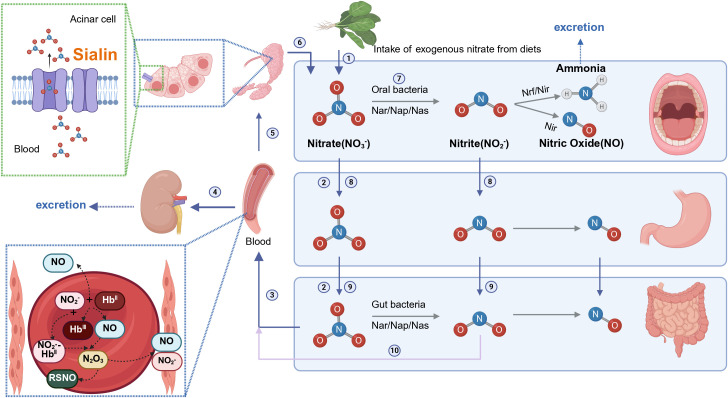
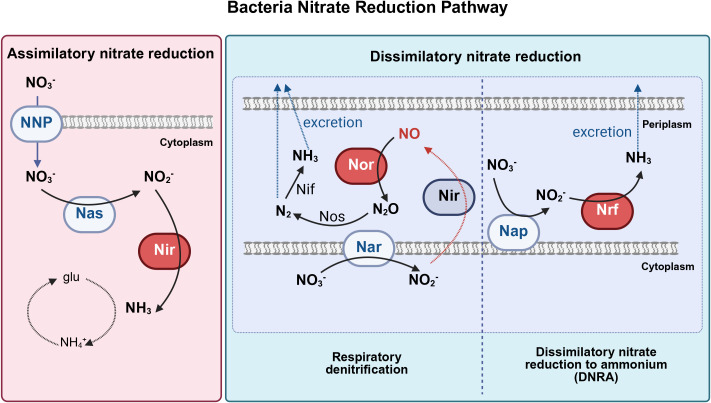
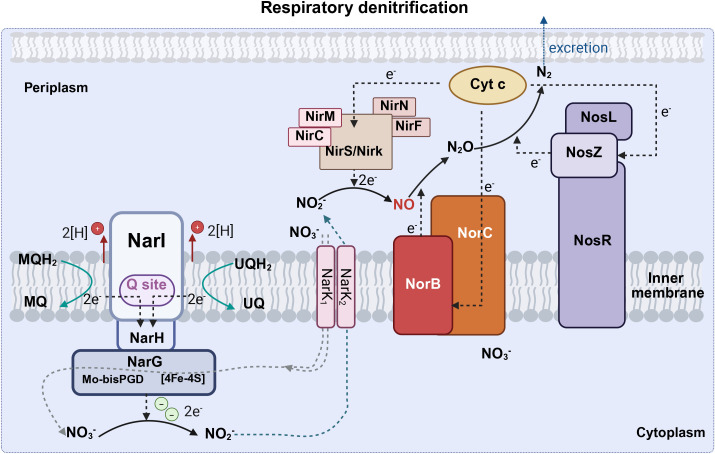
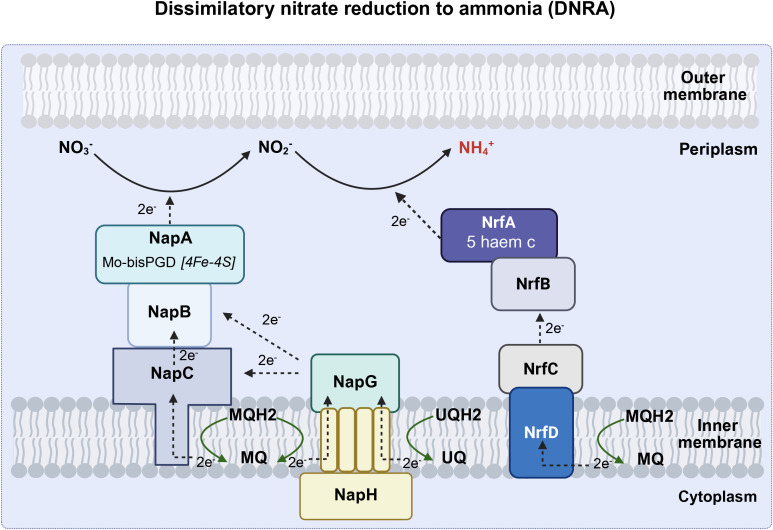
Nitrate, which maintains hemostasis in systemic circulation, is obtained from nitrate-rich vegetables, concentrated, reabsorbed by the salivary glands, and reduced to nitrite and nitric oxide (NO•). The bioavailability of nitrate and nitrite depends on unique nitrate reductases present in specific bacterial communities in the mouth and gut of mammals. The dominant bacteria in the oral cavity, stomach, and gut differ among internal environments. Nitrate can modulate microbiota metabolism and has important pathophysiological functions in diseases such as cardiovascular diseases, gastrointestinal diseases, diabetes, metabolic diseases, and brain diseases via nitrate-reducing bacteria. Thus, in this review, we summarized the beneficial role of enterosalivary nitrate metabolism, focusing on the role of oral and gut bacterial communities in the enzymatic reduction of nitrate to nitrite. We have also discussed different nitrate-reduction pathways; influencing factors of nitrate-reducing bacteria; and the relationship among systemic health, nitrate intake, and bacteria. This review of enterosalivary nitrate and related microbiomes could provide a new perspective for the application of nitrate.
Overview
The claims and statistics of this paper haven’t been checked yet.
Run the check — free, no account needed. It reads the open-access text and checks the sources it cites.
Integrity signals
Registry
Cites
Statistics
Figures
Verification
Claims the paper makes
The claims and statistics of this paper haven’t been checked yet.
Run the check — free, no account needed. It reads the open-access text and checks the sources it cites.
Claims other papers make about this one
Each is checked against this paper’s own text: does it say what the citing paper says it does?
The cited source doesn’t support the claim as written.
In the citing paper
“gastrointestinal disorders frequently disrupt the oral and intestinal microbiota, reducing populations of nitrate-reducing bacteria and consequently reducing endogenous NO production [295].”
From Dietary Nitrate-Rich Vegetables as Natural Modulators of Health: Mechanisms and Benefits in Ageing Populations (2026) · cites this paper as [295]
Checked by a reasoning model — may be wrong.
Experimental — accuracy not yet measured
Self-check
Percentages, sums and reported differences re-computed from the paper’s own numbers.
The self-check needs the paper’s full text.
Citations
Cites
Items 201–211 of 211
Nitrate supplementation affects taste by changing the oral metabolome and microbiome
Zhang, S., Clasen, F., Cai, H., Do, T., Shoaie, S., & Carpenter, G. H. (2025) · npj Biofilms and Microbiomes · doi:10.1038/s41522-025-00689-8 · Cited by 8
Öner, F., Onat, F. Ç., & Karasu, Y. Ö. (2024) · Heliyon · doi:10.1016/j.heliyon.2024.e25888 · Cited by 7
Rajendra, A., Bondonno, N. P., Murray, K., Zhong, L., Rainey‐Smith, S. R., Gardener, S. L., Blekkenhorst, L. C., Doré, V., Villemagne, V. L., Laws, S. M., et al. (2025) · The Journal of Prevention of Alzheimer s Disease · doi:10.1016/j.tjpad.2025.100161 · Cited by 7
Sowton, A. P., Holzner, L. M. W., Krause, F. N., Baxter, R. M., Mocciaro, G., Krzyzanska, D., Minnion, M., O’Brien, K. A., Harrop, M. C., Darwin, P. M., et al. (2024) · American Journal of Physiology-Endocrinology and Metabolism · doi:10.1152/ajpendo.00256.2024 · Cited by 6
Hughes, W. E., Treichler, D. P., Ueda, K., Bock, J. M., & Casey, D. P. (2021) · Nutrition Metabolism and Cardiovascular Diseases · doi:10.1016/j.numecd.2021.12.002 · Cited by 5
Dietary nitrate maintains intestinal epithelia homeostasis in aged mice
Wang, X., Liu, H., Yue, M., Wang, J., Zhang, C., Qin, L., Wang, S., & Hu, L. (2024) · Biogerontology · doi:10.1007/s10522-024-10127-5 · Cited by 5
Self-citationPedrinolla, A., Dorelli, G., Porcelli, S., Burleigh, M. C., Mendo, M., Martignon, C., Fonte, C., Carbonare, L. G. D., Easton, C., Muti, E., et al. (2025) · Nitric Oxide · doi:10.1016/j.niox.2025.03.001 · Cited by 4
Alharbi, M., Stephan, B. C. M., Shannon, O. M., & Siervo, M. (2023) · Nutrition & Metabolism · doi:10.1186/s12986-023-00766-9 · Cited by 4
Salivary biochemical indices related to early childhood caries.
Zhang, Y., Jia, S.-B., Li, F., Li, S.-S., Zhang, L., Tan, K., Lu, J., & Yang, F. (2021) · PubMed Central · doi:10.7518/hxkq.2021.03.009 · Cited by 3
Influence of orthodontic appliances and nitrate on the oral microbiota
Reichardt, E., Eigenthaler, M., Jost‐Brinkmann, P., Stellzig‐Eisenhauer, A., Verna, C., Plumeier, I., Kahl, S., Junca, H., Vilchez‐Vargas, R., & Pieper, D. H. (2025) · Applied Microbiology and Biotechnology · doi:10.1007/s00253-025-13496-0 · Cited by 3
Inorganic nitrate attenuates neuroinflammation after traumatic brain injury via Sialin
Liu, Z., Hu, L., Wang, Q., Zhao, X., Liu, W., Zhang, B., Pan, W., Song, W., Chen, X., Zhang, C., et al. (2025) · Tissue and Cell · doi:10.1016/j.tice.2025.102955 · Cited by 2
Self-citation
Cited by
Sorted by citations
Venkatesan, S., Smirne, C., Aquino, C. I., Surico, D., Remorgida, V., Pour, M. M. O., Pirisi, M., & Grossini, E. (2026) · International Journal of Molecular Sciences · doi:10.3390/ijms27020629 · Cited by 30
Change of oral microbiome diversity by smoking across different age groups
Seo, K., Min, J., Min, K. H., Oh, K.-H., Ryoo, S.-W., Son, S.-Y., & Lee, J.-H. (2025) · Frontiers in Microbiology · doi:10.3389/fmicb.2025.1714229 · Cited by 4
Kurhaluk, N., Kołodziejska, R., Buyun, L., Kamiński, P., & Tkaczenko, H. (2026) · International Journal of Molecular Sciences · doi:10.3390/ijms27083461 · Cited by 3
“Soluble fibres can influence gastric emptying and intestinal transit time, potentially altering the kinetics of nitrate release and uptake [293–295].”
Beetroot boost: Unlocking the power of Beta Vulgaris for peak athletic performance
Bibi, J., Lei, Y., Ahmad, M. Z., Kotwica-Mojzych, K., Głowacka, M., & Mojzych, M. (2026) · Journal of Functional Foods · doi:10.1016/j.jff.2026.107196 · Cited by 2
Liang, J., Huang, T., Li, J., Yang, Z., Ni, J., & Wang, Y. (2026) · RSC Advances · doi:10.1039/d6ra00317f · Cited by 4
Self-citation
Metadata
- Authors
- Yang, Z., Du, C., Chang, Z., Yang, Y., & Hu, L.
- Affiliations
- Capital Medical University (CN)
- Corresponding author
- Hu, Liang
- Venue
- Frontiers in Cellular and Infection Microbiology
- Publisher
- Frontiers Media SA
- Published
- 2025-07-03
- Volume
- 15
- Pages
- 1612223-1612223
- ISSN
- 2235-2988 (ISSN-L)
- PMC
- PMC12267184
- OpenAlex
- W4411963008
- Semantic Scholar
- d88f2ed1d64bf5192a148b9d5adfbad63bb4876f
- Cited by
- 19
- References
- 211
- Citations by year
- 2026: 16 · 2025: 3
- FWCI
- 1.67
- Type
- journal article
- Language
- en
- Open access
- gold
- doi.org
- Licence
- Locations
- Frontiers in Cellular and Infection Microbiology (publishedVersion, cc-by)
- PubMed Central (publishedVersion, cc-by)
- PubMed (publishedVersion)
- DOAJ (DOAJ: Directory of Open Access Journals) (submittedVersion, cc-by-sa)
- Funders
- National Natural Science Foundation of China (82001065, QML20211502)
- Capital Medical University (YSP202204)
- Topics
- Life Sciences › Biochemistry, Genetics and Molecular Biology › Molecular Biology › Gut microbiota and health
- Health Sciences › Dentistry › Periodontics › Oral microbiology and periodontitis research
- Health Sciences › Medicine › Physiology (medical) › Nitric Oxide and Endothelin Effects
- Keywords
- nitrate metabolism, oral microbiota, gut microbiota, nitrate-reducing bacteria, nitrite, nitric oxide, nitrate reductase, nitrate consumption, cardiovascular disease, gastrointestinal diseases, diabetes mellitus, metabolic disorders, brain disorders
- MeSH terms
- Gastrointestinal Microbiome, Animals, Bacteria, Humans, Mouth, Nitrates, Nitric Oxide, Nitrites
About these checks
Registry, retraction, Cites and statistics results are computed, not judged, with one exception: a printed reference that no index lists is read once by a model before it counts as a citation error. Claims are extracted by a model and kept only when their quote appears verbatim in the text; each cited source is then checked, with a model’s help, for whether it says what the claim relies on. Those verdicts can be wrong — read the claim’s quote and the cited source before relying on one.
Statistics and arithmetic are recomputed, not judged.
Confidence bands are shown only for fields calibrated on our annotated test set. None is calibrated yet, so no band is shown.
What counts as a claim ›How we measure confidence ›How we check this ›
Are you an author, or do you see a problem with this page? Request a review
