

Audio deepfakes: A survey
Open accessThe DOI matches its Crossref record; 127 of the 143 references it cites were found in a registry or an index; 32 of the 68 sources its claims cite were checked for support.
Abstract
A deepfake is content or material that is synthetically generated or manipulated using artificial intelligence (AI) methods, to be passed off as real and can include audio, video, image, and text synthesis. The key difference between manual editing and deepfakes is that deepfakes are AI generated or AI manipulated and closely resemble authentic artifacts. In some cases, deepfakes can be fabricated using AI-generated content in its entirety. Deepfakes have started to have a major impact on society with more generation mechanisms emerging everyday. This article makes a contribution in understanding the landscape of deepfakes, and their detection and generation methods. We evaluate various categories of deepfakes especially in audio. The purpose of this survey is to provide readers with a deeper understanding of (1) different deepfake categories; (2) how they could be created and detected; (3) more specifically, how audio deepfakes are created and detected in more detail, which is the main focus of this paper. We found that generative adversarial networks (GANs), convolutional neural networks (CNNs), and deep neural networks (DNNs) are common ways of creating and detecting deepfakes. In our evaluation of over 150 methods, we found that the majority of the focus is on video deepfakes, and, in particular, the generation of video deepfakes. We found that for text deepfakes, there are more generation methods but very few robust methods for detection, including fake news detection, which has become a controversial area of research because of the potential heavy overlaps with human generation of fake content. Our study reveals a clear need to research audio deepfakes and particularly detection of audio deepfakes. This survey has been conducted with a different perspective, compared to existing survey papers that mostly focus on just video and image deepfakes. This survey mainly focuses on audio deepfakes that are overlooked in most of the existing surveys. This article's most important contribution is to critically analyze and provide a unique source of audio deepfake research, mostly ranging from 2016 to 2021. To the best of our knowledge, this is the first survey focusing on audio deepfakes generation and detection in English.
Overview
CoChat Summary
## TL;DR
This 2023 survey argues that audio deepfakes are under-covered relative to video/image deepfakes and provides a detailed overview of how audio deepfakes are generated, detected, and benchmarked. It reports that across the surveyed literature, generation methods have advanced faster than detection, and that audio deepfake research needs better generalization and more robust defenses.
## Key findings
- The authors surveyed over 150 methods and say that audio deepfakes are overlooked in existing surveys; they claim this is the first survey focusing on audio deepfake generation and detection in English.
- In their review, they found that GANs, CNNs, and DNNs are common ways of creating and detecting deepfakes, and that most surveyed work focuses on video deepfakes, especially generation.
- For text deepfakes, they report more generation methods but very few robust detection methods, including fake news detection.
- For audio generation quality, they report that Mean Opinion Score (MOS) is better with single-speaker training data than with multi-speaker datasets, and that sampling rates below 16 kHz significantly reduce perceived quality.
- For replay-attack detection, they note one deep convolutional network method achieved EER = 0% on the ASVspoof 2017 development and evaluation set, compared with prior bests of 12% development EER and 2.76% evaluation EER.
## Methods
- The paper is a survey/review, not an empirical experiment: it synthesizes prior work across audio, text, video, and image deepfakes, with special focus on audio.
- It states that the review covers more than 150 methods, with detailed discussion of audio generation, detection, datasets, and architectures from roughly 2016 to 2021.
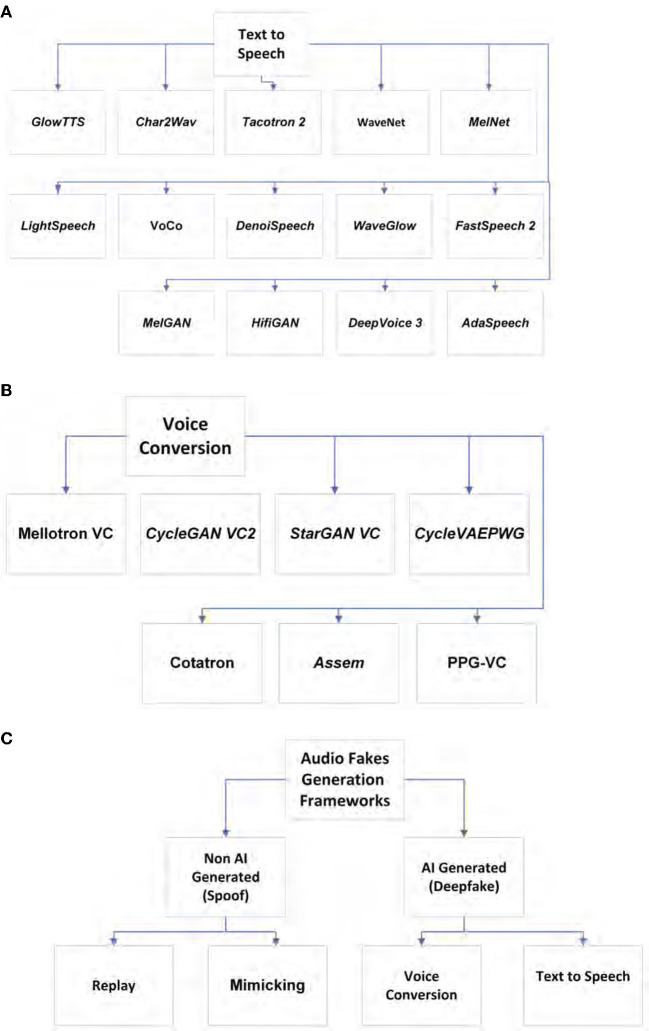
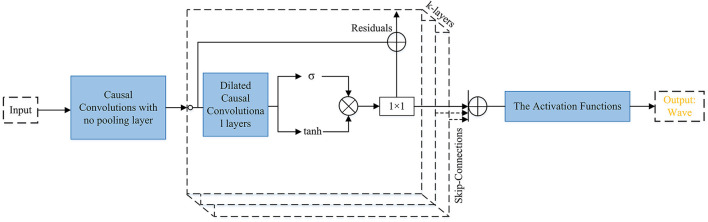
- The authors also summarize common datasets and models used in audio deepfake research, including ASVspoof 2015/2017/2019/2021, FoR, and WaveFake, plus architectures such as WaveNet, Tacotron, Tacotron 2, WaveGlow, Deep Voice 3, MelNet, ResNet, TCN, and biLSTM.
## Limitations
- The paper explicitly says it does not discuss the details of the frameworks used for all deepfake categories; instead, it gives more detailed attention to audio and only recent trends for the other categories.
- It also says that the survey of audio deepfakes is not exhaustive for every framework, relying on supplementary tables for summaries and guides.
- Evident from the text: several sections are high-level and descriptive rather than systematic meta-analysis, so the paper does not report a unified quantitative comparison across all methods.
Model-written summary. Check it against the paper before relying on it.
Integrity signals
Registry
Cites
Statistics
Figures




Verification
Claims the paper makes
25 Valid · 5 Not valid · 26 Not checked · 20 Own results and interpretations
Every source the paper cites for this claim was checked and supports it.
In the paper
“Accents can be hard to imitate because they lack dialect variation modeling (Kuligowska et al., 2018).”
§ Audio deepfakes: A survey > 3. Deepfake categories > 3.1. Audio deepfakes
What the sources say
- Supportedcites Kuligowska et al., 2018 source
Section 4.2 (Prosody; page not provided) states that speech synthesis systems lack dialect-variation modeling and discusses the difficulty of producing and changing accents. This supports the citing sentence’s paraphrase. (LLM, conf=0.94)
plainstates a cause- Asserted: passes — The authors put it forward as true.
- Checkable: passes — It can be checked against evidence.
- Load-bearing: unclear — It is unclear whether the paper’s conclusions depend on it.
- Based: passes — The paper gives a reason why it holds.
- Supported
Every source the paper cites for this claim was checked and supports it.
In the paper
“The ASVspoof 2019 (Wang X. et al., 2020) edition is the first audio spoof detection challenge that considered all three spoofing attack types (replay, text-to-speech and VC).”
§ Audio deepfakes: A survey > 4. Audio deepfake datasets
What the sources say
- Supportedcites Wang X. et al., 2020 source
The Introduction (p. 2) explicitly says ASVspoof 2019 was the first to consider speech synthesis, voice conversion, and replay within a single challenge. It contrasts this with the 2015 and 2017 editions, which addressed synthesis and conversion, and replay, respectively. (LLM, conf=0.95)
plain- Asserted: passes — The authors put it forward as true.
- Checkable: passes — It can be checked against evidence.
- Load-bearing: unclear — It is unclear whether the paper’s conclusions depend on it.
- Based: passes — The paper gives a reason why it holds.
- Supported
The cited sources support only part of this claim — read each source’s verdict below.
In the paper
“One can sometimes tell it is not human-like because there is no breathing, laughter, pauses, and sighs among other things in human speech (Kuligowska et al., 2018).”
§ Audio deepfakes: A survey > 3. Deepfake categories > 3.1. Audio deepfakes
What the sources say
- Partly supportedcites Kuligowska et al., 2018 sourceExperimental — accuracy not yet measured
Section 4.3 (Spontaneous speech; page unavailable) says current synthesis systems avoid or poorly model features of spontaneous speech, including laughter, sighs and breathing. It mentions hesitations but not pauses, and it does not say these features are always absent. Section 4.2 (Prosody; page unavailable) supports the broader point that synthetic speech can lack natural rhythm. (LLM, conf=0.84)
hedgedstates a possible cause- Asserted: passes — The authors put it forward as true.
- Checkable: passes — It can be checked against evidence.
- Load-bearing: unclear — It is unclear whether the paper’s conclusions depend on it.
- Based: passes — The paper gives a reason why it holds.
- Partly supported
The cited sources support only part of this claim — read each source’s verdict below.
In the paper
“Faceswapping can also be difficult to identify it as a deepfake when the pictures artifacts are hidden behind the compression artifacts (Mirsky and Lee, 2021).”
§ Audio deepfakes: A survey > 3. Deepfake categories > 3.4. Image deepfakes
What the sources say
- Partly supportedcites Mirsky and Lee, 2021 sourceExperimental — accuracy not yet measured
Section 6.1 (p. 26) describes artifacts used to detect face swaps, and Section 7.2 (p. 31) says compression can evade forensic detectors or raise their false-alarm rate. The paper does not specifically say that compression artifacts hide visible picture artifacts, so the claimed mechanism is not established. (LLM, conf=0.82)
plainstates a possible cause- Asserted: passes — The authors put it forward as true.
- Checkable: passes — It can be checked against evidence.
- Load-bearing: unclear — It is unclear whether the paper’s conclusions depend on it.
- Based: passes — The paper gives a reason why it holds.
- Partly supported
The cited sources support only part of this claim — read each source’s verdict below.
In the paper
“Given our evaluation of different audio deepfake frameworks' performance, the Mean Opinion Score (MOS) of the generated audio is better when the framework is trained using single speaker datasets (Oord et al., 2016; Ping et al., 2018; Kumar et al., 2019; Kong et al., 2020).”
§ Audio deepfakes: A survey > 6. Discussion and future directions > 6.1. Deepfake generation
What the sources say
- Partly supportedcites Oord et al., 2016 sourceExperimental — accuracy not yet measured
Section 3.2 (p. 6) reports that WaveNet trained on single-speaker datasets achieved higher MOS than baseline synthesizers. But the baselines used the same datasets, so this does not show that single-speaker training produces better MOS than multi-speaker training. Section 3.1 (p. 5) compares speaker counts only on validation performance, not MOS. (LLM, conf=0.85)
- Partly supportedcites Ping et al., 2018 sourceExperimental — accuracy not yet measured
The Results (pp. 8–9, Tables 2–3) report higher MOS values for Deep Voice 3 on its single-speaker dataset than on the multi-speaker VCTK and LibriSpeech datasets. But these are not controlled comparisons of speaker count, and the authors attribute LibriSpeech’s lower score relative to VCTK chiefly to recording quality. The paper therefore supports the observed score pattern, not the broader implication that single-speaker training itself produces better MOS. (LLM, conf=0.85)
- Partly supportedcites Kumar et al., 2019 sourceExperimental — accuracy not yet measured
Section 3.1 (pp. 6–7) reports a MelGAN MOS of 3.61 for a model trained on LJ Speech and 3.49 in a separate VCTK evaluation following discussion of training on a six-speaker dataset. Those scores are in the claimed direction, but the evaluations use different audio and are not a controlled comparison showing that single-speaker training produces better MOS generally. (LLM, conf=0.79)
plainstates a cause- Asserted: passes — The authors put it forward as true.
- Checkable: passes — It can be checked against evidence.
- Load-bearing: passes — The paper’s conclusions depend on it.
- Based: passes — The paper gives a reason why it holds.
- Partly supported
14 more claims
Create a free account to see all 76 claims and every source verdict.
- Probably not a substantial claim. 38
- It may state two separate claims as one. 35
Claims other papers make about this one
Each is checked against this paper’s own text: does it say what the citing paper says it does?
The source backs part of the claim, not all of it — or backs it for a different population, condition or comparison.
In the citing paper
“Heidari et al. (2023) and Khanjani et al. (2023) mentioned that blockchains and distributed ledger technologies can be leveraged for enhanced digital content traceability and identity sovereignty.”
From Deepfake: definitions, performance metrics and standards, datasets, and a meta-review (2024) · cites this paper as Khanjani et al., 2023
Experimental — accuracy not yet measuredThe cited source says what the claim attributes to it.
In the citing paper
“Unlike deepfake detection for images and videos, which has been intensively studied [28,29,30,31], audio deepfake detection has been overlooked in most of the existing surveys until recently [32].”
From Audio Deepfake Detection: What Has Been Achieved and What Lies Ahead (2025) · cites this paper as [32]
The cited source says what the claim attributes to it.
In the citing paper
“There have been significant advancements in machine learning models, methods for modifying audio and video, and other approaches along the technological progression of deep fake production (Khanjani etal. 2023).”
From Deepfake video detection: challenges and opportunities (2024) · cites this paper as Khanjani et al. 2023
The cited source says what the claim attributes to it.
In the citing paper
“only three of them (Heidari et al., 2023; Khanjani et al., 2023; Masood et al., 2023) mentioned audio datasets.”
From Deepfake: definitions, performance metrics and standards, datasets, and a meta-review (2024) · cites this paper as Khanjani et al., 2023
Self-check
Percentages, sums and reported differences re-computed from the paper’s own numbers.
Self-check results appear here once an independent check has confirmed them.
Cited works that were retracted
Works this paper cites that were later retracted, from the retraction notices publishers deposit. Major when the notice came out before this paper was published.
A note, not an issue: for example, a cited work that was retracted only after this paper was published, which its authors could not have known.
In the paper
“Song, 2021, Secure prediction and assessment of sports injuries using deep learning based convolutional neural network, J. Ambient. Intell. Humaniz Comput, 12, 3399, 10.1007/s12652-020-02560-4”
Cited work 10.1007/s12652-020-02560-4 · retracted 2024-06-07 · notice 10.1007/s12652-024-04823-w · this paper published 2023-01-09
Citations
Cites
1 retracted
Song, H., Han, X.-Y., Montenegro, C., & Krishnamoorthy, S. (2021) · Journal of Ambient Intelligence and Humanized Computing · doi:10.1007/s12652-020-02560-4 · Cited by 102
RetractedLeCun, Y., Bengio, Y., & Hinton, G. (2015) · Nature · doi:10.1038/nature14539 · Cited by 84,126
Gradient-based learning applied to document recognition
Lecun, Y., Bottou, L., Bengio, Y., & Haffner, P. (1998) · Proceedings of the IEEE · doi:10.1109/5.726791 · Cited by 58,805
Image-to-Image Translation with Conditional Adversarial Networks
Isola, P., Zhu, J.-Y., Zhou, T., & Efros, A. A. (2017) · 2017 IEEE Conference on Computer Vision and Pattern Recognition (CVPR) · doi:10.1109/cvpr.2017.632 · Cited by 22,930
Labaca-Castro, R. (2023) · Machine Learning under Malware Attack · doi:10.1007/978-3-658-40442-0_9 · Cited by 19,272
Sequence to Sequence Learning with Neural Networks
Sutskever, I., Vinyals, O., & Le, Q. V. (2014) · arXiv · doi:10.48550/arxiv.1409.3215 · Cited by 17,766
A Style-Based Generator Architecture for Generative Adversarial Networks
Karras, T., Laine, S., & Aila, T. (2019) · 2019 IEEE/CVF Conference on Computer Vision and Pattern Recognition (CVPR) · doi:10.1109/cvpr.2019.00453 · Cited by 11,714
Analyzing and Improving the Image Quality of StyleGAN
Karras, T., Laine, S., Aittala, M., Hellsten, J., Lehtinen, J., & Aila, T. (2020) · 2020 IEEE/CVF Conference on Computer Vision and Pattern Recognition (CVPR) · doi:10.1109/cvpr42600.2020.00813 · Cited by 6,332
Analyzing and Improving the Image Quality of StyleGAN
Karras, T., Laine, S., Aittala, M., Hellsten, J., Lehtinen, J., & Aila, T. (2019) · arXiv · doi:10.48550/arxiv.1912.04958 · Cited by 6,332
“Librispeech: an ASR corpus based on public domain audio books,”
Panayotov, V., Chen, G., Povey, D., & Khudanpur, S. (2015) · 2015 IEEE International Conference on Acoustics, Speech and Signal Processing (ICASSP) · doi:10.1109/icassp.2015.7178964 · Cited by 6,072
Research works printed but not linked: 9
- Ajder, 2019, The State of Deepfakes: Landscape, Threats, and Impact, Deeptrace
- Blue, 2022, “Who are you (I Really Wanna Know)? Detecting audio DeepFakes through vocal tract reconstruction,”, 31st USENIX Security Symposium (USENIX Security 22), 2691
- Chauhan, 2020, Establishing environment setup for preventing deepfakes using blockchain technology, Mukt Shabd J, 9, 771
- 2021, Ctrl shift face. YouTube
- Goodfellow, 2016, Deep Learning
- Ito, 2017, The LJ Speech Dataset
- Rea, 2019, Artists Create a Sinister 'deepfake' of Mark Zuckerberg to Teach Facebook (and the rest of us) a Lesson About Digital Propaganda
- Saul, 2020, After biden plays ‘despacito' at an event, trump shares a doctored video replacing it with an anti-police song, The New York Times
- Stupp, 2019, Fraudsters used AI to mimic CEO's voice in unusual cybercrime case, Wall Street J
Cited by
A systematic review of AI literacy scales
Lintner, T. (2024) · npj Science of Learning · doi:10.1038/s41539-024-00264-4 · Cited by 292
“Theemergenceofdeepfakeshasalsoledtoa new generation of disinformation in political campaigns 14 .”
Deepfake video detection: challenges and opportunities
Kaur, A., Noori Hoshyar, A., Saikrishna, V., Firmin, S., & Xia, F. (2024) · Artificial Intelligence Review · doi:10.1007/s10462-024-10810-6 · Cited by 214
“There have been significant advancements in machine learning models, methods for modifying audio and video, and other approaches along the technological progression of deep fake production (Khanjani et al. 2023).”
Abbas, F., & Taeihagh, A. (2024) · Expert Systems with Applications · doi:10.1016/j.eswa.2024.124260 · Cited by 184
A Survey on Speech Deepfake Detection
Li, M., Ahmadiadli, Y., & Zhang, X.-P. (2025) · ACM Computing Surveys · doi:10.1145/3714458 · Cited by 101
Deepfake: definitions, performance metrics and standards, datasets, and a meta-review
Altuncu, E., Franqueira, V. N. L., & Li, S. (2024) · Frontiers in Big Data · doi:10.3389/fdata.2024.1400024 · Cited by 134
Metadata
- Authors
- Khanjani, Z., Watson, G., & Janeja, V. P.
- Affiliations
- University of Maryland, Baltimore County (US)
- Corresponding author
- Janeja, Vandana P.
- ORCID
- Janeja, Vandana P.
- Venue
- Frontiers in Big Data
- Publisher
- Frontiers Media SA
- Published
- 2023-01-09
- Volume
- 5
- Pages
- 1001063-1001063
- ISSN
- 2624-909X (ISSN-L)
- PMC
- PMC9869423
- OpenAlex
- W4313984387
- Semantic Scholar
- 40cbeff7a8342178645654dfa60c4d0d41af1c2d
- Cited by
- 121
- References
- 143
- Citations by year
- 2026: 36 · 2025: 49 · 2024: 31 · 2023: 5
- FWCI
- 2.53
- Type
- journal article
- Language
- en
- Open access
- gold
- doi.org
- Licence
- Locations
- Frontiers in Big Data (publishedVersion, cc-by)
- PubMed Central (publishedVersion, cc-by)
- PubMed (publishedVersion)
- Maryland Shared Open Access Repository (USMAI Consortium) (submittedVersion, cc-by)
- DOAJ (DOAJ: Directory of Open Access Journals) (submittedVersion, cc-by-sa)
- Funders
- National Science Foundation (2210011, 14203)
- Topics
- Physical Sciences › Computer Science › Artificial Intelligence › Speech Recognition and Synthesis
- Physical Sciences › Computer Science › Computer Vision and Pattern Recognition › Digital Media Forensic Detection
- Physical Sciences › Computer Science › Signal Processing › Music and Audio Processing
- Keywords
- deepfake audio, deepfake detection, deepfake generation, generative adversarial networks, convolutional neural networks, deep neural network, fake news detection, synthetic media
About these checks
Registry, retraction, Cites and statistics results are computed, not judged, with one exception: a printed reference that no index lists is read once by a model before it counts as a citation error. Claims are extracted by a model and kept only when their quote appears verbatim in the text; each cited source is then checked, with a model’s help, for whether it says what the claim relies on. Those verdicts can be wrong — read the claim’s quote and the cited source before relying on one.
The claim verdicts this report counts are experimental: their accuracy is not yet measured.
A language model drew the claims from the paper on 2026-09-29, under version 3 of the claim definition (model deepseek-v4.1-flash, prompt extract-v3).
A second model labelled each claim on 2026-09-29 (model jev-1.13-20260917, definition revision gold-guideline-v0.2).
Cited sources are checked with a language model’s help (gpt-6-sol).
Statistics and arithmetic are recomputed, not judged.
Confidence bands are shown only for fields calibrated on our annotated test set. None is calibrated yet, so no band is shown.
What counts as a claim ›How we measure confidence ›How we check this ›
Are you an author, or do you see a problem with this page? Request a review
How to cite
Cite CoChat for the checks on this page, and the paper for its own findings.
- This page
- CoChat. (2026). Citation check: Audio deepfakes: A survey. https://app.cochat.ai/papers/10.3389/fdata.2022.1001063
- The paper
- Khanjani, Z., Watson, G., & Janeja, V. P. (2023). Audio deepfakes: A survey. Frontiers in Big Data. https://doi.org/10.3389/fdata.2022.1001063
Data sources
Bibliographic data: Semantic Scholar, OpenAlex, Crossref.
Contains information from the Semantic Scholar Academic Graph Datasets, made available under the ODC Attribution License (ODC-BY 1.0).
Semantic Scholar’s data is described in: Kinney, R., et al. (2023). The Semantic Scholar Open Data Platform. arXiv:2301.10140.
