

The role of counseling for non-traditional students in formal higher education: a scoping review
Open accessThe DOI matches its Crossref record; 49 of the 49 references it cites were found in a registry or an index; none of the 137 sources its claims cite is checked for support yet.
Abstract
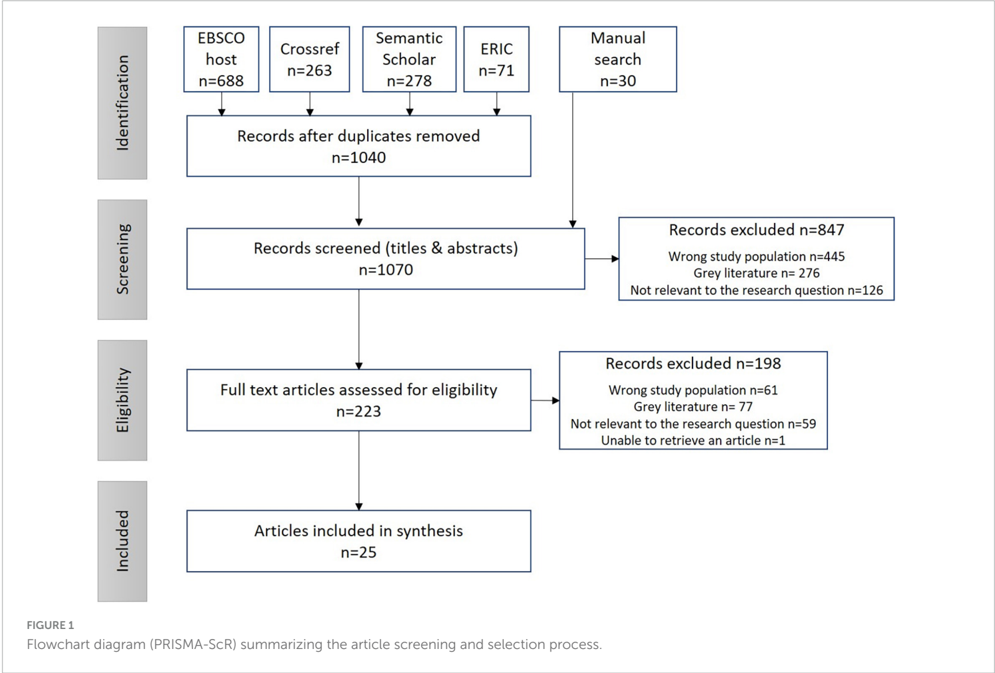
Introduction: Since the mid-20th century, the number of adult students enrolled in formal higher education (HE) programs has significantly increased. The profile of non-traditional students differs significantly from that of traditional students in terms of their characteristics, learning methods, obstacles and challenges, motivations for learning, and conditions for effective learning. Unlike traditional students, adult students often balance family, work, and educational responsibilities, necessitating a more nuanced approach to support and guidance. However, most HE institutions primarily serve the needs of traditional student populations, which results in limited support available to adult students. This scoping review aimed to explore and map the existing literature on the role of adult (or non-traditional) students counseling in the context of formal HE. Methods: We focused on literature related to academic advising for non-traditional students in formal HE, restricting our search to both empirical and non-empirical articles published in peer-reviewed journals between 2010 and 2022. Employing Arksey and O’Malley’s scoping review method and the PRISMA-ScR Checklist, we searched four databases (EBSCOhost, Crossref, Semantic Scholar, and ERIC), supplemented by a manual search. Results: Of the 1,330 articles identified and screened, 25 studies met the eligibility criteria. Our review included 17 empirical and eight non-empirical studies, with the majority conducted in the USA (21 of 25). Thematic analysis revealed five key research areas (or themes): academic advising practices, perceptions of advising, technology, and advising, advising models, and academic success. The most common research theme, advising practices for adult (undergraduate and doctoral) students, constituted 52% of the studies (n= 13). Discussion: Drawing from our analysis, we discuss current trends and future development in advising non-traditional students within formal HE settings. The added value of academic advising for adult students is explored, and any potential gaps in research literature knowledge are identified.
Overview
CoChat Summary
TL;DR
This scoping review maps 25 peer-reviewed articles (2010–2022) on counseling/advising non-traditional students in formal higher education, finding most research is US-based and focused on advising practices, perceptions, academic success, technology, and advising models. It concludes that tailored, holistic, proactive, and technology-enhanced advising is important, but the literature base is scarce and geographically narrow.
Key findings
- Of 1,330 articles identified, 260 duplicates were excluded, and 25 studies met eligibility criteria: 17 empirical and 8 non-empirical; 21 of 25 were conducted in the USA (84%), with one each in Israel, Colombia, Slovenia, and one in the USA and Ireland.
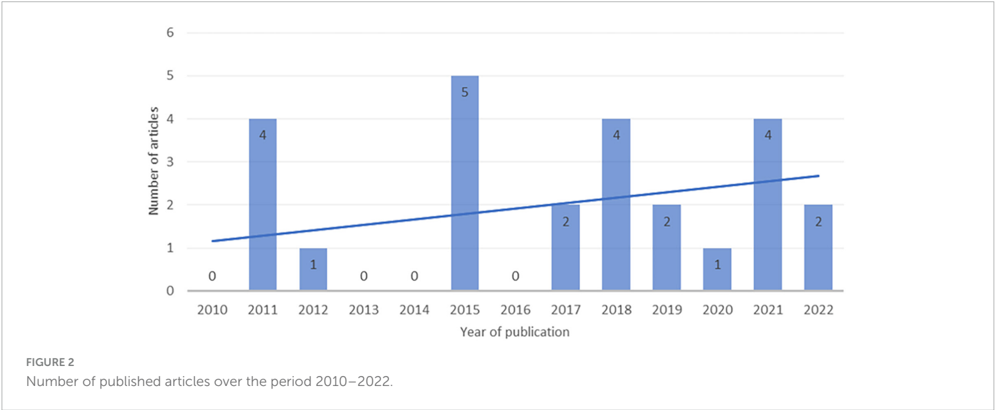
- Most studies (80%, n = 20) were published between 2015 and 2022. Five themes emerged: advising practices for adult/doctoral students was most common (52%, n = 13); academic success (48%, n = 12; subthemes: academic performance, retention, persistence); perceptions of advising (48%, n = 12); advising models/approaches (24%, n = 6); and technology and advising (20%, n = 5).
- Empirical studies included 6 qualitative (24%), 4 quantitative (16%), 5 mixed methods (20%), and 2 case studies (8%); 10 of the 25 reviewed articles did not explicitly identify their research designs or methodologies. Non-empirical studies included 4 literature reviews, 2 theoretical papers, 1 discussion paper, and 1 comparative study.
- The review reports that adult students benefit from holistic, developmental, proactive, flexible, accessible, and technology-based advising, as well as culturally sensitive and group-based mentoring for doctoral students; only two articles examined advisors’ perceptions.
Methods
- Scoping review using Arksey and O’Malley’s five-stage framework and the PRISMA-ScR checklist, guided by two research questions on trends and main research areas/outcomes in counseling non-traditional students in formal HE.
- Searched EBSCOhost, Crossref, Semantic Scholar, and ERIC, supplemented by manual search; included peer-reviewed English articles published 2010–2022, both empirical and non-empirical, focused on counseling/advising adult or non-traditional students in formal HE.
- Data were charted on authors, year, country, research design/methods, study population, sample size, and outcomes; thematic analysis followed Braun and Clarke’s six steps.
Limitations
- The authors state the review was not exhaustive: only 25 articles were identified from four databases, inclusion/exclusion criteria may have altered outcomes, the small sample limits breadth and depth, and the lack of peer-reviewed literature outside the US context may introduce bias.
- The authors identify gaps: only two articles explored advisors’ perceptions, few examined counseling for doctoral students, and future studies should search more databases and include book chapters, dissertations, and conference proceedings.
- Evident from the text: 10 of 25 included studies did not explicitly identify their research designs or methodologies, and the scoping review approach does not necessarily assess methodological quality or bias, limiting confidence in the synthesized findings.
Model-written summary. Check it against the paper before relying on it.
Integrity signals
Registry
Cites
Statistics
Figures

Verification
Claims the paper makes
0 Valid · 5 Not valid · 127 Not checked · 60 Own results and interpretations
A result the paper reports from its own data — it cites no other source for it, so there is none to check. The quote shows it is in the paper.
In the paper
“Of the 1,330 articles identified and screened, 25 studies met the eligibility criteria.”
- Also stated in: § 2.3 Stage 3: selecting relevant studies · plain
“Overall, 1,330 articles were initially identified using the four databases, of which 260 duplicate articles were excluded.”
§ The role of counseling for non-traditional students in formal higher education: a scoping review > Abstract
plain- Asserted: passes — The authors put it forward as true.
- Checkable: passes — It can be checked against evidence.
- Load-bearing: passes — The paper’s conclusions depend on it.
- Based: passes — The paper gives a reason why it holds.
- Also stated in: § 2.3 Stage 3: selecting relevant studies · plain
A result the paper states — it cites no source for it, so there is none to check. The quote shows it is in the paper.
In the paper
“In general, non-traditional students and adult doctoral students emphasized the importance of genuine engagement, active listening, and validation from their advisors.”
§ The role of counseling for non-traditional students in formal higher education: a scoping review > 4.2 Perceptions of advising 4.2.1 Students' perceptions
plain- Asserted: passes — The authors put it forward as true.
- Checkable: passes — It can be checked against evidence.
- Load-bearing: unclear — It is unclear whether the paper’s conclusions depend on it.
- Based: passes — The paper gives a reason why it holds.
A result the paper reports from its own data — it cites no other source for it, so there is none to check. The quote shows it is in the paper.
In the paper
“Ten of the 25 reviewed articles did not explicitly identify their research designs or methodologies.”
§ The role of counseling for non-traditional students in formal higher education: a scoping review > 3.3 Research methods of included studies
plain- Asserted: passes — The authors put it forward as true.
- Checkable: passes — It can be checked against evidence.
- Load-bearing: unclear — It is unclear whether the paper’s conclusions depend on it.
- Based: passes — The paper gives a reason why it holds.
None of the sources cited for this claim have been checked yet.
In the paper
“Adult students benefited from programmatic guidance that included direction, scheduling, course selection, and assistance with program policies (Schroeder and Terras, 2015;Esposito et al., 2017).”
§ The role of counseling for non-traditional students in formal higher education: a scoping review > 4.1.1 Advising practices for adult students
What the sources say
- Not checked yetcites Schroeder and Terras, 2015 matched to “Advising experiences and needs of online, cohort, and classroom adult graduate learners.” (2015) source
- Not checked yetcites Esposito et al., 2017 matched to “‘Doctoral students’ experiences with pedagogies of the home, pedagogies of love, and mentoring in the academy.” (2017) source
plainstates a cause- Asserted: passes — The authors put it forward as true.
- Checkable: passes — It can be checked against evidence.
- Load-bearing: passes — The paper’s conclusions depend on it.
- Based: passes — The paper gives a reason why it holds.
A result the paper reports from its own data — it cites no other source for it, so there is none to check. The quote shows it is in the paper.
In the paper
“Most studies (80%, n = 20) were published between 2015 and 2022 (Figure 2)”
§ The role of counseling for non-traditional students in formal higher education: a scoping review > 3.2 General characteristics of included studies
plainn = 20- Asserted: passes — The authors put it forward as true.
- Checkable: passes — It can be checked against evidence.
- Load-bearing: unclear — It is unclear whether the paper’s conclusions depend on it.
- Based: passes — The paper gives a reason why it holds.
70 more claims
Create a free account to see all 192 claims and to verify the 132 references still open.
- Probably not a substantial claim. 87
- It may state two separate claims as one. 63
Self-check
Percentages, sums and reported differences re-computed from the paper’s own numbers.
Each contradiction between two passages listed here was confirmed by an independent check.
Rated minor: it would not touch a result — a value no result rests on, a p-value that stays on the same side of the significance level, or a conflict that is clerical, resolved elsewhere in the paper, or outside its own findings.
In the paper
§ The role of counseling for non-traditional students in formal higher education: a scoping review > 3.4 Thematic areas of included studies
“The second most common theme was the academic success of adult students (48%, n = 12)”
§ The role of counseling for non-traditional students in formal higher education: a scoping review > 6 Limitations and contribution
“| Academic performance | 5 | S3, S7, S10, S13, S24 | | Retention | 4 | S3, S4, S21, S23 | | Persistence | 3 | S1, S11, S17 |”
Rated minor: it would not touch a result — a value no result rests on, a p-value that stays on the same side of the significance level, or a conflict that is clerical, resolved elsewhere in the paper, or outside its own findings.
In the paper
§ The role of counseling for non-traditional students in formal higher education: a scoping review > 5 Conclusion
“mixed methods were more commonly used than a single quantitative or qualitative method.”
§ The role of counseling for non-traditional students in formal higher education: a scoping review > 3.3 Research methods of included studies
“six (24% of the total studies) used qualitative methods for data collection, four (16% of the total studies) used quantitative methods, five (20% of the total studies) used mixed methods”
Rated minor: it would not touch a result — a value no result rests on, a p-value that stays on the same side of the significance level, or a conflict that is clerical, resolved elsewhere in the paper, or outside its own findings.
In the paper
“539 undergraduate students in total.86 participants (15.0%) were older than 23.”
§ The role of counseling for non-traditional students in formal higher education: a scoping review > Theoretical paper
Reported 15 · recomputed 15.955473
Rated minor: it would not touch a result — a value no result rests on, a p-value that stays on the same side of the significance level, or a conflict that is clerical, resolved elsewhere in the paper, or outside its own findings.
In the paper
§ The role of counseling for non-traditional students in formal higher education: a scoping review > 3.4 Thematic areas of included studies
“followed by adult students' and advisors' perceptions of academic advising (48%, n = 12).”
§ The role of counseling for non-traditional students in formal higher education: a scoping review > 6 Limitations and contribution
“| Students' perceptions | 10 | S1, S3, S6, S10, S12, S14, | | | | S15, S16, S22, S24 | | Advisors' perceptions | 2 | S12, S21 |”
Rated minor: it would not touch a result — a value no result rests on, a p-value that stays on the same side of the significance level, or a conflict that is clerical, resolved elsewhere in the paper, or outside its own findings.
In the paper
§ The role of counseling for non-traditional students in formal higher education: a scoping review > 3.4 Thematic areas of included studies
“Other themes examined were advising models and approaches (24%, n = 6)”
§ The role of counseling for non-traditional students in formal higher education: a scoping review > 6 Limitations and contribution
“| New theoretical approach | 1 | S18 | | New model presentation | 2 | S12, S18 | | Model presentation | 3 | S8, S9, S20 |”
1 more finding
Create a free account to see every finding of this check.
Citations
Cites
PRISMA Extension for Scoping Reviews (PRISMA-ScR): Checklist and Explanation
Tricco, A. C., Lillie, E., Zarin, W., O'Brien, K. K., Colquhoun, H., Levac, D., Moher, D., Peters, M. D. J., Horsley, T., Weeks, L., et al. (2018) · Annals of Internal Medicine · doi:10.7326/m18-0850 · Cited by 43,565
Scoping studies: towards a methodological framework
Arksey, H., & O'Malley, L. (2005) · International Journal of Social Research Methodology · doi:10.1080/1364557032000119616 · Cited by 36,742
Munn, Z., Peters, M. D. J., Stern, C., Tufanaru, C., McArthur, A., & Aromataris, E. (2018) · BMC Medical Research Methodology · doi:10.1186/s12874-018-0611-x · Cited by 11,385
Braun, V., & Clarke, V. (2012) · APA handbook of research methods in psychology, Vol 2: Research designs: Quantitative, qualitative, neuropsychological, and biological. · doi:10.1037/13620-004 · Cited by 10,299
Scoping reviews: reinforcing and advancing the methodology and application
Peters, M. D. J., Marnie, C., Colquhoun, H., Garritty, C. M., Hempel, S., Horsley, T., Langlois, E. V., Lillie, E., O’Brien, K. K., Tunçalp, Ӧ., et al. (2021) · Systematic Reviews · doi:10.1186/s13643-021-01821-3 · Cited by 887
Education at a Glance 2021: OECD Indicators
OECD (2021) · Education at a Glance · doi:10.1787/b35a14e5-en · Cited by 836
If Advising is Teaching, What Do Advisors Teach?
Lowenstein, M. (2005) · NACADA Journal · doi:10.12930/0271-9517-25.2.65 · Cited by 202
Multiple Roles of Adult Learners
Fairchild, E. E. (2003) · New Directions for Student Services · doi:10.1002/ss.84 · Cited by 178
Motivating Factors for Adult Learners in Higher Education
Sogunro, O. A. (2014) · International Journal of Higher Education · doi:10.5430/ijhe.v4n1p22 · Cited by 169
Individualizing instruction : making learning personal, empowering, and successful
Hiemstra, R. P., & Sisco, B. R. (1990) · Bibliothèque et Archives nationales du Québec (Québec government) · Cited by 159
Research works printed but not linked: 16
- Anderson, L. (2016). 27 is the new 18: Adult students on the rise. EdNote. Available online at: https://ednote.ecs.org/27-is-the-new-18-adult-students-on-the- rise/ (accessed September 29, 2022).
- Bowes, L., Thomas, L., Peck, L., and Nathwani, T. (2013). International research on the effectiveness of widening participation. Bristol: Higher Education Funding Council for England.
- Bruce-Sanford, G., Heskeyahu, T., Longo, J., and Rundles, K. (2015). The role of counseling centers for serving nontraditional students in higher education. PAACE J. Lifelong Learn. 24, 7-30.
- Calderon, A. (2018). Massification of higher education revisited. Melbourne, VI: RMIT University.
- Deardorff, D. K., de Wit, H., Leask, B., and Charles, H. (2021). The handbook of international higher education, 2nd Edn. Sterling, VA: Stylus Publishing, LLC Publishing.
- Jelenc-Krašovec, S. (2011). Guidance and counselling in adult education: Example of Slovenia, England and Ireland. Andrag. Stud. 1, 101-117.
- Jennings, C. (2021). Academic advising. Available online at: https://www.ucd. ie/teaching/t4media/academic_advising_a_literature_review.pdf (accessed September 29, 2022).
- McFarland, J., Hussar, B., Zhang, J., Wang, X., Wang, K., Hein, S., et al. (2019). 2019 (NCES 2019-144). Condition education. Washington, DC: National Center for Education Statistics.
- Merriam, S. B., and Baumgartner, L. M. (2020). Learning in adulthood: A comprehensive guide, 4th Edn. San Francisco, CA: Jossey-Bass.
- Merriam, S. B., and Brockett, R. G. (2007). Profession and practice of adult education.
- 2021, International educational attainment.
- Ohrablo, S. (2016). Advising online students: Replicating best practices of face-to-face advising'. Manhattan: NACADA Clearinghouse of Academic Advising.
- Ross-Gordon, J. M., Rose, A. D., and Kasworm, C. E. (2017). Foundations of adult and continuing education. San Francisco, CA: Jossey-Bass.
- Schlossberg, N. K., Waters, E. B., and Goodman, J. (1995). Counseling adults in transition: Linking practice with theory, 2nd Edn. New York, NY: Springer Publishing
- Snyder, T. D., de Brey, C., and Dillow, S. A. (2018). Digest of education statistics 2016 (NCES 2017-094), 52nd Edn. Washington, DC: National Center for Education Statistics, Institute of Education Sciences, United States Department of Education.
- Steele, G., and Carter, A. L. (2002). Managing electronic communication technologies for more effective advising. Acad. Advis. Today 25, 75-85.
Cited by
Traditional Learners vs. Non-Traditional Learners: Bridging the Educational Divide
Asrifan, A., Tayibu, K. N., Muhayyang, M., Ingilan, S. S., & Mahfud, A. (2025) · IGI Global eBooks · doi:10.4018/979-8-3693-8623-1.ch003 · Cited by 14
Tikhonova, E., & Raitskaya, L. (2025) · Journal of language and Education · doi:10.17323/jle.2025.28633 · Cited by 7
An exploratory study of students’ perceptions of advice and support services in a science university
Althewini, A. (2025) · Frontiers in Medicine · doi:10.3389/fmed.2025.1660132 · Cited by 7
Jēkabsone, I., Snebaha, I., Ulmane-Ozoliņa, L., Strazdina, I., Kulberga, I., Budņiks, L., Spjute, L., & Treija, R. (2025) · Education Sciences · doi:10.3390/educsci15121665 · Cited by 5
“Counselling practices that emphasise holistic support help cope with difficulties and motivation, addressing workload management problems (Stamou et al., 2024; Steel et al., 2024).”
Enwere, C. A., & Iloakasia, A. J. (2025) · Journal of Indonesian Primary School. · doi:10.62945/jips.v2i4.841 · Cited by 5
“Stamou et al (2024) emphasize that ASCA model encourages counselors to intervene in the classroom, but there is little literature on counselor-led classroom work as a fact, and counselors have very little time as instructional figures (Slaten et al., 2024).”
Es-Sahib, N., Okhaya, L., Takhdat, K., & Rafouk, L. (2026) · Mental Health and Social Inclusion · doi:10.1108/mhsi-02-2026-0044 · Cited by 3
A qualitative follow-up study on academic success of non-traditional students
Landberg, M., & Langen, R. (2026) · Cogent Education · doi:10.1080/2331186x.2025.2611598 · Cited by 2
Religion og spiritualitet i psykisk helse – en sonderende oversikt av kvalitativ forskning
Fidje, S. S., Thimm, J. C., & Mandelkow, L. (2025) · Tidsskrift for Norsk psykologforening · doi:10.52734/cizz2916 · Cited by 2
Bolin, G. M. (2025) · Scholars Crossing (Liberty University) · Cited by 2
Husniawati, N., Hidayat, D. R., Herdi, H., & Fitri, S. (2025) · G-Couns Jurnal Bimbingan dan Konseling · doi:10.31316/g-couns.v10i01.7880 · Cited by 2
Strategies for success in online learning for non-traditional students
Olaniyan, A. O., & Uzorka, A. (2026) · Social Sciences & Humanities Open · doi:10.1016/j.ssaho.2026.102723 · Cited by 1
Depth Counseling for Students Experiencing Cognitive Crisis in Learning
Lesmana, G., & Prasetia, I. (2026) · Journal of Educational Studies and Multidisciplinary Approaches · doi:10.51383/jesma.2026.142 · Cited by 1
A Helping Hand: Faculty’s Perceptions of Coaching and Mentoring in Pakistani HEIs
Raza, A., Mughal, M. M., Qureshi, H. A., Rehman, A., Siddiqui, M. U., Mobashar, M., Khan, Z. A. J., Rasheed, Z., Laraib, M., & Qureshi, M. (2026) · International Journal of Research and Innovation in Social Science · doi:10.47772/ijriss.2026.10200282 · Cited by 1
Engineering Identity of Non-Traditional Students in an Undergraduate Transfer Program
Conner, S., Harvey, T. G., Boyer, D. M., Kurz, M. E., & Neyens, D. M. (2025) · The Journal of Continuing Higher Education · doi:10.1080/07377363.2025.2468403 · Cited by 1
“The support of on campus friendships and social networks is positively correlated to degree attainment (Kamer & Ishitani, 2024), and academic advising has been shown to improve non-traditional students’ academic experience (Bennett et al., 2021; Stamou et al., 2024).”
Mitra, U., Rehman, S. U., Rooj, S., Khan, S. F., Parveen, S., & Banerjee, R. (2025) · IGI Global eBooks · doi:10.4018/979-8-3373-5007-3.ch007 · Cited by 1
Dat, N. T., Trung, C. T. T., Teh, C. J., & Tee, P. K. (2026) · Current Psychology · doi:10.1007/s12144-026-09598-1
“Although non-traditional students demonstrated relatively adaptive functioning, institutions should maintain flexible support systems, such as evening counseling services and hybrid learning options, to accommodate their dual roles (Stamou et al., 2024 ).”
Beyond the Break: Lived Experiences of Irregular Students on Academic Resilience
Biore, J., Nisnisan, M. A., Sumabong, J., Alboroto, H. M., Esteron, T. M., & Calacar, C. J. (2026) · Psychology and Education A Multidisciplinary Journal · doi:10.70838/pemj.560704
Mishra, L. K., Singh, M. N., Bhumita, P., Singh, N. B., Sharma, P. T., & Sarangthem, I. (2026) · Research Square · doi:10.21203/rs.3.rs-10477253/v1
The Evolution of Digital Credentialing: A Technical and Practical Perspective
Braxton, S. N., & Sullivan, C. (2025) · IGI Global eBooks · doi:10.4018/979-8-3373-3566-7.ch008
Blanco, E., Caride, P., & Bernardo, A. B. (2026) · IntechOpen eBooks · doi:10.5772/intechopen.1016099
Asrifan, A., & Furwana, D. (2026) · IGI Global eBooks · doi:10.4018/979-8-3373-9265-3.ch010
Khan, I., & Iqbal, N. (2026) · Lecture notes in networks and systems · doi:10.1007/978-3-032-31755-1_19
Enhancing Academic Advising in Saudi Universities Using Generative Artificial Intelligence
Feda, R., & Alsalloum, O. (2026) · doi:10.7176/jep/17-6-04
Increasing equity, inclusion, and belonging for postbaccalaureate learners on the pre-health pathway
Martinez, C. (2026) · Digital Repository Service (Northeastern University) · doi:10.17760/d20862575
The UAE’s Career Counsellors Competency Framework
Alawadhi, A. A. M. A. (2026) · CLOK (University of Central Lancashire) · doi:10.17030/uclan.thesis.00060353
Zhakanbayev, D. (2026) · Enlighten: Theses (The University of Glasgow) · doi:10.5525/gla.thesis.86280
Fannin, L. (2026) · Scholars Crossing (Liberty University)
Exploring the Appetite for Early Morning Online Classes: A Conceptual Framework for Future Research
Minto, N. (2026) · Arrow - TU Dublin (Technological University Dublin) · doi:10.21427/kpy4-k031
Onaolapo, A. A. (2025) · Perspectives in Education · doi:10.38140/pie.v43i3.7865
Investigating the well-being of non-traditional students at a University in Cape Town
Naude, L. (2026) · University of the Western Cape Electronic Theses and Dissertations Repository (University of the Western Cape)
Faelasofi, R., Cahyadi, R., Sabila, A., Hendrowati, T. Y., & Badrun, M. (2025) · Al-Jabar Jurnal Pendidikan Matematika · doi:10.24042/ajpm.v16i2.29097
Raimundi, E. (2025) · Digital Commons - ACU (Abilene Christian University)
Dizaji, S. A., Moradi, S., Khodadadi, A., & Memari, S. (2026) · doi:10.61838/kman.jayps.5250
Adult student in university, guidance and self-efficacy
Bojers, S. (2025) · UEF eRepo (University of Eastern Finland)
Rahmah, M., Fadila, F., & Rizal, S. (2025) · International Journal of Education, Information Technology, and Others
Rodríguez, J. A. M., Mosquera, L. E. M., & Vacacela, E. J. M. (2026) · Arandu-UTIC. · doi:10.69639/arandu.v13i3.2592
Sajadi, F. S., Balvardi, M., Akbari‐Hooye, H., & Mollaali, M. (2026) · Health Science Reports · doi:10.1002/hsr2.73548
“Such support may contribute to academic progress, personal development, and overall well‐being, while promoting persistence and successful completion of their studies [10, 11].”
Metadata
- Authors
- Stamou, P., Tsoli, K., & Babalis, T.
- Affiliations
- National and Kapodistrian University of Athens (GR)
- Corresponding author
- Stamou, Panagiota
- Venue
- Frontiers in Education
- Publisher
- Frontiers Media SA
- Published
- 2024-05-30
- Volume
- 9
- Pages
- 1361410
- ISSN
- 2504-284X (ISSN-L)
- OpenAlex
- W4399177333
- Cited by
- 38
- References
- 48
- Citations by year
- 2026: 21 · 2025: 17
- FWCI
- 10.18
- Type
- journal article
- Language
- en
- Open access
- gold
- doi.org
- Licence
- Locations
- Frontiers in Education (publishedVersion, cc-by)
- DOAJ (DOAJ: Directory of Open Access Journals) (submittedVersion)
- Topics
- Social Sciences › Education › Higher Education Research Studies
- Social Sciences › Education › Adult and Continuing Education Topics
- Social Sciences › Education › Mentoring and Academic Development
- Keywords
- non-traditional students, adult learners, academic advising, counseling, higher education, student support services, advising practices, academic performance, doctoral students, work-family-study balance
About these checks
Registry, retraction, Cites and statistics results are computed, not judged, with one exception: a printed reference that no index lists is read once by a model before it counts as a citation error. Claims are extracted by a model and kept only when their quote appears verbatim in the text; each cited source is then checked, with a model’s help, for whether it says what the claim relies on. Those verdicts can be wrong — read the claim’s quote and the cited source before relying on one.
A language model drew the claims from the paper on 2026-11-27, under version 3 of the claim definition (model deepseek-v4.1-flash, prompt extract-v3).
A second model labelled each claim on 2026-11-27 (model jev-1.13-20260917, definition revision gold-guideline-v0.2).
Statistics and arithmetic are recomputed, not judged.
Confidence bands are shown only for fields calibrated on our annotated test set. None is calibrated yet, so no band is shown.
What counts as a claim ›How we measure confidence ›How we check this ›
Are you an author, or do you see a problem with this page? Request a review
Data sources
Bibliographic data: Semantic Scholar, OpenAlex, Crossref.
Contains information from the Semantic Scholar Academic Graph Datasets, made available under the ODC Attribution License (ODC-BY 1.0).
Semantic Scholar’s data is described in: Kinney, R., et al. (2023). The Semantic Scholar Open Data Platform. arXiv:2301.10140.
