

The DOI matches its Crossref record; 79 of the 79 references it cites were found in a registry or an index.
Expanding Diversity in Molecular Structures and Functions of the IL-6/IL-12 Heterodimeric Cytokine Family
Open accessAbstract
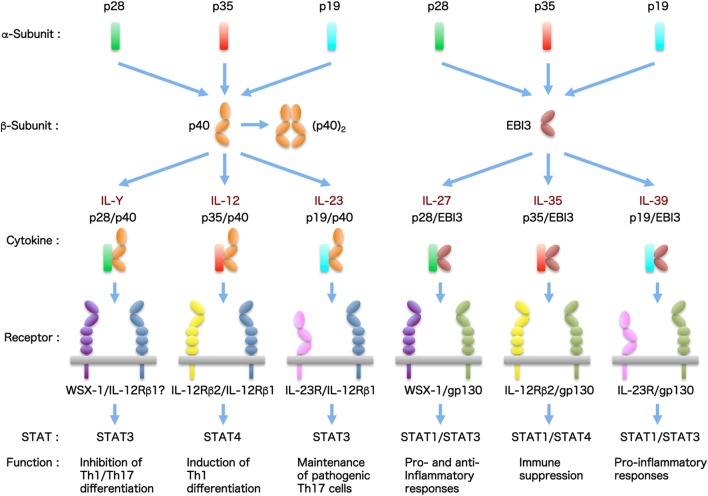
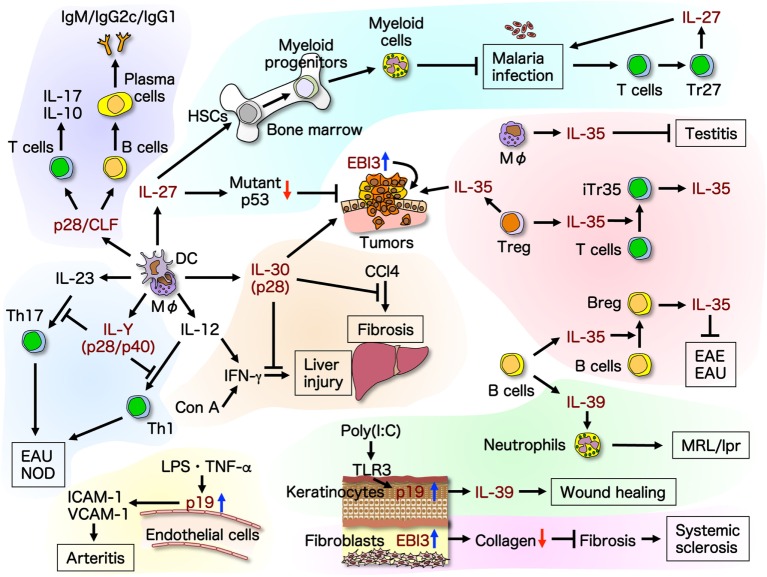
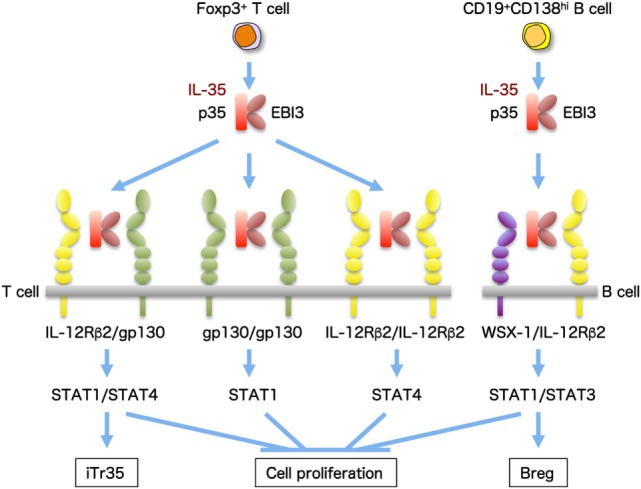
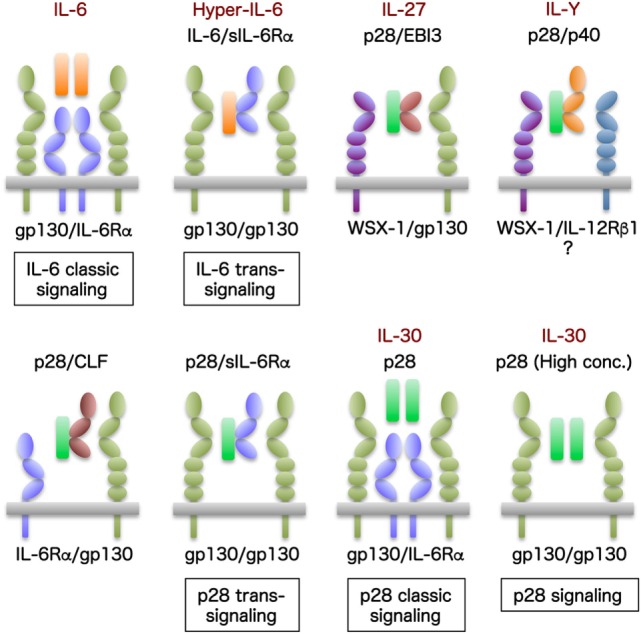
The interleukin (IL)-6/IL-12 family cytokines have pleiotropic functions and play critical roles in multiple immune responses. This cytokine family has very unique characteristics in that they are composed of two distinct subunits forming a heterodimer and each cytokine and receptor subunit shares with each other. The members of this cytokine family are increasing; currently, there are more than 6 cytokines, including the tentatively named cytokines IL-Y (p28/p40), IL-12 (p35/p40), IL-23 (p19/p40), IL-27 [p28/Epstein-Barr virus-induced protein 3 (EBI3)], IL-35 (p35/EBI3), and IL-39 (p19/EBI3). This family of cytokines covers a very broad range of immune responses, including pro-inflammatory responses such as helper T (Th)1, Th2, and Th17 to anti-inflammatory responses such as regulatory T (Treg) cells and IL-10-producing Treg cells. IL-12 is the first member of this family, and IL-12, IL-23, and IL-27 are mainly produced by activated antigen-presenting cells such as dendritic cells and macrophages. IL-12 plays a critical role in the promotion of Th1 immune responses by inducing interferon-γ production to combat pathogens and malignant tumors. IL-23 induces IL-17 production and is necessary to maintain pathogenic Th17 cells that cause inflammatory and autoimmune diseases. IL-27 was initially reported to play a critical role in promotion of Th1 differentiation; however, subsequent studies revealed that IL-27 has broader stimulatory and inhibitory roles by inducing IL-10-producing Treg cells. IL-35 is produced by forkhead box P3+ Treg cells and activated B cells and has immunosuppressive functions to maintain immune tolerance. The most recently identified cytokine, IL-39, is produced by activated B cells and has pro-inflammatory functions. The cytokine tentatively named IL-Y seems to have anti-inflammatory functions by inhibiting Th1 and Th17 differentiation. In addition, individual cytokine subunits were also shown to have self-standing activities. Thus, promiscuity within the IL-6/IL-12 family cytokines complicates structural and functional clarification and assignment of individual cytokines. A better understanding of the recent advances and expanding diversity in molecular structures and functions of the IL-6/IL-12 family cytokines could allow the creation of novel therapeutic strategies by using them as tools and targeted molecules.
Overview
The claims and statistics of this paper haven’t been checked yet.
Run the check — free, no account needed. It reads the open-access text and checks the sources it cites.
Integrity signals
Registry
Cites
Statistics
Figures
Verification
Claims the paper makes
The claims and statistics of this paper haven’t been checked yet.
Run the check — free, no account needed. It reads the open-access text and checks the sources it cites.
Claims other papers make about this one
Each is checked against this paper’s own text: does it say what the citing paper says it does?
The source backs part of the claim, not all of it — or backs it for a different population, condition or comparison.
In the citing paper
“IL-6, which was discovered in 1986 (27), is a pleiotropic cytokine involved not only in immune responses but also in inflammation, hematopoiesis, bone metabolism, embryonic development and other fundamental processes (1, 21, 28–32).”
From IL-6 in inflammation, autoimmunity and cancer (2021) · cites this paper as [32]
Experimental — accuracy not yet measured
Self-check
Percentages, sums and reported differences re-computed from the paper’s own numbers.
The self-check needs the paper’s full text.
Citations
Cites
Initial sequencing and analysis of the human genome
International Human Genome Sequencing Consortium, Whitehead Institute for Biomedical Research, C. F. G. R., Lander, E. S., Linton, L. M., Birren, B., Nusbaum, C., Zody, M. C., Baldwin, J., Devon, K., Dewar, K., et al. (2001) · Nature · doi:10.1038/35057062 · Cited by 24,216
The sequence of the human genome
Venter, J. C., Adams, M. D., Myers, E. W., Li, P. W., Mural, R. J., Sutton, G. G., Smith, H. O., Yandell, M., Evans, C. A., Holt, R. A., et al. (2001) · Science · doi:10.1126/science.1058040 · Cited by 13,909
Interleukin-10 and the Interleukin-10 Receptor
Moore, K. W., de Waal Malefyt, R., Coffman, R. L., & O'Garra, A. (2001) · Annual Review of Immunology · doi:10.1146/annurev.immunol.19.1.683 · Cited by 6,737
Interleukin-12 and the regulation of innate resistance and adaptive immunity
Trinchieri, G. (2003) · Nature reviews. Immunology · doi:10.1038/nri1001 · Cited by 4,007
The pro- and anti-inflammatory properties of the cytokine interleukin-6
Scheller, J., Chalaris, A., Schmidt-Arras, D., & Rose-John, S. (2011) · Biochimica et Biophysica Acta (BBA) - Molecular Cell Research · doi:10.1016/j.bbamcr.2011.01.034 · Cited by 3,212
Oppmann, B., Lesley, R., Blom, B., Timans, J. C., Xu, Y., Hunte, B., Vega, F., Yu, N., Wang, J., Singh, K. P., et al. (2000) · Immunity · doi:10.1016/s1074-7613(00)00070-4 · Cited by 2,819
The inhibitory cytokine IL-35 contributes to regulatory T-cell function
Collison, L., Workman, C., Kuo, T. T., Boyd, K., Wang, Y., Vignali, K. M., Cross, R., Sehy, D., Blumberg, R., & Vignali, D. (2007) · Nature · doi:10.1038/nature06306 · Cited by 2,152
The Sequence of the Human Genome
Venter, J. C., Smith, H. O., & Adams, M. D. (2015) · Clinical Chemistry · doi:10.1373/clinchem.2014.237016 · Cited by 1,665
Pflanz, S., Timans, J. C., Cheung, J., Rosales, R., Kanzler, H., Gilbert, J., Hibbert, L., Churakova, T., Travis, M. A., Vaisberg, E., et al. (2002) · Immunity · doi:10.1016/s1074-7613(02)00324-2 · Cited by 1,462
IL-12 family cytokines: immunological playmakers
Vignali, D. A. A., & Kuchroo, V. K. (2012) · Nature Immunology · doi:10.1038/ni.2366 · Cited by 1,331
Cited by
Sorted by citations
IL-6 in inflammation, autoimmunity and cancer
Hirano, T. (2021) · International Immunology · doi:10.1093/intimm/dxaa078 · Cited by 1,453
“IL-6, which was discovered in 1986 (27), is a pleiotropic cytokine involved not only in immune responses but also in inflammation, hematopoiesis, bone metabolism, embryonic development and other fundamental processes (1, 21, 28–32).”
BackgroundThe cytokine network involved in the host immune response to periodontitis
Pan, W., Wang, Q., & Chen, Q. (2019) · International Journal of Oral Science · doi:10.1038/s41368-019-0064-z · Cited by 740
Pleiotropy and specificity: insights from the interleukin 6 family of cytokines
Murakami, M., Kamimura, D., & Hirano, T. (2019) · Immunity · doi:10.1016/j.immuni.2019.03.027 · Cited by 533
Historical overview of the interleukin-6 family cytokine
Kang, S., Narazaki, M., Metwally, H., & Kishimoto, T. (2020) · Journal of Experimental Medicine · doi:10.1084/jem.20190347 · Cited by 360
IL-12 Family Cytokines in Cancer and Immunotherapy
Mirlekar, B., & Pylayeva‐Gupta, Y. (2021) · Cancers · doi:10.3390/cancers13020167 · Cited by 307
Metadata
- Authors
- Hasegawa, H., Mizoguchi, I., Chiba, Y., Ohashi, M., Xu, M., & Yoshimoto, T.
- Affiliations
- Tokyo Medical University (JP)
- Corresponding author
- Yoshimoto, Takayuki
- Venue
- Frontiers in Immunology
- Publisher
- Frontiers Media SA
- Published
- 2016-11-04
- Volume
- 7
- Pages
- 479-479
- ISSN
- 1664-3224 (ISSN-L)
- PMC
- PMC5095122
- OpenAlex
- W2548333195
- Cited by
- 142
- References
- 79
- Citations by year
- 2026: 6 · 2025: 13 · 2024: 16 · 2023: 14 · 2022: 13 · 2021: 16 · 2020: 16 · 2019: 17 · 2018: 22 · 2017: 9
- FWCI
- 1.61
- Type
- journal article
- Language
- en
- Open access
- gold
- doi.org
- Licence
- cc-by
- Locations
- Frontiers in Immunology (publishedVersion, cc-by)
- PubMed Central (publishedVersion, cc-by)
- PubMed (publishedVersion)
- DOAJ (DOAJ: Directory of Open Access Journals) (submittedVersion, cc-by-sa)
- Funders
- Japan Society for the Promotion of Science (16J04160, 15K07947, 15K08433)
- Topics
- Life Sciences › Immunology and Microbiology › Immunology › Cytokine Signaling Pathways and Interactions
- Life Sciences › Immunology and Microbiology › Immunology › T-cell and B-cell Immunology
- Life Sciences › Immunology and Microbiology › Immunology › Psoriasis: Treatment and Pathogenesis
- Keywords
- heterodimeric cytokine, IL-12, IL-23, IL-27, IL-35, IL-39, p40 subunit, EBI3, Th1 cells, Th17 cells, regulatory T cells, IL-10, interferon-gamma, IL-17, dendritic cells, macrophages
About these checks
Registry, retraction, Cites and statistics results are computed, not judged, with one exception: a printed reference that no index lists is read once by a model before it counts as a citation error. Claims are extracted by a model and kept only when their quote appears verbatim in the text; each cited source is then checked, with a model’s help, for whether it says what the claim relies on. Those verdicts can be wrong — read the claim’s quote and the cited source before relying on one.
Statistics and arithmetic are recomputed, not judged.
Confidence bands are shown only for fields calibrated on our annotated test set. None is calibrated yet, so no band is shown.
What counts as a claim ›How we measure confidence ›How we check this ›
Are you an author, or do you see a problem with this page? Request a review
