

The DOI matches its Crossref record; 114 of the 116 references it cites were found in a registry or an index.
CD3(+)CD4(-)CD8(-) (Double-negative) T cells in inflammation, immune disorders and cancer
Open accessAbstract
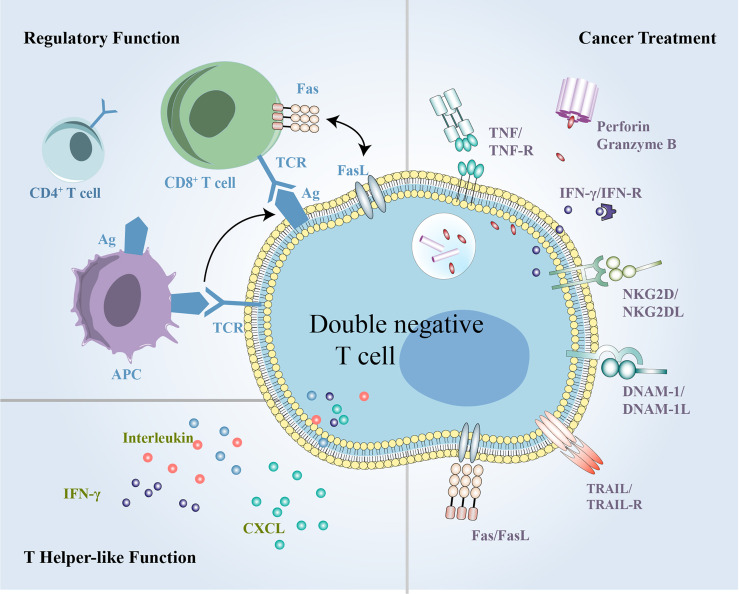
double-negative (DN) T cells, although constituting a rare subset of peripheral T cells, are gaining interest for their roles in inflammation, immune disease and cancer. Herein, we comprehensively review the origin, distribution and functions of this unique T cell subgroup. First, we focused on characterizing multifunctional DN T cells in various immune responses. DN regulatory T cells have the capacity to prevent graft-versus-host disease and have therapeutic value for autoimmune disease. T helper-like DN T cells protect against or promote inflammation and virus infection depending on the specific settings and promote certain autoimmune disease. Notably, we clarified the role of DN tumor-infiltrating lymphocytes and outlined the potential for malignant proliferation of DN T cells. Finally, we reviewed the recent advances in the applications of DN T cell-based therapy for cancer. In conclusion, a better understanding of the heterogeneity and functions of DN T cells may help to develop DN T cells as a potential therapeutic tool for inflammation, immune disorders and cancer.
Overview
The claims and statistics of this paper haven’t been checked yet.
Run the check — free, no account needed. It reads the open-access text and checks the sources it cites.
Integrity signals
Registry
Cites
Statistics
Figures
Verification
Claims the paper makes
The claims and statistics of this paper haven’t been checked yet.
Run the check — free, no account needed. It reads the open-access text and checks the sources it cites.
Claims other papers make about this one
Each is checked against this paper’s own text: does it say what the citing paper says it does?
The cited source says what the claim attributes to it.
In the citing paper
“Althought the roles of these cells in tumors are still controversial, the use of DN T cells for cancer immunotherpy against blood and solid tumor were reported (46).”
From mRNA vaccine with unmodified uridine induces robust type I interferon-dependent anti-tumor immunity in a melanoma model (2022) · cites this paper as [46]
Self-check
Percentages, sums and reported differences re-computed from the paper’s own numbers.
The self-check needs the paper’s full text.
Citations
Cites
DiNardo, C. D., Pratz, K., Pullarkat, V., Jonas, B. A., Arellano, M., Becker, P. S., Frankfurt, O., Konopleva, M., Wei, A. H., Kantarjian, H. M., et al. (2019) · Blood · doi:10.1182/blood-2018-08-868752 · Cited by 1,825
Six-of-the-best: unique contributions of γδ T cells to immunology
Vantourout, P., & Hayday, A. (2013) · Nature Reviews Immunology · doi:10.1038/nri3384 · Cited by 1,232
Lpr and gld: Single Gene Models of Systemic Autoimmunity and Lymphoproliferative Disease
Cohen, P. L., & Eisenberg, R. A. (1991) · Annual Review of Immunology · doi:10.1146/annurev.iy.09.040191.001331 · Cited by 1,169
The machinery of programmed cell death
Zimmermann, K. C., Bonzon, C., & Green, D. R. (2001) · Pharmacology & Therapeutics · doi:10.1016/s0163-7258(01)00159-0 · Cited by 829
Crispín, J. C., Oukka, M., Bayliss, G. P., Cohen, R. A., van Beek, C., Stillman, I. E., Kyttaris, V. C., Juang, Y., & Tsokos, G. C. (2008) · The Journal of Immunology · doi:10.4049/jimmunol.181.12.8761 · Cited by 800
Pollyea, D. A., Stevens, B. M., Jones, C. L., Winters, A., Pei, S., Minhajuddin, M., D’Alessandro, A., Culp-Hill, R., Riemondy, K. A., Gillen, A. E., et al. (2018) · Nature Medicine · doi:10.1038/s41591-018-0233-1 · Cited by 778
Zhang, Z., Yang, L. M., Young, K. J., DuTemple, B., & Zhang, L. (2000) · Nature Medicine · doi:10.1038/77513 · Cited by 459
Shivakumar, S., Tsokos, G. C., & Datta, S. (1989) · The Journal of Immunology · doi:10.4049/jimmunol.143.1.103 · Cited by 405
Huard, B., Prigent, P., Tournier, M., Bruniquel, D., & Triebel, F. (1995) · European Journal of Immunology · doi:10.1002/eji.1830250949 · Cited by 391
Fas death receptor signalling: roles of Bid and XIAP
Kaufmann, T., Strasser, A., & Jost, P. J. (2011) · Cell Death and Differentiation · doi:10.1038/cdd.2011.121 · Cited by 388
Cited by
Sorted by citations
An atlas of cells in the human tonsil
Massoni-Badosa, R., Aguilar-Fernández, S., Nieto, J. C., Soler-Vila, P., Elosua-Bayés, M., Marchese, D., Kulis, M., Vilas‐Zornoza, A., Bühler, M. M., Rashmi, S., et al. (2024) · Immunity · doi:10.1016/j.immuni.2024.01.006 · Cited by 188
Reproductive Ageing: Inflammation, immune cells, and cellular senescence in the aging ovary
Isola, J. V. V., Hense, J. D., Osorio, C. A. P., Biswas, S., Alberola‐Ila, J., Ocañas, S. R., Schneider, A., & Stout, M. B. (2024) · Reproduction · doi:10.1530/rep-23-0499 · Cited by 115
Xu, J., Wang, B., Yu, S., Chen, S., Yang, S., Liu, R., Chen, L., Hou, J., Chen, Z., Zhao, W., et al. (2024) · Journal of Hematology & Oncology · doi:10.1186/s13045-024-01530-z · Cited by 89
Sittplangkoon, C., Alameh, M.-G., Weissman, D., Lin, P. J. C., Tam, Y. K., Prompetchara, E., & Palaga, T. (2022) · Frontiers in Immunology · doi:10.3389/fimmu.2022.983000 · Cited by 79
“Althought the roles of these cells in tumors are still controversial, the use of DN T cells for cancer immunotherpy against blood and solid tumor were reported (46).”
BackgroundStrategies for overcoming bottlenecks in allogeneic CAR-T cell therapy
Lv, Z., Luo, F., & Chu, Y. (2023) · Frontiers in Immunology · doi:10.3389/fimmu.2023.1199145 · Cited by 70
Metadata
- Authors
- Wu, Z., Zheng, Y., Sheng, J., Han, Y., Yang, Y., Pan, H., & Yao, J.
- Affiliations
- Sir Run Run Shaw Hospital (CN)
- Corresponding author
- Pan, Hongming
- Yao, Junlin
- Venue
- Frontiers in Immunology
- Publisher
- Frontiers Media SA
- Published
- 2022-02-10
- Volume
- 13
- Pages
- 816005-816005
- ISSN
- 1664-3224 (ISSN-L)
- PMC
- PMC8866817
- OpenAlex
- W4211100870
- Cited by
- 265
- References
- 116
- Citations by year
- 2026: 38 · 2025: 90 · 2024: 75 · 2023: 47 · 2022: 14
- FWCI
- 6.14
- Type
- journal article
- Language
- en
- Open access
- gold
- doi.org
- Licence
- Locations
- Frontiers in Immunology (publishedVersion, cc-by)
- PubMed Central (publishedVersion, cc-by)
- PubMed (publishedVersion)
- DOAJ (DOAJ: Directory of Open Access Journals) (submittedVersion, cc-by-sa)
- Funders
- National Natural Science Foundation of China (81803070, 81702809)
- Natural Science Foundation of Zhejiang Province (LSY19H160006)
- Topics
- Life Sciences › Immunology and Microbiology › Immunology › T-cell and B-cell Immunology
- Life Sciences › Immunology and Microbiology › Immunology › Psoriasis: Treatment and Pathogenesis
- Health Sciences › Medicine › Oncology › Cancer Immunotherapy and Biomarkers
- Keywords
- double-negative T cells, CD3+CD4-CD8- T cells, regulatory T cells, graft-versus-host disease, autoimmune disease, inflammation, viral infection, tumor-infiltrating lymphocytes, T cell heterogeneity
- MeSH terms
- Autoimmune Diseases, Graft vs Host Disease, Humans, Inflammation, Neoplasms, CD8 Antigens, CD8-Positive T-Lymphocytes
About these checks
Registry, retraction, Cites and statistics results are computed, not judged, with one exception: a printed reference that no index lists is read once by a model before it counts as a citation error. Claims are extracted by a model and kept only when their quote appears verbatim in the text; each cited source is then checked, with a model’s help, for whether it says what the claim relies on. Those verdicts can be wrong — read the claim’s quote and the cited source before relying on one.
Statistics and arithmetic are recomputed, not judged.
Confidence bands are shown only for fields calibrated on our annotated test set. None is calibrated yet, so no band is shown.
What counts as a claim ›How we measure confidence ›How we check this ›
Are you an author, or do you see a problem with this page? Request a review
