

The DOI matches its Crossref record; 226 of the 226 references it cites were found in a registry or an index.
Combinatorial blockade for cancer immunotherapy: targeting emerging immune checkpoint receptors
Open accessAbstract
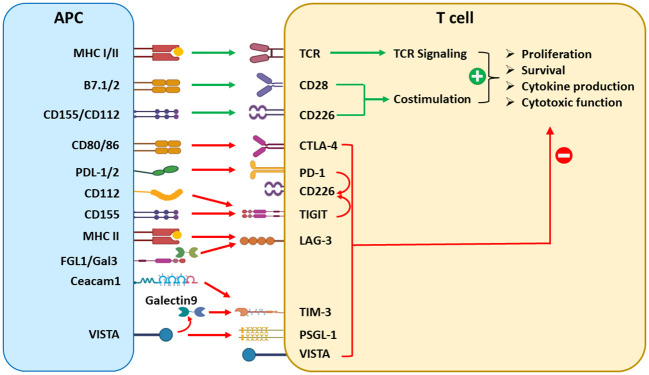
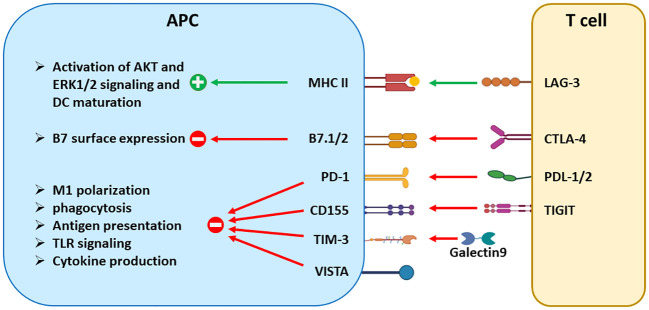
The differentiation, survival, and effector function of tumor-specific CD8+ cytotoxic T cells lie at the center of antitumor immunity. Due to the lack of proper costimulation and the abundant immunosuppressive mechanisms, tumor-specific T cells show a lack of persistence and exhausted and dysfunctional phenotypes. Multiple coinhibitory receptors, such as PD-1, CTLA-4, VISTA, TIGIT, TIM-3, and LAG-3, contribute to dysfunctional CTLs and failed antitumor immunity. These coinhibitory receptors are collectively called immune checkpoint receptors (ICRs). Immune checkpoint inhibitors (ICIs) targeting these ICRs have become the cornerstone for cancer immunotherapy as they have established new clinical paradigms for an expanding range of previously untreatable cancers. Given the nonredundant yet convergent molecular pathways mediated by various ICRs, combinatorial immunotherapies are being tested to bring synergistic benefits to patients. In this review, we summarize the mechanisms of several emerging ICRs, including VISTA, TIGIT, TIM-3, and LAG-3, and the preclinical and clinical data supporting combinatorial strategies to improve existing ICI therapies.
Overview
The claims and statistics of this paper haven’t been checked yet.
Run the check — free, no account needed. It reads the open-access text and checks the sources it cites.
Integrity signals
Registry
Cites
Statistics
Figures
Verification
Claims the paper makes
The claims and statistics of this paper haven’t been checked yet.
Run the check — free, no account needed. It reads the open-access text and checks the sources it cites.
Claims other papers make about this one
Each is checked against this paper’s own text: does it say what the citing paper says it does?
The cited source says what the claim attributes to it.
In the citing paper
“Physiologically, CTLA-4 is an immune checkpoint receptor expressed on Foxp3+ regulatory T cells and conventional T cells.”
From Preclinical development of an mRNA-based multiepitope immunotherapeutic for glioblastoma (2025) · cites this paper as [44]
The cited source says what the claim attributes to it.
In the citing paper
“CTLA-4 has also been detected in natural killer cells, B cells, dendritic cells and myeloid cells [44].”
From Preclinical development of an mRNA-based multiepitope immunotherapeutic for glioblastoma (2025) · cites this paper as [44]
Self-check
Percentages, sums and reported differences re-computed from the paper’s own numbers.
The self-check needs the paper’s full text.
Citations
Cites
2 retracted
TIGIT predominantly regulates the immune response via regulatory T cells
Kurtuluş, S., Sakuishi, K., Ngiow, S. F., Joller, N., Tan, D. J., Teng, M. W. L., Smyth, M. J., Kuchroo, V. K., & Anderson, A. C. (2015) · Journal of Clinical Investigation · doi:10.1172/jci81187 · Cited by 558
RetractedTim-3 Expression in Cervical Cancer Promotes Tumor Metastasis
Cao, Y., Zhou, X., Huang, X., Li, Q., Gao, L., Jiang, L., Huang, M. J., & Zhou, J. (2013) · PLoS ONE · doi:10.1371/journal.pone.0053834 · Cited by 145
RetractedAdverse Renal Effects of Immune Checkpoint Inhibitors: A Narrative Review
Wanchoo, R., Karam, S., Uppal, N. N., Barta, V. S., Deray, G., Devoe, C., Launay‐Vacher, V., Jhaveri, K. D., & on behalf of Cancer and Kidney International Network Workgroup on Immune Checkpoint Inhibitors (2017) · American Journal of Nephrology · doi:10.1159/000455014 · Cited by 15,320
Improved Survival with Ipilimumab in Patients with Metastatic Melanoma
Hodi, F. S., O'Day, S. J., McDermott, D. F., Weber, R. W., Sosman, J. A., Haanen, J. B., Gonzalez, R., Robert, C., Schadendorf, D., Hassel, J. C., et al. (2010) · New England Journal of Medicine · doi:10.1056/nejmoa1003466 · Cited by 15,155
Combined Nivolumab and Ipilimumab or Monotherapy in Untreated Melanoma
Larkin, J., Chiarion-Sileni, V., Gonzalez, R., Grob, J. J., Cowey, C. L., Lao, C. D., Schadendorf, D., Dummer, R., Smylie, M., Rutkowski, P., et al. (2015) · New England Journal of Medicine · doi:10.1056/nejmoa1504030 · Cited by 8,157
Oncology meets immunology: the cancer-immunity cycle.
Chen, D. S., & Mellman, I. (2013) · Immunity · doi:10.1016/j.immuni.2013.07.012 · Cited by 6,929
Overall Survival with Combined Nivolumab and Ipilimumab in Advanced Melanoma
Wolchok, J. D., Chiarion-Sileni, V., Gonzalez, R., Rutkowski, P., Grob, J.-J., Cowey, C. L., Lao, C. D., Wagstaff, J., Schadendorf, D., Ferrucci, P. F., et al. (2017) · New England Journal of Medicine · doi:10.1056/nejmoa1709684 · Cited by 5,357
Nivolumab plus Ipilimumab versus Sunitinib in Advanced Renal-Cell Carcinoma
Motzer, R. J., Tannir, N. M., McDermott, D. F., Arén Frontera, O., Melichar, B., Choueiri, T. K., Plimack, E. R., Barthélémy, P., Porta, C., George, S., et al. (2018) · New England Journal of Medicine · doi:10.1056/nejmoa1712126 · Cited by 4,656
Ipilimumab plus Dacarbazine for Previously Untreated Metastatic Melanoma
Robert, C., Thomas, L., Bondarenko, I., O'Day, S., Weber, J., Garbe, C., Lebbe, C., Baurain, J.-F., Testori, A., Grob, J.-J., et al. (2011) · New England Journal of Medicine · doi:10.1056/nejmoa1104621 · Cited by 4,496
Enhancement of Antitumor Immunity by CTLA-4 Blockade
Leach, D. R., Krummel, M. F., & Allison, J. P. (1996) · Science · doi:10.1126/science.271.5256.1734 · Cited by 3,955
Research works printed but not linked: 1
- Huang, 2015, LAG3 and PD1 co-inhibitory molecules collaborate to limit CD8+ T cell signaling and dampen antitumor immunity in a murine ovarian cancer model, Oncotarget, 6, 10.18632/oncotarget.4751 · DOI
Cited by
Sorted by citations
Preclinical development of an mRNA-based multiepitope immunotherapeutic for glioblastoma
Lutz, J., Feist, R. K., Sonntag, T., Peguero-Sánchez, E., Wolter, K., Bick, R., Bauer, J., Walz, J. S., & Heidenreich, R. (2025) · Cancer Immunology, Immunotherapy · doi:10.1007/s00262-025-04178-x · Cited by 9
Metadata
- Authors
- Roy, D., Gilmour, C., Patnaik, S., & Wang, L. L.
- Affiliations
- Cleveland Clinic (US)
- Corresponding author
- Wang, Li Lily
- Venue
- Frontiers in Immunology
- Publisher
- Frontiers Media SA
- Published
- 2023-10-19
- Volume
- 14
- Pages
- 1264327-1264327
- ISSN
- 1664-3224 (ISSN-L)
- PMC
- PMC10620683
- OpenAlex
- W4387777058
- Cited by
- 53
- References
- 226
- Citations by year
- 2026: 15 · 2025: 24 · 2024: 13 · 2023: 1
- FWCI
- 1.71
- Type
- journal article
- Language
- en
- Open access
- gold
- doi.org
- Licence
- Locations
- Frontiers in Immunology (publishedVersion, cc-by)
- PubMed Central (publishedVersion, cc-by)
- PubMed (publishedVersion)
- DOAJ (DOAJ: Directory of Open Access Journals) (submittedVersion, cc-by-sa)
- Funders
- U.S. Department of Defense (W81XWH)
- National Cancer Institute (R01CA223804, R21CA258618, R01CA164225, F31CA257276)
- Congressionally Directed Medical Research Programs (W81XWH-21-MRP-MCAA ME210229, W81XWH-21-LCRP-IITRA LC210336)
- Topics
- Health Sciences › Medicine › Oncology › Cancer Immunotherapy and Biomarkers
- Life Sciences › Immunology and Microbiology › Immunology › T-cell and B-cell Immunology
- Life Sciences › Immunology and Microbiology › Immunology › Immunotherapy and Immune Responses
- Keywords
- immune checkpoint receptors, immune checkpoint inhibitors, combination immunotherapy, T cell exhaustion, PD-1, CTLA-4, VISTA, TIGIT, TIM-3, LAG-3, cytotoxic T lymphocytes, antitumor immunity, costimulation
- MeSH terms
- Hepatitis A Virus Cellular Receptor 2, Humans, Immunotherapy, Neoplasms, Receptors, Immunologic, T-Lymphocytes, Cytotoxic
About these checks
Registry, retraction, Cites and statistics results are computed, not judged, with one exception: a printed reference that no index lists is read once by a model before it counts as a citation error. Claims are extracted by a model and kept only when their quote appears verbatim in the text; each cited source is then checked, with a model’s help, for whether it says what the claim relies on. Those verdicts can be wrong — read the claim’s quote and the cited source before relying on one.
Statistics and arithmetic are recomputed, not judged.
Confidence bands are shown only for fields calibrated on our annotated test set. None is calibrated yet, so no band is shown.
What counts as a claim ›How we measure confidence ›How we check this ›
Are you an author, or do you see a problem with this page? Request a review
