

The DOI matches its Crossref record; the references it cites are not checked yet.
Higher Abundance of Marine Predators and Changes in Fishers' Behavior Following Spatial Protection within the World's Biggest Shark Fishery
Open accessAbstract
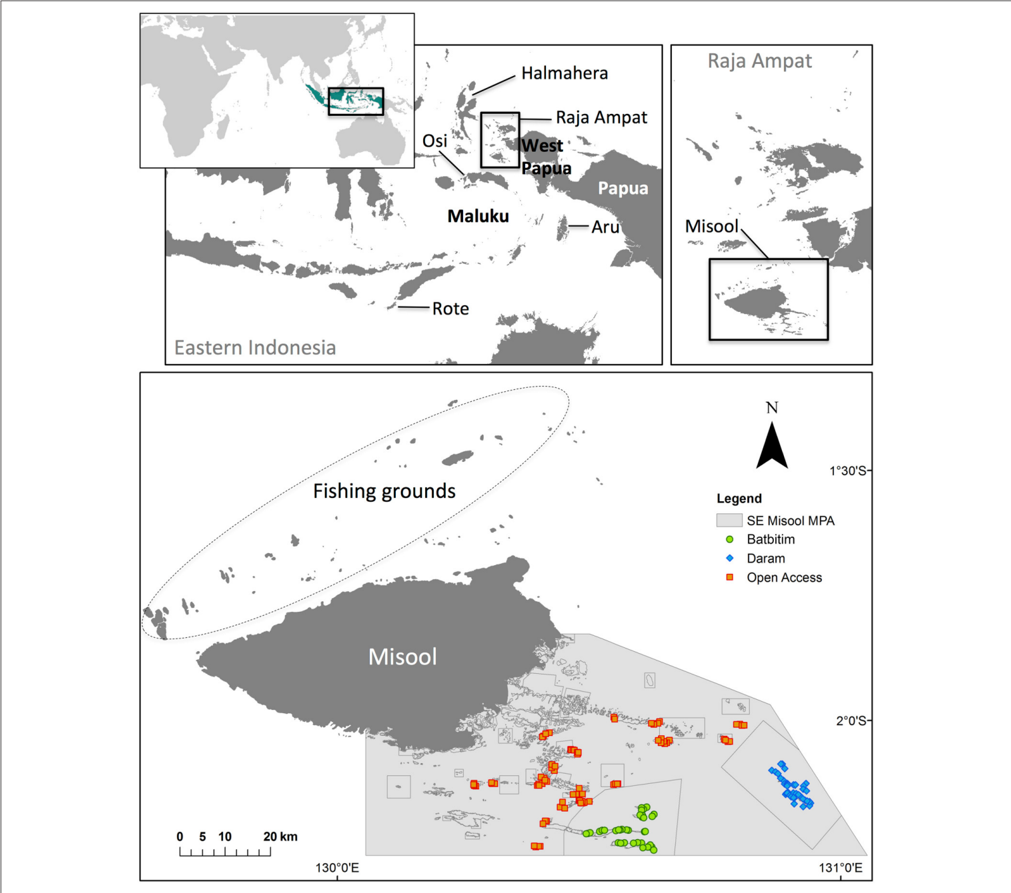
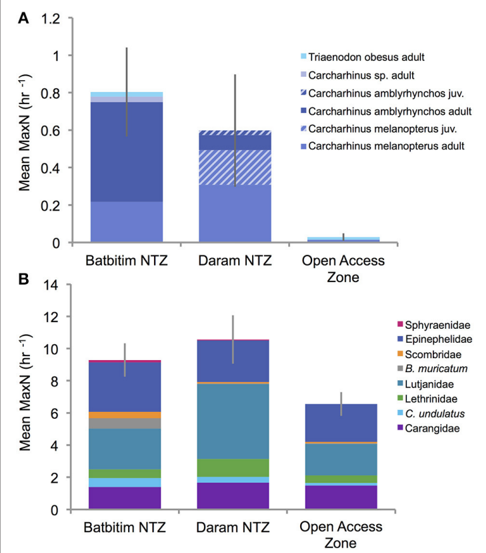
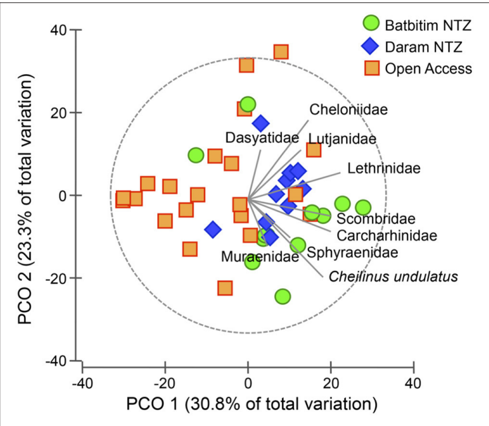
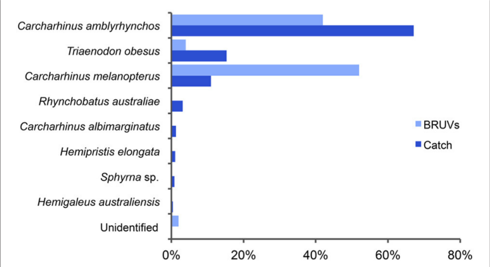
Fisheries are complex social-ecological systems, where managers struggle to balance the socio-economic interests of fishing communities with the biology and ecology of fisheries species. Spatial closures are a popular measure to address conservation and fisheries management goals, including the protection of shark populations. However, very little research has been published on the effectiveness of shark-specific closures to protect sharks, or their impacts on fisher behavior. Situated within the global center of tropical marine biodiversity, Indonesia’s shark fishery contributes more to the international shark fin trade than any other nation. Here we evaluate the effect of shark-specific closures on sharks and other species of interest, as well as shark fishers’ responses to losing access to their former fishing grounds. We assessed shark diversity and abundance in an open access zone (OAZ) and two No-Take Zones (NTZs) of a Marine Protected Area within the recently established shark sanctuary in Raja Ampat, Indonesia, where sharks have high monetary value as a tourism attraction. Shark abundance was significantly higher in the privately managed NTZs than in the OAZ. Across all management zones, neither zone size, depth nor reef complexity explained variations in shark abundance, suggesting that governance is the main driver of successful shark conservation areas. These trends were also reflected in species targeted by small-scale reef fisheries, including snappers, emperor, groupers, tunas, mackerels, and large-bodied wrasse and parrotfish. Interviews with shark fishers who lost access to their primary fishing grounds when the shark sanctuary was established showed that while most fishers (88%) knew that sharks were protected in Raja Ampat, many were unsure about the purpose of the sanctuary. Few fishers felt that the agencies implementing fishing bans understood their livelihood needs. We found that shark fishers adapted to the loss of former fishing grounds by shifting fishing effort to other locations or diversifying their livelihoods, including illegal petrol transport. While conserving sharks for tourism can be effective, it may inadvertently result in displacing fishing effort to unprotected regions. We propose that effective shark conservation in Indonesia will need to combine strategic spatial protection with efforts to support livelihood security and diversification.
Overview
The claims and statistics of this paper haven’t been checked yet.
Run the check — free, no account needed. It reads the open-access text and checks the sources it cites.
Integrity signals
Registry
Cites
Statistics
Figures
Verification
Claims the paper makes
The claims and statistics of this paper haven’t been checked yet.
Run the check — free, no account needed. It reads the open-access text and checks the sources it cites.
Claims other papers make about this one
Each is checked against this paper’s own text: does it say what the citing paper says it does?
The cited source says what the claim attributes to it.
In the citing paper
“Overall, reef shark CPUE in the TRNP was w 3 and 7 times higher than Batbatim & Daram (Jaiteh et al 2016) and Dampier & Penamu (Beer 2015), two NTZs in Raja Ampat (RA) MPAs network in Indonesia, respectively”
From Tubbataha Reefs Natural Park: the first comprehensive elasmobranch assessment reveals global hotspot for reef sharks (2019) · cites this paper as Jaiteh et al 2016
Self-check
Percentages, sums and reported differences re-computed from the paper’s own numbers.
The self-check needs the paper’s full text.
Citations
The citation lists are queued
They are fetched later and appear here then.
References 67 · Cited by 80
Research works printed but not linked: 10
- Allen, 2012, Reef Fishes of the East Indies, Vol. I–III
- Anderson, 2008, PERMANOVA+ for PRIMER: Guide to Software and Statistical Methods
- Christie, 2004, Marine protected areas as biological successes and social failures in Southeast Asia, Am. Fish. Soc., 42, 155
- FAO FishStatJ, 2015, Fisheries and Aquaculture Software
- McKibben, 1986, Patterns of movement and grouping of gray reef sharks, Carcharhinus amblyrhynchos, at Enewetak, Marshall Islands, Bull. Mar. Sci., 38, 89
- Muhajir, 2012, Marine Resource Use Monitoring in Misool Marine Protected Area, Raja Ampat, West Papua, 2006–2011. Report No.
- Nelson, 1980, Behavior of the reef sharks of Rangiroa, French Polynesia, Natl. Geogr. Soc. Res. Rep., 12, 479
- Seager, 2014, Event Measure. Measurement Science Specialists.
- Whitcraft, 2014, Evidence of Declines in Shark fin Demand, China
- White, 2006, Economically Important Sharks and Rays of Indonesia
Metadata
- Authors
- Jaiteh, V. F., Lindfield, S. J., Mangubhai, S., Warren, C., Fitzpatrick, B., & Loneragan, N. R.
- Affiliations
- Murdoch University (AU)
- The Nature Conservancy (US)
- Corresponding author
- Jaiteh, Vanessa F.
- Venue
- Frontiers in Marine Science
- Publisher
- Frontiers Media SA
- Published
- 2016-04-07
- Volume
- 3
- ISSN
- 2296-7745 (ISSN-L)
- OpenAlex
- W2332216724
- Cited by
- 80
- References
- 67
- Citations by year
- 2026: 4 · 2025: 14 · 2024: 8 · 2023: 5 · 2022: 15 · 2021: 4 · 2020: 11 · 2019: 7 · 2018: 7 · 2017: 2 · 2016: 3
- FWCI
- 5.47
- Type
- journal article
- Language
- en
- Open access
- gold
- doi.org
- Licence
- cc-by
- Locations
- Frontiers in Marine Science (publishedVersion, cc-by)
- Murdoch University Research Portal (submittedVersion)
- DOAJ (DOAJ: Directory of Open Access Journals) (submittedVersion)
- Funders
- Australia Awards (Prime Minister's Australia-Asia Endeavour Award, Australian Postgraduate Award)
- Murdoch University
- Topics
- Physical Sciences › Environmental Science › Nature and Landscape Conservation › Ichthyology and Marine Biology
- Physical Sciences › Environmental Science › Ecology › Coral and Marine Ecosystems Studies
- Life Sciences › Agricultural and Biological Sciences › Aquatic Science › Marine and fisheries research
- Keywords
- shark conservation, no-take zones, marine protected areas, fishing behavior, livelihood diversification, shark fin trade, Raja Ampat, ocean governance, social-ecological systems
About these checks
Registry, retraction, Cites and statistics results are computed, not judged, with one exception: a printed reference that no index lists is read once by a model before it counts as a citation error. Claims are extracted by a model and kept only when their quote appears verbatim in the text; each cited source is then checked, with a model’s help, for whether it says what the claim relies on. Those verdicts can be wrong — read the claim’s quote and the cited source before relying on one.
Statistics and arithmetic are recomputed, not judged.
Confidence bands are shown only for fields calibrated on our annotated test set. None is calibrated yet, so no band is shown.
What counts as a claim ›How we measure confidence ›How we check this ›
Are you an author, or do you see a problem with this page? Request a review
How to cite
Cite CoChat for the checks on this page, and the paper for its own findings.
- This page
- CoChat. (2026). Citation check: Higher Abundance of Marine Predators and Changes in Fishers' Behavior Following Spatial Protection within the World's Biggest Shark Fishery. https://app.cochat.ai/papers/10.3389/fmars.2016.00043
- The paper
- Jaiteh, V. F., Lindfield, S. J., Mangubhai, S., Warren, C., Fitzpatrick, B., & Loneragan, N. R. (2016). Higher Abundance of Marine Predators and Changes in Fishers' Behavior Following Spatial Protection within the World's Biggest Shark Fishery. Frontiers in Marine Science. https://doi.org/10.3389/fmars.2016.00043
