

Robotic Vehicles Enable High-Resolution Light Pollution Sampling of Sea Turtle Nesting Beaches
Open accessThe DOI matches its Crossref record; 33 of the 35 references it cites were found in a registry or an index; none of the 37 sources its claims cite is checked for support yet.
Abstract
Nesting sea turtles appear to avoid brightly lit beaches and often turn back to sea prematurely when exposed to artificial light. Observations and experiments have noted that nesting turtles prefer darker areas where buildings and high dunes act as light barriers. As a result, sea turtles often nest on darker beaches, creating spatial concentrations of nests. Artificial nighttime light, or light pollution, has been quantified using a variety of methods. However, it has proven challenging to make accurate measurements of ambient light at fine scales and on smaller nesting beaches. Additionally, light has traditionally been measured from stationary tripods perpendicular to beach vegetation, disregarding the point of view of a nesting sea turtle. In the present study, nighttime ambient light conditions were assessed on three beaches in central North Carolina: a developed coastline of a barrier island, a nearby State Park on the same barrier island comprised of protected and undeveloped land, and a completely uninhabited wilderness on an adjacent barrier island in the Cape Lookout National Seashore. Using an autonomous terrestrial rover, high resolution light measurements (mag/arcsec2) were collected every minute with two Sky Quality Meter-LU-DL, Unihedron along transects on each beach. Spatial comparisons between ambient light and nesting density at and between these locations reveal that highest densities of nests occur in regions with lowest light levels, supporting the hypothesis that light pollution from coastal development may influence turtle nesting distribution. These results can be used to support ongoing management strategies to mitigate this pressing conservation issue.
Overview
CoChat Summary
TL;DR
An autonomous terrestrial rover equipped with Sky Quality Meters sampled nighttime ambient light at sea-turtle eye level on three central North Carolina beaches in summer 2017. Light pollution was significantly higher and nesting density lower on the developed Atlantic Beach than on Fort Macon State Park and Shackleford Banks, supporting the hypothesis that coastal light pollution influences sea turtle nesting distribution.
Key findings
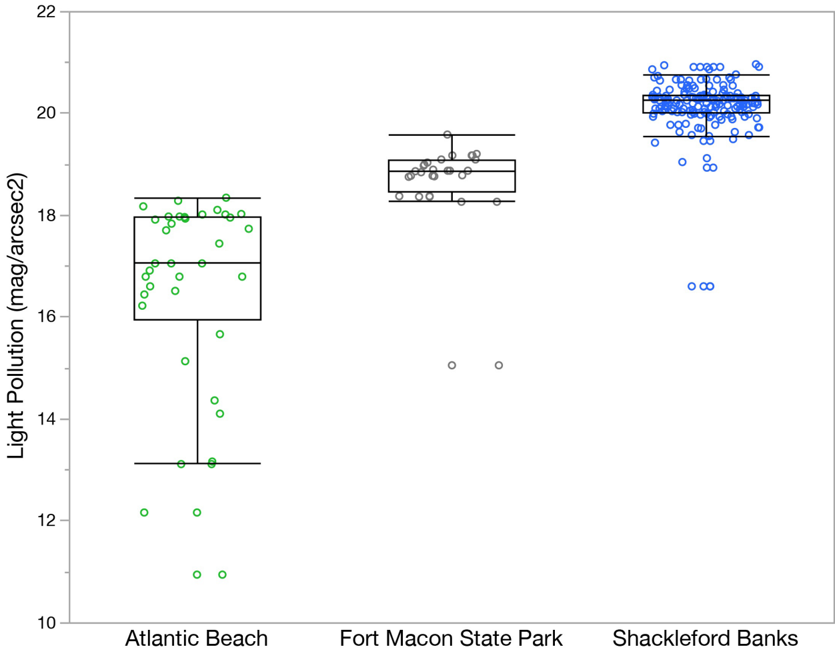
- Light pollution differed significantly among beaches (ANOVA p < 0.0001; Wilcoxon pairwise p < 0.0001): Atlantic Beach mean 16.29 ± 2.21 mag/arcsec² (min 10.13, max 19.46), Fort Macon State Park 18.57 ± 0.89 (15.06–19.59), and Shackleford Banks 20.23 ± 0.60 (16.03–21.35); lower mag/arcsec² indicates brighter light. Average Atlantic Beach light was 8× brighter than Fort Macon and 36× brighter than Shackleford Banks.
- Nesting density was lowest on Atlantic Beach (1.19 ± 0.85 nests/year/beach length; 37 nests), intermediate on Fort Macon (2.56 ± 1.82; 28 nests), and highest on Shackleford Banks (2.80 ± 0.97; 160 nests), the darkest beach.
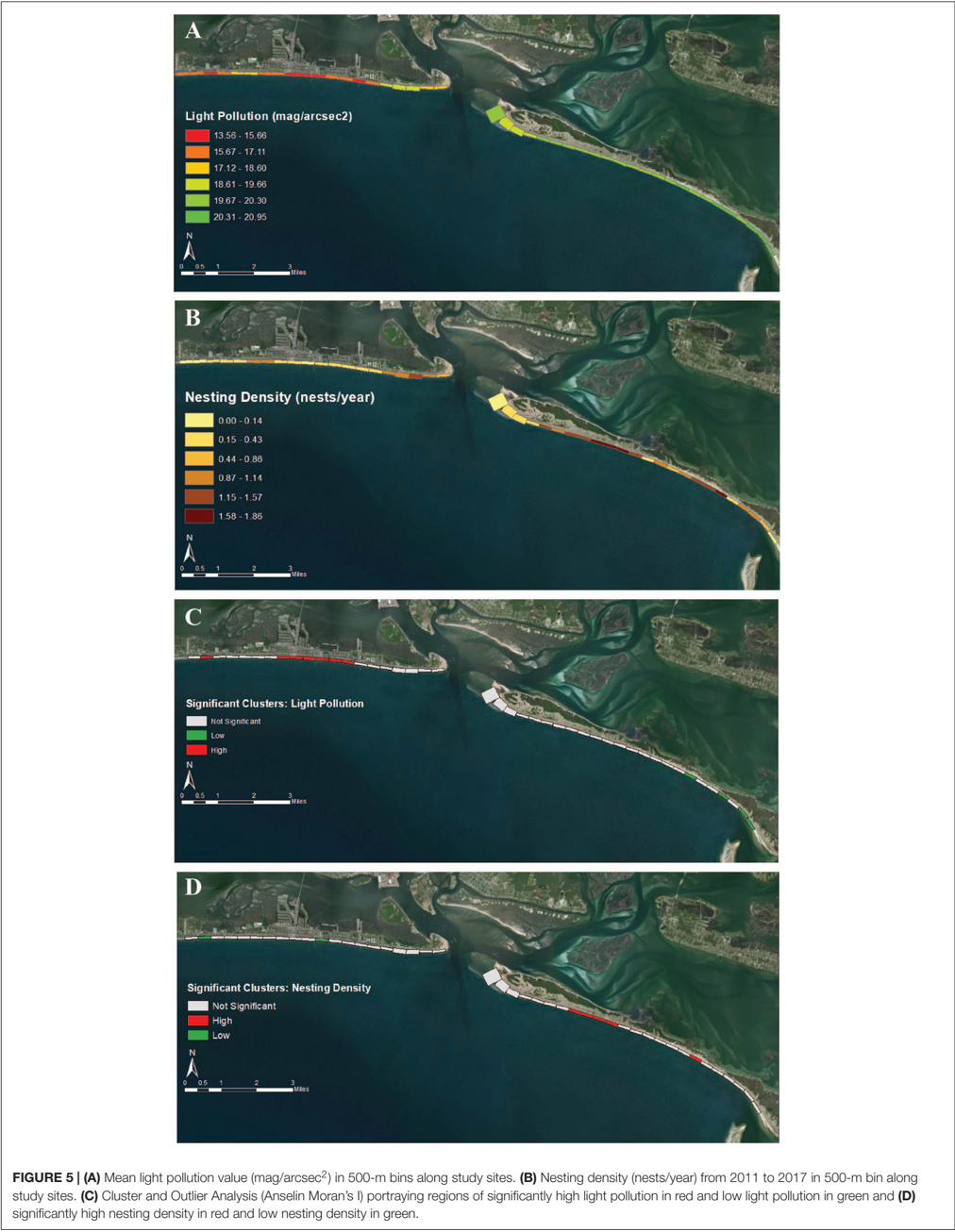
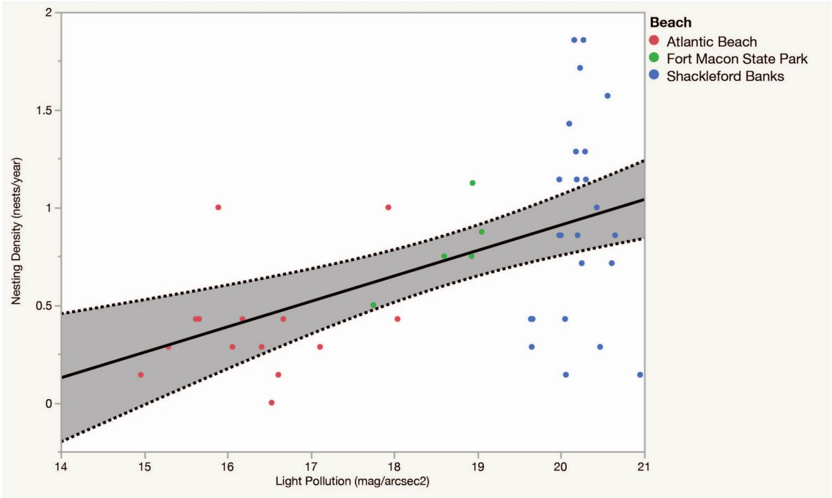
- In 500-m alongshore bins, mean light ranged from 13.56 to 20.95 mag/arcsec² and nesting density from 0 to 1.86 nests/year; mean light and nesting density were significantly correlated (n = 44, R² = 0.28, p = 0.0002), with lower nesting density in brighter areas (line of best fit: nesting density = -1.70 + 0.13 × light pollution).
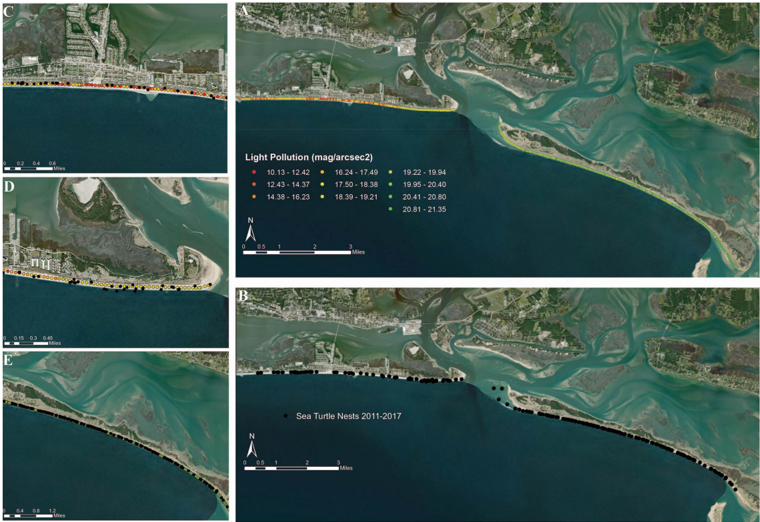
- Spatial analyses found significant clustering: Global Moran’s I = 0.629 (p = 0.00001); Anselin Local Moran’s I identified significant high-light clusters on Atlantic Beach and low-light clusters on Shackleford Banks, with high nesting density on Shackleford Banks and low nesting density on Atlantic Beach (p < 0.05).
Methods
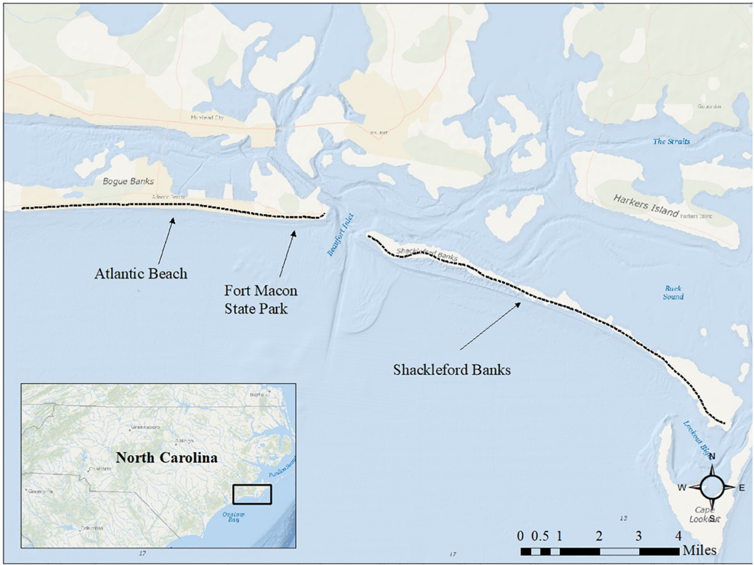
- Study area and timing: three adjacent central North Carolina beaches—Atlantic Beach (10,000 m developed coastline), Fort Macon State Park (1,600 m protected/undeveloped), and Shackleford Banks (~13,000 m uninhabited Cape Lookout National Seashore). Light data were collected on moonless nights between astronomical dusk and dawn in summer 2017.
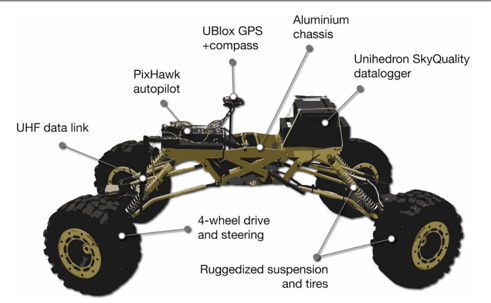
- Data collection: an autonomous terrestrial rover carried two Sky Quality Meter-LU-DL sensors recording ambient light every minute (mag/arcsec²) plus GPS; one sensor faced forward and one faced the beach, and analyses used the beach-facing sensor. Nest records from 2011–2017 were provided by beach coordinators: 37 nests on Atlantic Beach, 28 on Fort Macon, and 160 on Shackleford Banks.
- Analysis: each nest was linked to the closest light value via GIS spatial join (average distance ~10 m); differences among beaches were tested with one-way ANOVA and Wilcoxon Each Pair tests. Light and nesting density were aggregated into 500-m alongshore bins, compared with linear regression, and assessed for spatial clustering using Global Moran’s I and Anselin Local Moran’s I in ArcMap.
Limitations
- Stated in the paper: other anthropogenic variables such as noise and human activity/tourists can influence nesting, and environmental factors such as sand characteristics, temperature, and currents may also affect nesting; multivariate analyses are needed. Rover assembly requires some electronics and battery knowledge, and field technology problems can disrupt data collection. Spatial comparisons were done at 500-m increments, though finer scales could be used under higher nesting density. The light sensor’s limited field of view may not fully capture a sea turtle’s perspective; a wider field-of-view or planar irradiance sensor would refine results.
- Evident from the text: the study is correlational rather than experimental, light was sampled only in summer 2017 while nest data span 2011–2017, and the design covers only three beaches and one season, with no direct behavioral observations of nesting turtles; development and human activity may confound the light–nesting relationship.
Model-written summary. Check it against the paper before relying on it.
Integrity signals
Registry
Cites
Statistics
Figures
Verification
Claims the paper makes
0 Valid · 1 Not valid · 31 Not checked · 55 Own results and interpretations
A result the paper reports from its own data — it cites no other source for it, so there is none to check. The quote shows it is in the paper.
In the paper
“Although the rover collected high resolution light pollution measurements, spatial comparisons to nesting density were done in 500-m increments.”
§ Robotic Vehicles Enable High-Resolution Light Pollution Sampling of Sea Turtle Nesting Beaches > Caveats and Considerations
plain- Asserted: passes — The authors put it forward as true.
- Checkable: passes — It can be checked against evidence.
- Load-bearing: passes — The paper’s conclusions depend on it.
- Based: passes — The paper gives a reason why it holds.
A result the paper reports from its own data — it cites no other source for it, so there is none to check. The quote shows it is in the paper.
In the paper
“Nesting density on all three beaches varied from 0 to 5.33 (Table 1).”
§ Robotic Vehicles Enable High-Resolution Light Pollution Sampling of Sea Turtle Nesting Beaches > Nesting Density and Light Pollution
plain- Asserted: passes — The authors put it forward as true.
- Checkable: passes — It can be checked against evidence.
- Load-bearing: unclear — It is unclear whether the paper’s conclusions depend on it.
- Based: passes — The paper gives a reason why it holds.
A result the paper reports from its own data — it cites no other source for it, so there is none to check. The quote shows it is in the paper.
In the paper
“The Moran's I spatial autocorrelation conducted on nesting density revealed a significant 0.629 global statistic from 999 random permutations, demonstrating high clustering of nests in the study area (p = 0.00001).”
§ Robotic Vehicles Enable High-Resolution Light Pollution Sampling of Sea Turtle Nesting Beaches > Nesting Density and Light Pollution
boosted- Asserted: passes — The authors put it forward as true.
- Checkable: passes — It can be checked against evidence.
- Load-bearing: unclear — It is unclear whether the paper’s conclusions depend on it.
- Based: passes — The paper gives a reason why it holds.
A result the paper reports from its own data — it cites no other source for it, so there is none to check. The quote shows it is in the paper.
In the paper
“Mean light pollution values in all bins ranged from 13.56 to 20.95 mag/arcsec 2 (Figure 5).”
§ Robotic Vehicles Enable High-Resolution Light Pollution Sampling of Sea Turtle Nesting Beaches > Nesting Density and Light Pollution
plain- Asserted: passes — The authors put it forward as true.
- Checkable: passes — It can be checked against evidence.
- Load-bearing: unclear — It is unclear whether the paper’s conclusions depend on it.
- Based: passes — The paper gives a reason why it holds.
A result the paper reports from its own data — it cites no other source for it, so there is none to check. The quote shows it is in the paper.
In the paper
“The regions of low nesting density were located in areas of high coastal development, such as in front of a brightly lit pier on Atlantic Beach and near a waterfront hotel.”
§ Robotic Vehicles Enable High-Resolution Light Pollution Sampling of Sea Turtle Nesting Beaches > Nesting Density and Light Pollution
plainstates an association- Asserted: passes — The authors put it forward as true.
- Checkable: passes — It can be checked against evidence.
- Load-bearing: passes — The paper’s conclusions depend on it.
- Based: passes — The paper gives a reason why it holds.
25 more claims
Create a free account to see all 87 claims and to verify the 25 references still open.
- It may state two separate claims as one. 34
- Probably not a substantial claim. 32
Self-check
Percentages, sums and reported differences re-computed from the paper’s own numbers.
Each contradiction between two passages listed here was confirmed by an independent check.
Rated minor: it would not touch a result — a value no result rests on, a p-value that stays on the same side of the significance level, or a conflict that is clerical, resolved elsewhere in the paper, or outside its own findings.
In the paper
§ Robotic Vehicles Enable High-Resolution Light Pollution Sampling of Sea Turtle Nesting Beaches > CONCLUSION
“(C-E) Enlarged map insets illustrating the increase of total nesting density (nests/year) from 2011 to 2017 as light pollution levels increase on (C) Atlantic Beach, (D) Fort Macon State Park, and (E) Shackleford Banks.”
§ Robotic Vehicles Enable High-Resolution Light Pollution Sampling of Sea Turtle Nesting Beaches > Nesting Density and Light Pollution
“All significantly high light pollution levels on Atlantic Beach correspond to low nesting density, supporting the hypothesis that light pollution may influence sea turtle nesting density (Figure 5).”
Citations
Cites
Longcore, T., & Rich, C. (2004) · Frontiers in Ecology and the Environment · doi:10.1890/1540-9295(2004)002[0191:elp]2.0.co;2 · Cited by 1,423
Autonomous Rover Navigation on Unknown Terrains: Functions and Integration
Lacroix, S., Mallet, A., Bonnafous, D., Bauzil, G., Fleury, S., Herrb, M., & Chatila, R. (2002) · The International Journal of Robotics Research · doi:10.1177/0278364902021010841 · Cited by 185
Mortimer, J. A. (1990) · Copeia · doi:10.2307/1446446 · Cited by 175
Unoccupied Aircraft Systems in Marine Science and Conservation
Johnston, D. W. (2019) · Annual Review of Marine Science · doi:10.1146/annurev-marine-010318-095323 · Cited by 167
Self-citationTuxbury, S. M., & Salmon, M. (2005) · Biological Conservation · doi:10.1016/j.biocon.2004.04.022 · Cited by 162
Mazor, T. K., Levin, N., Possingham, H. P., Levy, Y., Rocchini, D., Richardson, A. J., & Kark, S. (2013) · Biological Conservation · doi:10.1016/j.biocon.2012.11.004 · Cited by 115
Using expert opinion surveys to rank threats to endangered species: a case study with sea turtles
DONLAN, C. J., WINGFIELD, D. K., CROWDER, L. B., & WILCOX, C. (2010) · Conservation Biology · doi:10.1111/j.1523-1739.2010.01541.x · Cited by 114
Coastal light pollution and marine turtles: assessing the magnitude of the problem
Kamrowski, R., Limpus, C., Moloney, J., & Hamann, M. (2012) · Endangered Species Research · doi:10.3354/esr00462 · Cited by 104
Environmental pollution and biodiversity: Light pollution and sea turtles in the Caribbean
Brei, M., Pérez‐Barahona, A., & Strobl, E. (2016) · Journal of Environmental Economics and Management · doi:10.1016/j.jeem.2016.02.003 · Cited by 74
Salmon, M., Wyneken, J., Fritz, E., & Lucas, M. (1992) · Behaviour · doi:10.1163/156853992x00309 · Cited by 74
Research works printed but not linked: 4
- Manning, R., Rovelstad, E., Moore, C., Hallo, J., and Smith, B. (2015). Indicators and standards of quality for viewing the night sky in the national parks. Park Sci. 32, 9-17.
- Salmon, M. (2003). Artificial night lighting and sea turtles. Biologist 50, 163-168.
- Witherington, B. E. (1997). "The problem of photopollution for sea turtles and other nocturnal animals, " in Behavioral Approaches to Conservation in the Wild, eds J. R. Clemmons and R. Buchholz (Cambridge University Press, Cambridge), 303-328.
- Witherington, B. E., and Martin, R. E. (2003). Understanding, Assessing, and Resolving Light-Pollution Problems on Sea Turtle Nesting Beaches, 3rd Edn. St. Petersburg: Florida Marine Research Institute Technical Report TR-2.
Cited by
Impacts of artificial light at night in marine ecosystems—A review
Marangoni, L. F. B., Davies, T., Smyth, T., Rodríguez, A., Hamann, M., Duarte, C., Pendoley, K., Berge, J., Maggi, E., & Levy, O. (2022) · Global Change Biology · doi:10.1111/gcb.16264 · Cited by 203
How to measure light pollution—a systematic review of methods and applications
Mander, S., Alam, F., Lovreglio, R., & Ooi, M. (2023) · Sustainable Cities and Society · doi:10.1016/j.scs.2023.104465 · Cited by 96
Effects of pollution on marine organisms
Mearns, A. J., Bissell, M., Morrison, A. M., Rempel‐Hester, M. A., Arthur, C., & Rutherford, N. (2019) · Water Environment Research · doi:10.1002/wer.1218 · Cited by 43
Globally important refuge for the loggerhead sea turtle: Maio Island, Cabo Verde
Patiño-Martínez, J., Passos, L. D., Afonso, I. O., Teixidor, A., Tiwari, M., Székely, T., & Moreno, R. (2021) · Oryx · doi:10.1017/s0030605320001180 · Cited by 32
Longcore, T., Duriscoe, D. M., Aubé, M., Jechow, A., Kyba, C. C. M., & Pendoley, K. L. (2020) · Frontiers in Marine Science · doi:10.3389/fmars.2020.00706 · Cited by 17
Simantiris, N., Vardaki, M. Z., Dimitriadis, C., Netzipi, O., & Malaperdas, G. (2025) · Journal of Marine Science and Engineering · doi:10.3390/jmse13102020 · Cited by 8
(2023) · European Journal of Sustainable Development · doi:10.14207/ejsd.2023.v12n2p35 · Cited by 6
Maneja, R. H., Flandez, A. V. B., Syed, A. H., Baig, M. H., Tiwari, S. P., Gopalan, J. V., Alnuwairah, M. A., Asiri, Y. Y., Reshi, O. R., Alzoghiby, I. A., et al. (2023) · IEEE International Geoscience and Remote Sensing Symposium (IGARSS) · doi:10.1109/igarss52108.2023.10282579 · Cited by 3
Huang, S.-E., Suhi, K. F. F., & Islam, M. J. (2025) · Environmental Monitoring and Assessment · doi:10.1007/s10661-025-13862-5 · Cited by 2
The impact of artificial light at night on the distribution of sea turtles in the Mediterranean
Blyth, M. R. (2024) · The Plymouth Student Scientist · doi:10.70156/1754-2383.1501 · Cited by 1
Watson, K. P., & Lamont, M. M. (2022) · Journal of Experimental Marine Biology and Ecology · doi:10.1016/j.jembe.2021.151647 · Cited by 1
Ellgutter, J. A. C., Rosell, F., Renssen, H., Hawkes, L. A., & Reinhardt, S. (2026) · Frontiers in Marine Science · doi:10.3389/fmars.2026.1746438
Liu, M., Jiao, F., Wang, Z. M., Sheng, H., Wu, C., & Yuan, S. (2026) · LEUKOS The Journal of the Illuminating Engineering Society of North America · doi:10.1080/15502724.2026.2722655
Moura, É., Maffucci, F., Roncari, C., Farina, M., Teti, R., & Hochscheid, S. (2026) · Mediterranean Marine Science · doi:10.12681/mms.40434
Vanleynseele, C., de Montgolfier, B., & Fournier, D. (2026) · SSRN Electronic Journal · doi:10.2139/ssrn.7067429
Metadata
- Authors
- Windle, A. E., Hooley, D. S., & Johnston, D. W.
- Affiliations
- Duke University (US)
- North Carolina State University (US)
- Corresponding author
- Windle, Anna E.
- Venue
- Frontiers in Marine Science
- Publisher
- Frontiers Media SA
- Published
- 2018-12-20
- Volume
- 5
- Pages
- 493
- ISSN
- 2296-7745 (ISSN-L)
- OpenAlex
- W2905896330
- Cited by
- 16
- References
- 35
- Citations by year
- 2026: 4 · 2025: 3 · 2024: 1 · 2023: 3 · 2022: 1 · 2021: 2 · 2020: 1 · 2019: 1
- FWCI
- 0.57
- Type
- journal article
- Language
- en
- Open access
- gold
- doi.org
- Licence
- Locations
- Frontiers in Marine Science (publishedVersion, cc-by)
- DOAJ (DOAJ: Directory of Open Access Journals) (submittedVersion)
- Funders
- Edna Bailey Sussman Foundation
- Topics
- Physical Sciences › Environmental Science › Nature and Landscape Conservation › Turtle Biology and Conservation
- Physical Sciences › Environmental Science › Global and Planetary Change › Impact of Light on Environment and Health
- Physical Sciences › Environmental Science › Pollution › Microplastics and Plastic Pollution
- Keywords
- light pollution, sea turtle nesting, nest density, coastal development, barrier islands, Cape Lookout National Seashore, turtle conservation, light barrier
About these checks
Registry, retraction, Cites and statistics results are computed, not judged, with one exception: a printed reference that no index lists is read once by a model before it counts as a citation error. Claims are extracted by a model and kept only when their quote appears verbatim in the text; each cited source is then checked, with a model’s help, for whether it says what the claim relies on. Those verdicts can be wrong — read the claim’s quote and the cited source before relying on one.
A language model drew the claims from the paper on 2026-11-24, under version 3 of the claim definition (model deepseek-v4.1-flash, prompt extract-v3).
A second model labelled each claim on 2026-11-24 (model jev-1.13-20260917, definition revision gold-guideline-v0.2).
Statistics and arithmetic are recomputed, not judged.
Confidence bands are shown only for fields calibrated on our annotated test set. None is calibrated yet, so no band is shown.
What counts as a claim ›How we measure confidence ›How we check this ›
Are you an author, or do you see a problem with this page? Request a review
Data sources
Bibliographic data: Semantic Scholar, OpenAlex, Crossref.
Contains information from the Semantic Scholar Academic Graph Datasets, made available under the ODC Attribution License (ODC-BY 1.0).
Semantic Scholar’s data is described in: Kinney, R., et al. (2023). The Semantic Scholar Open Data Platform. arXiv:2301.10140.
