

The DOI matches its Crossref record; 25 of the 25 references it cites were found in a registry or an index.
Artificial Intelligence in Skin Cancer Diagnostics: The Patients' Perspective
Open accessAbstract
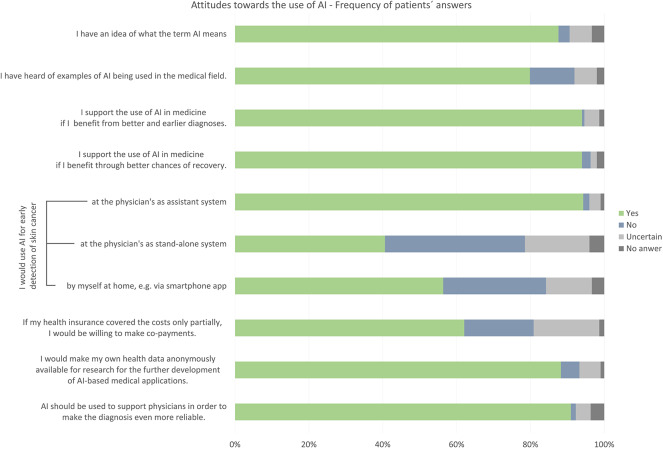
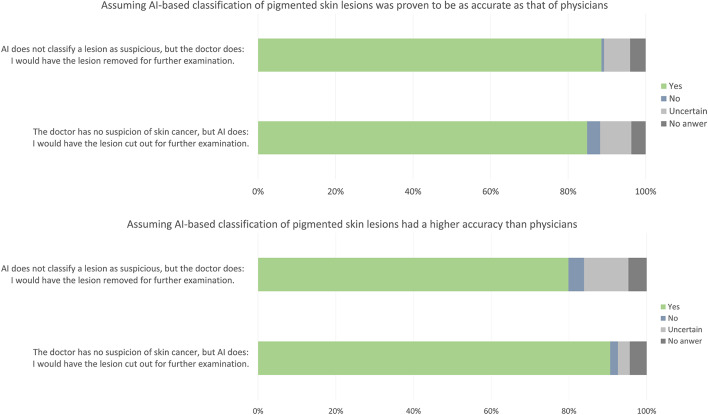
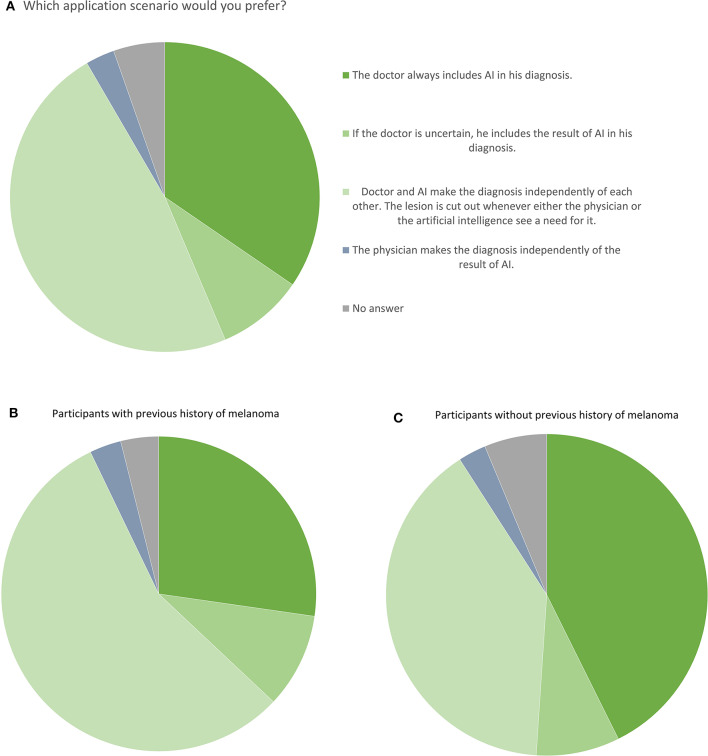
Background: Artificial intelligence has shown promise in numerous experimental studies, particularly in skin cancer diagnostics. Translation of these findings into the clinic is the logical next step. This translation can only be successful if patients’ concerns and questions are addressed suitably. We therefore conducted a survey to evaluate the patients’ view of artificial intelligence in melanoma diagnostics in Germany. Participants and Methods: A web-based questionnaire was designed using LimeSurvey, sent by e-mail to university hospitals and melanoma support groups and advertised on social media. The anonymous questionnaire evaluated patients’ expectations and concerns towards artificial intelligence in general as well as their attitudes towards different application scenarios. Descriptive analysis was performed with expression of categorical variables as percentages and 95% confidence intervals. Statistical tests were performed to investigate associations between sociodemographic data and selected items of the questionnaire. Results: 298 people (154 with melanoma diagnosis, 143 without) responded to the questionnaire. About 94% [95% CI = 0.913 – 0.967] of respondents supported the use of artificial intelligence in medical approaches. 88% [95% CI = 0.846 – 0.919] would even make their own health data anonymously available for the further development of AI-based applications in medicine. Only 41% [95% CI = 0.350 – 0.462] of respondents were amenable to the use of artificial intelligence as stand-alone system, 94% [95% CI = 0.917 – 0.969 to its use as assistant system for physicians. In sub-group analyses, only minor differences were detectable. Respondents with a previous history of melanoma were more amenable to the use of AI applications for early detection even at home. They would prefer an application scenario where physician and AI classify the lesions independently. With respect to AI-based applications in medicine, patients were concerned about insufficient data protection, impersonality and susceptibility to errors, but expected faster, more precise and unbiased diagnostics, less diagnostic errors and support for physicians. Conclusions: The vast majority of participants exhibited a positive attitude towards the use of artificial intelligence in melanoma diagnostics, especially as an assistance system.
Overview
The claims and statistics of this paper haven’t been checked yet.
Run the check — free, no account needed. It reads the open-access text and checks the sources it cites.
Integrity signals
Registry
Cites
Statistics
Figures
Verification
Claims the paper makes
The claims and statistics of this paper haven’t been checked yet.
Run the check — free, no account needed. It reads the open-access text and checks the sources it cites.
Claims other papers make about this one
Each is checked against this paper’s own text: does it say what the citing paper says it does?
In the citing paper
“The results of previous empirical studies on patients’ acceptance or trust in AI are somewhat conflicting. Some studies have shown that participants are more accepting of AI if it is proven to be more accurate than providers26,29 or if the use of AI fits societal and cultural norms.35,36 However, other studies have found that trust in AI did not increase when participants were informed that the AI”
From Patient perspectives on informed consent for medical AI: A web-based experiment (2024) · cites this paper as [29]
Self-check
Percentages, sums and reported differences re-computed from the paper’s own numbers.
The self-check needs the paper’s full text.
Citations
Cites
Dermatologist-level classification of skin cancer with deep neural networks
Esteva, A., Kuprel, B., Novoa, R. A., Ko, J., Swetter, S. M., Blau, H. M., & Thrun, S. (2017) · Nature · doi:10.1038/nature21056 · Cited by 14,362
On Pixel-Wise Explanations for Non-Linear Classifier Decisions by Layer-Wise Relevance Propagation
Bach, S., Binder, A., Montavon, G., Klauschen, F., Müller, K.-R., & Samek, W. (2015) · PLOS ONE · doi:10.1371/journal.pone.0130140 · Cited by 4,524
International evaluation of an AI system for breast cancer screening
McKinney, S. M., Sieniek, M., Godbole, V., Godwin, J., Antropova, N., Ashrafian, H., Back, T., Chesus, M., Corrado, G. S., Darzi, A., et al. (2020) · Nature · doi:10.1038/s41586-019-1799-6 · Cited by 3,287
Artificial intelligence in medical practice: the question to the answer?
Miller, D. D., & Brown, E. W. (2018) · The American Journal of Medicine · doi:10.1016/j.amjmed.2017.10.035 · Cited by 774
Medical students' attitude towards artificial intelligence: a multicentre survey
Pinto dos Santos, D., Giese, D., Brodehl, S., Chon, S. H., Staab, W., Kleinert, R., Maintz, D., & Baeßler, B. (2019) · European Radiology · doi:10.1007/s00330-018-5601-1 · Cited by 754
Governing artificial intelligence: ethical, legal and technical opportunities and challenges
Cath, C. (2018) · Philosophical Transactions of the Royal Society A: Mathematical, Physical and Engineering Sciences · doi:10.1098/rsta.2018.0080 · Cited by 745
Brinker, T. J., Hekler, A., Enk, A. H., Klode, J., Hauschild, A., Berking, C., Schilling, B., Haferkamp, S., Schadendorf, D., Holland-Letz, T., et al. (2019) · European Journal of Cancer · doi:10.1016/j.ejca.2019.04.001 · Cited by 605
Self-citationDeep neural networks are superior to dermatologists in melanoma image classification
Brinker, T. J., Hekler, A., Enk, A. H., Berking, C., Haferkamp, S., Hauschild, A., Weichenthal, M., Klode, J., Schadendorf, D., Holland-Letz, T., et al. (2019) · European Journal of Cancer · doi:10.1016/j.ejca.2019.05.023 · Cited by 415
Self-citationPhysician Confidence in Artificial Intelligence: An Online Mobile Survey
Oh, S., Kim, J. H., Choi, S.-W., Lee, H. J., Hong, J., & Kwon, S. H. (2019) · Journal of Medical Internet Research · doi:10.2196/12422 · Cited by 387
Han, S. S., Park, G. H., Lim, W., Kim, M. S., Na, J. I., Park, I., & Chang, S. E. (2018) · PLoS ONE · doi:10.1371/journal.pone.0191493 · Cited by 305
Artificial Intelligence in Medicine: Where Are We Now?
Kulkarni, S., Seneviratne, N., Baig, M. S., & Khan, A. H. A. (2019) · Academic Radiology · doi:10.1016/j.acra.2019.10.001 · Cited by 301
Artificial Intelligence in Dermatology—Where We Are and the Way to the Future: A Review
Hogarty, D. T., Su, J. C., Phan, K. H., Attia, M., Hossny, M., Nahavandi, S., Lenane, P., Moloney, F. J., & Yazdabadi, A. (2019) · American Journal of Clinical Dermatology · doi:10.1007/s40257-019-00462-6 · Cited by 195
Shrivastava, V. K., Londhe, N. D., Sonawane, R. S., & Suri, J. S. (2017) · Computer Methods and Programs in Biomedicine · doi:10.1016/j.cmpb.2017.07.011 · Cited by 118
A mobile revolution for healthcare? Setting the agenda for bioethics
Lucivero, F., & Jongsma, K. R. (2018) · Journal of Medical Ethics · doi:10.1136/medethics-2017-104741 · Cited by 105
Attitudes towards artificial intelligence within dermatology: an international online survey
Polesie, S., Gillstedt, M., Kittler, H., Lallas, A., Tschandl, P., Zalaudek, I., & Paoli, J. (2020) · British Journal of Dermatology · doi:10.1111/bjd.18875 · Cited by 93
Artificial Intelligence in Health: New Opportunities, Challenges, and Practical Implications
Lau, A. Y. S., Staccini, P., & Informatics, S. E. F. T. I. Y. S. O. E. A. C. H. (2019) · Yearbook of Medical Informatics · doi:10.1055/s-0039-1677935 · Cited by 61
Internet-Based Experiments: Prospects and Possibilities for Behavioral Accounting Research
Bryant, S. M., Hunton, J. E., & Stone, D. N. (2004) · Behavioral Research in Accounting · doi:10.2308/bria.2004.16.1.107 · Cited by 54
FDA approves stroke-detecting AI software
(2018) · Nature Biotechnology · doi:10.1038/nbt0418-290 · Cited by 48
Jonmarker, O., Strand, F., Brandberg, Y., & Lindholm, P. (2019) · Acta Radiologica Open · doi:10.1177/2058460119880315 · Cited by 43
Grande, D., Asch, D. A., Wan, F., Bradbury, A. R., Jagsi, R., & Mitra, N. (2015) · Journal of Oncology Practice · doi:10.1200/jop.2015.004820 · Cited by 42
Can clinical decision making be enhanced by artificial intelligence?
Janda, M., & Soyer, H. P. (2019) · British Journal of Dermatology · doi:10.1111/bjd.17110 · Cited by 36
Patient Attitudes and Their Awareness Towards Skin Cancer–Related Apps: Cross-Sectional Survey
Steeb, T., Wessely, A., Mastnik, S., Brinker, T. J., French, L. E., Niesert, A., Berking, C., & Heppt, M. V. (2019) · JMIR mhealth and uhealth · doi:10.2196/13844 · Cited by 25
Self-citationFink, C., Uhlmann, L., Hofmann, M. A., Forschner, A., Eigentler, T., Garbe, C., Enk, A., & Haenssle, H. A. (2018) · JDDG Journal der Deutschen Dermatologischen Gesellschaft · doi:10.1111/ddg.13562 · Cited by 24
Künstliche Intelligenz in der Bildgebung der Lunge
Prayer, F., Röhrich, S., Pan, J., Hofmanninger, J., Langs, G., & Prosch, H. (2019) · Der Radiologe · doi:10.1007/s00117-019-00611-2 · Cited by 20
The Importance of Relevance: Willingness to Share eHealth Data for Family Medicine Research
Bartlett, G., MacGibbon, B., Rubinowicz, A., Nease, C., Dawes, M. G., & Tamblyn, R. M. (2018) · Frontiers in Public Health · doi:10.3389/fpubh.2018.00255 · Cited by 9
Cited by
Sorted by citations
Durán, J. M., & Jongsma, K. R. (2021) · Journal of Medical Ethics · doi:10.1136/medethics-2020-106820 · Cited by 446
Young, A. T., Amara, D., Bhattacharya, A., & Wei, M. L. (2021) · The Lancet Digital Health · doi:10.1016/s2589-7500(21)00132-1 · Cited by 400
Langer, M., & Landers, R. N. (2021) · Computers in Human Behavior · doi:10.1016/j.chb.2021.106878 · Cited by 338
Jones, O. T., Matin, R. N., van der Schaar, M., Prathivadi Bhayankaram, K., Ranmuthu, C. K. I., Islam, M. S., Behiyat, D., Boscott, R., Calanzani, N., Emery, J., et al. (2022) · The Lancet Digital Health · doi:10.1016/s2589-7500(22)00023-1 · Cited by 272
Kuntz, S., Krieghoff‐Henning, E., Kather, J. N., Jutzi, T. B., Höhn, J., Kiehl, L., Hekler, A., Alwers, E., Kalle, C. V., Fröhling, S., et al. (2021) · European Journal of Cancer · doi:10.1016/j.ejca.2021.07.012 · Cited by 203
Self-citation
Metadata
- Authors
- Jutzi, T. B., Krieghoff-Henning, E. I., Holland-Letz, T., Utikal, J. S., Hauschild, A., Schadendorf, D., Sondermann, W., Fröhling, S., Hekler, A., Schmitt, M., Maron, R. C., & Brinker, T. J.
- Affiliations
- German Cancer Research Center (DE)
- University Hospital Schleswig-Holstein (DE)
- Essen University Hospital (DE)
- Corresponding author
- Brinker, Titus J.
- ORCID
- Venue
- Frontiers in Medicine
- Publisher
- Frontiers Media SA
- Published
- 2020-06-02
- Volume
- 7
- Pages
- 233-233
- ISSN
- 2296-858X (ISSN-L)
- PMC
- PMC7326111
- OpenAlex
- W3033209670
- Cited by
- 196
- References
- 25
- Citations by year
- 2026: 31 · 2025: 44 · 2024: 47 · 2023: 26 · 2022: 30 · 2021: 17 · 2020: 1
- FWCI
- 6.68
- Type
- journal article
- Language
- en
- Open access
- gold
- doi.org
- Licence
- Locations
- Frontiers in Medicine (publishedVersion, cc-by)
- PubMed Central (publishedVersion, cc-by)
- PubMed (publishedVersion)
- DOAJ (DOAJ: Directory of Open Access Journals) (submittedVersion, cc-by-sa)
- Topics
- Health Sciences › Medicine › Oncology › Cutaneous Melanoma Detection and Management
- Health Sciences › Medicine › Health Informatics › Artificial Intelligence in Healthcare and Education
- Physical Sciences › Computer Science › Artificial Intelligence › AI in cancer detection
- Keywords
- artificial intelligence, melanoma, patient attitudes, patient perspectives, early detection, data protection, patient trust, sociodemographic factors
About these checks
Registry, retraction, Cites and statistics results are computed, not judged, with one exception: a printed reference that no index lists is read once by a model before it counts as a citation error. Claims are extracted by a model and kept only when their quote appears verbatim in the text; each cited source is then checked, with a model’s help, for whether it says what the claim relies on. Those verdicts can be wrong — read the claim’s quote and the cited source before relying on one.
Statistics and arithmetic are recomputed, not judged.
Confidence bands are shown only for fields calibrated on our annotated test set. None is calibrated yet, so no band is shown.
What counts as a claim ›How we measure confidence ›How we check this ›
Are you an author, or do you see a problem with this page? Request a review
