

The DOI matches its Crossref record; 203 of the 206 references it cites were found in a registry or an index.
Non-alcoholic Fatty Liver Disease and Alcohol-Related Liver Disease: Two Intertwined Entities
Open accessAbstract
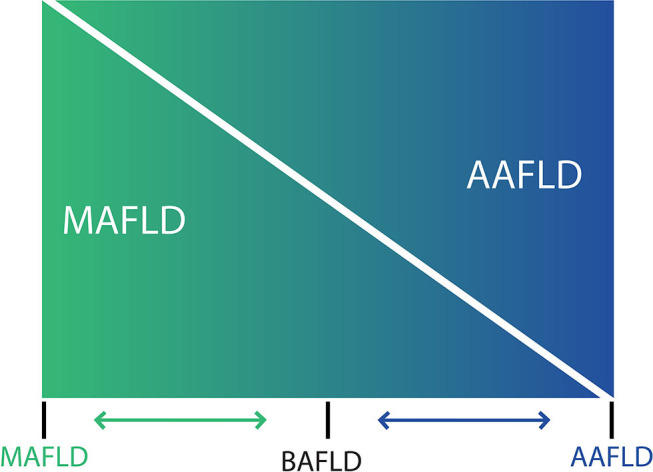
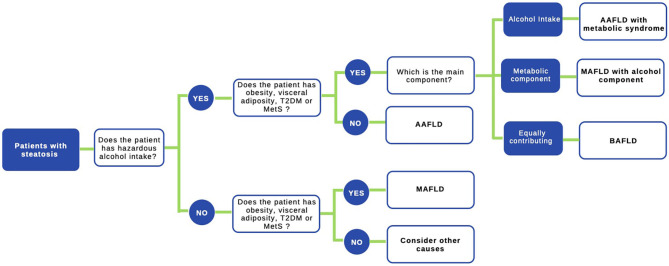
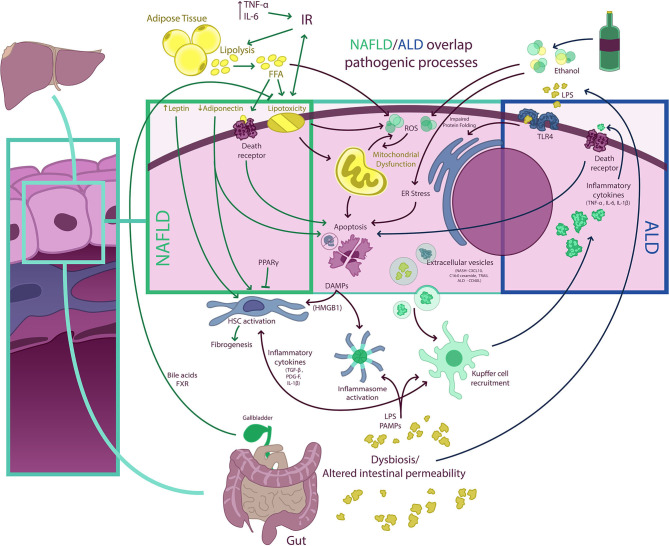
Non-alcoholic fatty liver disease (NAFLD) is the most common cause of chronic liver disease worldwide, with a prevalence of 25-30%. Since its first description in 1980, NAFLD has been conceived as a different entity from alcohol-related fatty liver disease (ALD), despite that, both diseases have an overlap in the pathophysiology, share genetic-epigenetic factors, and frequently coexist. Both entities are characterized by a broad spectrum of histological features ranging from isolated steatosis to steatohepatitis and cirrhosis. Distinction between NAFLD and ALD is based on the amount of consumed alcohol, which has been arbitrarily established. In this context, a proposal of positive criteria for NAFLD diagnosis not considering exclusion of alcohol consumption as a prerequisite criterion for diagnosis had emerged, recognizing the possibility of a dual etiology of fatty liver in some individuals. The impact of moderate alcohol use on the severity of NAFLD is ill-defined. Some studies suggest protective effects in moderate doses, but current evidence shows that there is no safe threshold for alcohol consumption for NAFLD. In fact, given the synergistic effect between alcohol consumption, obesity, and metabolic dysfunction, it is likely that alcohol use serves as a significant risk factor for the progression of liver disease in NAFLD and metabolic syndrome. This also affects the incidence of hepatocellular carcinoma. In this review, we summarize the overlapping pathophysiology of NAFLD and ALD, the current data on alcohol consumption in patients with NAFLD, and the effects of metabolic dysfunction and overweight in ALD.
Overview
The claims and statistics of this paper haven’t been checked yet.
Run the check — free, no account needed. It reads the open-access text and checks the sources it cites.
Integrity signals
Registry
Cites
Statistics
Figures
Verification
Claims the paper makes
The claims and statistics of this paper haven’t been checked yet.
Run the check — free, no account needed. It reads the open-access text and checks the sources it cites.
Claims other papers make about this one
Each is checked against this paper’s own text: does it say what the citing paper says it does?
The source backs part of the claim, not all of it — or backs it for a different population, condition or comparison.
In the citing paper
“Aberrant lipid handling causes the intracellular accumulation of potentially toxic bioactive lipid species in hepatocytes; an essential phenomenon in both MASH and ASH(201).”
From The liver as a central "hub" of the immune system: pathophysiological implications (2025) · cites this paper as [201]
Experimental — accuracy not yet measured
Self-check
Percentages, sums and reported differences re-computed from the paper’s own numbers.
The self-check needs the paper’s full text.
Citations
Cites
Younossi, Z. M., Koenig, A. B., Abdelatif, D., Fazel, Y., Henry, L., & Wymer, M. (2016) · Hepatology · doi:10.1002/hep.28431 · Cited by 10,781
Gut flora metabolism of phosphatidylcholine promotes cardiovascular disease
Wang, Z., Klipfell, E., Bennett, B. J., Koeth, R., Levison, B. S., DuGar, B., Feldstein, A. E., Britt, E. B., Fu, X., Chung, Y.-M., et al. (2011) · Nature · doi:10.1038/nature09922 · Cited by 5,597
EASL–EASD–EASO Clinical Practice Guidelines for the management of non-alcoholic fatty liver disease
(2016) · Journal of Hepatology · doi:10.1016/j.jhep.2015.11.004 · Cited by 4,836
Eslam, M., Newsome, P. N., Sarin, S. K., Anstee, Q. M., Targher, G., Romero-Gomez, M., Zelber-Sagi, S., Wai-Sun Wong, V., Dufour, J.-F., Schattenberg, J. M., et al. (2020) · Journal of Hepatology · doi:10.1016/j.jhep.2020.03.039 · Cited by 4,472
Self-citationMechanisms of NAFLD development and therapeutic strategies
Friedman, S. L., Neuschwander-Tetri, B. A., Rinella, M., & Sanyal, A. J. (2018) · Nature Medicine · doi:10.1038/s41591-018-0104-9 · Cited by 4,354
Autophagy regulates lipid metabolism
Singh, R., Kaushik, S., Wang, Y., Xiang, Y., Novak, I., Komatsu, M., Tanaka, K., Cuervo, A. M., & Czaja, M. J. (2009) · Nature · doi:10.1038/nature07976 · Cited by 3,975
Chalasani, N., Younossi, Z. M., Lavine, J. E., Diehl, A. M., Brunt, E. M., Cusi, K. J., Charlton, M., & Sanyal, A. J. (2012) · Hepatology · doi:10.1002/hep.25762 · Cited by 3,854
Introduction to the human gut microbiota
Thursby, E., & Juge, N. (2017) · Biochemical Journal · doi:10.1042/bcj20160510 · Cited by 3,600
Griswold, M. G., Fullman, N., Hawley, C., Arian, N., Zimsen, S. R. M., Tymeson, H. D., Venkateswaran, V., Tapp, A. D., Forouzanfar, M. H., Salama, J. S., et al. (2018) · The Lancet · doi:10.1016/s0140-6736(18)31310-2 · Cited by 3,524
MAFLD: a consensus-driven proposed nomenclature for metabolic associated fatty liver disease
Eslam, M., Sanyal, A. J., George, J., Sanyal, A., Neuschwander-Tetri, B., Tiribelli, C., Kleiner, D. E., Brunt, E., Bugianesi, E., Yki-Järvinen, H., et al. (2020) · Gastroenterology · doi:10.1053/j.gastro.2019.11.312 · Cited by 3,286
Self-citation
Cited by
Sorted by citations
Oxidative Stress in Liver Pathophysiology and Disease
Allameh, A., Niayesh‐Mehr, R., Aliarab, A., Sebastiani, G., & Pantopoulos, K. (2023) · Antioxidants · doi:10.3390/antiox12091653 · Cited by 606
Alcohol consumption and metabolic syndrome: clinical and epidemiological impact on liver disease
Åberg, F., Byrne, C. D., Pirola, C. J., Männistö, V., & Sookoian, S. (2023) · Journal of Hepatology · doi:10.1016/j.jhep.2022.08.030 · Cited by 307
Multiomics study of nonalcoholic fatty liver disease
Sveinbjörnsson, G., Ulfarsson, M. O., Þórólfsdóttir, R. B., Jónsson, B. A., Einarsson, E., Gunnlaugsson, G., Rögnvaldsson, S., Arnar, D. O., Baldvinsson, M., Bjarnason, R. G., et al. (2022) · Nature Genetics · doi:10.1038/s41588-022-01199-5 · Cited by 251
The intersection between alcohol-related liver disease and nonalcoholic fatty liver disease
Díaz, L. A., Arab, J. P., Louvet, A., Bataller, R., & Arrese, M. (2023) · Nature Reviews Gastroenterology & Hepatology · doi:10.1038/s41575-023-00822-y · Cited by 207
Self-citationDiet and exercise in NAFLD/NASH: Beyond the obvious
Semmler, G., Datz, C., Reiberger, T., & Trauner, M. (2021) · Liver International · doi:10.1111/liv.15024 · Cited by 187
Metadata
- Authors
- Idalsoaga, F., Kulkarni, A. V., Mousa, O. Y., Arrese, M., & Arab, J. P.
- Affiliations
- Pontificia Universidad Católica de Chile (CL)
- Asian Institute of Gastroenterology (IN)
- Mayo Clinic (US)
- Corresponding author
- Arab, Juan Pablo
- Venue
- Frontiers in Medicine
- Publisher
- Frontiers Media SA
- Published
- 2020-08-20
- Volume
- 7
- Pages
- 448-448
- ISSN
- 2296-858X (ISSN-L)
- PMC
- PMC7468507
- OpenAlex
- W3080530345
- Cited by
- 136
- References
- 206
- Citations by year
- 2026: 14 · 2025: 23 · 2024: 23 · 2023: 26 · 2022: 32 · 2021: 17
- FWCI
- 2.74
- Type
- journal article
- Language
- en
- Open access
- gold
- doi.org
- Licence
- Locations
- Frontiers in Medicine (publishedVersion, cc-by)
- PubMed Central (publishedVersion, cc-by)
- PubMed (publishedVersion)
- DOAJ (DOAJ: Directory of Open Access Journals) (submittedVersion, cc-by-sa)
- Funders
- Fondo Nacional de Desarrollo Científico y Tecnológico (1191145, 1200227)
- Consejo Nacional de Innovación, Ciencia y Tecnología (AFB170005)
- Topics
- Health Sciences › Medicine › Hepatology › Liver Disease Diagnosis and Treatment
- Health Sciences › Medicine › Pathology and Forensic Medicine › Alcohol Consumption and Health Effects
- Health Sciences › Medicine › Hepatology › Liver physiology and pathology
- Keywords
- non-alcoholic fatty liver disease, alcoholic liver disease, alcohol consumption, steatohepatitis, liver cirrhosis, metabolic dysfunction, obesity, metabolic syndrome, hepatocellular carcinoma, pathophysiology, disease progression
About these checks
Registry, retraction, Cites and statistics results are computed, not judged, with one exception: a printed reference that no index lists is read once by a model before it counts as a citation error. Claims are extracted by a model and kept only when their quote appears verbatim in the text; each cited source is then checked, with a model’s help, for whether it says what the claim relies on. Those verdicts can be wrong — read the claim’s quote and the cited source before relying on one.
Statistics and arithmetic are recomputed, not judged.
Confidence bands are shown only for fields calibrated on our annotated test set. None is calibrated yet, so no band is shown.
What counts as a claim ›How we measure confidence ›How we check this ›
Are you an author, or do you see a problem with this page? Request a review
