

Reduced blood-brain barrier penetration of acne vulgaris antibiotic sarecycline compared to minocycline corresponds with lower lipophilicity
The DOI matches its Crossref record; 20 of the 20 references it cites were found in a registry or an index.
Abstract
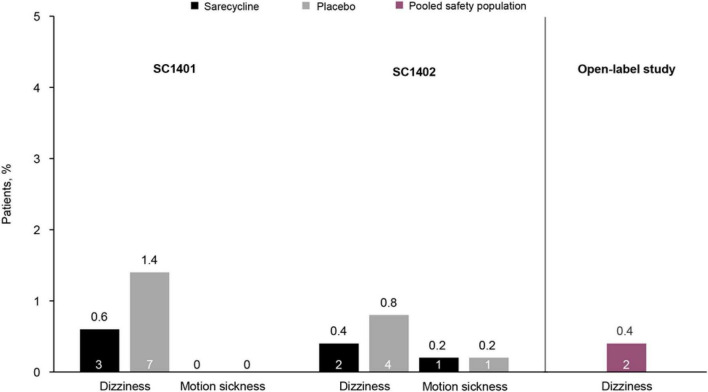
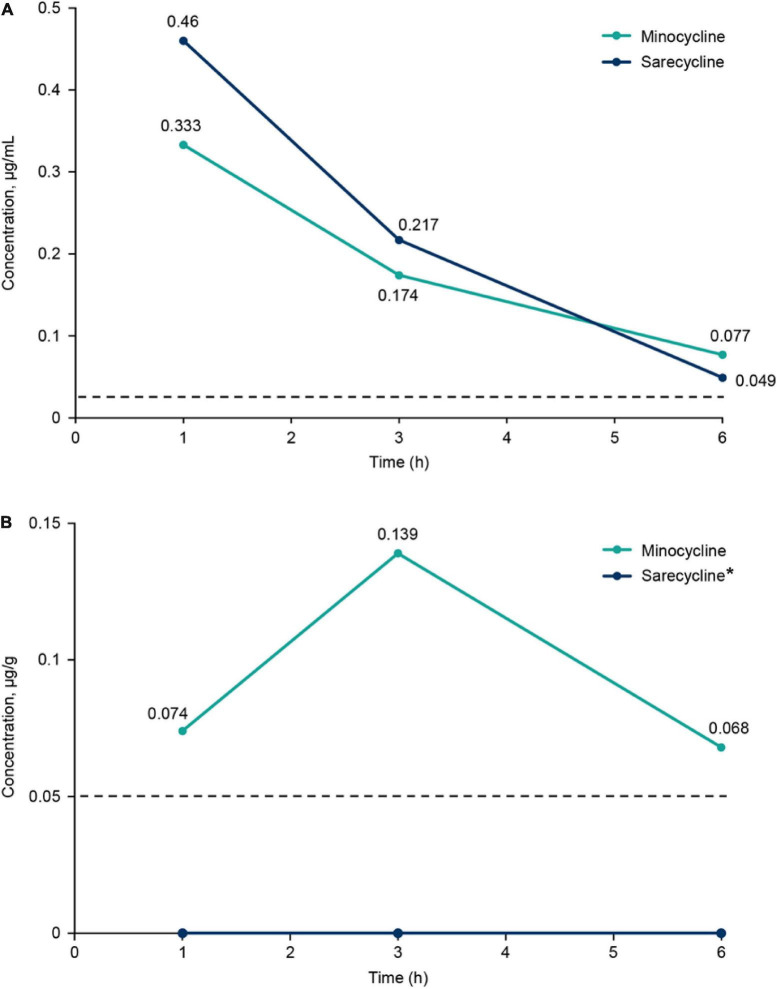
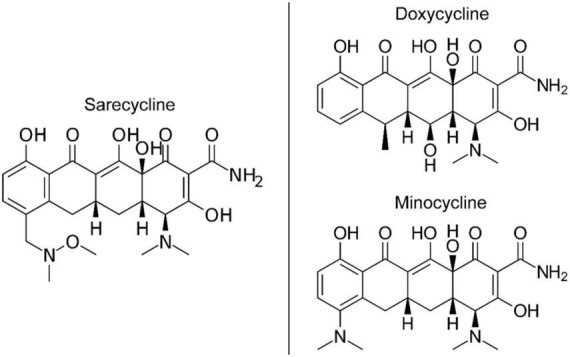
Background: Vestibular side effects such as dizziness and vertigo can be a limitation for some antibiotics commonly used to treat acne, rosacea, and other dermatology indications. Objective: Unlike minocycline, which is a second-generation tetracycline, sarecycline, a narrow-spectrum third-generation tetracycline-class agent approved to treat acne vulgaris, has demonstrated low rates of vestibular-related adverse events in clinical trials. In this work, we evaluate the brain-penetrative and lipophilic attributes of sarecycline in 2 non-clinical studies and discuss potential associations with vestibular adverse events. Methods: Rats received either intravenous sarecycline or minocycline (1.0 mg/kg). Blood-brain penetrance was measured at 1, 3, and 6 h postdosing. In another analysis, the lipophilicity of sarecycline, minocycline, and doxycycline was measured via octanol/water and chloroform/water distribution coefficients (logD) at pH 3.5, 5.5, and 7.4. Results: Unlike minocycline, sarecycline was not detected in brain samples postdosing. In the octanol/water solvent system, sarecycline had a numerically lower lipophilicity profile than minocycline and doxycycline at pH 5.5 and 7.4. Conclusion: The reduced blood-brain penetrance and lipophilicity of sarecycline compared with other tetracyclines may explain low rates of vestibular-related adverse events seen in clinical trials.
Overview
The claims and statistics of this paper haven’t been checked yet.
Free: it reads the open-access text and checks the first 5 claims that cite a source we can check. Create a free account to check every claim.
Integrity signals
Registry
Cites
Statistics
Figures
Verification
Claims the paper makes
The claims and statistics of this paper haven’t been checked yet.
Free: it reads the open-access text and checks the first 5 claims that cite a source we can check. Create a free account to check every claim.
Claims other papers make about this one
Each is checked against this paper’s own text: does it say what the citing paper says it does?
The source backs part of the claim, not all of it — or backs it for a different population, condition or comparison.
In the citing paper
“Its pronounced lipophilicity enables preferential accumulation within the sebum‑rich environment of the pilosebaceous unit, thereby supporting its sebaceous gland-targeted therapeutic profile [10].”
From Dissolvable silk microneedles delivering minocycline-loaded ZIF-8 nanoparticles for targeted modulation of sebocyte metabolism and improved acne therapy (2026) · cites this paper as [10]
Experimental — accuracy not yet measured
Self-check
Percentages, sums and reported differences re-computed from the paper’s own numbers.
The self-check needs the paper’s full text.
Citations
Cites
Guidelines of care for the management of acne vulgaris
Zaenglein, A. L., Pathy, A. L., Schlosser, B. J., Alikhan, A., Baldwin, H. E., Berson, D. S., Bowe, W. P., Graber, E. M., Harper, J. C., Kang, S., et al. (2016) · Journal of the American Academy of Dermatology · doi:10.1016/j.jaad.2015.12.037 · Cited by 1,597
Self-citationMinocycline: Far beyond an Antibiotic
Garrido‐Mesa, N., Zarzuelo, A., & Gálvez, J. (2013) · British Journal of Pharmacology · doi:10.1111/bph.12139 · Cited by 935
Tetracycline antibiotics and resistance mechanisms
Nguyen, F., Starosta, A. L., Arenz, S., Sohmen, D., Dönhöfer, A., & Wilson, D. N. (2014) · Biological Chemistry · doi:10.1515/hsz-2013-0292 · Cited by 528
Barza, M., Brown, R. B., Shanks, C., Gamble, C., & Weinstein, L. (1975) · Antimicrobial Agents and Chemotherapy · doi:10.1128/aac.8.6.713 · Cited by 211
Chikhale, E. G., Ng, K.-Y., Burton, P. S., & Borchardt, R. T. (1994) · Pharmaceutical Research · doi:10.1023/a:1018969222130 · Cited by 204
pH-Partition Behavior of Tetracyclines
Colaizzi, J. L., & Klink, P. R. (1969) · Journal of Pharmaceutical Sciences · doi:10.1002/jps.2600581003 · Cited by 164
Alternative Measures of Lipophilicity: From Octanol–Water Partitioning to IAM Retention
Giaginis, C., & Tsantili‐Kakoulidou, A. (2008) · Journal of Pharmaceutical Sciences · doi:10.1002/jps.21244 · Cited by 140
Minocycline: A Review of its Antibacterial and Pharmacokinetic Properties and Therapeutic Use
Brogden, R. N., Speight, T. M., & Avery, G. S. (1975) · Drugs · doi:10.2165/00003495-197509040-00005 · Cited by 109
Minocycline in Acne Vulgaris: Benefits and Risks
Ochsendorf, F. R. (2010) · American Journal of Clinical Dermatology · doi:10.2165/11319280-000000000-00000 · Cited by 93
Treating acne with the tetracycline class of antibiotics: A review
Graber, E. (2021) · Dermatological Reviews · doi:10.1002/der2.49 · Cited by 70
Sarecycline interferes with tRNA accommodation and tethers mRNA to the 70S ribosome
Batool, Z., Lomakin, I. B., Polikanov, Y. S., & Bunick, C. G. (2020) · Proceedings of the National Academy of Sciences · doi:10.1073/pnas.2008671117 · Cited by 50
Self-citationAntibacterial Mechanisms and Efficacy of Sarecycline in Animal Models of Infection and Inflammation
Bunick, C. G., Keri, J. E., Tanaka, S. K., Furey, N., Damiani, G. B., Johnson, J. L., & Grada, A. A. (2021) · Antibiotics · doi:10.3390/antibiotics10040439 · Cited by 48
Self-citationComplications of Minocycline Therapy for Acne Vulgaris: Case Reports and Review of the Literature
Somech, R., Arav‐Boger, R., Assia, A., et al. (1999) · Pediatric Dermatology · doi:10.1046/j.1525-1470.1999.00106.x · Cited by 41
Cunha, B. A., Baron, J. I., & Cunha, C. B. (2017) · European Journal of Clinical Microbiology & Infectious Diseases · doi:10.1007/s10096-017-3081-x · Cited by 33
Sarecycline: A Review of Preclinical and Clinical Evidence
Moore, A. Y., Rosso, J. Q. D., Johnson, J. L., & Grada, A. A. (2020) · Clinical Cosmetic and Investigational Dermatology · doi:10.2147/ccid.s190473 · Cited by 23
Self-citationBrain Delivery of Peptides and Proteins
Dufès, C. (2011) · Elsevier eBooks · doi:10.1016/b978-0-12-384935-9.10006-9 · Cited by 11
Fighting Acne for the Fighting Forces
Brahe, C. A., & Peters, K. (2020) · Cutis · doi:10.12788/cutis.0057 · Cited by 9
Czyrski, A. (2019) · Journal of Chemistry · doi:10.1155/2019/3407091
Tayar, N. E., Tsai, R., Testa, B., Carrupt, P., & Leo, A. J. (1991) · Journal of Pharmaceutical Sciences · doi:10.1002/jps.2600800619
Tetracyclines in urology: Current concepts
Cunha, B. A., & Garabedian-Buffalo, S. M. (1990) · Urology · doi:10.1016/0090-4295(90)80201-w
Research works printed but not linked: 10
- Del Rosso JQ. Oral doxycycline in the management of acne vulgaris: current perspectives on clinical use and recent findings with a new double-scored small tablet formulation. J Clin Aesthet Dermatol. (2015) 8: 19– 26. 26029331 PMC4445892
- SOLODYN. SOLODYN [package insert]. Scottsdale, AZ: Medicis pharmaceutical corporation (2011).
- SEYSARA. SEYSARA [package insert]. Exton, PA: Almirall, LLC (2020).
- Del Rosso JQ Stein Gold L Baldwin H Harper JC Zeichner J Obagi S Management of truncal acne with oral sarecycline: pooled results from two phase-3 clinical trials. J Drugs Dermatol. (2021) 20: 634– 40. 34076386
- Moore A Green LJ Bruce S Sadick N Tschen E Werschler P Once-daily oral sarecycline 1.5 mg/kg/day is effective for moderate to severe acne vulgaris: results from two identically designed, phase 3, randomized, double-blind clinical trials. J Drugs Dermatol. (2018) 17: 987– 96. 30235387
- Pariser DM Green LJ Lain EL Schmitz C Chinigo AS McNamee B Safety and tolerability of sarecycline for the treatment of acne vulgaris: results from a phase III, multicenter, open-label study and a phase I phototoxicity study. J Clin Aesthet Dermatol. (2019) 12: E53– 62. 32038757 PMC6937166
- Stewart DM Torok HM Weiss JS Plott RT Solodyn Phase 2 Study Group. Dose-ranging efficacy of new once-daily extended-release minocycline for acne vulgaris. Cutis. (2006) 78(Suppl.): 11– 20. 17436825
- Fleischer AB Jr. Dinehart S Stough D Plott RT Solodyn Phase 2 Study Group, Solodyn Phase 3 Study Group. Safety and efficacy of a new extended-release formulation of minocycline. Cutis. (2006) 78(Suppl.): 21– 31. 17436826
- Armstrong AW Hekmatjah J Kircik LH. Oral tetracyclines and acne: a systematic review for dermatologists. J Drugs Dermatol JDD. (2020) 19: s6– 13. 33196746
- Leyden JJ Del Rosso JQ. Oral antibiotic therapy for acne vulgaris: pharmacokinetic and pharmacodynamic perspectives. J Clin Aesthet Dermatol. (2011) 4: 40– 7. PMC3050614 21386956
Cited by
Yang, X., Ruan, D., Ye, F., Qiu, X., Li, S., Huang, L., Zouboulis, C. C., Mo, X., Jiang, X., & Ju, Q. (2026) · Journal of Nanobiotechnology · doi:10.1186/s12951-026-04221-8 · Cited by 4
Metadata
- Authors
- Grada, A., Del Rosso, J. Q., Moore, A. Y., Stein Gold, L., Harper, J., Damiani, G., Shaw, K., Obagi, S., Salem, R. J., Tanaka, S. K., & Bunick, C. G.
- Venue
- Frontiers in Medicine
- Publisher
- Frontiers Media SA
- Published
- 2022-12-08
- Volume
- 9
- ISSN
- 2296-858X
- PMC
- PMC9773825
- Cited by
- 14
- References
- 20
- Funders
- Almirall
About these checks
Registry, retraction, Cites and statistics results are computed, not judged, with one exception: a printed reference that no index lists is read once by a model before it counts as a citation error. Claims are extracted by a model and kept only when their quote appears verbatim in the text; each cited source is then checked, with a model’s help, for whether it says what the claim relies on. Those verdicts can be wrong — read the claim’s quote and the cited source before relying on one.
Statistics and arithmetic are recomputed, not judged.
Confidence bands are shown only for fields calibrated on our annotated test set. None is calibrated yet, so no band is shown.
What counts as a claim ›How we measure confidence ›How we check this ›
Are you an author, or do you see a problem with this page? Request a review
Data sources
Bibliographic data: Semantic Scholar, OpenAlex, Crossref.
Contains information from the Semantic Scholar Academic Graph Datasets, made available under the ODC Attribution License (ODC-BY 1.0).
Semantic Scholar’s data is described in: Kinney, R., et al. (2023). The Semantic Scholar Open Data Platform. arXiv:2301.10140.
