

The DOI matches its Crossref record; 34 of the 34 references it cites were found in a registry or an index.
Psychometric evaluation of a national exam for clinical undergraduates
Open accessAbstract
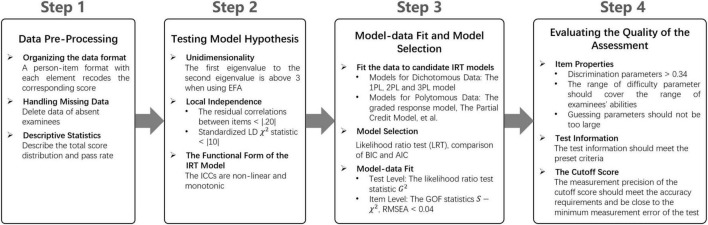
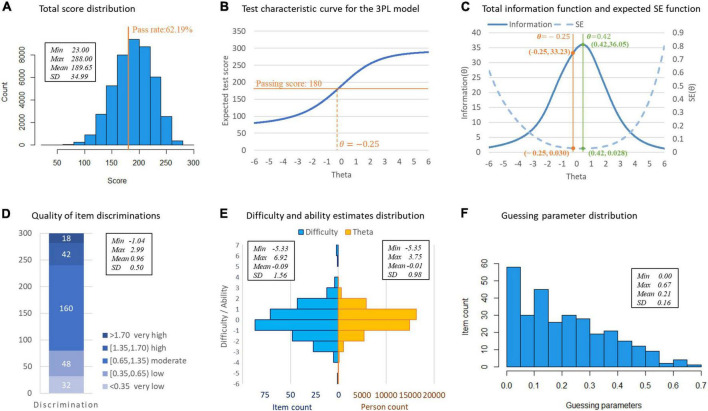
Background: As a high-stake national-level examination administrated before students’ clerkship in China, the Standardized Competence Test for Clinical Medicine Undergraduates (SCTCMU) has received much attention from the relevant educational departments and society at large. Investigating SCTCMU’s validity and reliability is critical to the national healthcare profession education. Materials and methods: Raw responses from SCTCMU, answered by 44,332 examines of 4th-year undergraduate medical students on 300 multiple-choice items, were used to evaluate the quality of the exam via psychometric methods based on item response theory (IRT). The core assumptions and model-data fit of IRT models were evaluated, as well as the item properties and information functions. Results: The IRT models were fitted to the observed assessment data, where all the required assumptions were met. The IRT analysis showed that most items had acceptable psychometric properties, and the passing score was located close to the lowest measurement error computed from the model outcomes. Conclusion: The proposed modern psychometric method provides a practical and informative approach to calibrating and analyzing medical education assessments. This work showcases a realistic depiction of the IRT analysis process and therefore facilitates the work of applied researchers wanting to conduct, interpret, and report IRT analyses on medical assessments.
Overview
The claims and statistics of this paper haven’t been checked yet.
Run the check — free, no account needed. It reads the open-access text and checks the sources it cites.
Integrity signals
Registry
Cites
Statistics
Figures
Verification
Claims the paper makes
The claims and statistics of this paper haven’t been checked yet.
Run the check — free, no account needed. It reads the open-access text and checks the sources it cites.
Self-check
Percentages, sums and reported differences re-computed from the paper’s own numbers.
The self-check needs the paper’s full text.
Citations
Cites
(1978) · Medical Entomology and Zoology · Cited by 53,488
A Rasch model for partial credit scoring
Masters, G. N. (1982) · Psychometrika · doi:10.1007/bf02296272 · Cited by 3,782
Fundamentals of item response theory
(1992) · Choice Reviews Online · doi:10.5860/choice.29-4185 · Cited by 3,416
mirt : A Multidimensional Item Response Theory Package for the R Environment
Chalmers, R. P. (2012) · Journal of Statistical Software · doi:10.18637/jss.v048.i06 · Cited by 3,001
Statistically based tests for the number of common factors
Steiger, J. H. (1980) · Medical Entomology and Zoology · Cited by 2,413
Estimation of Latent Ability Using a Response Pattern of Graded Scores
Samejima, F. (1969) · Psychometrika · doi:10.1007/bf03372160 · Cited by 2,194
(1968) · Addison-Wesley eBooks · Cited by 2,001
The theory and practice of item response theory.
Ayala, D. (2009) · Guilford Press eBooks · Cited by 1,812
A Generalized Partial Credit Model: Application of an EM Algorithm
Muraki, E. (1992) · Applied Psychological Measurement · doi:10.1177/014662169201600206 · Cited by 1,597
Reeve, B. B., Hays, R. D., Bjørner, J. B., Cook, K. F., Crane, P. K., Teresi, J. A., Thissen, D., Revicki, D. A., Weiss, D. J., Hambleton, R. K., et al. (2007) · Medical Care · doi:10.1097/01.mlr.0000250483.85507.04 · Cited by 1,516
Research works printed but not linked: 5
- Baker, 2001, The Basics of Item Response Theory. Clearinghouse on Assessment and Evaluation.
- Revelle, 2022, psych: Procedures for Psychological, Psychometric, and Personality Research. R package Version 2.2.9.
- Angoff, 1971, Scales, norms, and equivalent scores., Educational Measurement., p. 508
- Linacre, 1989, Many-Faceted Rasch Measurement.
- 2014, Standards for Educational and Psychological Testing.
Cited by
Development and applications of graduate outcome-based curriculum for basic medical education
Chen, G., Wang, H., Lingling, Z., Yang, J., Xu, L., & Yong, L. (2024) · Frontiers in Medicine · doi:10.3389/fmed.2024.1400811 · Cited by 18
Self-citationXu, L., Jiang, Z., Cai, F., Ouyang, J., Liu, H., & Cai, T. (2024) · BMC Medical Education · doi:10.1186/s12909-024-05905-1 · Cited by 6
Self-citationSubali, B., Negoro, R. A., Ellianawati, E., Dwijananti, P., Anandita, A. S., Setyaningsih, N. E., & Siswanto, S. (2025) · REID (Research and Evaluation in Education) · doi:10.21831/reid.v11i2.89666 · Cited by 2
Integration of Item Response Theory and Fuzzy C-means in Adaptive Assessment
Utomo, W., Kamdi, W., Sutadji, E., & Sudjimat, D. A. (2025) · International Conference on Computer Sciences, Engineering, and Technology Innovation (ICoCSETI) · doi:10.1109/icocseti63724.2025.11019401 · Cited by 1
Belay, L. M., Siebeck, M., Fischer, M. R., Berndt, M., & Sendekie, T. Y. (2026) · BMC Medical Education · doi:10.1186/s12909-026-08568-2 · Cited by 1
Metadata
- Authors
- Han, Y., Jiang, Z., Ouyang, J., Xu, L., & Cai, T.
- Affiliations
- Peking University (CN)
- Corresponding author
- Jiang, Zhehan
- Venue
- Frontiers in Medicine
- Publisher
- Frontiers Media SA
- Published
- 2022-12-14
- Volume
- 9
- Pages
- 1037897-1037897
- ISSN
- 2296-858X (ISSN-L)
- PMC
- PMC9794566
- OpenAlex
- W4311496642
- Cited by
- 5
- References
- 34
- Citations by year
- 2026: 1 · 2025: 1 · 2024: 3
- FWCI
- 0.88
- Type
- journal article
- Language
- en
- Open access
- gold
- doi.org
- Licence
- Locations
- Frontiers in Medicine (publishedVersion, cc-by)
- PubMed Central (publishedVersion, cc-by)
- PubMed (publishedVersion)
- DOAJ (DOAJ: Directory of Open Access Journals) (submittedVersion, cc-by-sa)
- Funders
- National Natural Science Foundation of China
- Peking University Health Science Center
- Topics
- Social Sciences › Education › Innovations in Medical Education
- Social Sciences › Decision Sciences › Management Science and Operations Research › Psychometric Methodologies and Testing
- Social Sciences › Education › Medical Education and Admissions
- Keywords
- national medical licensing examination, clinical competence assessment, medical undergraduates, test validity, test reliability, item response theory, item calibration, passing scores, measurement error, medical education assessment
About these checks
Registry, retraction, Cites and statistics results are computed, not judged, with one exception: a printed reference that no index lists is read once by a model before it counts as a citation error. Claims are extracted by a model and kept only when their quote appears verbatim in the text; each cited source is then checked, with a model’s help, for whether it says what the claim relies on. Those verdicts can be wrong — read the claim’s quote and the cited source before relying on one.
Statistics and arithmetic are recomputed, not judged.
Confidence bands are shown only for fields calibrated on our annotated test set. None is calibrated yet, so no band is shown.
What counts as a claim ›How we measure confidence ›How we check this ›
Are you an author, or do you see a problem with this page? Request a review
How to cite
Cite CoChat for the checks on this page, and the paper for its own findings.
- This page
- CoChat. (2026). Citation check: Psychometric evaluation of a national exam for clinical undergraduates. https://app.cochat.ai/papers/10.3389/fmed.2022.1037897
- The paper
- Han, Y., Jiang, Z., Ouyang, J., Xu, L., & Cai, T. (2022). Psychometric evaluation of a national exam for clinical undergraduates. Frontiers in Medicine. https://doi.org/10.3389/fmed.2022.1037897
Data sources
Bibliographic data: Semantic Scholar, OpenAlex, Crossref.
Contains information from the Semantic Scholar Academic Graph Datasets, made available under the ODC Attribution License (ODC-BY 1.0).
Semantic Scholar’s data is described in: Kinney, R., et al. (2023). The Semantic Scholar Open Data Platform. arXiv:2301.10140.
