

METORY: Development of a Demand-Driven Blockchain-Based Dynamic Consent Platform Tailored for Clinical Trials
The DOI matches its Crossref record; 6 of the 6 references it cites were found in a registry or an index.
Abstract
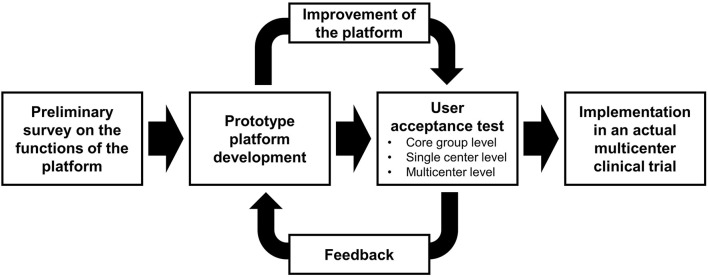
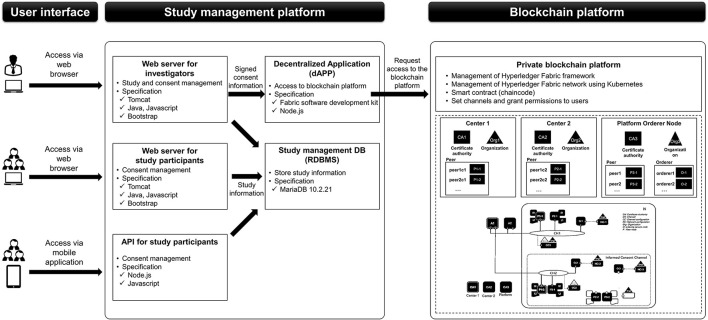
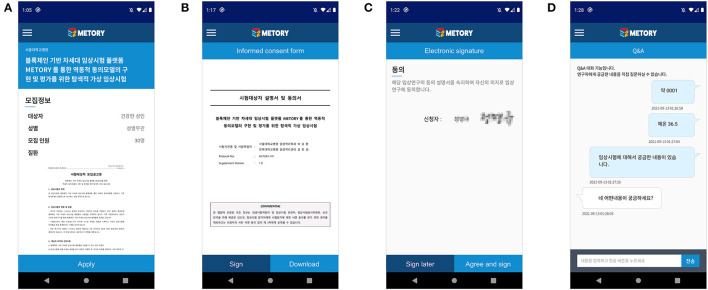
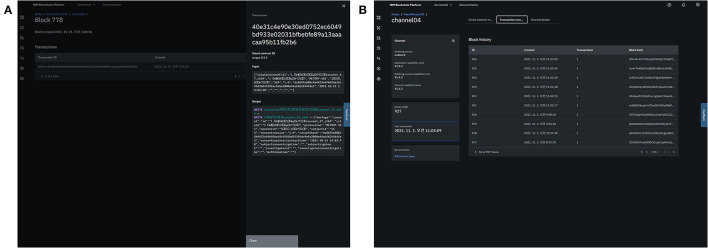
The recent advent of the dynamic consent concept intensified the data integrity issue in clinical trials. Incorporating blockchain technology into a dynamic consent platform can be a feasible solution. Due to various clinical trial settings, a demand-driven development strategy is required. We developed a blockchain-based dynamic consent platform named METORY tailored for clinical trials. The platform consisted of three parts: web and mobile application user interface, study management platform, and blockchain platform. Hyperledger Fabric, an enterprise-grade private blockchain framework, was used to integrate blockchain into the study consent platform. We conducted user acceptance tests and applied feedback to the improvement of the platform. Identity and role-based access control was constructed by combining mobile-application-based certificate system and access control functionalities in Hyperledger fabric. Data were encrypted using SHA-256 prior to transmission to blockchain server and TLS protocol was used for in-transit encryption. File-system level encryption was separated implemented within the security measures from Amazon RDS. Users' experience in the clinical trial was acceptable in the ease and usefulness of the platform.
Overview
The claims and statistics of this paper haven’t been checked yet.
Free: it reads the open-access text and checks the first 5 claims that cite a source we can check. Create a free account to check every claim.
Integrity signals
Registry
Cites
Statistics
Figures
Verification
Claims the paper makes
The claims and statistics of this paper haven’t been checked yet.
Free: it reads the open-access text and checks the first 5 claims that cite a source we can check. Create a free account to check every claim.
Claims other papers make about this one
Each is checked against this paper’s own text: does it say what the citing paper says it does?
In the citing paper
“Nine higher-maturity studies examined applications of blockchain/DLT systems in clinical trials/research governance [36-44].”
From Blockchain for Digital Health Governance: Evidence Gap Map and Scoping Review (2026) · cites this paper as [38]
In the citing paper
“METORY was developed as a blockchain-based dynamic consent platform [38] and subsequently evaluated in a decentralized multicenter trial involving 60 participants [39].”
From Blockchain for Digital Health Governance: Evidence Gap Map and Scoping Review (2026) · cites this paper as [38]
In the citing paper
“Additionally, this study demonstrates that the specific contribution of DLT properties to measured outcomes could generally not be isolated from that of interface design, system integration, and conventional infrastructure [27,28,31,32,37-45].”
From Blockchain for Digital Health Governance: Evidence Gap Map and Scoping Review (2026) · cites this paper as [38]
In the citing paper
“In line with this, systems in which the ledger was most central did not reach sustained use [27,28,31,32,37-45].”
From Blockchain for Digital Health Governance: Evidence Gap Map and Scoping Review (2026) · cites this paper as [38]
Self-check
Percentages, sums and reported differences re-computed from the paper’s own numbers.
The self-check needs the paper’s full text.
Citations
Cites
Blockchain technology in healthcare: a systematic review
Agbo, C. C., Mahmoud, Q. H., & Eklund, J. M. (2019) · Healthcare · doi:10.3390/healthcare7020056 · Cited by 1,131
The mHealth App Usability Questionnaire (MAUQ): Development and Validation Study
Zhou, L., Bao, J., Setiawan, I. M. A., Saptono, A., & Parmanto, B. (2019) · JMIR mHealth and uHealth · doi:10.2196/11500 · Cited by 675
Waterhouse, D. M., Harvey, R. D., Hurley, P., Levit, L. A., Kim, E. S., Klepin, H. D., Mileham, K. F., Nowakowski, G., Schenkel, C., Davis, C., et al. (2020) · JCO Oncology Practice · doi:10.1200/op.20.00275 · Cited by 199
Prototype of running clinical trials in an untrustworthy environment using blockchain
Wong, D. R., Bhattacharya, S., & Butte, A. J. (2019) · Nature Communications · doi:10.1038/s41467-019-08874-y · Cited by 160 · cited 1×
“The experience of the platforms in prospective clinical trials is even more limited, although evaluation using retrospective clinical trial data was tried (22).”
BackgroundPotential Risks of Hyperledger Fabric Smart Contracts
Yamashita, K., Nomura, Y., Zhou, E., Pi, B., & Jun, S. (2019) · 2019 IEEE International Workshop on Blockchain Oriented Software Engineering (IWBOSE) · doi:10.1109/iwbose.2019.8666486 · Cited by 131
Blockchain protocols in clinical trials: Transparency and traceability of consent
Benchoufi, M., Porcher, R., & Ravaud, P. (2018) · F1000Research · doi:10.12688/f1000research.10531.5 · Cited by 129
Research works printed but not linked: 34
- Otte A Maier-Lenz H Dierckx RA. Good clinical practice: historical background and key aspects. Nucl Med Commun. (2005) 26: 563– 74. 10.1097/01.mnm.0000168408.03133.e3 15942475 · DOI
- Broekstra R Maeckelberghe EL Stolk RP. Written informed consent in health research is outdated. Eur J Public Health. (2017) 27: 194– 5. 10.1093/eurpub/ckw198 27815285 · DOI
- Jaton E Stang J Biros M Staugaitis A Scherber J Merkle F. The use of electronic consent for COVID-19 clinical trials: lessons for emergency care research during a pandemic and beyond. Acad Emerg Med. (2020) 27: 1183– 6. 10.1111/acem.14141 32970895 PMC7536977 · doi:10.1111/acem.14141
- Khin NA Grandinetti C Dixey H Yu B Skeete R Ayalew K. Tackling challenging data integrity topics in 2020: update on good clinical practice perspectives from the US FDA and MHRA UK. Clin Pharmacol Ther. (2021). 10.1002/cpt.2386 34358334 · doi:10.1002/cpt.2386
- De Sutter E Zaçe D Boccia S Di Pietro ML Geerts D Borry P. Implementation of electronic informed consent in biomedical research and stakeholders' perspectives: systematic review. J Med Internet Res. (2020) 22: e19129. 10.2196/19129 33030440 PMC7582148 · DOI
- Khin NA Francis G Mulinde J Grandinetti C Skeete R Yu B. Data integrity in global clinical trials: discussions from joint US food and drug administration and UK medicines and healthcare products regulatory agency good clinical practice workshop. Clin Pharmacol Ther. (2020) 108: 949– 63. 10.1002/cpt.1794 31958142 · DOI
- Chen C Lee PI Pain KJ Delgado D Cole CL Campion TR Jr. Replacing paper informed consent with electronic informed consent for research in academic medical centers: a scoping review. AMIA Jt Summits Transl Sci Proc. (2020) 2020: 80– 8. 32477626 PMC7233043
- Wilbanks J. Design issues in E-consent. J Law Med Ethics. (2018) 46: 110– 8. 10.1177/1073110518766025 30057442 PMC6062847 · DOI
- Prictor M Lewis MA Newson AJ Haas M Baba S Kim H. Dynamic consent: an evaluation and reporting framework. J Empir Res Hum Res Ethics. (2020) 15: 175– 86. 10.1177/1556264619887073 31729900 · DOI
- Wee R Henaghan M Winship I. Dynamic consent in the digital age of biology: online initiatives and regulatory considerations. J Prim Health Care. (2013) 5: 341– 7. 24294625 · DOI
- Shi S He D Li L Kumar N Khan MK Choo KR. Applications of blockchain in ensuring the security and privacy of electronic health record systems: a survey. Comput Secur. (2020) 97: 101966. 10.1016/j.cose.2020.101966 32834254 PMC7362828 · DOI · Paper page
- Mamo N Martin GM Desira M Ellul B Ebejer JP. Dwarna: a blockchain solution for dynamic consent in biobanking. Eur J Hum Genet. (2020) 28: 609– 26. 10.1038/s41431-019-0560-9 31844175 PMC7170942 · DOI
- Kim TM Lee S-J Chang D-J Koo J Kim T Yoon K-H. DynamiChain: development of medical blockchain ecosystem based on dynamic consent system. Appl Sci. (2021) 11: 1612. 10.3390/app11041612 · DOI
- Albalwy F Brass A Davies A. A Blockchain-based dynamic consent architecture to support clinical genomic data sharing (ConsentChain): proof-of-concept study. JMIR Med Inform. (2021) 9: e27816. 10.2196/27816 34730538 PMC8600428 · DOI
- Stein DT Terry SF. Reforming biobank consent policy: a necessary move away from broad consent toward dynamic consent. Genet Test Mol Biomarkers. (2013) 17: 855– 6. 10.1089/gtmb.2013.1550 24283583 · DOI
- Omar IA Jayaraman R Salah K Yaqoob I Ellahham S. Applications of blockchain technology in clinical trials: review and open challenges. Arab J Sci Eng. (2021) 46: 3001– 15. 10.1007/s13369-020-04989-334856332 · doi:10.1007/s13369-020-04989-334856332
- Omar IA Jayaraman R Salah K Simsekler MCE Yaqoob I Ellahham S. Ensuring protocol compliance and data transparency in clinical trials using Blockchain smart contracts. BMC Med Res Methodol. (2020) 20: 224. 10.1186/s12874-020-01109-5 32894068 PMC7487835 · DOI
- Benchoufi M Altman D Ravaud P. From clinical trials to highly trustable clinical trials: blockchain in clinical trials, a game changer for improving transparency? Front Blockchain. (2019) 2: e23. 10.3389/fbloc.2019.00023 · DOI
- Vanaken HI Masand SN. Awareness and collaboration across stakeholder groups important for eConsent achieving value-driven adoption. Ther Innov Regul Sci. (2019) 53: 724– 35. 10.1177/2168479019861924 31319717 · DOI
- Casino F Dasaklis TK Patsakis C. A systematic literature review of blockchain-based applications: current status, classification and open issues. Telem Inform. (2019) 36: 55– 81. 10.1016/j.tele.2018.11.00634703661 · doi:10.1016/j.tele.2018.11.00634703661
- Huh KY Moon SJ Jeong SU Kim MJ Yang W Jeong M. Evaluation of a blockchain-based dynamic consent platform (METORY) in a decentralized and multicenter clinical trial using virtual drugs. Clin Transl Sci. (2022). 10.1111/cts.13246 35157788 PMC9099134 · DOI · Paper page
- Androulaki E Barger A Bortnikov V Cachin C Christidis K Caro AD. Hyperledger fabric: a distributed operating system for permissioned blockchains, Article 30. In: Proceedings of the Thirteenth EuroSys Conference (2018). · DOI · Paper page
- Antwi M Adnane A Ahmad F Hussain R. Habib ur Rehman M, Kerrache CA. The case of HyperLedger Fabric as a blockchain solution for healthcare applications. Blockchain Res Appl. (2021) 2: 100012. 10.1016/j.bcra.2021.100012 · DOI
- Angeletti F Chatzigiannakis I Vitaletti A. Towards an architecture to guarantee both data privacy and utility in the first phases of digital clinical trials. Sensors. (2018) 18: 4175. 10.3390/s18124175 30487435 PMC6308650 · DOI
- Rouhani S Deters R. Blockchain based access control systems: State of the art and challenges. In: IEEE/WIC/ACM International Conference on Web Intelligence. Thessaloniki, Greece: Association for Computing Machinery (2019). p. 423– 8. · DOI · Paper page
- Uchibeke UU Schneider KA Kassani SH Deters R editors. Blockchain Access Control Ecosystem for Big Data Security. In: 2018 IEEE International Conference on Internet of Things (iThings) and IEEE Green Computing and Communications (GreenCom) and IEEE Cyber, Physical and Social Computing (CPSCom) and IEEE Smart Data (SmartData) (2018). · DOI
- Rouhani S Pourheidari V Deters R editors. Physical access control management system based on permissioned blockchain. In: 2018 IEEE International Conference on Internet of Things (iThings) and IEEE Green Computing and Communications (GreenCom) and IEEE Cyber, Physical and Social Computing (CPSCom) and IEEE Smart Data (SmartData) (2018). · DOI
- Stamatellis C Papadopoulos P Pitropakis N Katsikas S Buchanan WJ. A Privacy-preserving healthcare framework using hyperledger fabric. Sensors. (2020) 20: 6587. 10.3390/s20226587 33218022 PMC7698751 · DOI
- Brotsis S Kolokotronis N Limniotis K Bendiab G Shiaeles S editors. On the security and privacy of hyperledger fabric: challenges and open issues. In: 2020 IEEE World Congress on Services (SERVICES) (2020). · DOI
- Chacko JA Mayer R Jacobsen H-A. Why do my blockchain transactions fail? a study of hyperledger fabric. In: Proceedings of the 2021 International Conference on Management of Data. Association for Computing Machinery (2021). p. 221– 34. · DOI
- Harle CA Golembiewski EH Rahmanian KP Brumback B Krieger JL Goodman KW. Does an interactive trust-enhanced electronic consent improve patient experiences when asked to share their health records for research? A randomized trial. J Am Med Inform Assoc. (2019) 26: 620– 9. 10.1093/jamia/ocz015 30938751 PMC6562160 · DOI
- Soni H Grando A Murcko A Bayuk M Chandrashekar P Mukundan M. Current state of electronic consent processes in behavioral health: outcomes from an observational study. AMIA Annu Symp Proc. (2017) 2017: 1607– 16. 29854231 PMC5977724
- Golembiewski EH Mainous AG 3rd Rahmanian KP Brumback B Rooks BJ Krieger JL. An electronic tool to support patient-centered broad consent: a multi-arm randomized clinical trial in family medicine. Ann Fam Med. (2021) 19: 16– 23. 10.1370/afm.2610 33431386 PMC7800739 · DOI
- De Sutter E Borry P Geerts D Huys I. Personalized and long-term electronic informed consent in clinical research: stakeholder views. BMC Med Ethics. (2021) 22: 108. 10.1186/s12910-021-00675-7 34332572 PMC8325412 · DOI
Cited by
Blockchain for Digital Health Governance: Evidence Gap Map and Scoping Review
Yaghobian, S., Sulkowski, N., Galambos, G., Scarazzini, L., Maloumian, N., & Verhaeghe, S. (2026) · Journal of Medical Internet Research · doi:10.2196/96098 · Cited by 1
Metadata
- Authors
- Huh, K. Y., Jeong, S.-U., Moon, S. J., Kim, M.-J., Yang, W., Jeong, M., Song, I., Kwak, Y.-G., Lee, S., & Kim, M.-G.
- Venue
- Frontiers in Medicine
- Publisher
- Frontiers Media SA
- Published
- 2022-05-13
- Volume
- 9
- ISSN
- 2296-858X
- PMC
- PMC9136007
- Cited by
- 20
- References
- 6
- Funders
- Korea Health Industry Development Institute
About these checks
Registry, retraction, Cites and statistics results are computed, not judged, with one exception: a printed reference that no index lists is read once by a model before it counts as a citation error. Claims are extracted by a model and kept only when their quote appears verbatim in the text; each cited source is then checked, with a model’s help, for whether it says what the claim relies on. Those verdicts can be wrong — read the claim’s quote and the cited source before relying on one.
Statistics and arithmetic are recomputed, not judged.
Confidence bands are shown only for fields calibrated on our annotated test set. None is calibrated yet, so no band is shown.
What counts as a claim ›How we measure confidence ›How we check this ›
Are you an author, or do you see a problem with this page? Request a review
Data sources
Bibliographic data: Semantic Scholar, OpenAlex, Crossref.
Contains information from the Semantic Scholar Academic Graph Datasets, made available under the ODC Attribution License (ODC-BY 1.0).
Semantic Scholar’s data is described in: Kinney, R., et al. (2023). The Semantic Scholar Open Data Platform. arXiv:2301.10140.
