

The DOI matches its Crossref record; 110 of the 110 references it cites were found in a registry or an index.
Biogeochemical implications of the ubiquitous colonization of marine habitats and redox gradients by Marinobacter species
Open accessAbstract
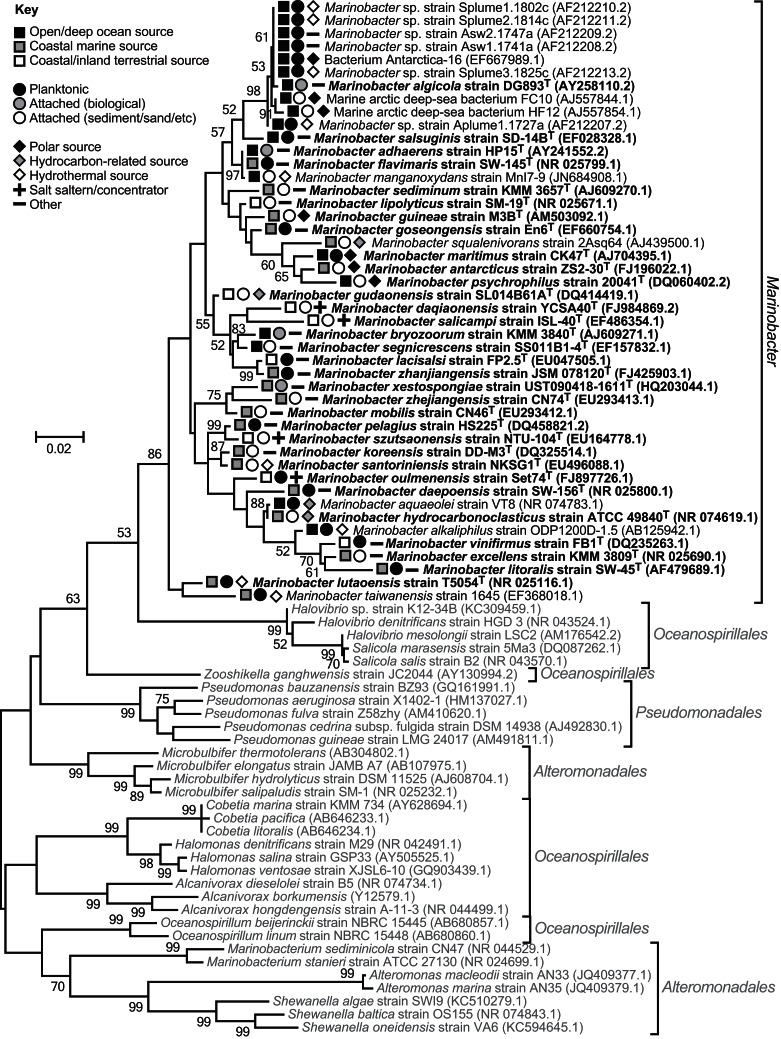
The Marinobacter genus comprises widespread marine bacteria, found in localities as diverse as the deep ocean, coastal seawater and sediment, hydrothermal settings, oceanic basalt, sea-ice, sand, solar salterns, and oil fields. Terrestrial sources include saline soil and wine-barrel-decalcification wastewater. The genus was designated in 1992 for the Gram-negative, hydrocarbon-degrading bacterium Marinobacter hydrocarbonoclasticus. Since then, a further 31 type strains have been designated. Nonetheless, the metabolic range of many Marinobacter species remains largely unexplored. Most species have been classified as aerobic heterotrophs, and assessed for limited anaerobic pathways (fermentation or nitrate reduction), whereas studies of low-temperature hydrothermal sediments, basalt at oceanic spreading centers, and phytoplankton have identified species that possess a respiratory repertoire with significant biogeochemical implications. Notable physiological traits include nitrate-dependent Fe(II)-oxidation, arsenic and fumarate redox cycling, and Mn(II) oxidation. There is also evidence for Fe(III) reduction, and metal(loid) detoxification. Considering the ubiquity and metabolic capabilities of the genus, Marinobacter species may perform an important and underestimated role in the biogeochemical cycling of organics and metals in varied marine habitats, and spanning aerobic-to-anoxic redox gradients.
Overview
The claims and statistics of this paper haven’t been checked yet.
Run the check — free, no account needed. It reads the open-access text and checks the sources it cites.
Integrity signals
Registry
Cites
Statistics
Figures
Verification
Claims the paper makes
The claims and statistics of this paper haven’t been checked yet.
Run the check — free, no account needed. It reads the open-access text and checks the sources it cites.
Self-check
Percentages, sums and reported differences re-computed from the paper’s own numbers.
The self-check needs the paper’s full text.
Citations
Cites
Thompson, J. D., Higgins, D. G., & Gibson, T. J. (1994) · Nucleic Acids Research · doi:10.1093/nar/22.22.4673 · Cited by 64,617
Tamura, K., Peterson, D., Peterson, N., Stecher, G., Nei, M., & Kumar, S. (2011) · Molecular Biology and Evolution · doi:10.1093/molbev/msr121 · Cited by 40,207
Prokaryotes: The unseen majority
Whitman, W. B., Coleman, D. C., & Wiebe, W. J. (1998) · Proceedings of the National Academy of Sciences · doi:10.1073/pnas.95.12.6578 · Cited by 4,871 · cited 2×
“MINI REVIEW ARTICLE published: 22 May 2013 doi: 10.3389/fmicb.2013.00136 Biogeochemical implications of the ubiquitous colonization of marine habitats and redox gradients by Marinobacter species”
BackgroundInfluentialMicrobial biogeography: putting microorganisms on the map
Martiny, J. B. H., Bohannan, B. J. M., Brown, J. H., Colwell, R. K., Fuhrman, J. A., Green, J. L., Horner‐Devine, M. C., Kane, M. D., Krumins, J. A., Kuske, C. R., et al. (2006) · Nature Reviews Microbiology · doi:10.1038/nrmicro1341 · Cited by 3,093
Metals, minerals and microbes: geomicrobiology and bioremediation
Gadd, G. M. (2010) · Microbiology · doi:10.1099/mic.0.037143-0 · Cited by 2,013
Hydrothermal vents and the origin of life
Martin, W., Baross, J., Kelley, D., & Russell, M. J. (2008) · Nature Reviews Microbiology · doi:10.1038/nrmicro1991 · Cited by 1,608
Potential commercial applications of microbial surfactants
Banat, I. M., Makkar, R. S., & Cameotra, S. S. (2000) · Applied Microbiology and Biotechnology · doi:10.1007/s002530051648 · Cited by 1,597
Genome sequence of the dissimilatory metal ion–reducing bacterium Shewanella oneidensis
Heidelberg, J. F., Paulsen, I. T., Nelson, K. E., Gaidos, E. J., Nelson, W. C., Read, T. D., Eisen, J. A., Seshadri, R., Ward, N. L., Methé, B. A., et al. (2002) · Nature Biotechnology · doi:10.1038/nbt749 · Cited by 862
Iron-Oxidizing Bacteria: An Environmental and Genomic Perspective
Emerson, D., Fleming, E. J., & McBeth, J. (2010) · Annual Review of Microbiology · doi:10.1146/annurev.micro.112408.134208 · Cited by 797
Community Proteomics of a Natural Microbial Biofilm
Ram, R. J., VerBerkmoes, N. C., Thelen, M. P., Tyson, G. W., Baker, B. J., Blake, R. C., Shah, M. B., Hettich, R. L., & Banfield, J. F. (2005) · Science · doi:10.1126/science.1109070 · Cited by 659
Cited by
Sorted by citations
Unexplored microbial diversity from 2,500 food metagenomes and links with the human microbiome.
Carlino, N., Blanco-Míguez, A., Punčochář, M., Mengoni, C., Pinto, F., Tatti, A., Manghi, P., Armanini, F., Avagliano, M., Barcenilla, C., et al. (2024) · Cell · doi:10.1016/j.cell.2024.07.039 · Cited by 146
Microorganisms from deep-sea hydrothermal vents
Zeng, X., Alain, K., & Shao, Z. (2021) · Marine Life Science & Technology · doi:10.1007/s42995-020-00086-4 · Cited by 113
N2O formation by nitrite-induced (chemo)denitrification in coastal marine sediment
Otte, J. M., Blackwell, N., Ruser, R., Kappler, A. A., Kleindienst, S., & Schmidt, C. (2019) · Scientific Reports · doi:10.1038/s41598-019-47172-x · Cited by 82
Poddar, N., Sen, R., & Martin, G. J. O. (2018) · Algal Research · doi:10.1016/j.algal.2018.06.002 · Cited by 75
Han, D. M., Chun, B. H., Feng, T., Kim, H. M., & Jeon, C. O. (2020) · Food Microbiology · doi:10.1016/j.fm.2020.103591 · Cited by 75
Metadata
- Authors
- Handley, K. M., & Lloyd, J. R.
- Affiliations
- Argonne National Laboratory (US)
- University of Manchester (GB)
- Corresponding author
- Handley, Kim M.
- Venue
- Frontiers in Microbiology
- Publisher
- Frontiers Media SA
- Published
- 2013
- Volume
- 4
- Pages
- 136-136
- ISSN
- 1664-302X (ISSN-L)
- PMC
- PMC3660661
- OpenAlex
- W2099533595
- Cited by
- 126
- References
- 109
- Citations by year
- 2026: 18 · 2025: 14 · 2024: 17 · 2023: 7 · 2022: 12 · 2021: 14 · 2020: 15 · 2019: 11 · 2018: 5 · 2017: 6 · 2016: 2 · 2015: 5
- FWCI
- 2.06
- Type
- journal article
- Language
- en
- Open access
- gold
- doi.org
- Licence
- cc-by
- Locations
- Frontiers in Microbiology (publishedVersion, cc-by)
- Europe PMC (PubMed Central) (publishedVersion, cc-by)
- PubMed Central (publishedVersion, cc-by)
- PubMed (publishedVersion)
- Research Explorer (The University of Manchester) (publishedVersion)
- DOAJ (DOAJ: Directory of Open Access Journals) (submittedVersion, cc-by-sa)
- ResearchSpace (University of Auckland) (submittedVersion, cc-by)
- Funders
- European Commission
- Topics
- Physical Sciences › Environmental Science › Ecology › Microbial Community Ecology and Physiology
- Physical Sciences › Environmental Science › Environmental Engineering › Microbial Fuel Cells and Bioremediation
- Physical Sciences › Earth and Planetary Sciences › Geochemistry and Petrology › Geochemistry and Elemental Analysis
- Keywords
- Marinobacter, marine bacteria, biogeochemical cycles, redox gradients, fumarate respiration, Mn(II) oxidation, Fe(III) reduction, hydrocarbon-degrading bacteria, hydrothermal sediments, oceanic basalts, marine sediment, anaerobic metabolism
About these checks
Registry, retraction, Cites and statistics results are computed, not judged, with one exception: a printed reference that no index lists is read once by a model before it counts as a citation error. Claims are extracted by a model and kept only when their quote appears verbatim in the text; each cited source is then checked, with a model’s help, for whether it says what the claim relies on. Those verdicts can be wrong — read the claim’s quote and the cited source before relying on one.
Statistics and arithmetic are recomputed, not judged.
Confidence bands are shown only for fields calibrated on our annotated test set. None is calibrated yet, so no band is shown.
What counts as a claim ›How we measure confidence ›How we check this ›
Are you an author, or do you see a problem with this page? Request a review
